
City Australia and Oceania
Sydney
Sydney is the biggest city in Australia. It wraps around a huge, sparkling harbor. It has a giant steel bridge, an opera house with white roofs like sails and lots of beaches.
Sydney is Australia's largest city and the capital of the state of New South Wales. It surrounds Port Jackson, a harbor of countless bays, on the lands of the Gadigal people of the Eora Nation. The British set up a convict colony here in 1788. Today the Harbour Bridge, the Opera House and its beaches are world famous, and about 5.45 million people lived in Greater Sydney in 2023.
Sydney, capital of New South Wales and Australia's largest city, spreads from the Pacific beaches to the Blue Mountains around Port Jackson, one of the South Pacific's great ports. A British penal colony founded at Sydney Cove in 1788 on Gadigal land, it grew fastest between 1850 and 1890, overtook Melbourne as the financial center in the 1970s and hosted the 2000 Olympics. Greater Sydney had 5,450,496 people on June 30, 2023.
Photo: Diliff, CC BY-SA 3.0, via Wikimedia Commons
Discover Sydney
Sydney is the biggest city in Australia.
It is built around a giant harbor full of bays and boats. A huge bridge crosses the water. Sandy beaches line the ocean nearby.
Sydney is on the southeastern coast of Australia. It is the country's largest city and the capital of the state of New South Wales, though not of Australia itself; that is Canberra. Built on low hills around a huge harbor with countless bays and inlets, it is one of the most important ports in the South Pacific.
The Gadigal people of the Eora Nation are the traditional custodians of the land where the city center stands. About 5.45 million people lived in Greater Sydney in 2023. Many of them can glimpse blue water from their windows, and nearly everyone lives within an hour of a beach.
Sydney, capital of New South Wales, lies at about 34° S on Australia's southeastern coast. Britannica calls it the country's largest city and, with its magnificent harbor, one of the most important ports in the South Pacific; even as a small convict settlement in the early 19th century it traded with the Pacific Islands, India, China, South Africa and the Americas. The Australian Bureau of Statistics counted 5,450,496 people in Greater Sydney on June 30, 2023, across a statistical area of about 12,406 km², only about a third of it urban.
The City of Sydney recognizes the Gadigal people of the Eora Nation as traditional custodians, and states that the 1788 convict outpost had 'far reaching and devastating impacts' on the Eora Nation, while Aboriginal cultures endured. Britannica notes a compact central business district on a narrow peninsula between two arms of the harbor, ringed by vast suburbs of mostly one-story houses.
- Country
- Australia (capital of New South Wales)
- People in Greater Sydney (June 30, 2023)
- 5,450,496
- Area of Greater Sydney
- 12,406 km²
- Traditional custodians
- the Gadigal people of the Eora Nation
Famous places
Sydney has a famous bridge shaped like a big steel arch.
Trains and cars cross it every day. Next to it, the Opera House has white roofs that look like sails. Inside, people watch concerts, plays and ballet.
The Sydney Harbour Bridge opened on March 19, 1932. More than 1,600 people worked on it, and builders used more than 52,800 tonnes of steel. Its two half-arches were built out from each shore until they met in the middle in 1930.
Across the cove stands the Sydney Opera House, opened in 1973. Its white, shell-shaped roofs seem to echo the sails of the yachts in the harbor. Designed by the Danish architect Jørn Utzon, it is a UNESCO World Heritage Site. Nearby are the Royal Botanic Gardens, founded in 1816, and the Rocks, the oldest part of the city.
Britannica describes the city as dominated by the Harbour Bridge, one of the longest steel-arch bridges in the world, and the Opera House. The bridge, built by Dorman Long to a design overseen by Ralph Freeman and championed by the engineer Bradfield, used more than 52,800 tonnes of steel, 39,000 in the arch; the half-arches, cantilevered from each shore and held by 128 cables, met on August 19, 1930, and the bridge opened on March 19, 1932, after more than 1,600 people had worked on it.
The Opera House stands on Bennelong Point, Tubowgule to the Gadigal, named for Woollarawarre Bennelong of the Wangal people. Jørn Utzon won its 1957 competition; inaugurated in 1973, its three groups of interlocking vaulted shells roof two main halls and a restaurant, and UNESCO inscribed it in 2007. Downtown, Sydney Tower (1981, spire 1991) rises above 305 m, and Macquarie Street, leading from Hyde Park to the Opera House, holds Francis Greenway's Hyde Park Barracks and St. James Church.
- Sydney Harbour Bridge
- opened March 19, 1932
- Steel in the bridge
- more than 52,800 tonnes
- Sydney Opera House
- opened 1973; UNESCO 2007
- Sydney Tower
- more than 305 m tall

From Sydney Cove to world city
Aboriginal people have lived around the harbor for a very long time.
They fished and gathered food along the shores. In 1788, ships arrived from Britain. The newcomers built a town by a little cove. It grew into a giant city.
Long before the city, the harbor was home to Aboriginal people. Around Bennelong Point they found oysters, mussels, fish and many plants to eat. In 1788 the British First Fleet, led by Arthur Phillip, arrived to set up a colony for convicts. Phillip chose a cove with fresh water and named it Sydney Cove; today it is called Circular Quay.
Life was hard at first for the convicts and settlers, and the arrival of the British had devastating effects on the Eora Nation. Under Governor Lachlan Macquarie (1810–21), Sydney grew into a busy town. Between 1850 and 1890 it grew from 60,000 to 400,000 people. In 2000 it hosted the Summer Olympic Games.
The Opera House's history of Tubowgule records a point rich in shellfish, fish, game and plants, with shell middens left by Aboriginal people around the harbor. Arthur Phillip's First Fleet reached Botany Bay in 1788, found it unsuitable and moved to Port Jackson, founding the settlement at a cove with a freshwater stream that he named for the home secretary, Viscount Sydney. The colonists crushed Aboriginal middens for lime to make mortar. The City of Sydney describes the convict outpost's 'far reaching and devastating impacts on the Eora Nation, including the occupation and appropriation of traditional lands'.
Britannica describes early Sydney as a grim penal colony, often short of food. Governor Macquarie (1810–21) and the convict architect Francis Greenway turned it into a town of Georgian public buildings. The first railway, to Parramatta, began in 1855; between 1850 and 1890 the population rose from 60,000 to 400,000. Melbourne briefly overtook it, but by 1911 Sydney was again Australia's largest city; it became the financial center in the 1970s and hosted the 2000 Olympics.

Getting around Sydney
In Sydney, lots of people go to work by ferry!
The boats zip across the harbor. Trains rumble over the big bridge. Buses and trams carry people too.
People who live around the harbor can ride public ferries, and Circular Quay, in the heart of the city, is the hub for ferries, trains, buses and cruise ships. Trains have run since 1855, and since 1932 they have crossed the Harbour Bridge to the north shore. Sydney also has buses and a light-rail system.
Because the harbor splits the city, most people coming from the North Shore must cross the bridge or the Harbour Tunnel, which opened in 1992, so traffic can be heavy. The main airport sits on Botany Bay, south of the city.
Since 1855 a radial suburban railway has linked the center with its suburbs; it was electrified between the world wars, the first underground section opened in 1926, the north shore was linked by rail when the Harbour Bridge opened in 1932, and lines reached the eastern suburbs in 1979. Britannica judges that public transport has failed to keep pace with demand: with work concentrated downtown and homes in the outer suburbs, traffic funnels across the harbor by the bridge, the 1992 tunnel and the Gladesville Bridge. Martin Place became a pedestrian plaza in 1971.
The public ferry system serves harbor-shore suburbs, and Circular Quay is the hub for ferries and cruise ships and a bus and rail center; there is also light rail. The main airport, for both international and domestic flights, is on the northern shore of Botany Bay, where a second port, 16 km south of Port Jackson, handles petroleum products, chemicals and bulk cargo.
- First railway
- 1855, to Parramatta
- Harbour Tunnel
- opened 1992
- Ferry hub
- Circular Quay
- Main airport
- on the northern shore of Botany Bay
Weather and seasons
Sydney is warm and sunny most of the year.
Summer comes in December and January, when people go to the beach. Winter, in July, is cool but not freezing. Rain falls in every season.
Sydney has a warm, sunny, temperate climate. It is south of the equator, so summer is from December to February: in January, highs average about 27 °C and lows about 20 °C. Winter is from June to August, with July highs around 17 °C and lows around 9 °C.
About 1,200 millimeters of rain fall in a year, spread fairly evenly through the seasons, with short tropical downpours in summer. On a few very hot days, a westerly wind blows hot, dry air from the desert, and sometimes a cool wind from the south called the "Southerly Buster" brings relief.
Britannica gives average temperatures of 22 °C in January and 13 °C in July and about 1,200 mm of precipitation, all as rain, spread relatively evenly through the year: most in late autumn, least in early spring, with short tropical deluges in summer (December–February). World Meteorological Organization normals for 1981–2010 give mean daily maxima and minima of 26.5 °C and 19.6 °C in January and 17.4 °C and 8.7 °C in July; April is the wettest month at about 141 mm.
Sydney is unbearably hot for only a few days a year, when westerly winds bring dry desert air; such heat is broken from time to time by a cold front from the Tasman Sea, heralded by the stiff southerly wind known as the 'Southerly Buster'. In winter (June–August) the westerly wind is cool.
- January, average daily high and low
- about 27 °C and 20 °C
- July, average daily high and low
- about 17 °C and 9 °C
- Rain in a year
- about 1,200 mm
Living in Sydney
People in Sydney love being outdoors.
They swim, surf and sail. Lifeguards watch over the beaches in summer. Across the harbor is a big zoo with about 2,000 animals.
Few cities offer so much swimming, surfing and sailing. Bondi Beach is a short drive from the city center, and volunteer lifesaving clubs provide guards on the beaches all summer. On weekends the harbor fills with sailboats. The city also has fine places to play cricket, rugby, Australian rules football and tennis.
Taronga Zoo, opened in 1916 on the harbor, has about 2,000 animals. The Australian Museum, founded in 1827, is the country's oldest museum, and the University of Sydney, from 1850, is Australia's first university. Many families came from Britain and Ireland, and since World War II newcomers have arrived from across Europe, Asia and New Zealand.
Britannica calls Sydney above all a city for physical enjoyment: harbor beaches, world-famous surf beaches such as Bondi and those of Manly and the Palm Beach peninsula, guarded by volunteer lifesaving clubs, and yachting on the harbor and Pittwater. Sydney Olympic Park was built for the 2000 Games on reclaimed industrial land, with recycled materials and energy- and water-saving designs.
Cultural institutions include the University of Sydney (1850), the Australian Museum (1827), the country's oldest museum with its largest natural history collection, and the Art Gallery of New South Wales (1874), with a large collection of Aboriginal art; Taronga Zoo (1916) and the Royal Botanic Gardens (1816), Australia's oldest scientific institution, face the harbor. After World War II, immigrants from Europe, Asia and New Zealand joined a population largely of British and Irish descent. Sydney is a city of government and commerce and, since the 1970s, Australia's financial center.
- Taronga Zoo
- opened 1916, about 2,000 animals
- University of Sydney
- 1850, Australia's first university
- Australian Museum
- 1827, Australia's oldest museum
- Summer Olympic Games
- 2000
Sydney on the map
Find Sydney on the globe.
It is in Australia, on the southeast coast. Look for the Pacific Ocean. Sydney sits beside it, around a big harbor.
Sydney is on the southeastern coast of Australia, facing the Pacific Ocean. Its harbor, Port Jackson, reaches deep into the land with many bays and inlets. About 16 kilometers to the south is Botany Bay, which Captain James Cook reached in 1770.
Greater Sydney stretches from the Pacific beaches in the east to the Blue Mountains in the west. National parks almost ring the city, so there is wild bush close to the suburbs.
Sydney lies at about 34° S on the Pacific coast, built on low hills around Port Jackson, a harbor of innumerable bays and inlets. Greater Sydney extends from the Blue Mountains in the west to the Pacific in the east, and from the southern shore of Lake Macquarie in the north to south of Botany Bay; Parramatta, about 25 km west, is a second business center.
Britannica notes that the region is almost completely ringed by dozens of national and regional parks: Sydney Harbour, Garigal and Lane Cove national parks lie within the city, Ku-ring-gai Chase to the north and Botany Bay and Royal national parks to the south. The mouth of the Hawkesbury River gives sheltered water for sailing.
- Latitude
- about 33.9° south
- Longitude
- about 151.2° east
- Harbor
- Port Jackson (Sydney Harbour)
Amazing facts
-
Thousands of children walked across the Harbour Bridge before it opened.
By the time the Harbour Bridge officially opened, 52,000 school children had already walked across it on special school days.
Before the official opening on March 19, 1932, some 52,000 school children had crossed the bridge in a series of 'school days'.
-
The stone for the bridge towers came from far down the coast.
The granite for the bridge's foundations and towers came from a quarry at Moruya, and more than 250 stonemasons, mostly from Scotland and Italy, came to work there.
The granite for the abutments and pylons was quarried at Moruya on the NSW south coast by more than 250 stonemasons, mainly from Scotland and Italy, brought out with their families.
-
A fort once stood where the Opera House is now.
Before the Opera House, Bennelong Point held Fort Macquarie, finished in 1821, and later a tram shed.
Governor Macquarie had Fort Macquarie built on Bennelong Point (completed 1821) under the convict architect Francis Greenway; it was demolished in 1902 for a tram shed.
-
Sydney's botanic garden is very, very old.
The Royal Botanic Gardens, founded in 1816, are Australia's oldest scientific institution.
Founded in 1816 on the harbor, the Royal Botanic Gardens are, Britannica notes, the country's oldest scientific institution.
-
Sydney is named after a British leader.
Arthur Phillip named Sydney Cove after the British home secretary, Viscount Sydney.
Phillip named Sydney Cove for Thomas Townshend, 1st Viscount Sydney, the home secretary to whom he wrote his famous dispatch of May 15, 1788.
Words to know
- harbor
- a sheltered area of water where ships can anchor safely
- traditional custodians
- the Aboriginal people whose ancestors have cared for an area of land for thousands of years
- colony
- a place settled and ruled by people from another country
- convict
- a person found guilty of a crime and sent to prison or, in the past, to a faraway colony
- arch
- a curved structure that spans an opening and holds up weight
- ferry
- a boat that carries people across water on a regular route
- midden
- a heap of shells and bones left from meals long ago
Discovery challenge
-
What do the Opera House roofs look like?
The white roofs of the Sydney Opera House are often compared to what?
Britannica says the Opera House's shell-shaped roofs seem to echo what in the harbor?
- Sails of boats
- Mountains
- Clouds
Show the answer
Sails of boats
Sails! They look like boats on the water.
The sails of the yachts in the harbor.
The sails of the many yachts in the adjacent harbor.
-
Who has lived around Sydney's harbor for a very long time?
Which people are the traditional custodians of the land where Sydney's center stands?
Which people of the Eora Nation are the traditional custodians of Tubowgule (Bennelong Point)?
- The Gadigal people
- The Vikings
- The Romans
Show the answer
The Gadigal people
The Gadigal people, who are Aboriginal Australians.
The Gadigal people of the Eora Nation.
The Gadigal, acknowledged by the Opera House and the City of Sydney.
-
How do many people cross Sydney's harbor?
Which boats carry commuters across Sydney's harbor?
Which public service, centered on Circular Quay, serves Sydney's harbor-shore suburbs?
- Ferries
- Submarines
- Hot-air balloons
Show the answer
Ferries
Ferries! The boats zip across the water.
Public ferries, from Circular Quay.
The public ferry system, with Circular Quay as its hub.
-
In which month is it summer in Sydney?
Because Sydney is south of the equator, in which month is summer?
In Sydney, which month has the warmest average daily highs, about 26.5 °C?
- January
- July
- April
Show the answer
January
January! People go to the beach.
January. Summer runs from December to February.
January (and February), at 26.5 °C; July's highs average 17.4 °C.
-
When did the Harbour Bridge open?
In which year did the Sydney Harbour Bridge open?
The half-arches met in 1930. In which year did the bridge officially open?
- 1932
- 1788
- 2000
Show the answer
1932
1932! That is more than 90 years ago.
1932, on March 19.
1932 (March 19); 1788 is the First Fleet and 2000 the Olympics.
Nearby places
-
Watch
Landmark
Sydney Opera House
The Sydney Opera House stands on a point of land in Sydney Harbour, Australia. Danish architect Jørn Utzon won a competition to design it in 1957, building began in 1959, and it opened on October 20, 1973. Its shell-shaped roofs are covered in more than a million tiles.
-
 Watch
Natural wonder
K'gari
K'gari, off the coast of Queensland in Australia, is the largest sand island in the world. Sand dunes rise up to about 250 meters, rainforest grows right on the sand, and about half of the world's perched dune lakes sparkle among the dunes. Once called Fraser Island, it was officially renamed K'gari, the Butchulla people's name for it, in 2023.
-
 Watch
Natural wonder
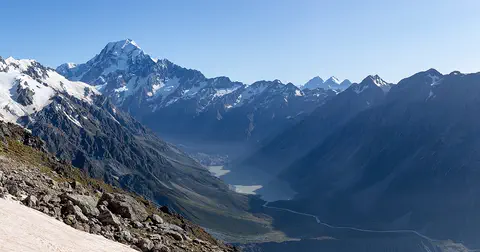
Aoraki / Mount Cook
Aoraki / Mount Cook is New Zealand's highest mountain, in the Southern Alps of the South Island. Its name joins its Māori name, Aoraki, with its English name, Mount Cook. The mountain is being pushed up where two of Earth's plates meet, and glaciers carve the valleys around it. In 2013 surveyors measured it at 3,724 meters.
-
 Watch
Natural wonder
Great Barrier Reef
The Great Barrier Reef stretches about 2,300 kilometers along the coast of Queensland, Australia. It is made of about 2,500 separate reefs and more than 900 islands, built by tiny coral animals, and it is home to more than 1,500 kinds of fish.
-
 Watch
Natural wonder
Uluru
Uluru is a huge sandstone rock in the desert of central Australia, rising 348 meters above the plain, with a base 9.4 kilometers around. The Anangu are its Traditional Owners, and the national park around it is run by Anangu and Parks Australia together.
-
 Watch
Natural wonder
Kakadu National Park
Kakadu, in Australia's Northern Territory, is the country's largest national park. It stretches from a high sandstone cliff called the escarpment down to floodplains, mangroves and the sea. Aboriginal people have lived here for tens of thousands of years, and their rock paintings, some up to 20,000 years old, record their way of life.
-
 Watch
Natural wonder
Komodo National Park
Komodo National Park, in Indonesia, is a group of rugged, dry islands between Sumbawa and Flores. Its three main islands, Komodo, Rinca and Padar, were made by volcanoes. The park contains most of the places where wild Komodo dragons, the largest living lizards, still live, along with rich coral reefs visited by turtles, dolphins and whales.
-
 Watch
Natural wonder
Mount Agung
Mount Agung is a cone-shaped volcano on the eastern end of Bali, in Indonesia, and the island's highest point at about 3,000 meters. It erupted strongly in 1963 and 1964, and again with explosions, ash clouds and lava in its crater from 2017 to 2019. Scientists watch it all the time and set safety zones around it when it is restless.
Experiments to try
Explore next
-
 Watch
 Country
Australia
Australia is a country and the smallest continent, surrounded by ocean in the Southern Hemisphere. Much of its middle is dry and flat, most people live near the coast, and its animals include kangaroos, koalas and the platypus, a mammal that lays eggs.
-
Watch
Landmark
Sydney Opera House
The Sydney Opera House stands on a point of land in Sydney Harbour, Australia. Danish architect Jørn Utzon won a competition to design it in 1957, building began in 1959, and it opened on October 20, 1973. Its shell-shaped roofs are covered in more than a million tiles.
-
Watch
Natural wonder
Great Barrier Reef
The Great Barrier Reef stretches about 2,300 kilometers along the coast of Queensland, Australia. It is made of about 2,500 separate reefs and more than 900 islands, built by tiny coral animals, and it is home to more than 1,500 kinds of fish.
-
 Watch
City
Rio de Janeiro
Rio de Janeiro is a city of about 6.7 million people (2025) on Brazil's Atlantic coast. Forested mountains, a giant statue on Corcovado, the Sugarloaf peak and famous beaches make it one of the most recognizable cities on Earth. It was Brazil's capital until 1960.
- Watch Try it What If? Lab What if June were winter? Earth's two halves take turns leaning toward the Sun, so they have opposite seasons. In our sunlight model, on June 21 London gets 16.4 hours of daylight and a high Sun, while Sydney, south of the equator, gets just 9.7 hours and a low Sun: its shortest day of the year.
For parents & teachers
What children will learn
- Locate Sydney on Australia's southeastern coast around Port Jackson.
- Recognize the Gadigal people of the Eora Nation as the traditional custodians of central Sydney.
- Describe how the Harbour Bridge was built and why the Opera House is a World Heritage Site.
- Explain why summer in Sydney comes in December and January.
Recommended ages: 3 to 17 · About 15 minutes
Talk about it
- Sydney's harbor splits the city in two. How do people get across, and which way would you choose?
- Why is it important to learn about the people who lived in a place before a city was built?
- The Opera House roofs look like sails. If you designed a building for your town, what would it look like?
Try at home or in class
- Build an arch from two stacks of books leaning in with a paper strip between them, then test how much it can hold.
- Draw a map of a harbor with bays and inlets, then plan ferry routes that link every shore.
Key vocabulary: harbor, traditional custodians, colony, convict, arch, ferry, midden
Where these facts come from
- Wikidata , Wikimedia Foundation (CC0 1.0)
- Natural Earth vector data , Natural Earth (NACIS) (Public domain)
- Sydney , Encyclopaedia Britannica
- Sydney: People, economy and transportation , Encyclopaedia Britannica
- Sydney: Cultural life , Encyclopaedia Britannica
- Sydney: History , Encyclopaedia Britannica
- Tubowgule , Sydney Opera House (official site)
- Sydney Opera House , UNESCO World Heritage Centre
- Sydney Harbour Bridge opens , National Museum of Australia
- Reconciliation , City of Sydney
- Regional population, 2022-23 , Australian Bureau of Statistics
- Sydney: climatological information , World Meteorological Organization, World Weather Information Service
- Wikimedia Commons , Wikimedia Foundation (Per file (public domain, CC0, CC BY or CC BY-SA); see each media record)
Checked, not yet human-reviewed. Last updated October 27, 2026. Spotted a mistake? Tell us.