
Natural wonder Australia and Oceania
Great Barrier Reef
The Great Barrier Reef is a giant coral reef in the sea next to Australia. Coral is made by tiny animals. Fish, turtles and whales live there.
The Great Barrier Reef stretches about 2,300 kilometers along the coast of Queensland, Australia. It is made of about 2,500 separate reefs and more than 900 islands, built by tiny coral animals, and it is home to more than 1,500 kinds of fish.
The Great Barrier Reef, off northeastern Australia, is what UNESCO calls the world's most extensive coral reef ecosystem: about 2,500 reefs and more than 900 islands across 348,000 km² and 14 degrees of latitude. Its reefs, built by colonies of stony coral polyps, grew over the past 15,000 years, and in 2024 it went through its fifth mass coral bleaching since 2016.
Photo: Ank Kumar, CC BY-SA 4.0, via Wikimedia Commons
Discover the Great Barrier Reef
The Great Barrier Reef is in the sea next to Australia.
It is made of coral. Coral is built by tiny animals. The reef is so big that it has thousands of parts. The water is blue and green and clear.
The Great Barrier Reef lies in the Coral Sea, off the coast of Queensland in northeastern Australia. NOAA says it stretches for 1,429 miles, about 2,300 kilometers, and calls it the largest coral reef system in the world.
It is not one single reef. UNESCO counts about 2,500 separate reefs, plus more than 900 islands, from tiny sandy islands called cays to big, rugged islands. NOAA also calls the Great Barrier Reef the largest living structure on Earth; it is large enough to be seen from space.
Practically the whole ecosystem was inscribed as a World Heritage Site in 1981: 348,000 km² across 14 degrees of latitude (10° S to 24° S), from the low-water mark of the Queensland coast to as far as 250 km offshore. UNESCO counts about 2,500 individual reefs and over 900 islands, from small sandy cays to continental islands, one rising more than 1,100 m above sea level. (NOAA's figure is nearly 3,000 reefs.)
The reef is not all shallow coral. UNESCO notes that one-third of the property lies beyond the seaward edge of the shallower reefs, taking in the continental slope, oceanic waters more than 2,000 m deep and abyssal plains. About 99 percent of it, 344,400 km², lies within the Great Barrier Reef Marine Park, managed by the Great Barrier Reef Marine Park Authority, an independent Australian Government agency. NOAA describes the reef as the largest living structure on Earth.
- Length
- about 2,300 km (1,429 miles)
- Individual reefs
- about 2,500
- Islands
- more than 900
- World Heritage Area
- 348,000 km², inscribed 1981
How the reef was built
Coral looks like a plant or a rock, but it is made by animals.
Tiny coral animals build hard homes. They grow on top of old ones, again and again. Over a very long time, they make a whole reef.
Coral may look like rock or a plant, but corals are animals. A coral is made of hundreds to thousands of tiny creatures called polyps, most no thicker than a nickel. Each soft polyp builds a hard skeleton of limestone underneath itself. When polyps die, new ones grow on top, and slowly the limestone piles up into a reef.
Most corals have tiny plant-like algae living inside them. The algae use sunlight to make food and share it with the coral. UNESCO says today's reefs have grown over the past 15,000 years on the continental shelf, the shallow sea floor next to Australia.
NOAA explains that stony corals are colonies of polyps, each secreting a skeleton of calcium carbonate onto rock or the skeletons of earlier polyps; as generations grow and die, they lay down the limestone framework of a reef. Most corals host zooxanthellae, microscopic algae living in their tissues that photosynthesize using the coral's waste products. Reefs begin when coral larvae settle on hard surfaces near coasts; barrier reefs, like this one, border a shoreline at a distance.
UNESCO describes the Great Barrier Reef as shaped by at least four glacial and interglacial cycles. When glacial sea levels fell, the reefs were exposed as flat-topped hills of eroded limestone, with rivers winding between them; when seas rose again, continental islands and coral cays formed and new coral growth began. Over the past 15,000 years reefs have grown on the continental shelf, and old massive corals preserve this history in their cores.
Life on the reef
The reef is full of life.
There are bright fish, sea turtles and whales. There are sea stars, crabs and shells. Big gentle animals called dugongs eat sea grass nearby.
The reef is one of the richest places for life on Earth. UNESCO lists more than 1,500 kinds of fish, about 400 kinds of coral, 4,000 kinds of mollusks such as clams and snails, and about 240 kinds of birds.
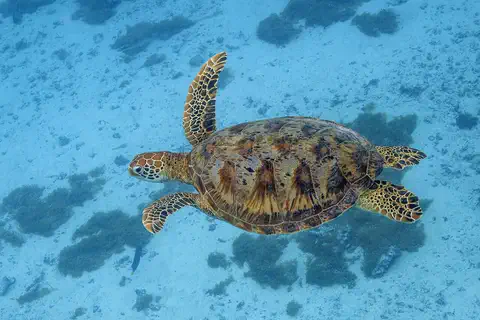
Six of the world's seven kinds of sea turtles are found here, and Raine Island is the biggest place in the world where green turtles breed. At least 30 kinds of whales and dolphins are seen on the reef, and it is an important place for humpback whales to have their calves. The seagrass meadows feed one of the world's largest groups of dugongs.
UNESCO records over 1,500 fish species, about 400 coral species in 60 genera, 4,000 mollusks and some 240 bird species, along with sponges, anemones, marine worms and crustaceans, and notes that no other World Heritage property contains such biodiversity. The shallower waters hold half the world's diversity of mangroves and many seagrass species, which feed one of the world's largest populations of the threatened dugong.
Six of the world's seven marine turtle species occur here. Raine Island is the world's largest green turtle breeding site, and many other cays hold regionally important turtle rookeries; 22 seabird species breed on cays and some continental islands. At least 30 species of whales and dolphins occur, and the reef is a significant area for humpback whale calving. UNESCO also lists the annual coral spawning, nesting turtles and large fish spawning aggregations among the reef's natural spectacles.
People and the reef
Aboriginal and Torres Strait Islander people have strong links to the reef.
The reef is part of their sea country. Today, lots of visitors come to see the reef too.
Aboriginal and Torres Strait Islander peoples have strong, continuing links with the reef, which is part of their sea country. UNESCO notes many old shell heaps, called middens, and fish traps. Many Traditional Owners still use the reef's resources for traditional food, to keep their sea culture alive and to teach younger people.
The reef is also a marine park and World Heritage Area, used for tourism, shipping and other activities. Britannica describes the coastal city of Cairns as a tourist center for the Great Barrier Reef offshore.
UNESCO describes strong ongoing links between Aboriginal and Torres Strait Islanders and their sea country, seen in numerous shell middens and fish traps. Many Traditional Owners carry out traditional use of marine resources to provide traditional food, practice their living maritime culture and educate younger generations about traditional rules and protocols. These activities are managed through Traditional Use of Marine Resource Agreements and Indigenous Land Use Agreements, which cover some 30 percent of the inshore area.
The property has always been managed as a multiple-use area, with a range of commercial and recreational activities, including tourism and shipping. Britannica describes Cairns as a tourist center for the reef offshore, whose airport was upgraded for international flights in the late 20th century. The marine park is zoned: its core conservation areas, the no-take and no-entry zones, cover 115,000 km².

Keeping the reef healthy
Sometimes the sea gets too warm.
Then some corals turn white. Corals can get better if the water cools down soon. Many people work to keep the reef healthy.
Corals are sensitive to heat. When the water is too warm, corals push out the tiny algae living inside them and turn completely white. This is called coral bleaching. A bleached coral is not dead. If the stress is not too severe, it can recover, but if it goes on too long, the coral can die.
In 2024 the Great Barrier Reef had its fifth mass bleaching since 2016, during a bleaching event around the world. People are working to help. Parts of the marine park are no-take zones, where nothing may be caught, reef fishing stops at times when reef fish spawn, and plans aim to keep the water that flows from the land clean. UNESCO says cleaner water and healthier coasts give the reef its best chance to recover.
NOAA explains bleaching: when corals are stressed by changes in temperature, light or nutrients, they expel their zooxanthellae and turn white; they can survive, but if the stress continues they eventually die. Smithsonian Magazine reported in April 2024 that NOAA's Coral Reef Watch had confirmed the fourth global coral bleaching event on record, and that for the Great Barrier Reef Marine Park it was the fifth mass bleaching since 2016, with all three of the park's areas bleaching heavily at the same time for the first time.
UNESCO's summary of the 2009 Outlook Report says the reef's long-term challenges are dominated by climate change, alongside declining water quality from land-based sources, loss of coastal habitats and some impacts of fishing; cyclones and crown-of-thorns starfish outbreaks are natural pressures. Responses include a five-yearly Outlook Report, a Reef Water Quality Protection Plan, a Climate Change Action Plan, 115,000 km² of no-take and no-entry zones, and a ban on reef fishing during the moon phases when reef fish spawn. UNESCO notes that most habitats and species groups can recover from disturbance, and that building resilience gives the reef its best chance against a changing climate.
Visiting safely
Look at the coral, but never touch it or stand on it.
Never chase turtles or fish. Take all your rubbish home with you. Then the reef stays beautiful for the fish.
Queensland's parks service and the Reef Authority ask boat crews to use public moorings, blue cone-shaped buoys, whenever they can. Dropping an anchor on coral can damage or destroy it in seconds, and the coral may take years to grow back, or never fully recover. Where there is no mooring, boats anchor in sand or mud, away from coral, and never inside the white pyramid-shaped buoys that mark no-anchoring areas.
In the water, never touch, stand or rest on coral. NOAA's Florida Keys marine sanctuary explains that even a brush with a hand or fin can damage the tiny coral animals. Don't touch, feed or chase turtles, fish or other sea animals. Take all your rubbish with you and put it in bins on shore.
A 2019 guide from the Queensland Parks and Wildlife Service and the Reef Authority sets out how to protect coral. Use public moorings, blue cone-shaped buoys whose colored band shows the vessel size and wind limits; never anchor inside the white pyramid-shaped reef protection markers that mark no-anchoring areas; and otherwise anchor in sand or mud away from coral. An anchor dropped on coral can damage or destroy it in seconds; even under ideal circumstances it may take years to rebuild, and some coral never returns to its former state. Damaging coral is an offense in the marine parks. The guide also asks visitors to check zoning maps, avoid taking plant-eating fish such as parrotfish, which remove seaweed and make space for new corals, report suspected illegal fishing, never touch or stand on corals, and take all rubbish ashore.
General reef guidance from NOAA's Florida Keys National Marine Sanctuary adds that even a minor brush with hands, fins or gear can damage coral, and that touching, handling, feeding or chasing marine life can stress animals and disrupt their feeding and mating.
Amazing facts
-
Coral is made by animals, not plants.
Corals are animals: each one is made of many tiny polyps, most no thicker than a nickel.
Corals count as animals because they cannot make their own food; their polyps catch it with tiny tentacles, while symbiotic algae add food from photosynthesis.
-
The reef is so big you can see it from space.
NOAA says the Great Barrier Reef is large enough to be seen from space.
NOAA describes the Great Barrier Reef as the largest living structure on Earth, visible from space.
-
Lots of green turtles lay their eggs on one island.
Raine Island, on the Great Barrier Reef, is the biggest green turtle nesting place in the world.
UNESCO identifies Raine Island as the world's largest green turtle breeding area.
-
People stop fishing on the reef for a while when reef fish lay their eggs.
Reef fishing is banned across the Great Barrier Reef at certain times, during the moon phases when reef fish spawn.
UNESCO notes temporal closures, legislated across the reef, that prohibit all reef fishing during specific moon phases when reef fish are spawning.
Words to know
- coral polyp
- a tiny soft animal that builds a hard skeleton; many together make a coral
- reef
- a ridge of rock or coral close to the surface of the sea
- cay
- a small, low island made of sand or coral pieces
- coral bleaching
- when stressed corals lose the algae inside them and turn white
- Sea Country
- the sea, islands and coast that Aboriginal and Torres Strait Islander peoples are connected to
- mooring
- a fixed buoy that boats tie up to, so they do not drop anchor
Discovery challenge
-
Who builds coral?
What builds the coral of the Great Barrier Reef?
Which organisms secrete the limestone framework of the reef?
- Tiny animals called polyps
- Fish chewing rocks
- Waves piling up sand
Show the answer
Tiny animals called polyps
Tiny animals called polyps build coral.
Coral polyps build hard limestone skeletons that pile up over time into reefs.
Stony coral polyps secrete calcium carbonate skeletons, laying down the reef's limestone foundation.
-
Which country is the Great Barrier Reef next to?
Off the coast of which country is the Great Barrier Reef?
Along which Australian state's coast does the Great Barrier Reef extend?
- Brazil
- Australia (Queensland)
- Japan
Show the answer
Australia (Queensland)
The reef is in the sea next to Australia.
It lies in the Coral Sea off Queensland, in northeastern Australia.
It extends about 2,300 km along the coast of Queensland, between about 10° and 24° south.
-
What color does coral turn when the sea is too warm?
What happens to coral during coral bleaching?
What do corals expel during bleaching, and how do they look?
- It turns black because algae grow on it
- It turns white because its algae leave
- It turns blue because the water is cold
Show the answer
It turns white because its algae leave
It turns white. If the water cools, it can get better.
Stressed corals push out the algae living inside them and turn white; they can recover if the stress ends.
Heat-stressed corals expel their zooxanthellae and turn white; prolonged stress can kill them.
-
How many kinds of sea turtles use the reef?
How many of the world's seven kinds of sea turtles are found on the reef?
How many of the world's seven marine turtle species occur in the Great Barrier Reef?
- One
- Three
- Six
Show the answer
Six
Six kinds of sea turtles use the reef.
Six of the seven kinds of sea turtles are found here.
UNESCO records six of the world's seven marine turtle species in the Great Barrier Reef, including the world's largest green turtle breeding site at Raine Island.
-
What should boats do so they do not hurt coral?
Why do boats on the reef use moorings?
Why do Queensland's parks service and the Reef Authority ask boaters to use public moorings?
- So anchors do not break the coral
- So the fish can rest on them
- So the boats go faster
Show the answer
So anchors do not break the coral
Moorings stop anchors from breaking the coral.
An anchor can break coral in seconds, and it can take years to grow back.
An anchor dropped on coral can damage or destroy it in seconds; it may take years to rebuild, and some coral never returns to its former state.
Nearby places
-
 Watch
Natural wonder
K'gari
K'gari, off the coast of Queensland in Australia, is the largest sand island in the world. Sand dunes rise up to about 250 meters, rainforest grows right on the sand, and about half of the world's perched dune lakes sparkle among the dunes. Once called Fraser Island, it was officially renamed K'gari, the Butchulla people's name for it, in 2023.
-
 Watch
Natural wonder
Kakadu National Park
Kakadu, in Australia's Northern Territory, is the country's largest national park. It stretches from a high sandstone cliff called the escarpment down to floodplains, mangroves and the sea. Aboriginal people have lived here for tens of thousands of years, and their rock paintings, some up to 20,000 years old, record their way of life.
-
 Watch
Natural wonder
Uluru
Uluru is a huge sandstone rock in the desert of central Australia, rising 348 meters above the plain, with a base 9.4 kilometers around. The Anangu are its Traditional Owners, and the national park around it is run by Anangu and Parks Australia together.
-
 Watch
Landmark
Sydney Opera House
The Sydney Opera House stands on a point of land in Sydney Harbour, Australia. Danish architect Jørn Utzon won a competition to design it in 1957, building began in 1959, and it opened on October 20, 1973. Its shell-shaped roofs are covered in more than a million tiles.
-
 Watch
City
Sydney
Sydney is Australia's largest city and the capital of the state of New South Wales. It surrounds Port Jackson, a harbor of countless bays, on the lands of the Gadigal people of the Eora Nation. The British set up a convict colony here in 1788. Today the Harbour Bridge, the Opera House and its beaches are world famous, and about 5.45 million people lived in Greater Sydney in 2023.
-
 Watch
Natural wonder
Komodo National Park
Komodo National Park, in Indonesia, is a group of rugged, dry islands between Sumbawa and Flores. Its three main islands, Komodo, Rinca and Padar, were made by volcanoes. The park contains most of the places where wild Komodo dragons, the largest living lizards, still live, along with rich coral reefs visited by turtles, dolphins and whales.
- Watch Natural wonder Mariana Trench The Mariana Trench is a long, curving valley in the floor of the western Pacific Ocean, near the island of Guam. Its deepest spot, the Challenger Deep, is the deepest place known in the whole ocean, close to 11,000 meters down. If Mount Everest stood on the bottom, its peak would still be about 2 kilometers under water.
-
 Watch
Natural wonder
Mount Agung
Mount Agung is a cone-shaped volcano on the eastern end of Bali, in Indonesia, and the island's highest point at about 3,000 meters. It erupted strongly in 1963 and 1964, and again with explosions, ash clouds and lava in its crater from 2017 to 2019. Scientists watch it all the time and set safety zones around it when it is restless.
Experiments to try
- Watch Try it What If? Lab What if the oceans became warmer? Water expands a little when it warms. The ocean is so deep and wide that this small stretch adds up: in our model, warming the top 700 meters by 2 °C raises the sea about 28 centimeters, with no ice melting at all.
- Watch What If? Lab What if coral reefs could be regrown? Scientists grow broken pieces of coral in underwater nurseries, then plant them back on damaged reefs. Follow how coral gardens work, how scientists search for corals that cope with heat, and what happens when fish come back to a restored reef.
Explore next
-
 Watch
 Country
Australia
Australia is a country and the smallest continent, surrounded by ocean in the Southern Hemisphere. Much of its middle is dry and flat, most people live near the coast, and its animals include kangaroos, koalas and the platypus, a mammal that lays eggs.
-
Watch
Animal
Green sea turtle
The green sea turtle is the largest sea turtle with a hard shell. It lives in warm seas around the world and, unlike other sea turtles, grown-ups eat mostly seagrass and algae. Females swim hundreds or even thousands of kilometers to lay their eggs on the beaches where they hatched long ago.
-
 Watch
Animal
Dugong
The dugong is a large, slow marine mammal that grazes on seagrass meadows in warm, shallow coastal seas from East Africa to the western Pacific. It is a relative of the manatee and, surprisingly, more closely related to elephants than to cows. It has a whale-like tail, a big bristly snout and very good hearing.
-
 Watch
3D
Animal
Humpback whale
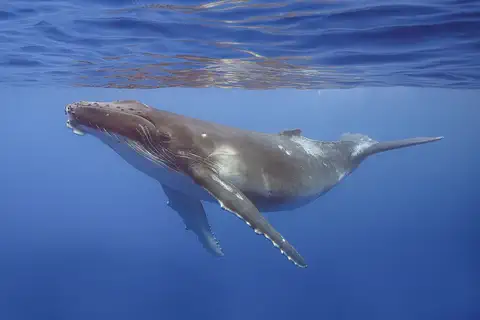
The humpback whale is a baleen whale famous for leaping out of the water, slapping its giant flippers and singing long, complex songs. It lives in every ocean and makes one of the longest journeys of any mammal, between cold feeding waters and warm waters where calves are born. Once hunted almost to extinction, it is now recovering.
-
 Watch
Animal
Ocellaris clownfish
The ocellaris clownfish is a small orange-and-white reef fish from the Indian and Pacific Oceans. It shelters among the stinging tentacles of a sea anemone, protected by a slimy coat, and every clownfish starts life as a male.
- Watch Try it What If? Lab What if the oceans became warmer? Water expands a little when it warms. The ocean is so deep and wide that this small stretch adds up: in our model, warming the top 700 meters by 2 °C raises the sea about 28 centimeters, with no ice melting at all.
- Watch What If? Lab What if coral reefs could be regrown? Scientists grow broken pieces of coral in underwater nurseries, then plant them back on damaged reefs. Follow how coral gardens work, how scientists search for corals that cope with heat, and what happens when fish come back to a restored reef.
- Watch Geography National parks and protected areas Countries set aside land and sea as national parks and other protected areas, so that wildlife, forests, reefs and wonderful landscapes are looked after. Yellowstone became the first national park in 1872. Today about 18 percent of the world's land is protected, and countries have agreed to aim for 30 percent by 2030.
For parents & teachers
What children will learn
- Locate the Great Barrier Reef off Queensland, Australia, and describe its size.
- Explain that corals are animals whose polyps build limestone reefs, helped by algae.
- Describe what coral bleaching is and how people help the reef recover.
- Name responsible reef practices, such as using moorings and taking litter home.
Recommended ages: 3 to 17 · About 15 minutes
Talk about it
- Why do you think coral is easy to mistake for a plant or a rock?
- How might the people who have looked after the reef for thousands of years help scientists today?
- What could you do at a beach near you to help sea life?
Try at home or in class
- Build a reef from egg-carton cups: each cup is a polyp's skeleton, and new cups glued on top show how reefs grow upward.
- Put a white and a colored cloth in sunlight and talk about how coral loses its color when its algae leave.
Key vocabulary: coral polyp, reef, cay, coral bleaching, Sea Country, mooring
Where these facts come from
- Wikidata , Wikimedia Foundation (CC0 1.0)
- UNESCO World Heritage List , UNESCO World Heritage Centre (Linked as a reference; site facts come from Wikidata)
- Natural Earth vector data , Natural Earth (NACIS) (Public domain)
- Great Barrier Reef , UNESCO World Heritage Centre
- Public moorings and anchoring in the southern Great Barrier Reef: protecting coral in the Keppels and Capricorn Bunkers (2019) , Queensland Parks and Wildlife Service and Great Barrier Reef Marine Park Authority
- The World's Fourth Mass Coral Bleaching Event Is Underway (April 17, 2024) , Smithsonian Magazine
- Cairns , Encyclopaedia Britannica
- What is the Great Barrier Reef? , NOAA National Ocean Service
- Are corals animals or plants? , NOAA National Ocean Service
- How do coral reefs form? , NOAA National Ocean Service
- What is coral bleaching? , NOAA National Ocean Service
- Tips for Being a Responsible Diver , NOAA Florida Keys National Marine Sanctuary
- Wikimedia Commons , Wikimedia Foundation (Per file (public domain, CC0, CC BY or CC BY-SA); see each media record)
Checked, not yet human-reviewed. Last updated October 27, 2026. Spotted a mistake? Tell us.
Picture credits
- Photo: Ank Kumar, CC BY-SA 4.0, via Wikimedia Commons · source · license
- Photo: Charles J. Sharp, CC BY-SA 4.0, via Wikimedia Commons · source · license
- Photo: Frances76 at the English-language Wikipedia, CC BY-SA 3.0, via Wikimedia Commons · source · license
- Photo: Julien Willem, CC BY-SA 3.0, via Wikimedia Commons · source · license
- Photo: Charles J. Sharp, CC BY-SA 4.0, via Wikimedia Commons · source · license