
Animal
Australian box jellyfish
The Australian box jellyfish is a see-through jelly shaped like a box. It lives in warm seas in the north of Australia, and it has 24 eyes!
The Australian box jellyfish has a clear, box-shaped bell with bunches of long tentacles at each of its four corners. Unlike most jellyfish it swims on purpose, it has 24 eyes but no brain, and it grows very fast after leaving the tiny polyp it started from. Its sting is very dangerous, so people in northern Australia swim carefully in stinger season.
Chironex fleckeri is a chirodropid cubozoan of tropical northern Australian coasts, from about Agnes Water and Gladstone in Queensland across the Northern Territory to Broome and Exmouth in Western Australia. Its medusae swim actively, carry 24 eyes on four rhopalia, grow fast after leaving estuarine polyps, and deliver a sting that Surf Life Saving Queensland classes as dangerous.
Photo: Emőke Dénes, CC BY-SA 4.0, via Wikimedia Commons
Meet the box jellyfish
The box jellyfish is a jelly shaped like a box.
It is clear, like glass, so it is very hard to see. Long tentacles hang from its four corners. It lives in warm seas in the north of Australia.
The Australian box jellyfish gets its name from its bell, which is shaped like a cube when it is healthy. The bell is almost see-through, which makes this jellyfish very hard to spot in the water.
At each of the bell's four corners grows a bunch of long tentacles, up to about 15 of them per corner. Box jellyfish are not true jellyfish like moon jellies: they belong to a different group called cubozoans, or box jellies, which swim strongly and have eyes.
Chironex fleckeri Southcott, 1956, belongs to the class Cubozoa (box jellyfish) and the order Chirodropida, the box jellies with several tentacles on each corner. Animal Diversity Web describes a transparent, box-shaped bell usually 16 to 24 centimeters across, some reaching 35 centimeters, with up to 15 tentacles on each of the four pedalia (the bell's corners), up to 60 in all.
Surf Life Saving Queensland gives a box-shaped bell up to 38 centimeters across and up to 17 ribbon-like tentacles per corner, which can contract to about 10 centimeters or extend to 3 meters. Australian Geographic notes that most of its organs sit inside the firm, jelly-like bell.
Quick facts
- Group
- Invertebrate
- Length
- 16 to 24 cm
- Weight
- up to 2 kg
- Top speed
- up to 7.4 km/h
Where it lives
Box jellyfish live in warm, shallow seas in the north of Australia.
They like calm water near beaches, river mouths and mangroves. In the warm, wet months there are more of them near the shore.
Box jellyfish live in shallow, tropical waters along Australia's northern coasts: from Queensland, across the Northern Territory, to northern Western Australia.
Their babies grow up in rivers and creeks that flow into the sea. When they become young jellies, they move out toward the coast. That is why there are more of them near beaches during the warm, wet months, the time people in northern Australia call stinger season, which usually runs from November to May.
Surf Life Saving Queensland gives the distribution as shallow tropical Australian waters north of Agnes Water in Queensland, all Northern Territory waters, and Western Australia south to Exmouth. A 2002 letter in the Medical Journal of Australia gives Broome to at least Gladstone. Animal Diversity Web also mentions Southeast Asia; this page maps only Australia, where the species is well documented.
The polyps are thought to live some distance up estuaries, and young medusae are washed out of creeks at the start of the season (Gordon and Seymour, 2012). Medusae typically appear along the far north Queensland coast in December, sometimes as early as October, and Surf Life Saving Queensland notes that the stinger season typically runs from November to May.
Continent
Did you know?
Scientists can count a box jelly's age in days.
Tiny stones in a box jellyfish's sense organs grow a new ring every day, so scientists can count its age in days, like tree rings.
Statoliths in the rhopalia add daily growth rings, letting Gordon and Seymour (2012) age medusae and measure growth.
Where can you find this animal?
- Lives here naturally · Countries and seas named by a scientific source
- Sightings recorded · Records of wild sightings (GBIF)
Lives here naturally · Countries and seas named by a scientific source
Shallow tropical coastal waters of northern Australia: Queensland north of Agnes Water, all Northern Territory waters, and Western Australia south to Exmouth. It lives only along these northern coasts, not around the whole country.
Places: Australia.
Source: https://lifesaving.com.au/safety-info/marine-stingers · checked October 2026
Sightings recorded · Records of wild sightings (GBIF)
Counts of GBIF records of wild observations (human and machine) and preserved specimens. Records include introduced populations, vagrants, escaped or released animals and misidentifications, so a country with records is not necessarily part of the native range.
Wild sightings have been recorded in Australia, Philippines, Mexico, Pacific Ocean, Indian Ocean, Southern Ocean, Arctic Ocean and Atlantic Ocean.
Source: gbif · checked October 2026
Range maps show where scientists say an animal lives, often country by country. An animal may live in only part of a country shown, and sightings records can include animals that wandered far from home.
A swimming hunter
Box jellyfish eat small fish and prawns.
Their tentacles catch the food. Then the tentacles pull it up to the jelly's mouth.
Adult box jellyfish hunt in shallow water, mainly for small fish and prawns. Young ones eat mostly tiny shrimp.
Their tentacles are covered in millions of microscopic stinging capsules called nematocysts. Each one works like a tiny spring-loaded needle that fires when touched. A box jellyfish cannot chase fast fish, so its sting must stop them very quickly. The tentacles then reel the prey up to the mouth.
Animal Diversity Web reports that adults feed mainly on small fish and prawns in shallow water, and that juveniles feed mostly on shrimp, especially Acetes australis; Australian Geographic gives a diet of mostly fish and sometimes crustaceans.
Each tentacle carries millions of nematocysts. Because each releases only a minute dose, the jellyfish discharges as many as possible and draws captured prey toward the bell and other tentacles. Australian Geographic explains that although box jellyfish can swim against currents and steer by pulsing the bell, they are not fast enough to pursue prey, so their venom acts quickly on fish.
Did you know?
Green sea turtles can eat box jellyfish without getting hurt.
Green sea turtles eat box jellyfish. The stings cannot get through their thick skin.
ADW names the green turtle as a known predator, protected by skin the venom does not penetrate.
Twenty-four eyes, no brain
A box jellyfish has 24 eyes. But it has no brain!
Its eyes help it tell light from dark. It can swim where it wants to go.
A box jellyfish has 24 eyes, set in four clusters on small sense organs around its bell, yet it has no brain. Its eyes can tell light from dark, and it tends to swim toward light and avoid dark shapes. Scientists are not sure whether it can see shapes.
Unlike most jellyfish, which drift with the current, box jellyfish swim on purpose and can steer. They can reach about 4 knots, about 7 kilometers per hour, but usually swim slowly during the day.
The 24 eyes sit on four rhopalia, the eye-bearing sensory structures of the bell. ADW notes photoreceptors that distinguish light from dark, attraction to light and avoidance of dark shapes, and uncertainty over whether the species processes shapes; it may also sense vibrations. Each rhopalium holds a statolith that adds a growth ring every day, which Gordon and Seymour (2012) used to age medusae.
Box jellyfish swim actively: ADW reports speeds up to 4 knots, usually 1 knot or less by day, with slower swimming by day than at night. Unlike most jellyfish they rest on the sea floor, and they sink to the bottom when seas are rough.
From river polyp to jelly
A box jellyfish starts life as a tiny polyp in a river.
The polyp turns into a baby jelly smaller than a grain of rice. The baby swims out to sea and grows big very fast.
Adult box jellyfish release eggs and sperm into the water. The fertilized eggs become tiny larvae that settle on a hard surface, like the underside of a stone, and grow into polyps just 1 to 2 millimeters long. A polyp can make copies of itself by budding.
Then each polyp changes into a tiny box jellyfish about 1.2 to 1.4 millimeters across. These babies leave the rivers and grow fast, up to 3 millimeters a day. In a study at Weipa, Queensland, the oldest jellies were only about 78 days old. ADW reports that adults are thought to die soon after spawning.
ADW describes spawning in rivers, with eggs and sperm released into the water; planulae settle as sessile polyps 1 to 2 millimeters long with two tentacles, usually in sheltered crevices or on the undersides of hard surfaces, and bud asexually before metamorphosing into medusae. Juvenile medusae measure about 1.2 to 1.4 millimeters at metamorphosis.
At Weipa, Gordon and Seymour (PLoS One, 2012) found that the earliest metamorphosis of each season fell between 30 August and 5 September, varying by only 7 days between seasons, with juveniles added over an extended period. Medusae grew at up to about 3 millimeters a day to an asymptotic interpedalial distance of about 190 millimeters, and the oldest were estimated at about 78 days. ADW reports that adults are thought to die soon after spawning and live less than a year; the longest-lived in captivity survived nine months.
Day and night
Box jellyfish swim slowly in the day.
They can rest on the sea floor. When the sea is rough and stormy, they sink down to calm water.
Box jellyfish are busy swimmers, but they also rest. During the day they usually swim slowly, and they swim faster at night. Unlike most jellyfish, they can rest on the sea floor without moving, and when the sea gets rough they sink down until it is calm again.
Few animals eat box jellyfish because of their stings. Green sea turtles are a known predator: their thick skin protects them from the stinging cells.
ADW reports slower swimming by day than at night, rest periods on the sea floor that may balance the energy spent swimming, and sinking to the bottom in rough seas or moving to deeper, calmer water during storms. Gordon and Seymour (2012) found more juveniles along the coastline and larger medusae in estuarine populations, and noted that medusae did not appear to accumulate along the coast.
ADW names green turtles (Chelonia mydas) as a known predator, unaffected because the venom does not penetrate their thick skin, though jellyfish are not their main food.
Did you know?
A box jellyfish has 24 eyes!
A box jellyfish has 24 eyes in four clusters, but no brain.
Twenty-four eyes sit on four rhopalia; whether the species processes shapes is uncertain (ADW).
Staying safe in stinger season
Box jellyfish are not in danger.
Their sting is very strong. In northern Australia, people swim at beaches with lifeguards, nets and special suits. Never touch a jellyfish. Tell a grown-up.
The Australian box jellyfish has not been assessed for the IUCN Red List, and there are no special efforts to protect it. It is a natural part of tropical Australian seas.
Its sting is extremely dangerous, so people in northern Australia take care during stinger season. Some beaches have stinger nets that keep box jellyfish away, and swimmers can wear special stinger suits that the stinging cells cannot get through. Lifeguards help too. If you visit, always follow their advice.
Chironex fleckeri has not been evaluated for the IUCN Red List (GBIF's Red List copy: Not Evaluated; ADW: no special status). Surf Life Saving Queensland classes it among the dangerous tropical marine stingers; its sting causes immediate severe pain and whip-like marks and can be life-threatening, and antivenom is held at hospitals and ambulance stations in tropical coastal areas.
Prevention relies on stinger nets at some beaches and suits made of a material that nematocysts cannot penetrate (Australian Geographic), lifeguard help, and avoiding the water during the stinger season. Research on its venom, ADW notes, has led to an antivenom and to studies of why it affects the heart so strongly.
Did you know?
Box jellyfish can rest on the sea floor.
Unlike most jellyfish, box jellyfish can rest on the sea floor, and they sink down when the sea gets rough.
Resting on the bottom may help offset the energy cost of active swimming (ADW).
Amazing facts
-
A box jellyfish has 24 eyes!
A box jellyfish has 24 eyes in four clusters, but no brain.
Twenty-four eyes sit on four rhopalia; whether the species processes shapes is uncertain (ADW).
-
Green sea turtles can eat box jellyfish without getting hurt.
Green sea turtles eat box jellyfish. The stings cannot get through their thick skin.
ADW names the green turtle as a known predator, protected by skin the venom does not penetrate.
-
Box jellyfish can rest on the sea floor.
Unlike most jellyfish, box jellyfish can rest on the sea floor, and they sink down when the sea gets rough.
Resting on the bottom may help offset the energy cost of active swimming (ADW).
-
Scientists can count a box jelly's age in days.
Tiny stones in a box jellyfish's sense organs grow a new ring every day, so scientists can count its age in days, like tree rings.
Statoliths in the rhopalia add daily growth rings, letting Gordon and Seymour (2012) age medusae and measure growth.
Words to know
- box jellyfish
- a jellyfish with a box-shaped bell that swims strongly and has eyes
- tentacle
- a long, thin, bendy body part used to catch food
- polyp
- a small, tube-shaped stage that stays stuck in one place
- estuary
- the place where a river meets the sea
- stinger season
- the warm months when dangerous jellyfish are near northern Australian beaches
- nematocyst
- a tiny stinging capsule made by jellyfish and their relatives
Discovery challenge
-
How many eyes does a box jellyfish have?
How many eyes does an Australian box jellyfish have?
How many eyes are carried on the rhopalia of Chironex fleckeri?
- 2
- 8
- 24
Show the answer
24
It has 24 eyes, but no brain!
It has 24 eyes in four clusters, which tell light from dark.
Twenty-four, on four rhopalia, each of which also holds a statolith.
-
Where do box jellyfish live?
Where does the Australian box jellyfish live?
Which describes the documented range of Chironex fleckeri?
- Icy seas near the North Pole
- Warm seas in northern Australia
- Lakes in the mountains
Show the answer
Warm seas in northern Australia
They live in warm seas in the north of Australia.
They live in shallow, tropical waters along Australia's northern coasts.
Northern Australian coasts from Agnes Water or Gladstone (Queensland) to Exmouth or Broome (Western Australia).
-
Where do baby box jellyfish start life?
Where do box jellyfish polyps live?
Where is the polyp stage of Chironex fleckeri thought to be found?
- In rivers that flow into the sea
- On mountain tops
- Inside coral reefs far out at sea
Show the answer
In rivers that flow into the sea
They start as tiny polyps in rivers.
Polyps live in rivers and creeks near the coast, then young jellies move out to sea.
Up estuaries, some distance from the coast; young medusae are washed out at the start of the season.
-
How can people stay safe from box jellyfish?
Which of these helps people stay safe in stinger season?
Which measure is used to prevent box jellyfish stings in northern Australia?
- Swimming at night with no lifeguards
- Swimming inside stinger nets in a stinger suit
- Picking up jellyfish to move them
Show the answer
Swimming inside stinger nets in a stinger suit
Swim where lifeguards say, inside nets, in a special suit. Never touch a jellyfish.
Stinger nets keep box jellyfish out, and stinger suits stop the stinging cells from reaching skin.
Stinger nets, suits that nematocysts cannot penetrate, lifeguards and staying out of the water in stinger season.
Places where you might see it
Explore next
-
 Watch
Animal
Moon jellyfish
The moon jellyfish is a clear, saucer-shaped jelly found in coastal seas around the world. It has no eyes, brain or heart, and it is about 95 percent water. Four horseshoe-shaped rings show through its bell, and short stinging tentacles fringe its edge to catch tiny plankton.
-
 Watch
Animal
Lion's mane jellyfish
The lion's mane jellyfish is one of the biggest jellyfish in the world. Its bell is usually 30 to 50 centimeters across, but in very cold seas it can grow to about 2 meters, and hundreds of long, hair-like tentacles trail beneath it to catch food.
-
 Watch
Animal
Green sea turtle
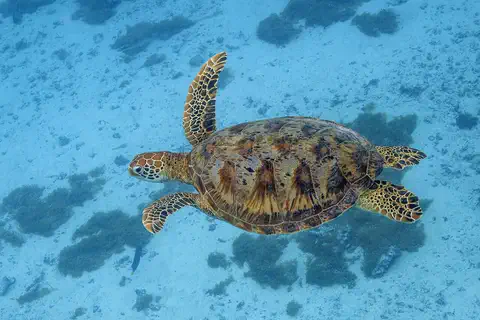
The green sea turtle is the largest sea turtle with a hard shell. It lives in warm seas around the world and, unlike other sea turtles, grown-ups eat mostly seagrass and algae. Females swim hundreds or even thousands of kilometers to lay their eggs on the beaches where they hatched long ago.
-
 Watch
 Country
Australia
Australia is a country and the smallest continent, surrounded by ocean in the Southern Hemisphere. Much of its middle is dry and flat, most people live near the coast, and its animals include kangaroos, koalas and the platypus, a mammal that lays eggs.
-
 Watch
Animal
Portuguese man o' war
The Portuguese man o' war is not a true jellyfish. It is a siphonophore: a colony of many tiny, identical animals, each with its own job. A gas-filled float with a crest catches the wind like a sail, while long stinging tentacles below catch fish.
-
 Watch
Animal
American lobster
The American lobster is a big crustacean that lives on the rocky sea floor of the northwest Atlantic Ocean. It has two very different claws, one for crushing and one for tearing, and it must climb out of its hard shell again and again to grow.
-
 Watch
3D
Animal
Antarctic krill
Antarctic krill are small, shrimp-like crustaceans about 6 centimeters long that live in the icy Southern Ocean around Antarctica. They gather in enormous swarms, and almost all the bigger animals of the Antarctic, from penguins to blue whales, depend on them for food.
-
 Watch
Animal
Army ant
Army ants hunt together in giant swarms and never build a permanent nest. This page is about the best-studied kind, Eciton burchellii, of Central and South American forests. Each night of its traveling phase the colony moves, and the workers link their legs to build a living camp around their queen and young.
For parents & teachers
What children will learn
- Describe the box jellyfish's box-shaped bell, tentacles and 24 eyes.
- Explain how box jellyfish differ from true jellyfish: they swim actively and have eyes.
- Describe its life cycle from river polyp to coastal medusa and how fast it grows.
- Know how people stay safe in northern Australia's stinger season.
Recommended ages: 3 to 17 · About 12 minutes
Talk about it
- How can an animal with no brain use 24 eyes?
- Why might a jellyfish that swims slowly need such a fast-acting sting?
- What safety rules would you follow on a tropical beach?
Try at home or in class
- Fill a clear plastic box with water and look through it from the side to see how a transparent animal can be hard to spot.
- Use a ruler to draw how a box jellyfish grows: 1.4 millimeters on day one, adding up to 3 millimeters a day.
Key vocabulary: box jellyfish, tentacle, polyp, estuary, stinger season, nematocyst
Where these facts come from
- GBIF Backbone Taxonomy and GBIF Occurrence Search , Global Biodiversity Information Facility (CC0 1.0 (backbone); occurrence counts are facts derived from records under CC0, CC BY and CC BY-NC)
- Marine Stingers , Surf Life Saving Queensland
- Growth, Development and Temporal Variation in the Onset of Six Chironex fleckeri Medusae Seasons (Gordon and Seymour, PLoS One 2012) , PLoS One, via PubMed Central
- The Gove chirodropid: a box jellyfish appearing in the "safe season" , Medical Journal of Australia (2002)
- Chironex fleckeri , Animal Diversity Web, University of Michigan Museum of Zoology
- Fact File: Box jellyfish (Chironex fleckeri) , Australian Geographic
- Wikidata , Wikimedia Foundation (CC0 1.0)
- Wikimedia Commons , Wikimedia Foundation (Per file: Public domain, CC0, CC BY or CC BY-SA only (credited on each page))
Checked, not yet human-reviewed. Last updated October 27, 2026. Spotted a mistake? Tell us.