
Animal
Black caiman
The black caiman is a very big caiman with dark skin. It lives in the rivers and lakes of the Amazon.
The black caiman is the biggest caiman and the largest predator of the Amazon. It lives in slow rivers, lakes, flooded forests and swamps across the Amazon region of South America. People once hunted millions of them for their shiny dark skins, but since hunting was banned in the 1970s, many populations have grown again.
Melanosuchus niger, the only living species of its genus, is the largest member of the family Alligatoridae and the biggest Amazonian predator, considered a keystone species. Botero-Arias, Hernández-Rangel, Thorbjarnarson, Magnusson and Da Silveira assessed it as Least Concern for the IUCN Red List (assessed 1 March 2023, published 2025): after intensive skin hunting through much of the 20th century, populations have recovered considerably, with about 10,000 mature individuals and an increasing trend.
Photo: Whaldener Endo, CC BY-SA 4.0, via Wikimedia Commons
Meet the black caiman
The black caiman is a very big caiman.
Its skin is dark.
It lives in the Amazon in South America.
Caimans are cousins of alligators that live in Central and South America. The black caiman is the biggest of them all. The IUCN calls it the largest predator in the Amazon and the largest member of the alligator family.
A growth study in Guyana predicted that full-grown females reach about 2.9 meters long and males about 3.8 meters, and some hunted animals were longer than 5 meters. Even grown-ups keep pale bands along their sides.
Melanosuchus niger is the only living species of its genus, which has been reported from the late Miocene of South America; no subspecies are recognized. Some morphology-based studies placed it inside the genus Caiman, but molecular phylogenies place it as the sister group of Caiman (IUCN).
The IUCN calls it the biggest Amazonian vertebrate and the largest of the alligatorids, though maximum size is hard to pin down: Medem (1983) cited hunted individuals over 5.1 meters, and size-at-age models in Guyana predicted mean asymptotic lengths of 3.8 meters for males and 2.9 meters for females (Taylor et al. 2016). The Animal Diversity Web notes that adults keep their markings: gray or brown bands on the lower jaw and white or yellowish bands on the sides.
Quick facts
- Group
- Reptile
- Length
- 2.9 to 3.8 m
Flooded forests of the Amazon
Black caimans live in rivers, lakes and swamps.
The forest there floods every year.
Black caimans live only in the Amazon region, in seven countries: Bolivia, Brazil, Colombia, Ecuador, French Guiana, Guyana and Peru. More than 70% of their range is in Brazil.
They live in big rivers, oxbow lakes, flooded grasslands, floating meadows of water plants and swamps, and in French Guiana even near mangroves by the coast. They are most common in the flooded forests along the rivers. They do not live in small, shady forest streams, and they are rare above rapids and waterfalls.
The IUCN lists seven range countries (Bolivia, Brazil, Colombia, Ecuador, French Guiana, Guyana and Peru), with more than 70% of the range in Brazil, from sea level to 250 meters; reports from Venezuela have been refuted several times. The range covers the Andean-Amazonian piedmont, the Amazon floodplain forests and tributaries draining the Brazilian and Guiana Shields, and coastal French Guiana.
It occupies large rivers and canals, oxbow lakes, flooded grasslands, floating meadows, swamps and peatlands, flooded savannas and coastal mangroves, and even reservoirs and other artificial waters, but is most abundant in floodplain forest waters. It is absent from small, closed-canopy terra firme streams with little sunlight and rare or absent above rapids and waterfalls.
Continent
Its habitats


Where can you find this animal?
- Lives here naturally · Countries and seas named by a scientific source
- Sightings recorded · Records of wild sightings (GBIF)
Lives here naturally · Countries and seas named by a scientific source
Countries where the IUCN lists the black caiman as resident, across the Amazon region; it lives only in parts of them, and more than 70% of its range is in Brazil. The IUCN also lists French Guiana, which has no shape on this map. Reports from Venezuela have been refuted, so it is not shaded.
Places: Bolivia, Brazil, Colombia, Ecuador, Guyana and Peru.
Source: iucn-red-list · checked October 2026
Sightings recorded · Records of wild sightings (GBIF)
Counts of GBIF records of wild observations (human and machine) and preserved specimens. Records include introduced populations, vagrants, escaped or released animals and misidentifications, so a country with records is not necessarily part of the native range.
Wild sightings have been recorded in Brazil, Peru, Ecuador, Bolivia, Guyana, Colombia, Suriname, Venezuela and 3 more places.
Source: gbif · checked October 2026
Range maps show where scientists say an animal lives, often country by country. An animal may live in only part of a country shown, and sightings records can include animals that wandered far from home.
From insects to capybaras
Young black caimans eat bugs and other small animals.
Big ones eat lots of fish.
Young black caimans eat insects, crustaceans and other small animals without backbones. As they grow, they switch to bigger prey. Grown-ups eat many fish, such as piranhas and catfish, and snails and other mollusks, and they can catch larger animals too, even capybaras.
Most of their hunting happens in the water, but at night they may come out onto land to hunt.
The Animal Diversity Web notes that diet studies are limited: prey size tends to increase with caiman size, juveniles take insects, crustaceans and other invertebrates, and adults eat many fish, including piranhas and catfish, as well as mollusks and aquatic and terrestrial vertebrates such as capybara. Most hunting is in water, but black caimans may hunt on land, usually at night. Fishers have claimed that caimans eat large amounts of commercial fish, but one stomach-content study found only small volumes of such fish (ADW). As the largest Amazonian predator, the IUCN describes it as a keystone species with an important role in the food web.
Did you know?
In one reserve in Brazil, the number of black caimans seen grew a lot in four years.
In Brazil's Mamirauá Reserve, the number of black caimans seen rose from 556 in 1994 to 3,789 in 1998.
In the Mamirauá Sustainable Development Reserve, counts rose 580% from 1994 to 1998, and nests from 1 in 1996 to 22 in 1999 (Da Silveira 2002, via IUCN).
Dark skin with pale bands
Its skin is dark.
It has pale stripes on its sides.
Its nostrils sit on a bump at the end of its nose.
Black caimans have dark skin, which was once made into shiny black leather. Grown-ups keep gray or brown bands on the lower jaw and white or yellowish bands along their sides.
Hunters preferred black caiman skin because it has fewer bony plates, called osteoderms, than the skin of other Amazon caimans, which made better-looking leather.
The Animal Diversity Web describes adults that retain distinctive markings into adulthood: gray or brown bands on the lower jaw and white or yellowish bands on the flanks. The IUCN notes that its skin has fewer osteoderms than other Amazonian caimans, which made it the preferred hide, since osteoderms affect the look of finished leather; hunters turned to it after the Orinoco and American crocodiles had been heavily overhunted for their hides. In Brazil, small and medium-sized black caimans grow more slowly in productive várzea floodplain forest, where caimans are crowded, than in blackwater igapó forest, suggesting that growth depends on density (Da Silveira et al. 2013).
Big nests and big eggs
The mother builds a big nest of plants.
She lays many eggs inside.
The babies stay together in a group.
In the dry season, a female black caiman builds a mound nest of plants in the forest, near a bank, or even on a floating mat of water plants. She usually lays 35 to 50 hard-shelled eggs, which weigh about 120 grams on average.
The eggs hatch after about two to three months, which may be around the start of the rainy season, and the mother scrapes the nest open. The babies gather in groups called pods, often with their mother nearby. Scientists still do not know when black caimans are grown up; some have assumed that females start nesting at about 2.5 meters long.
The IUCN describes mound nests built in the dry season in forest, near banks or on floating vegetation mats (matupá), with clutches generally of 35 to 50 rigid, elliptical eggs averaging 121.8 grams; the Animal Diversity Web gives an average clutch of 39.3 eggs of 143.6 grams, incubation of two to three months depending on nest temperature, hatching that may coincide with the start of the rains, and young that gather in pods, sometimes from more than one nest, guarded by the female.
Age and size at maturity are unknown: histology of a few wild animals suggested a male of 2.9 meters was adult at about 14 years and a female of 2.9 meters reproductive at about 17. Without firm evidence, several authors have assumed that females nest from 2.5 meters, which would be 19 to 20 years in a Brazilian study and 13.7 to 22.8 years in Guyana. Multiple paternity has been reported in Anavilhanas National Park (Muniz et al. 2011).
Following the flood
When the rivers flood, black caimans spread out.
When the water goes down, they gather in lakes.
Life in the Amazon follows the water. When the rivers flood, black caimans spread out over a wide area. In the dry season, as the water drops, they gather in lakes, rivers and channels that never dry up, and young caimans often stay in groups.
Dominant males keep a home area that they patrol and defend, while females stay near their nesting places. Black caimans call to each other with sounds like rumbling thunder.
The IUCN describes populations that disperse widely in the flood season and concentrate in permanent lakes, rivers and channels in the dry season, where juveniles and sub-adults are gregarious and large adults probably hold territories. Movements follow water levels, prey and density: dominant males patrol and defend home ranges, females use small, well-defined areas near nesting sites, and juveniles may disperse long distances. The Animal Diversity Web adds that black caimans communicate with vocalizations like rumbling thunder and that their niche appears to differ enough from other caimans that they coexist without much competition.
Did you know?
Some black caiman nests float on water plants!
Some females build their nests on floating mats of water plants, called matupá in Brazil.
Mound nests are built in forest, near banks or on floating vegetation mats known locally as matupá (IUCN).
A comeback in the Amazon
People once hunted many black caimans for their skins.
Now hunting is banned, and there are more of them again.
Black caimans were once very common, but from the early 1900s people hunted them in huge numbers for their skins. Between 1950 and 1965 alone, more than 7.5 million skins were sold. Until the 1990s they were counted among the most endangered crocodilians of Central and South America.
After hunting was banned in the 1970s and protected areas were created, many populations recovered, and today the species is listed as least concern. Illegal hunting for meat, damage to riverside forests, dams and pollution are still problems in some places. Big black caimans can be dangerous, so people should keep well away from them.
The IUCN assessors found that populations have recovered considerably since the mid-20th century, with an estimated decline of less than 30% over three generations (75 years), about 10,000 mature individuals and an increasing trend. Commercial hunting began in the early 1900s for the exotic-skin market; from 1950 to 1965 more than 7.5 million legally sourced skins left the Amazon. Hunting bans in the 1970s, the end of the skin trade, CITES regulation (Brazil's population moved from Appendix I to II in 2007) and protected areas reversed the decline.
National red lists still rate it Vulnerable in Bolivia, Colombia and Ecuador and Near Threatened in French Guiana and Peru. Current threats include an illegal salted-meat trade, the illegal use of caiman meat as bait for piracatinga catfish (Brazil has banned piracatinga fishing since 2014, indefinitely from July 2023), habitat loss, dams, mercury and oil pollution, and conflicts with people as caimans become commoner near settlements. In Guyana, black caiman tourism has provided income for local communities since the early 2000s.
IUCN Red List
How is the black caiman doing in the wild?
- Least Concern (this animal)
- Near Threatened
- Vulnerable
- Endangered
- Critically Endangered
- Extinct in the Wild
- Extinct
Least Concern
Not at risk of disappearing from the wild right now.
Amazing facts
-
Black caimans call with a sound like thunder.
Black caimans talk to each other with calls that sound like rumbling thunder.
Vocalizations resembling rumbling thunder are used to communicate with other black caimans (ADW).
-
Some black caiman nests float on water plants!
Some females build their nests on floating mats of water plants, called matupá in Brazil.
Mound nests are built in forest, near banks or on floating vegetation mats known locally as matupá (IUCN).
-
Baby caimans live in groups called pods.
Baby black caimans gather in groups called pods, which can include babies from more than one nest.
Hatchling pods may contain young from more than one nest and are often guarded by an adult female (ADW).
-
In one reserve in Brazil, the number of black caimans seen grew a lot in four years.
In Brazil's Mamirauá Reserve, the number of black caimans seen rose from 556 in 1994 to 3,789 in 1998.
In the Mamirauá Sustainable Development Reserve, counts rose 580% from 1994 to 1998, and nests from 1 in 1996 to 22 in 1999 (Da Silveira 2002, via IUCN).
Words to know
- caiman
- a crocodilian of Central and South America, a close cousin of alligators
- keystone species
- a species that has a very large effect on the other living things around it
- floodplain
- flat land beside a river that is covered with water when the river floods
- pod
- a group of young crocodilians that stay together
- osteoderm
- a bony plate that grows in the skin of some reptiles, like armor
- least concern
- not currently at serious risk of dying out in the wild
Discovery challenge
-
Where do black caimans live?
In which region of South America do black caimans live?
Which region is Melanosuchus niger restricted to?
- The Amazon
- The Sahara
- The Arctic
Show the answer
The Amazon
The Amazon!
They live only in the Amazon region, mostly in Brazil.
Widely and exclusively distributed in the Amazon region; over 70% of the range is in Brazil (IUCN).
-
What do black caimans do when the water goes down?
Where do black caimans gather in the dry season?
How does the distribution of Melanosuchus niger change in the dry season?
- They gather in lakes and rivers that never dry up
- They fly away
- They climb up trees
Show the answer
They gather in lakes and rivers that never dry up
They gather in the lakes!
As the water drops, they crowd into permanent lakes, rivers and channels.
They concentrate in permanent lakes, rivers and channels, with gregarious juveniles and sub-adults (IUCN).
-
Why did people hunt black caimans?
What were black caimans mostly hunted for in the 20th century?
Which trade drove the 20th-century decline of Melanosuchus niger?
- Their skins, for leather
- Their feathers
- Their wool
Show the answer
Their skins, for leather
Their skins!
More than 7.5 million skins were sold between 1950 and 1965.
The exotic-skin trade; its skin, with fewer osteoderms, was preferred for leather (IUCN).
-
What are baby caiman groups called?
What is a group of young black caimans called?
What term describes aggregations of hatchling crocodilians?
- Pods
- Herds
- Flocks
Show the answer
Pods
Pods!
The young gather in pods, often near their mother.
Pods, sometimes with young from more than one nest, guarded by the female (ADW).
Places where you might see it
-
 Watch
 Country
Brazil
Brazil covers about half of South America and is the fifth-largest country in the world. It holds most of the Amazon River basin and much of the world's largest rainforest, and about 214 million people lived there in 2026, most of them near the Atlantic coast.
-
 Watch
 Country
Peru
Peru is a country on the Pacific coast of South America. It has a dry desert coast, the high Andes mountains and the Amazon rainforest, and about 34 million people lived there in 2025, many of them in the capital, Lima.
-
 Watch
Natural wonder
Amazon River
The Amazon River flows from tiny streams in the Andes Mountains of Peru across Colombia and Brazil to the Atlantic Ocean. NASA calls it the largest river in the world: about 219,000 cubic meters of water pour into the ocean every second, nearly a fifth of all the water that rivers carry to the oceans.
Explore next
-
 Watch
Animal
Spectacled caiman
The spectacled caiman is a medium-sized crocodilian that lives in rivers, lakes, swamps and marshes from southern Mexico to Peru and Brazil. A bony ridge in front of and between its eyes sets it apart from American alligators and crocodiles. It is very common: scientists think there are millions of them.
-
 Watch
3D
Animal
American alligator
The American alligator is a large, armored reptile of the swamps, marshes and lakes of the southeastern United States. Alligator mothers guard their nests and carry their babies to the water, and the holes alligators dig help many other animals survive dry seasons.
-
 Watch
Animal
Matamata
The matamata is a big freshwater turtle of the Amazon basin in South America. With its flat, triangular head, skin flaps and rough shell it looks like a pile of debris on the muddy bottom. It hunts fish by sucking them in with a sudden gulp. In 2020 scientists split matamatas into two species; this page is about the Amazon matamata.
-
Watch
Country
Brazil
Brazil covers about half of South America and is the fifth-largest country in the world. It holds most of the Amazon River basin and much of the world's largest rainforest, and about 214 million people lived there in 2026, most of them near the Atlantic coast.
-
Watch
Country
Peru
Peru is a country on the Pacific coast of South America. It has a dry desert coast, the high Andes mountains and the Amazon rainforest, and about 34 million people lived there in 2025, many of them in the capital, Lima.
-
Watch
Natural wonder
Amazon River
The Amazon River flows from tiny streams in the Andes Mountains of Peru across Colombia and Brazil to the Atlantic Ocean. NASA calls it the largest river in the world: about 219,000 cubic meters of water pour into the ocean every second, nearly a fifth of all the water that rivers carry to the oceans.
-
 Watch
Animal
Aldabra giant tortoise
The Aldabra giant tortoise is one of the largest land tortoises on Earth. Wild ones live on Aldabra Atoll, a ring of coral islands in the Indian Ocean, where about 180,000 of them graze, browse and shape the land like elephants do in Africa. They can live for more than 100 years.
-
 Watch
Animal
Alligator snapping turtle
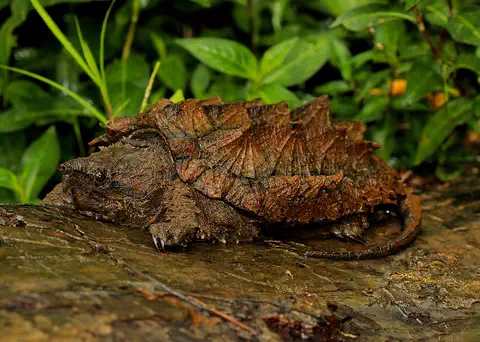
The alligator snapping turtle is the largest freshwater turtle in the United States. It lies still on the bottom of rivers and lakes with its mouth open, wiggling a worm-like lure on its tongue to trick fish into swimming close. Its numbers have fallen, and it is now endangered.
For parents & teachers
What children will learn
- Describe where black caimans live and how the yearly flood changes their lives.
- Explain why black caimans were hunted and how they recovered.
- Explain what a keystone species is.
- Describe how nesting and pods help young caimans.
Recommended ages: 3 to 17 · About 15 minutes
Talk about it
- Why might a big predator be important for a river and its fish?
- How can protected areas help an animal recover?
- Why is it important to watch big wild animals only from a safe distance?
Try at home or in class
- Flood and dry: put some pebbles in a tray, fill it with water, then pour some out. Watch how the water gathers in the deepest spots, as black caimans gather in permanent lakes in the dry season.
- Measure a giant: with a grown-up, use a tape measure to mark 3.8 meters on the floor or sidewalk and lie down next to it.
Key vocabulary: caiman, keystone species, floodplain, pod, osteoderm, least concern
Where these facts come from
- GBIF Backbone Taxonomy and GBIF Occurrence Search , Global Biodiversity Information Facility (CC0 1.0 (backbone); occurrence counts are facts derived from records under CC0, CC BY and CC BY-NC)
- Wikidata , Wikimedia Foundation (CC0 1.0)
- The IUCN Red List of Threatened Species , International Union for Conservation of Nature (IUCN terms of use (no redistribution of Red List data or range maps))
- Melanosuchus niger (Botero-Arias et al., assessed 1 March 2023, published 2025) , IUCN Red List of Threatened Species
- Melanosuchus niger: taxonomic notes, justification, range, population, habitat, threats, use and trade, and conservation text , IUCN Red List of Threatened Species
- Melanosuchus niger: IUCN Red List global assessment record (Botero-Arias et al. 2025), IUCN checklist on GBIF , GBIF
- Melanosuchus niger (black caiman) , Animal Diversity Web, University of Michigan Museum of Zoology
- File:Melanosuchus niger RDS Uacari.jpg (11 July 2009, Whaldener Endo) , Wikimedia Commons
- Wikimedia Commons , Wikimedia Foundation (Per file: Public domain, CC0, CC BY or CC BY-SA only (credited on each page))
Checked, not yet human-reviewed. Last updated November 1, 2026. Spotted a mistake? Tell us.