Animal
Alligator snapping turtle
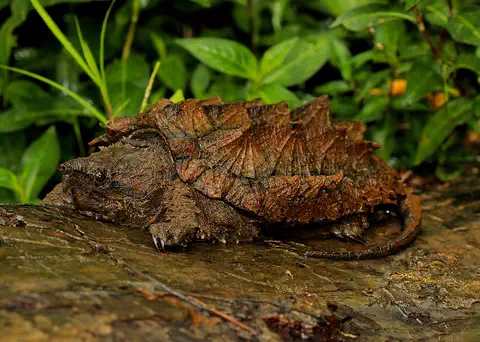
The alligator snapping turtle is a giant river turtle. It has a spiky shell. A wiggly 'worm' on its tongue helps it catch fish.
The alligator snapping turtle is the largest freshwater turtle in the United States. It lies still on the bottom of rivers and lakes with its mouth open, wiggling a worm-like lure on its tongue to trick fish into swimming close. Its numbers have fallen, and it is now endangered.
Macrochelys temminckii, the western alligator snapping turtle, is a large, almost fully aquatic turtle of rivers draining to the Gulf of Mexico. It is the only turtle known to have a lure for catching prey. Slow to mature, it has declined by more than 50 percent in about a century, mainly from harvesting and habitat change, and is assessed by the IUCN as Endangered.
Photo: Peter Paplanus from St. Louis, Missouri, CC BY 2.0, via Wikimedia Commons
Meet the alligator snapping turtle
The alligator snapping turtle is a giant turtle.
It lives at the bottom of rivers and lakes. Its shell has three rows of bumpy spikes. It has a big head and strong jaws.
The alligator snapping turtle is the largest freshwater turtle in the United States. With its huge head, hooked jaws and three rows of spiky ridges along its shell, it looks almost like a dinosaur.
It is deep brown, and algae often grows on its shell, which helps it blend in with the river bottom. It is a cousin of the common snapping turtle, but much bigger.
Macrochelys temminckii belongs to the snapping turtle family, Chelydridae. The U.S. Fish and Wildlife Service calls it the largest freshwater turtle in the United States: adult males reach up to 29 inches (about 74 centimeters) and 249 pounds (113 kilograms), females up to 22 inches and 62 pounds. The Missouri Department of Conservation gives typical adult shells of 15 to 20 inches and weights of 35 to 150 pounds.
The carapace carries three rows of spiky keels, and fleshy points surround the eyes on the sides of the large head. Like other snapping turtles, it has a small lower shell, so it cannot pull its head and limbs fully inside.
Quick facts
- Group
- Reptile
- Length
- 0.38 to 0.51 m
- Weight
- 16 to 68 kg
- Lifespan in the wild
- up to 70 years
Where it lives
Alligator snapping turtles live in the United States.
They live in big, slow rivers, lakes and swamps. They hide under sunken logs and tree roots.
Alligator snapping turtles live in the south-central and south-eastern United States, in rivers that flow into the Gulf of Mexico. Alabama, Mississippi and Louisiana are the heart of their range.
They like deep water in large rivers, plus streams, lakes, swamps, oxbow lakes and reservoirs, especially where there are tree roots, stumps and sunken trees to hide among. They hardly ever leave the water, except when a female comes out to lay her eggs.
The IUCN's 2025 assessment centers the range on river systems draining to the Gulf of Mexico, from the Apalachicola River in Florida and Georgia west to the Buffalo Bayou, Brazos and San Bernard drainages in Texas, with Alabama, Mississippi and Louisiana as the core. It lists the species as extant in 11 states and possibly extinct in Indiana, Kansas and Kentucky; the range once reached up the Mississippi system to Illinois and Indiana, and the extent of occurrence has shrunk by about 25 percent.
Preferred habitat is deep water in large rivers, sloughs and oxbow lakes, with submerged trees, root masses and stumps (U.S. Fish and Wildlife Service). Turtles found in other countries, such as Japan, Spain and the United Kingdom, are introduced animals or released pets.
Continent
Its habitat

Where can you find this animal?
- Lives here naturally · Countries and seas named by a scientific source
- Sightings recorded · Records of wild sightings (GBIF)
Lives here naturally · Countries and seas named by a scientific source
Rivers, lakes and swamps draining to the Gulf of Mexico in the south-central and south-eastern United States, from Florida and Georgia west to Texas and north to Illinois and Missouri. It lives in only this part of the United States.
Places: United States.
Source: iucn-red-list · checked October 2026
Sightings recorded · Records of wild sightings (GBIF)
Counts of GBIF records of wild observations (human and machine) and preserved specimens. Records include introduced populations, vagrants, escaped or released animals and misidentifications, so a country with records is not necessarily part of the native range.
Wild sightings have been recorded in United States, Japan, China, Spain, France, Taiwan, Belize, Canada and 1 more places.
Source: gbif · checked October 2026
Range maps show where scientists say an animal lives, often country by country. An animal may live in only part of a country shown, and sightings records can include animals that wandered far from home.
The fishing turtle
This turtle has a wiggly 'worm' on its tongue.
It lies still with its mouth open and wiggles the worm. When a fish swims in to look, the turtle snaps its mouth shut. Gotcha!
The alligator snapping turtle is the only turtle with its own fishing lure. On its tongue is a small part shaped like a worm. The turtle lies still on the river bottom, slowly opens its jaws, and wiggles the 'worm'. When a curious fish swims inside, the jaws snap shut.
It eats many other foods too: fish, crayfish, mussels, snails, insects, snakes, smaller turtles, birds and some plants. Young snappers eat small fish, insects, crayfish and snails.
The U.S. Fish and Wildlife Service describes the species as the only turtle with a body part for luring prey: a small, worm-like appendage on the tongue. The turtle lies motionless, opens its jaws over one to two minutes, and wriggles the lure; prey that enters the mouth is seized as the jaws snap shut.
The diet is broad: fish, crayfish, mollusks, smaller turtles, insects, snakes, birds, nutria and some vegetation (U.S. Fish and Wildlife Service). The Missouri Department of Conservation adds nuts and fruits such as acorns and persimmons, and says juveniles take small fish, aquatic insects, crayfish, mussels and snails. As large predators, the turtles help keep populations of many aquatic animals in check.
Did you know?
Alligator snapping turtles almost never sunbathe.
Unlike many turtles, alligator snappers seldom climb out of the water to bask in the sun.
Almost entirely aquatic, the species seldom basks; most individuals seen on land are nesting females.
A living dinosaur?
Its shell has bumpy ridges like a dinosaur's back.
It has a big head, a hooked beak and a long tail. Its feet are webbed for walking under water.
Look at the shell: three rows of tall, pointed ridges run from front to back. The head is huge, with a hooked beak and little fleshy points around the eyes. The tail is long, and the strong legs have webbed toes and long, pointed claws.
Alligator snappers are not great swimmers. Instead, they usually walk slowly along the bottom. They need to come up for air: in one test, turtles in water at 21 °C could stay under for no more than 50 minutes.
Diagnostic features include three rows of spiked keels on the carapace, a massive head with a hooked beak, fleshy projections around laterally placed eyes, a long tail, and muscular legs with webbed toes and long claws (U.S. Fish and Wildlife Service). Males grow larger and have longer tails than females.
The species seldom swims, usually walking along the bottom. It cannot stay submerged as long as some aquatic turtles: at a water temperature of 70 °F (21 °C), test animals surfaced within 50 minutes, extending the neck to breathe at the surface (Missouri Department of Conservation).
A slow start
The mother turtle climbs out of the water to dig a nest.
She lays lots of round eggs and covers them with sand. The babies hatch in late summer. They take many years to grow up.
Alligator snappers court and mate in the water, mostly in spring. From late April to June, a female climbs out of the water, often at night, to dig a nest on land. She can lay anywhere from about 8 to more than 50 round, white eggs with leathery shells, then covers them up and returns to the water.
The babies hatch in late summer, after about 80 to 114 days. Very few survive to grow up. Those that do become adults at about 11 to 21 years old and can live for many decades.
Courtship and mating are aquatic, mainly in spring. Females emerge, apparently at night, from late April through June, and can dig, lay and cover a nest within four hours. The Missouri Department of Conservation gives clutches of about 9 to 61 eggs (average 28) and incubation of 80 to 114 days; the U.S. Fish and Wildlife Service gives 8 to 52 eggs in a single clutch per year, and some females may lay only every other year.
Maturity comes at 11 to 21 years. Missouri gives lifespans of up to 70 years; the oldest documented in captivity reached 80, and wild animals may live longer (U.S. Fish and Wildlife Service). Survival before maturity is low, which makes populations sensitive to the loss of adults, especially females (U.S. Fish and Wildlife Service).
Hiding on the river bottom
Alligator snapping turtles hide during the day.
They come out at night. They almost never climb out of the water to sun themselves.
Alligator snapping turtles spend the daytime hiding among sunken logs and tree roots in deep water, and become active at night. Unlike many turtles, they hardly ever climb out to bask in the sun.
They can travel quite far: one turtle can range over more than 15 miles of river in three years. In winter they move to shallower areas, and in summer to deeper water.
The species is almost entirely aquatic and seldom basks; most individuals seen out of water are females seeking nest sites (Missouri Department of Conservation). It hides by day in root snags and among submerged logs and is active at night.
Movements can be extensive, with one individual ranging over more than 15 miles of river in three years (Missouri Department of Conservation), and the U.S. Fish and Wildlife Service notes a seasonal shift from shallower water in winter to deeper water in summer. Hatchlings favor shallow water with abundant canopy and vegetation.
Did you know?
These turtles walk on the river bottom.
Alligator snapping turtles are not great swimmers. They usually walk slowly along the bottom of the river.
The species seldom swims, moving instead by walking on the bottom, and must surface to breathe, within 50 minutes at 21 °C in one study.
Protecting a river giant
There are fewer alligator snapping turtles than there used to be.
People are raising baby turtles and letting them go in rivers. Keeping rivers clean helps too.
Alligator snapping turtles are endangered. In the 1960s and 1970s people caught huge numbers of them to sell, and many rivers have never recovered. Today it is against the law to catch them for sale in every state where they live.
They still face problems: illegal collecting, getting caught on fishing hooks and lines, dirty water, and changes to their rivers. Raccoons and other animals eat many of their eggs. Fish hatcheries now raise young turtles and release them into rivers to help.
The IUCN's 2025 global assessment (assessed in 2023) lists Macrochelys temminckii as Endangered (A2bcd+4bcd), citing a decline of more than 50 percent over about 100 years from commercial and recreational overharvest, habitat degradation, loss and fragmentation, and increased predation on nests and juveniles. It was previously assessed as Vulnerable in 1996. Under the U.S. Endangered Species Act, the Fish and Wildlife Service found on November 9, 2021 that listing was warranted and proposed listing it as Threatened; its review published on October 31, 2025 still lists it as proposed, not yet given final protection.
In the late 1960s and 1970s up to three to four tons a day were taken from Georgia's Flint River, which had not recovered 22 years after harvest ended. Commercial harvest is now banned throughout the range. Remaining threats include poaching for the pet and meat trade, bycatch and drowning on trotlines, boat strikes, pollution and dredging. Federal hatcheries release young turtles in Illinois, Oklahoma, Louisiana and Kansas.
IUCN Red List
How is the alligator snapping turtle doing in the wild?
- Least Concern
- Near Threatened
- Vulnerable
- Endangered (this animal)
- Critically Endangered
- Extinct in the Wild
- Extinct
Endangered
At very high risk of disappearing from the wild.
See the IUCN Red List assessment · The IUCN Red List of Threatened Species 2025.2
Amazing facts
-
This turtle has a wiggly 'worm' on its tongue to catch fish.
The alligator snapping turtle is the only turtle with its own fishing lure: a worm-like part of its tongue that it wiggles to attract fish.
The U.S. Fish and Wildlife Service describes it as the only turtle species with a body part for luring prey, a small vermiform tongue appendage.
-
Alligator snapping turtles almost never sunbathe.
Unlike many turtles, alligator snappers seldom climb out of the water to bask in the sun.
Almost entirely aquatic, the species seldom basks; most individuals seen on land are nesting females.
-
A mother turtle can lay a lot of eggs at once.
A female can lay from about 8 to more than 50 eggs in one nest.
Clutch sizes of 8 to 52 (U.S. Fish and Wildlife Service) and 9 to 61, averaging 28 (Missouri Department of Conservation), have been reported.
-
These turtles walk on the river bottom.
Alligator snapping turtles are not great swimmers. They usually walk slowly along the bottom of the river.
The species seldom swims, moving instead by walking on the bottom, and must surface to breathe, within 50 minutes at 21 °C in one study.
Words to know
- lure
- something that tricks an animal into coming closer
- freshwater
- water that is not salty, like in rivers and lakes
- camouflage
- colors or patterns that help an animal blend in with its surroundings
- carapace
- the top part of a turtle's shell
- bycatch
- animals caught by accident when people are fishing for something else
- endangered
- at risk of disappearing from the wild
Discovery challenge
-
What does this turtle have on its tongue?
What special thing does an alligator snapping turtle have on its tongue?
Which feature makes the alligator snapping turtle unique among turtles?
- A worm-shaped lure
- A tiny flower
- Sharp teeth
Show the answer
A worm-shaped lure
It has a part shaped like a worm. Fish swim in to look at it!
A worm-shaped part of its tongue works as a fishing lure to attract fish.
A small, worm-like tongue appendage used to lure prey; the U.S. Fish and Wildlife Service calls it the only turtle with such a lure.
-
Where does this turtle live?
Where do alligator snapping turtles live?
Which habitat does the alligator snapping turtle mainly use?
- In the desert
- In rivers and lakes
- In the ocean
Show the answer
In rivers and lakes
It lives in rivers and lakes.
It lives in deep rivers, lakes and swamps in the southern United States.
Deep water of large rivers, sloughs and oxbow lakes, with submerged trees and root masses.
-
When is this turtle busy?
When are alligator snapping turtles most active?
At what time of day are alligator snapping turtles active?
- At night
- Only at noon
- Only in snowstorms
Show the answer
At night
It hides in the day and comes out at night.
They hide among sunken logs during the day and become active at night.
They spend daylight hours hidden in root snags and submerged logs and are active at night.
-
How are people helping these turtles?
What are fish hatcheries doing to help alligator snapping turtles?
What do federal hatcheries do for alligator snapping turtle recovery?
- Painting their shells
- Raising young turtles and releasing them
- Teaching them to fly
Show the answer
Raising young turtles and releasing them
People raise baby turtles and let them go in rivers.
Hatcheries raise young turtles and release them into rivers to bring populations back.
Tishomingo and Natchitoches National Fish Hatcheries raise turtles for release in Illinois, Oklahoma, Louisiana and Kansas.
Places where you might see it
Explore next
-
 Watch
3D
Animal
Common snapping turtle
The common snapping turtle is a big freshwater turtle of eastern North America. It hides in the mud of ponds and rivers with just its nose poking up, eats almost anything it finds, and can live for many decades. Each summer, mother turtles walk over land to dig nests in sand and gravel.
-
 Watch
Animal
Painted turtle
The painted turtle is one of the most common turtles in North America. Its dark shell and skin are decorated with bright red and yellow markings, and on sunny days dozens may pile onto one log to bask. It lives in ponds, marshes and slow streams from Canada to northern Mexico.
-
 Watch
3D
Animal
American alligator
The American alligator is a large, armored reptile of the swamps, marshes and lakes of the southeastern United States. Alligator mothers guard their nests and carry their babies to the water, and the holes alligators dig help many other animals survive dry seasons.
-
 Watch
3D
Animal
Red-eared slider
The red-eared slider is a freshwater turtle from the central United States and northeastern Mexico, named for the red stripe behind each eye. It basks on logs, swims with webbed feet and eats both plants and small animals. Because so many were sold as pets and later let go, sliders now live wild in many other countries too, where they can harm native turtles.
-
 Watch
 Country
United States
The United States is a large country in North America made of 50 states, from icy Alaska to the warm islands of Hawaii. It has the Grand Canyon, the Mississippi River and Yellowstone, and about 342 million people live there.
-
 Watch
Animal
Aldabra giant tortoise
The Aldabra giant tortoise is one of the largest land tortoises on Earth. Wild ones live on Aldabra Atoll, a ring of coral islands in the Indian Ocean, where more than 100,000 of them graze, browse and shape the land like elephants do in Africa. They can live for more than 100 years.
-
 Watch
Animal
American crocodile
The American crocodile is a large reptile of warm coasts and mangrove swamps, from the southern tip of Florida through Mexico, Central America, the Caribbean and northern South America. It is shy, it basks in the sun to warm up, and mother crocodiles carry their babies to the water.
-
 Watch
Animal
Black mamba
The black mamba is a long, slender, very fast snake of the savannas and rocky hills of sub-Saharan Africa. It is gray to brown, gets its name from its inky-black mouth, hunts small mammals by day, and is shy: it would almost always rather slip away from people. It is also highly venomous, so it is a snake to admire from far away.
For parents & teachers
What children will learn
- Describe the alligator snapping turtle's body and how it differs from other turtles.
- Explain how the tongue lure helps it catch fish.
- Describe its slow life cycle and why that makes it sensitive to overharvest.
- Explain why it is endangered and how people are helping.
Recommended ages: 3 to 17 · About 15 minutes
Talk about it
- Why might sitting still and using a lure be a good way to catch food?
- Why does it matter so much when adult turtles are taken from a river?
- How could people who fish help protect river turtles?
Try at home or in class
- Make a model mouth from a paper cup and a pipe cleaner 'worm' and act out how the lure works.
- Draw the turtle's shell from above and mark the three rows of ridges.
Key vocabulary: lure, freshwater, camouflage, carapace, bycatch, endangered
Where these facts come from
- The IUCN Red List of Threatened Species , International Union for Conservation of Nature (IUCN terms of use (no redistribution of Red List data or range maps))
- GBIF Backbone Taxonomy and GBIF Occurrence Search , Global Biodiversity Information Facility (CC0 1.0 (backbone); occurrence counts are facts derived from records under CC0, CC BY and CC BY-NC)
- Macrochelys temminckii (Western Alligator Snapping Turtle), global Red List assessment 2025 , IUCN Red List of Threatened Species
- Alligator Snapping Turtle (Macrochelys temminckii) , U.S. Fish and Wildlife Service
- Alligator Snapping Turtle, Field Guide , Missouri Department of Conservation
- Endangered and Threatened Wildlife and Plants; Threatened Species Status With Section 4(d) Rule for Alligator Snapping Turtle (proposed rule, Federal Register, November 9, 2021) , U.S. Fish and Wildlife Service, via GovInfo
- Review of Species That Are Candidates for Listing as Endangered or Threatened; Annual Notification of Findings (Federal Register, October 31, 2025; alligator snapping turtle listed as PT, proposed threatened) , U.S. Fish and Wildlife Service, via GovInfo
- Wikidata , Wikimedia Foundation (CC0 1.0)
- Wikimedia Commons , Wikimedia Foundation (Per file: Public domain, CC0, CC BY or CC BY-SA only (credited on each page))
Checked, not yet human-reviewed. Last updated October 27, 2026. Spotted a mistake? Tell us.