
Animal
Matamata
The matamata is a river turtle that looks like a pile of debris. It waits very still, then sucks in a fish with one big gulp!
The matamata is a big freshwater turtle of the Amazon basin in South America. With its flat, triangular head, skin flaps and rough shell it looks like a pile of debris on the muddy bottom. It hunts fish by sucking them in with a sudden gulp. In 2020 scientists split matamatas into two species; this page is about the Amazon matamata.
Chelus fimbriata (family Chelidae), the Amazon matamata, is a highly aquatic, ambush-feeding turtle of the Amazon basin and eastern Guianas, restricted to that range when Vargas-Ramírez et al. (2020) described the Orinoco matamata (C. orinocensis). Portelinha and colleagues assessed it as Least Concern for the IUCN Red List (assessed 27 August 2023, published 2026), while calling the international pet trade a great threat to it.
Photo: J. Patrick Fischer, CC BY-SA 3.0, via Wikimedia Commons
Meet the matamata
The matamata is a turtle that lives in rivers.
It has a flat head and a long, pointy nose.
It looks like a pile of debris in the water!
The matamata looks almost unreal. Its head is wide, flat and shaped like a triangle, with flaps of skin on the sides, and its nose is a long, thin tube. Its rough shell has three bumpy ridges running from front to back.
It is a big turtle: females are grown up when their shell is about 30 centimeters long, and the biggest shells ever measured were almost 44 centimeters. Scientists say it is the largest turtle in its family.
Chelus fimbriata belongs to the turtle family Chelidae, and the IUCN calls it the largest species in that family (Rueda-Almonacid et al. 2007). The maximum straight carapace lengths recorded are 43.7 centimeters for females and 42.8 for males (Dixon and Soini 1977; Rhodin, via IUCN). The Animal Diversity Web account (written before the 2020 split) describes a carapace with three lengthwise knobby keels, a broadly triangular head with large lateral skin flaps, tubercles near the mouth and on the neck, chin barbels, and a snout drawn out into a snorkel.
In 2020, Vargas-Ramírez and colleagues showed that Chelus contains two genetically divergent, morphologically distinct lineages: C. fimbriata was restricted to the Amazon basin and eastern Guianas, and C. orinocensis was described for the Orinoco, Rio Negro, Rio Branco and Essequibo basins (IUCN).
Quick facts
- Group
- Reptile
- Length
- 0.3 to 0.44 m
- Lifespan in the wild
- 30 years
Slow, muddy waters of the Amazon
Matamatas live in rivers, lakes and flooded forests.
They like shallow, muddy water.
The Amazon matamata lives across the Amazon River basin, in Brazil, Bolivia, Colombia, Ecuador, Peru, Suriname and French Guiana. It lives along the shores of rivers and lagoons, in flooded forest, in small streams and in still oxbow lakes.
It is a weak swimmer, so it stays out of strong currents and keeps to shallow, muddy places, where it walks along the bottom. It is rarely seen, and people usually find it only by chance.
The IUCN gives a range throughout the Amazon basin: Bolivia (Beni), much of Brazil, southern Colombia, eastern Ecuador, French Guiana, Peru (Loreto, Madre de Dios, Ucayali) and Suriname, from sea level to 511 meters, in both Amazon and Cerrado areas. It occurs along shorelines in lagoons, rivers, flooded forest (igapó), floodplain streams (igarapé), oxbow lakes and still inlets (Pritchard 2008; Vogt et al. 2023); its use of shallow, muddy habitats fits its being a weak swimmer that avoids currents and walks on the bottom (Pritchard and Trebbau 1984; Rueda-Almonacid et al. 2007).
It is rarely seen and mainly found by chance, possibly because of its cryptic, heavily aquatic habits (Pritchard 2008), and there are no quantitative population data.
Continent
Its habitats


Where can you find this animal?
- Lives here naturally · Countries and seas named by a scientific source
- Sightings recorded · Records of wild sightings (GBIF)
Lives here naturally · Countries and seas named by a scientific source
Countries where the IUCN lists the Amazon matamata as resident, across the Amazon River basin; it lives only in parts of them. The IUCN also lists French Guiana, which has no shape on this map. Matamatas in Venezuela, Guyana, Trinidad and parts of northern Brazil and eastern Colombia belong to the Orinoco matamata, a separate species since 2020, so those countries are not shaded for this species.
Places: Bolivia, Brazil, Colombia, Ecuador, Peru and Suriname.
Source: iucn-red-list · checked October 2026
Sightings recorded · Records of wild sightings (GBIF)
Counts of GBIF records of wild observations (human and machine) and preserved specimens. Records include introduced populations, vagrants, escaped or released animals and misidentifications, so a country with records is not necessarily part of the native range.
Wild sightings have been recorded in Colombia, Brazil, Peru, Ecuador, Venezuela, Guyana, Bolivia, Japan and 6 more places.
Source: gbif · checked October 2026
Range maps show where scientists say an animal lives, often country by country. An animal may live in only part of a country shown, and sightings records can include animals that wandered far from home.
One big gulp
Matamatas eat fish.
They wait very still.
Then they open their mouth wide and suck the fish in!
Matamatas are meat eaters, and they eat mostly fish. A matamata does not chase or chew its food. It waits very still, or sweeps its head from side to side. When a fish comes close, it shoots out its head and opens its mouth wide, and the rush of water sucks the fish in. Then it pushes out the extra water and swallows the fish whole.
Small rodents, frogs, tadpoles, small water creatures and even birds have also been found in its diet.
The IUCN describes a carnivorous, predominantly piscivorous diet taken by suction (Fachín-Terán et al. 1995; Pritchard 2008), with small rodents, frogs, tadpoles, aquatic invertebrates and birds also reported (Rueda-Almonacid et al. 2007; Vogt 2008; Ferrara et al. 2017). The Animal Diversity Web explains that the lower jaws are not joined in the middle and are too weak to seize and chew prey: the turtle strikes, opens its mouth, and the low pressure draws in water and prey, which it swallows whole after expelling the water. It may trawl with sideways head movements or wait motionless, and has been seen herding fish into a confined area before feeding.
Did you know?
Baby matamatas are pink and brown.
Young matamatas are salmon pink to reddish-brown; their colors fade as they grow up.
Juveniles salmon pink to reddish-brown with dark mottling; adults faded yellows, browns, oranges and grays (ADW).
A turtle in disguise
Its skin has flaps and bumps.
It breathes through its long nose, like a snorkel.
Fish may swim close without noticing it.
The matamata's flaps, bumps and rough shell make it look like a pile of debris, and algae can grow on its shell. Its long nose works like a snorkel: only the tip needs to poke out of the water for it to breathe.
Its eyesight is very poor, but the flaps of skin on its head have nerves that respond to movements in the water.
The Animal Diversity Web describes an almost surreal appearance that resembles debris: young animals are salmon pink to reddish-brown with dark mottling, fading with age to yellows, browns, oranges and grays, and algae may cover much of the carapace. The lateral head flaps contain nerves that respond to stimuli including water movement, and tubercles and chin barbels are also reported to carry sensory nerves. The snorkel-like snout lets only its tip break the surface to breathe. Eyesight is extremely poor despite a reflective tapetum lucidum, and a well-developed tympanum on each side of the head detects sound. Adult males have a concave plastron and a long, thick tail; females have a flatter plastron and a smaller tail.
Round eggs in the dry season
The mother lays round eggs in a nest by the river.
The eggs take many months to hatch.
The babies look after themselves.
Female matamatas nest in the Amazon dry season, between June and December depending on the country. A female climbs onto a sandbank or riverbank and lays 12 to 28 round eggs, each about 3.5 centimeters wide, in a nest about 25 centimeters deep. In Colombia, females have been seen climbing steep riverbanks backwards, using the weight of their head as a counterweight.
In the wild the eggs take about 200 days to hatch. Hatchlings are about 5 centimeters long, and females are grown up at about 5 to 7 years old.
The IUCN gives female maturity at about 30 centimeters carapace length and 5 to 7 years (Rueda-Almonacid et al. 2007; Vogt 2008); nesting in the Amazon dry season (June to December by country) on sandbanks or riverbanks, with 12 to 28 spherical eggs averaging 3.5 centimeters wide in nests 25 centimeters deep; incubation of about 200 days in nature but 9 to 10 months in captivity; apparently genetic sex determination, as in other Chelidae (Ferrara et al. 2017); hatchlings of 4.9 centimeters carapace length and 15 to 19 grams; and an estimated generation time of 11.7 years (Iverson 2024 equations). It has lived at least 30 years in captivity, and longevity in the wild is unknown. The Animal Diversity Web notes that young hatch and leave the nest on their own, with no parental care.
A patient bottom-walker
Matamatas stay under the water almost all the time.
They walk on the bottom instead of swimming.
Matamatas spend nearly all their time underwater and rarely bask in the sun. With their weak legs they walk slowly over the muddy bottom and seldom swim. Females leave the water only to nest.
They live alone, are active both by day and by night, and move slowly and carefully, which helps them blend in. When a matamata is picked up or frightened, it can give off an unpleasant smell.
The Animal Diversity Web describes a solitary, sedentary turtle, active by day and night, that rarely basks and spends almost all its time underwater, prowling muddy bottoms on weak limbs and seldom swimming; females haul out only to nest, and slow, deliberate movements add to its camouflage. The IUCN notes unpleasant odors given off mainly when it is handled or stressed (Dixon and Soini 1986), which help explain why it is rarely eaten, and that it can partially regurgitate its stomach contents as a defense (Ferrara et al. 2017).
Did you know?
A matamata cannot chew. It swallows fish whole.
Its jaws are too weak to grab and chew, so it sucks fish in and swallows them whole.
Lower jaws not joined medially and too weak to seize prey; suction feeding with neck muscles and the hyoid apparatus (ADW).
Least concern, but much traded
Matamatas are not endangered.
But many babies are taken to be sold as pets.
Laws in some countries protect them.
The Amazon matamata is listed as least concern: it lives across a huge area, much of its habitat is still natural, and it lives in many protected areas. But it is heavily collected for the international pet trade: many hatchlings are taken from the wild and sent abroad, mainly from Colombia and Peru.
Dams, droughts linked to climate change and forest clearing may also harm it. Since 2023, international trade in matamatas has been controlled by CITES, and Brazil includes it in a national plan for Amazon turtles.
Portelinha, Marques, Cunha, Brito, Valadão, Portilla, Páez and Lamar assessed Chelus fimbriata as Least Concern for the IUCN Red List (Global; assessed 27 August 2023, published 2026; trend stable), noting that no population sizes are known. The assessors call the international pet trade, mainly from Colombia and Peru and focused on hatchlings and juveniles, a great threat; in Colombia, 7,559 matamatas (Chelus, either species) were seized between 2010 and 2021 (WCS 2022, via the IUCN's Orinoco matamata assessment). Other threats are dams, climate-driven drought, deforestation (in 2021 more than 90% of its range was still natural cover; MapBiomas) and mercury, found at levels not high enough to harm the turtles (Schneider et al. 2010).
The assessment notes protection and export bans in Colombia, Venezuela and Brazil (Pritchard 2008), though controls are weak; the species is part of Brazil's national action plan for Amazonian turtles, occurs in many protected areas, and was listed on CITES Appendix II in 2023. It was previously assessed provisionally as Least Concern by the IUCN Tortoise and Freshwater Turtle Specialist Group in 2011.
IUCN Red List
How is the matamata doing in the wild?
- Least Concern (this animal)
- Near Threatened
- Vulnerable
- Endangered
- Critically Endangered
- Extinct in the Wild
- Extinct
Least Concern
Not at risk of disappearing from the wild right now.
Amazing facts
-
A matamata breathes through its nose like a snorkel.
Only the tip of a matamata's long nose needs to poke out of the water for it to breathe.
The snout is a snorkel: only its tip emerges during respiration, minimizing movement (ADW).
-
A matamata cannot chew. It swallows fish whole.
Its jaws are too weak to grab and chew, so it sucks fish in and swallows them whole.
Lower jaws not joined medially and too weak to seize prey; suction feeding with neck muscles and the hyoid apparatus (ADW).
-
Mother matamatas can climb steep riverbanks backwards!
In Colombia, nesting females have been seen climbing steep riverbanks backwards, with their heavy head as a counterweight.
Females ascend precipitous riverbanks by advancing backwards, using the head as counterweight (W. W. Lamar, via IUCN).
-
Baby matamatas are pink and brown.
Young matamatas are salmon pink to reddish-brown; their colors fade as they grow up.
Juveniles salmon pink to reddish-brown with dark mottling; adults faded yellows, browns, oranges and grays (ADW).
Words to know
- camouflage
- colors, shapes or patterns that help an animal blend in with its surroundings
- snorkel
- a tube for breathing while most of the body stays underwater
- suction feeding
- catching food by quickly sucking it into the mouth with water
- carapace
- the top part of a turtle's shell
- debris
- scattered bits and pieces of broken or dead things
- least concern
- not currently at serious risk of dying out in the wild
Discovery challenge
-
How does a matamata catch a fish?
How does a matamata catch its food?
Which feeding method does Chelus fimbriata use?
- It sucks the fish in with a big gulp
- It bites and chews the fish
- It catches the fish with its claws
Show the answer
It sucks the fish in with a big gulp
A big gulp!
It opens its mouth wide and the rushing water carries the fish in.
Suction feeding: a strike, a wide gape and low pressure draw in prey (IUCN; ADW).
-
What does a matamata look like?
What does a resting matamata look like on the river bottom?
How does the matamata's appearance help it hunt?
- A pile of debris
- A bright red ball
- A shiny fish
Show the answer
A pile of debris
A pile of debris!
Its flaps, bumps and rough shell help it blend in.
Its debris-like look and slow movements let fish approach unaware (ADW).
-
How does a matamata breathe under water?
How does a matamata breathe without leaving the water?
What is the function of the matamata's long, tubular snout?
- It pokes its long nose out like a snorkel
- It breathes water like a fish
- It never needs to breathe
Show the answer
It pokes its long nose out like a snorkel
A snorkel nose!
Only the tip of its nose needs to reach the air.
A snorkel: only the tip breaks the surface during respiration (ADW).
-
Where do Amazon matamatas live?
In which river basin does the Amazon matamata live?
Which drainage defines the range of Chelus fimbriata since the 2020 split?
- The Amazon
- The Nile
- The Mississippi
Show the answer
The Amazon
The Amazon!
Across the Amazon River basin in South America.
The Amazon basin and eastern Guianas; the Orinoco lineage is C. orinocensis (IUCN).
Places where you might see it
-
 Watch
 Country
Brazil
Brazil covers about half of South America and is the fifth-largest country in the world. It holds most of the Amazon River basin and much of the world's largest rainforest, and about 214 million people lived there in 2026, most of them near the Atlantic coast.
-
 Watch
 Country
Peru
Peru is a country on the Pacific coast of South America. It has a dry desert coast, the high Andes mountains and the Amazon rainforest, and about 34 million people lived there in 2025, many of them in the capital, Lima.
Explore next
-
 Watch
Animal
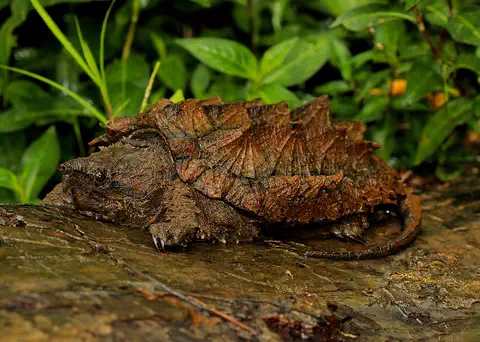
Alligator snapping turtle
The alligator snapping turtle is the largest freshwater turtle in the United States. It lies still on the bottom of rivers and lakes with its mouth open, wiggling a worm-like lure on its tongue to trick fish into swimming close. Its numbers have fallen, and it is now endangered.
-
 Watch
Animal
Pig-nosed turtle
The pig-nosed turtle is a large freshwater turtle with a snout like a pig's, a soft, leathery shell and big flippers like a sea turtle's. It lives in rivers, lagoons and swamps of southern New Guinea and northern Australia and eats mostly fruits and plants. Heavy collection of its eggs and adults has made it endangered.
-
 Watch
Animal
Painted turtle
The painted turtle is one of the most common turtles in North America. Its dark shell and skin are decorated with bright red and yellow markings, and on sunny days dozens may pile onto one log to bask. It lives in ponds, marshes and slow streams from Canada to northern Mexico.
-
Watch
Country
Brazil
Brazil covers about half of South America and is the fifth-largest country in the world. It holds most of the Amazon River basin and much of the world's largest rainforest, and about 214 million people lived there in 2026, most of them near the Atlantic coast.
-
Watch
Country
Peru
Peru is a country on the Pacific coast of South America. It has a dry desert coast, the high Andes mountains and the Amazon rainforest, and about 34 million people lived there in 2025, many of them in the capital, Lima.
-
 Watch
Animal
Black caiman
The black caiman is the biggest caiman and the largest predator of the Amazon. It lives in slow rivers, lakes, flooded forests and swamps across the Amazon region of South America. People once hunted millions of them for their shiny dark skins, but since hunting was banned in the 1970s, many populations have grown again.
-
 Watch
Animal
Aldabra giant tortoise
The Aldabra giant tortoise is one of the largest land tortoises on Earth. Wild ones live on Aldabra Atoll, a ring of coral islands in the Indian Ocean, where about 180,000 of them graze, browse and shape the land like elephants do in Africa. They can live for more than 100 years.
-
 Watch
3D
Animal
American alligator
The American alligator is a large, armored reptile of the swamps, marshes and lakes of the southeastern United States. Alligator mothers guard their nests and carry their babies to the water, and the holes alligators dig help many other animals survive dry seasons.
For parents & teachers
What children will learn
- Describe how the matamata's shape and skin flaps work as camouflage.
- Explain how suction feeding works.
- Explain why scientists sometimes split one species into two.
- Explain why a species can be least concern and still be harmed by the pet trade.
Recommended ages: 3 to 17 · About 15 minutes
Talk about it
- Why might a slow, weak swimmer do well by waiting instead of chasing?
- How could a snorkel nose help an animal stay hidden?
- Why might taking many hatchlings from the wild be a problem even for a common species?
Try at home or in class
- Suction test: with a grown-up, squeeze a clean turkey baster or plastic pipette under water and let go, and watch how the water rushes in, like a matamata's gulp.
- Spot the turtle: lay a brown paper turtle shape among real dry leaves on a table and ask someone to find it.
Key vocabulary: camouflage, snorkel, suction feeding, carapace, debris, least concern
Where these facts come from
- GBIF Backbone Taxonomy and GBIF Occurrence Search , Global Biodiversity Information Facility (CC0 1.0 (backbone); occurrence counts are facts derived from records under CC0, CC BY and CC BY-NC)
- Wikidata , Wikimedia Foundation (CC0 1.0)
- The IUCN Red List of Threatened Species , International Union for Conservation of Nature (IUCN terms of use (no redistribution of Red List data or range maps))
- Chelus fimbriata (Portelinha et al., assessed 27 August 2023, published 2026) , IUCN Red List of Threatened Species
- Chelus fimbriata: justification, range, population, habitat, threats, use and trade, and conservation text , IUCN Red List of Threatened Species
- Chelus fimbriata: IUCN Red List global assessment record (Portelinha et al. 2026), IUCN checklist on GBIF , GBIF
- Chelus orinocensis: taxonomic notes, range and trade text (Morales-Betancourt, Lasso and Rojas-Runjaic, assessed 27 August 2023, published 2026) , IUCN Red List of Threatened Species
- Chelus fimbriatus (matamata) , Animal Diversity Web, University of Michigan Museum of Zoology
- File:2009 Chelus fimbriatus.JPG (24 August 2009, J. Patrick Fischer) , Wikimedia Commons
- Wikimedia Commons , Wikimedia Foundation (Per file: Public domain, CC0, CC BY or CC BY-SA only (credited on each page))
Checked, not yet human-reviewed. Last updated November 1, 2026. Spotted a mistake? Tell us.