Animal
Painted lady
The painted lady is an orange, black and white butterfly. It lives in many parts of the world, and it can fly very, very far.
The painted lady is one of the most widespread butterflies in the world. Its orange and black wings carry it on huge journeys: each year, families of painted ladies fly between Africa and northern Europe, one generation after another.
Vanessa cardui, the painted lady, is a nymphalid butterfly found on every continent except Antarctica and Australia. Its caterpillars eat more than 100 kinds of plants, and its yearly migration between tropical Africa and northern Europe, completed by several generations in a row, was reported in 2018 as the farthest known butterfly migration.
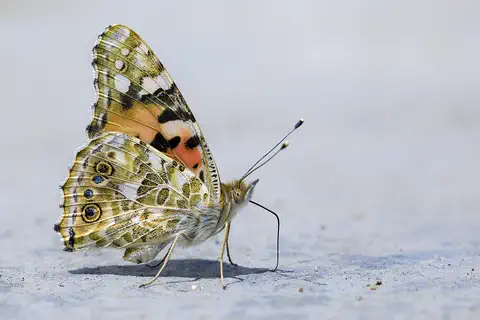
Photo: Anitava Roy, CC BY-SA 4.0, via Wikimedia Commons
Meet the painted lady
The painted lady is a butterfly.
The tops of its wings are orange with black lines and white spots. Underneath, its wings are brown, gray and creamy, with little round spots. Painted ladies live in lots of countries around the world.
The painted lady is a butterfly found in more places than almost any other. It lives across Europe, Asia, Africa and North America, from gardens and fields to deserts and mountains.
The top of each wing is pinkish orange with thick black lines and white spots near the tips. When it folds its wings, you see the underside instead: a pattern of brown, gray, black and red-orange with small spots near the edge. That pattern helps it blend in when it rests.
Vanessa cardui belongs to the brush-footed butterflies (family Nymphalidae). The University of Wisconsin Extension calls it the most widespread butterfly in the world, and Animal Diversity Web records it on every continent except Antarctica and Australia.
The upper side of the wings is pinkish orange with heavy black lines and white spots near the forewing tips; the underside is a mottled mix of black, brown, red-orange and gray with four small spots near the margins. Butterfly Conservation gives a wingspan of 50 to 56 millimeters, from males to the larger females. Its fame comes from migration: each year, successive generations move between Africa and northern Europe, a journey no single butterfly completes.
Quick facts
- Group
- Invertebrate
- Wingspan
- 5 to 5.6 cm
- Lifespan in the wild
- 2 weeks
Where it lives
Painted ladies like open, sunny places.
They visit fields, meadows and gardens full of flowers. In summer they fly north. In fall many fly south again, where it is warmer.
Painted ladies like wide-open places with lots of plants, such as fields, meadows, prairies, old lots and gardens. They can turn up almost anywhere, even in deserts and mountains, but they cannot survive cold winters.
That is why they travel. In North America, painted ladies move north each year from the deserts of northern Mexico and the southwestern United States into the rest of the United States and Canada. In Europe, they arrive in spring from North Africa and the Middle East.
Animal Diversity Web lists a huge range of habitats, from fields and meadows to marsh, tundra, desert, chaparral and forest, though open, flower-rich ground is preferred. What the species cannot do is survive a harsh winter: in Wisconsin it lives through only very mild ones.
So much of its range is filled each year by migrants. In North America, adults move north out of the deserts of northern Mexico and the southwestern U.S. to colonize the United States and Canada south of the Arctic, and in some years enormous numbers arrive. In Europe, Butterfly Conservation describes painted ladies spreading north each year from the desert fringes of North Africa, the Middle East and central Asia. The map shades whole continents; painted ladies are common in some years and scarce in others.
Continents
Its habitat

Where can you find this animal?
- Lives here naturally · Countries and seas named by a scientific source
- Sightings recorded · Records of wild sightings (GBIF)
Lives here naturally · Countries and seas named by a scientific source
Found across Africa, Asia, Europe and North America (including Central America), though many northern areas are filled each year by migrants that cannot survive cold winters. The map shades whole continents, not every place painted ladies breed.
Places: Africa, Asia, Europe and North America.
Source: https://hort.extension.wisc.edu/articles/painted-lady-butterfly-vanessa-cardui/ · checked October 2026
Sightings recorded · Records of wild sightings (GBIF)
Counts of GBIF records of wild observations (human and machine) and preserved specimens. Records include introduced populations, vagrants, escaped or released animals and misidentifications, so a country with records is not necessarily part of the native range.
Wild sightings have been recorded in UK, Netherlands, France, Switzerland, United States, Belgium, Germany, Sweden and 134 more places.
Source: gbif · checked October 2026
Range maps show where scientists say an animal lives, often country by country. An animal may live in only part of a country shown, and sightings records can include animals that wandered far from home.
What it eats
Painted lady caterpillars munch leaves.
They like thistles, mallows and sunflowers. The grown-up butterfly sips sweet nectar from flowers with a long tongue, like a straw.
A painted lady eats two very different meals in its life. The caterpillar chews leaves, and it is not fussy: people have found painted lady caterpillars on more than 100 kinds of plants, including thistles, mallows, hollyhocks and sunflowers.
The adult butterfly drinks instead of chewing. It sips sweet nectar from flowers such as asters, cosmos, zinnias and purple coneflowers. It likes tall flowers, 3 to 6 feet (about 1 to 2 meters) high. A butterfly's tongue, called a proboscis, works like a straw and also sucks up water.
Larvae are polyphagous: more than 100 host plants have been recorded, mainly in the aster family (Compositae), the borage family (Boraginaceae) and the mallow family (Malvaceae). Thistles, calendula, hollyhock, mallow and sunflower are favorites, and Butterfly Conservation notes that thistles are preferred in Britain and Ireland. Crowded caterpillars can strip a plant bare.
Adults feed on nectar, preferring plants 3 to 6 feet tall, such as blazing star, cosmos, New England aster, Joe-pye weed and zinnias; Animal Diversity Web adds that they have been seen taking honeydew left by aphids. They drink through the proboscis, a straw-like tongue that Monarch Watch describes sucking up nectar and water and curling up when not in use.
Did you know?
A painted lady can taste sweet things with its feet.
Butterflies like the painted lady have tasters on their feet, so they can tell a sweet drink just by standing on it.
Monarch Watch describes organs on the back of a butterfly's tarsi that detect sweet liquids on contact.
A butterfly body
A painted lady has a head, a middle and a long back part.
It has two feelers, two big eyes and four wings. Its tongue is long and thin. It rolls it up when it is not drinking.
Like all insects, a painted lady has three body parts: the head, the thorax in the middle and the long abdomen. The head has two huge eyes, two antennae with knobs at the tips and a long, coiled tongue. Each big eye is made of thousands of tiny parts that work together.
The wings and legs grow from the thorax. Painted ladies have six legs, but they look as if they have only four. Their two front legs are tiny and fold up against the body. Their feet can even taste sweet liquids.
The adult body has the usual three insect regions. Monarch Watch describes four main structures on a butterfly's head: compound eyes made of thousands of ommatidia, two antennae and two palpi covered in scales that sense molecules in the air, and the coiled proboscis. Animal Diversity Web adds that the painted lady's compound eyes help it find mates and host plants.
The three thoracic segments each carry a pair of legs; the second and third also carry the forewings and hindwings. Painted ladies are brush-footed butterflies, a family whose front legs are tiny and curled up next to the thorax, so the insect looks four-legged. Organs on its feet taste sweet liquids.
Egg to butterfly
A painted lady starts as a tiny green egg.
A spiky caterpillar hatches and eats and eats. Then it hangs upside down and makes a hard case called a chrysalis. Inside, it changes into a butterfly!
Painted ladies go through complete metamorphosis, a total change of shape. A female lays pale green eggs, each about the size of a pinhead, one at a time on leaves. After 3 to 5 days, a spiny caterpillar hatches.
The caterpillar eats and grows, shedding its skin as it gets bigger, until it is about 3 centimeters long. It spins a loose silk nest on its plant. Then it hangs upside down and becomes a chrysalis. About 7 to 10 days later, a new butterfly climbs out. The grown butterfly lives about two weeks.
Development is complete (holometabolous). Females lay pale green eggs singly on host plants; Animal Diversity Web says a female lays about 500. The spiny larvae hatch after 3 to 5 days, live in loosely woven silk nests and pass through five instars, reaching about 1¼ inches (about 3 centimeters).
The last-instar larva hangs upside down from a silk thread and forms a chrysalis, from which the adult emerges 7 to 10 days later. Speed depends on temperature: egg to adult takes 33 to 44 days in subtropical areas and can take more than 60 days in cooler climates. Adults are ready to mate five to seven days after emerging and live about two weeks. Wisconsin usually sees two generations a year, and scientists have raised up to eight in a year in the laboratory.
An amazing journey
Painted ladies are great travelers.
Every year, they fly from Africa to the far north of Europe and back. One butterfly cannot fly all the way. Its children and grandchildren finish the trip.
Each year, painted ladies make the longest trip known for any butterfly. In spring they leave Africa and fly north into Europe. They lay eggs along the way, and the new butterflies keep going north. In autumn, their descendants fly back south.
No single butterfly makes the whole trip. It takes up to six generations. Scientists found that on the way south, painted ladies fly so high, more than 500 meters up, that people on the ground do not see them go. They ride helpful winds at up to 30 miles an hour.
In 2009, a study by Butterfly Conservation, the University of York, Rothamsted Research and others combined more than 60,000 public sightings across Europe with radar over southern England. It showed that painted ladies do fly south in autumn, at an average height above 500 meters, choosing winds that carry them at up to 30 miles per hour. Radar suggested about 11 million entered the UK that spring and 26 million left in autumn.
The full loop between tropical Africa and the Arctic Circle is made by up to six successive generations. In 2018, chemical markers in wings, which record where a butterfly fed as a caterpillar, showed that butterflies raised in tropical Africa recolonize the Mediterranean in early spring; Science News reported the round trip as about 12,000 kilometers a year, the farthest known butterfly migration. Males also perch and patrol in the afternoon, looking for females.
Did you know?
Millions of painted ladies can fly over one country in a year.
In 2009, radar showed that about 26 million painted ladies flew out of the United Kingdom in autumn.
Rothamsted Research radar estimated about 11 million painted ladies entered the UK in spring 2009 and 26 million departed in autumn.
Helping painted ladies
There are lots of painted ladies in the world.
You can help them by planting flowers. A dish of wet sand gives them a drink. Not using bug spray keeps them safe.
Painted ladies are not endangered. Their numbers change a lot from year to year: in some years millions arrive in a country, and in other years far fewer.
You can still help. Plant flowers they love, such as asters, zinnias and cosmos. Put out a shallow dish of water or damp sand where they can drink. And keep your garden free of pesticides, the sprays people use to kill insects.
The species is not considered endangered. In Great Britain, Butterfly Conservation lists it as Least Concern on the 2022 Red List, with an abundance trend of plus 141 percent from 1976 to 2019, though numbers vary greatly from year to year.
Painted ladies still face predators, including birds, bats, ants, wasps and spiders, and adults rely on camouflage and flight to escape. Gardeners can support them with tall nectar plants, shallow water or damp sand, and a pesticide-free yard. Richard Fox of Butterfly Conservation has described the whole migration as a journey to find plants for the caterpillars to eat.
Did you know?
Painted ladies look like they have four legs, but they have six.
Painted ladies belong to the brush-footed butterflies, whose two front legs are so tiny that they seem to have only four.
In nymphalid butterflies the two front legs are tiny and curl up next to the thorax, so the adult looks four-legged.
Amazing facts
-
A painted lady can taste sweet things with its feet.
Butterflies like the painted lady have tasters on their feet, so they can tell a sweet drink just by standing on it.
Monarch Watch describes organs on the back of a butterfly's tarsi that detect sweet liquids on contact.
-
Painted ladies look like they have four legs, but they have six.
Painted ladies belong to the brush-footed butterflies, whose two front legs are so tiny that they seem to have only four.
In nymphalid butterflies the two front legs are tiny and curl up next to the thorax, so the adult looks four-legged.
-
Millions of painted ladies can fly over one country in a year.
In 2009, radar showed that about 26 million painted ladies flew out of the United Kingdom in autumn.
Rothamsted Research radar estimated about 11 million painted ladies entered the UK in spring 2009 and 26 million departed in autumn.
-
A painted lady mother can lay hundreds of eggs.
A female painted lady lays about 500 eggs, one at a time, each on a plant her caterpillars can eat.
Animal Diversity Web gives about 500 eggs per female, laid singly on host plants, with up to eight generations a year observed in the laboratory.
Words to know
- proboscis
- a butterfly's long tongue, shaped like a straw, that curls up when not in use
- migration
- a regular journey animals make from one place to another
- metamorphosis
- a big change in body shape as an animal grows, like caterpillar to butterfly
- chrysalis
- the hard case a caterpillar forms while it changes into a butterfly
- generation
- all the animals born at about the same time in a family line, such as parents or children
- nectar
- a sweet liquid inside flowers
Discovery challenge
-
What does a painted lady use to drink?
What does a painted lady use to drink nectar?
Which structure does an adult painted lady feed through?
- Its antennae
- A tongue shaped like a straw
- Its wings
Show the answer
A tongue shaped like a straw
Its long tongue works like a straw.
The proboscis is a straw-shaped tongue that sucks up nectar and water, then curls up.
Adults feed through the proboscis, a coiled, straw-like tube; the antennae sense smells.
-
What does the caterpillar turn into before it is a butterfly?
Which stage comes just before the adult butterfly?
In the painted lady's complete metamorphosis, which stage comes just before the adult?
- An egg
- A tadpole
- A chrysalis
Show the answer
A chrysalis
The caterpillar becomes a chrysalis. Then a butterfly comes out.
The caterpillar hangs upside down and forms a chrysalis; the butterfly comes out 7 to 10 days later.
Egg, larva (five instars), pupa (chrysalis, 7 to 10 days), adult. Tadpoles belong to frogs.
-
Can one painted lady fly the whole long trip?
How do painted ladies finish their yearly trip between Africa and northern Europe?
How is the painted lady's annual migration loop completed?
- One butterfly flies the whole way
- Several generations take turns
- They ride on birds
Show the answer
Several generations take turns
No. Its children and grandchildren finish the trip.
Up to six generations take turns, laying eggs along the way.
The loop is a series of steps by up to six successive generations; butterflies returning south are several generations removed from those that left Africa.
-
How many plants can painted lady caterpillars eat?
About how many kinds of plants have painted lady caterpillars been found eating?
How many host plant species have been recorded for painted lady larvae?
- Only one
- About 5
- More than 100
Show the answer
More than 100
Lots! More than 100 kinds of plants, like thistles.
More than 100 kinds, including thistles, mallows, hollyhocks and sunflowers.
More than 100 host species, mostly in the aster, borage and mallow families: a polyphagous larva.
Places where you might see it
-
 Watch
 Country
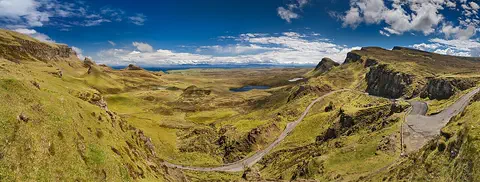
United Kingdom
The United Kingdom, or UK, lies on islands off the northwest coast of Europe. It is made up of four parts, England, Scotland, Wales and Northern Ireland, and about 69.5 million people live there. Its capital is London.
-
 Watch
 Country
Morocco
Morocco is a country in the northwest corner of Africa, with coasts on both the Atlantic Ocean and the Mediterranean Sea. The Atlas Mountains cross its center, and its 2024 census counted about 36.8 million people, in cities such as Casablanca, Rabat, Fez and Marrakesh and in mountain villages.
Experiments to try
Explore next
-
 Watch
3D
Animal
Monarch butterfly
The monarch butterfly is famous for its bright orange wings and its amazing journey. Each fall, monarchs from eastern North America fly up to 3,000 miles to mountain forests in Mexico, where they spend the winter clustered together on fir trees. Their caterpillars eat only milkweed, which makes them taste bad to predators.
-
 Watch
3D
Animal
Eastern tiger swallowtail
The eastern tiger swallowtail is a large butterfly of eastern North America. Males are yellow with black tiger stripes, while many females are dark, which helps them look like a bad-tasting butterfly. Its caterpillars disguise themselves as bird droppings, then turn green with big fake eyes.
-
 Watch
Animal
Common blue morpho
The common blue morpho is a large butterfly of the forests of Mexico, Central America and South America. The tops of its wings flash bright blue, but the undersides are brown with big eyespots, which camouflage it when it lands with its wings closed. Adults sip juice from rotting fruit instead of nectar.
-
Watch
Country
United Kingdom
The United Kingdom, or UK, lies on islands off the northwest coast of Europe. It is made up of four parts, England, Scotland, Wales and Northern Ireland, and about 69.5 million people live there. Its capital is London.
-
Watch
Country
Morocco
Morocco is a country in the northwest corner of Africa, with coasts on both the Atlantic Ocean and the Mediterranean Sea. The Atlas Mountains cross its center, and its 2024 census counted about 36.8 million people, in cities such as Casablanca, Rabat, Fez and Marrakesh and in mountain villages.
-
 Watch
3D
Animal
Old World swallowtail
The Old World swallowtail is a large butterfly with yellow wings, black veins, blue spots and a red eyespot near the long tails on its hindwings. It lives across Europe and Asia and in northern North America. Its green and black caterpillar has a hidden orange fork that pops out when it is bothered.
-
 Watch
3D
Animal
European peacock butterfly
The European peacock butterfly has rusty-red wings with four big, colorful eyespots, like the spots on a peacock's tail. When a bird comes close, it flashes its eyespots and makes a hissing sound. Its black, spiny caterpillars live together on stinging nettles, and the adults sleep through the winter in hollow trees and sheds.
- Watch What If? Lab What if a caterpillar never became a butterfly? A caterpillar is an eating machine. Inside its chrysalis it rebuilds its whole body into a butterfly that can fly, find a mate and lay eggs. Imagine a caterpillar that never changed: what would it miss, and what would happen to the next generation?
For parents & teachers
What children will learn
- Name the parts of a butterfly (antennae, compound eyes, proboscis, thorax, wings, legs) and what each does.
- Describe the four stages of complete metamorphosis.
- Explain how a migration can be completed by several generations instead of one animal.
- Suggest simple ways a garden can support butterflies.
Recommended ages: 3 to 17 · About 15 minutes
Talk about it
- Why might a butterfly that cannot survive cold winters still spread north every summer?
- How did scientists find painted ladies flying south when nobody could see them?
- How is a proboscis like a drinking straw, and how is it different?
Try at home or in class
- Measure 5.5 centimeters on paper and draw a painted lady with its wings open at real size.
- Fill a shallow dish with damp sand and place it near garden flowers; watch quietly for butterflies coming to drink.
Key vocabulary: proboscis, migration, metamorphosis, chrysalis, generation, nectar
Where these facts come from
- GBIF Backbone Taxonomy and GBIF Occurrence Search , Global Biodiversity Information Facility (CC0 1.0 (backbone); occurrence counts are facts derived from records under CC0, CC BY and CC BY-NC)
- Wikidata , Wikimedia Foundation (CC0 1.0)
- Painted Lady Butterfly, Vanessa cardui , University of Wisconsin–Madison Division of Extension
- Painted Lady , Butterfly Conservation
- Painted Lady migration secrets revealed , Butterfly Conservation
- Each year painted lady butterflies cross the Sahara, and then go back again , Science News
- Vanessa cardui (painted lady) , Animal Diversity Web, University of Michigan
- Monarch biology , Monarch Watch, University of Kansas
- The IUCN Red List of Threatened Species , International Union for Conservation of Nature (IUCN terms of use (no redistribution of Red List data or range maps))
- Wikimedia Commons , Wikimedia Foundation (Per file: Public domain, CC0, CC BY or CC BY-SA only (credited on each page))
Checked, not yet human-reviewed. Last updated October 28, 2026. Spotted a mistake? Tell us.