
Animal
North Atlantic right whale
The North Atlantic right whale is a big black whale. It has white bumps on its head. There are not many left, so people are working hard to help them.
The North Atlantic right whale is a large black baleen whale that lives along the east coast of North America. It filters tiny animals called copepods from the water and has rough white patches on its head that are different on every whale. It is one of the most endangered large whales, with about 384 left (2024), and many people are working to protect it.
Eubalaena glacialis is a critically endangered baleen whale of the western North Atlantic. Hunted almost to extinction by the 1890s, it now numbers about 384 (start of 2024), with only about 70 reproductively active females. Entanglement in fishing gear and vessel strikes are the leading causes of death.
Photo: Pcb21 (uploader), public domain, via Wikimedia Commons
Meet the right whale
The right whale is big, black and round.
It has no fin on its back. It has white bumpy patches on its head. When it breathes out, its spout makes a V shape.
The North Atlantic right whale is a huge, stocky black whale. Adults can grow to about 15.8 meters long and weigh up to about 63,500 kilograms. It has no fin on its back, short paddle-shaped flippers and a broad black tail with a deep notch in the middle.
When it breathes out, its spout splits into a V shape. Long ago, whalers called these the 'right' whales to hunt, because they float after they die. That is how they got their name.
Eubalaena glacialis is one of three right whale species, alongside the North Pacific and southern right whales. Adults reach about 52 feet (15.8 meters) and 140,000 pounds (about 63.5 tonnes). The stocky black body lacks a dorsal fin; the belly may be all black or carry irregular white patches; the flippers are short, broad and paddle-shaped; and the broad, deeply notched flukes have a smooth trailing edge.
Its blow is shaped like a V. The common name comes from whalers, who regarded it as the 'right' whale to hunt because it floated when killed. By the early 1890s, commercial whalers had hunted the species to the brink of extinction.
Quick facts
- Group
- Mammal
- Length
- up to 15.8 m
- Weight
- up to 63,500 kg
- Lifespan in the wild
- up to 70 years
Where it lives and travels
Right whales live in the Atlantic Ocean, near the coast of North America.
In summer many eat in the sea up north. In winter some swim south to warm water, where babies are born.
North Atlantic right whales live mostly in coastal waters along the east coast of the United States and Canada, though they sometimes travel far out to sea. They are sometimes called the 'urban whale' because they live so close to busy cities and ports.
From spring to fall, many right whales feed off New England and farther north in Canadian waters. Each fall, some travel more than 1,600 kilometers south to the shallow coastal waters off North Carolina, South Carolina, Georgia and Florida, where calves are born.
The species occurs primarily in Atlantic coastal waters over the continental shelf, though individuals travel far offshore over deep water. Acoustic monitoring shows right whales off New England and the Mid-Atlantic year-round.
In spring, summer and fall many feed and mate off New England and in Canadian waters. Each fall some travel more than 1,000 miles (1,600 kilometers) to calving grounds off the southeastern United States, though migration patterns vary. NOAA Fisheries has designated two critical habitats: a foraging area off New England and a calving area from Cape Fear, North Carolina, to below Cape Canaveral, Florida. Over the past decade, the whales have shifted their distribution, likely following changes in prey caused by warming waters.
Did you know?
Boats must stay far away from right whales.
In the United States, boats, kayaks and even drones must stay at least 500 yards from a right whale, about the length of five football fields.
U.S. rules prohibit approaching within 500 yards (1,500 feet) of a right whale by vessel, aircraft or drone.
Where can you find this animal?
- Migration route · Countries and seas named by a scientific source
- Lives here naturally · Countries and seas named by a scientific source
- Sightings recorded · Records of wild sightings (GBIF)
Migration route · Countries and seas named by a scientific source
Each fall, some right whales travel more than 1,600 km from feeding grounds off New England to calving grounds off North Carolina, South Carolina, Georgia and Florida; migration patterns vary and some whales stay north all year. The line joins the two areas along the coast; it is not the exact path of any whale.
Places: Atlantic Ocean.
Source: https://www.fisheries.noaa.gov/species/north-atlantic-right-whale · checked October 2026
Lives here naturally · Countries and seas named by a scientific source
Mostly coastal waters of the western North Atlantic, from the feeding grounds off New England and eastern Canada to the calving grounds off the southeastern United States. Right whales live in the sea, not inland.
Places: Atlantic Ocean, United States and Canada.
Source: iucn-red-list · checked October 2026
Sightings recorded · Records of wild sightings (GBIF)
Counts of GBIF records of wild observations (human and machine) and preserved specimens. Records include introduced populations, vagrants, escaped or released animals and misidentifications, so a country with records is not necessarily part of the native range.
Wild sightings have been recorded in United States, Canada, UK, Ireland, Iceland, Netherlands, Spain, Norway and 24 more places.
Source: gbif · checked October 2026
Range maps show where scientists say an animal lives, often country by country. An animal may live in only part of a country shown, and sightings records can include animals that wandered far from home.
Skimming for copepods
Right whales eat tiny animals called copepods.
They swim slowly with their mouths open. Their baleen catches the tiny animals, like a sieve.
Right whales eat copepods, which are tiny crustaceans, along with other zooplankton. A right whale swims slowly through a thick patch of them with its mouth open.
The water flows out through its baleen plates. The copepods get caught in a tangle of hair-like fringes on the baleen, like food in a sieve. Sometimes you can see a right whale skim-feeding with the front of its head sticking out of the water.
Right whales are skim feeders that target dense patches of copepods and other zooplankton. Swimming slowly with the mouth open, they strain huge volumes of water through baleen plates, where prey is trapped in a tangle of hair-like fringes. Feeding can take place anywhere from the surface, sometimes with the rostrum above water, to the bottom of the water column.
NOAA Fisheries reports that over the past decade right whales have changed where they spend time, likely following changes in their prey as oceans warm. It links a recent dip in births and longer gaps between calves to females struggling to find enough food to support pregnancy.
Did you know?
Right whales talk with low moans.
Right whales make low moans, groans and pulses, which may help them keep in touch.
Low-frequency moans, groans and pulses may maintain contact, signal threats or aggression, or serve other social roles.
Callosities: a whale's ID card
Right whales have white bumpy patches on their heads.
The patches are rough skin covered with tiny whale lice. Every right whale has its own pattern, like a name tag.
A right whale's head is covered with knobby patches of rough skin called callosities. The skin underneath is black, but the patches look white because they are covered with tiny animals called whale lice.
Every right whale has its own pattern of callosities. Scientists photograph whales from planes and boats and compare the patterns with a big catalog of photos to tell which whale is which. That is how they can follow each whale for years and count how many are left.
Callosities are raised patches of roughened skin on the head that appear white because they are covered by cyamids (whale lice). Their pattern is unique to each animal, and NOAA Fisheries calls this an invaluable tool for tracking the population's size and health.
Aerial and ship-based surveys feed the North Atlantic Right Whale Consortium's photo-identification database, maintained by the New England Aquarium, which follows individuals over the years. NOAA's yearly abundance and death estimates are then calculated with a population model (Linden 2025). Calves measure about 14 feet (4.3 meters) at birth.
Growing up
A right whale mom has one baby at a time.
The baby grows inside her for more than a year. It is born in winter, in warm water near Georgia and Florida.
A female right whale is ready to have her first calf at about 10 years old. She is pregnant for more than a year and gives birth to one calf in winter, usually in the warm coastal waters of the southeastern United States. A newborn calf is about 4.3 meters long.
New mothers spend most of their energy feeding and caring for their calves, so they rest a lot and take shallow breaths. A healthy mother would have a calf about every three years, but today the gap is often 7 to 10 years.
Females reach sexual maturity at about 10 years and give birth to a single calf after a gestation of more than a year, mainly on the southeastern U.S. calving grounds. Calves are about 14 feet (4.3 meters) at birth, and new mothers show energy-conserving behavior, resting and breathing shallowly while nursing.
A three-year calving interval is considered healthy, but intervals now average 7 to 10 years, which biologists link partly to the stress of entanglement and to poorer feeding. Right whales can live at least 70 years, yet females now typically die by about 45 and males by about 65, from human causes rather than old age. More adult females than males have died in recent years.
Splashes, moans and quiet swimming
Right whales sometimes jump out of the water with a big splash.
They talk with low moans and groans. Often they swim quietly at the top of the water, which makes them hard to see.
Right whales may travel alone or in small groups. On their feeding grounds you might see one breach, leaping out of the water and crashing down with a thunderous splash. Groups also gather at the surface to socialize and mate.
Right whales talk with low moans, groans and pulses. They often swim and rest just at or below the surface with very little of their body showing. That makes them hard for boat drivers to spot, especially in bad weather or low light.
Right whales may travel alone or in small groups and form surface-active groups (SAGs), where socializing and mating occur, in all seasons and habitats. Breaching is seen on the feeding grounds. Their low-frequency moans, groans and pulses may keep individuals in contact, signal threats or aggression, or serve other social roles.
A tendency to swim and rest at or just below the surface, with little of the body exposed, makes them hard to detect, and poor weather, sea state, murky water and low light make it harder still. Most mariners who have reported hitting a whale never saw it beforehand, and NOAA notes that the faster a vessel is moving, the more likely a strike is to cause serious injury or death.

Helping right whales recover
There are not many right whales, so many people are helping them.
Boats slow down where the whales live. Fishers and scientists work together to make fishing safer for whales. Rescue teams help whales tangled in ropes.
Right whales are critically endangered. Scientists estimated that about 384 were alive at the start of 2024, and only about 70 of them are females that are able to have calves. The biggest dangers are getting tangled in fishing ropes and being hit by ships.
People are working hard to help. Boats must stay at least 500 yards away, and ships slow down in areas where whales are found. Fishing and shipping companies work with scientists on new safety rules, rescue teams free tangled whales, and anyone who sees a right whale is asked to report it. Numbers have started to rise again, slowly.
The IUCN lists the species as Critically Endangered (2020) and it has been listed as endangered under the U.S. Endangered Species Act since 1970. In October 2025 NOAA Fisheries estimated 384 (+10/−9) whales alive at the start of 2024; NOAA says the population has shown signs of increasing for a third consecutive year, but there are only about 70 reproductively active females. An Unusual Mortality Event declared in 2017 is ongoing, and only about one-third of deaths are thought to be detected.
Over 85 percent of right whales have been entangled at least once, and since 2017 at least 18 have been confirmed dead or seriously injured by vessel strikes. Measures include a 500-yard no-approach zone, required slow speeds in Seasonal Management Areas, voluntary Slow Zones where whales are detected, sinking groundline, broadly required in U.S. trap and gillnet fisheries, disentanglement response, sighting alerts and joint recovery planning with Canada. NOAA describes itself as cautiously optimistic.
IUCN Red List
How is the north atlantic right whale doing in the wild?
- Least Concern
- Near Threatened
- Vulnerable
- Endangered
- Critically Endangered (this animal)
- Extinct in the Wild
- Extinct
Critically Endangered
At extremely high risk of disappearing from the wild.
See the IUCN Red List assessment · The IUCN Red List of Threatened Species 2022.2
Amazing facts
-
A right whale's spout looks like the letter V.
When a right whale breathes out, its spout is shaped like a V.
NOAA Fisheries describes the right whale's blow as V-shaped.
-
Every right whale has its own head pattern.
Scientists tell right whales apart by the pattern of white callosities on their heads, like a name tag.
Unique callosity patterns let researchers track individuals over the years in the North Atlantic Right Whale Consortium catalog.
-
Boats must stay far away from right whales.
In the United States, boats, kayaks and even drones must stay at least 500 yards from a right whale, about the length of five football fields.
U.S. rules prohibit approaching within 500 yards (1,500 feet) of a right whale by vessel, aircraft or drone.
-
Right whales talk with low moans.
Right whales make low moans, groans and pulses, which may help them keep in touch.
Low-frequency moans, groans and pulses may maintain contact, signal threats or aggression, or serve other social roles.
Words to know
- callosity
- a rough patch of skin on a right whale's head
- copepod
- a tiny crustacean that drifts in the sea
- baleen
- comb-like plates in some whales' mouths that strain food from water
- entanglement
- getting caught and wrapped up in ropes or nets
- critically endangered
- at very high risk of disappearing from the wild
- calf
- a baby whale
Discovery challenge
-
What helps people tell one right whale from another?
How do scientists tell individual right whales apart?
Which feature is used to photo-identify individual right whales?
- The white patches on its head
- The color of its eyes
- How loud it sings
Show the answer
The white patches on its head
Each right whale has its own pattern of white head patches.
The pattern of callosities on the head is different on every whale.
Callosity patterns, whitened by cyamids, are unique and recorded in a photo-ID catalog.
-
What do right whales eat?
What is the right whale's main food?
Which prey do right whales skim-feed on?
- Tiny copepods
- Big fish and seals
- Seaweed
Show the answer
Tiny copepods
They eat tiny animals called copepods.
They strain tiny crustaceans called copepods from the water with their baleen.
Dense patches of copepods and other zooplankton, filtered through baleen.
-
What is one way people keep right whales safe?
Which of these helps protect right whales?
Which measure do U.S. rules use to make vessel strikes on right whales less likely to be deadly?
- Boats slowing down where whales swim
- Feeding them bread
- Moving them to a lake
Show the answer
Boats slowing down where whales swim
Boats that go slowly are safer for whales.
Ships slow down in areas where right whales are found, and boats stay at least 500 yards away.
Speed reduction lowers the likelihood of serious injury or death if a vessel hits a whale.
-
Where are baby right whales born?
Where are most right whale calves born?
Where is the right whale's calving critical habitat?
- Warm waters off the southeastern United States
- Under the ice near the North Pole
- In a river
Show the answer
Warm waters off the southeastern United States
They are born in warm water near Georgia and Florida.
Calves are born in shallow coastal waters off North Carolina, South Carolina, Georgia and Florida.
From Cape Fear, North Carolina, to below Cape Canaveral, Florida.
Places where you might see it
-
 Watch
 Country
United States
The United States is a large country in North America made of 50 states, from icy Alaska to the warm islands of Hawaii. It has the Grand Canyon, the Mississippi River and Yellowstone, and about 342 million people live there.
-
 Watch
 Country
Canada
Canada is the second-largest country in the world, stretching across the north of North America from the Atlantic to the Pacific and up into the Arctic. It has the Rocky Mountains, thousands of islands and about 42 million people, who speak English, French and many other languages.
Explore next
-
Watch
Country
United States
The United States is a large country in North America made of 50 states, from icy Alaska to the warm islands of Hawaii. It has the Grand Canyon, the Mississippi River and Yellowstone, and about 342 million people live there.
-
Watch
Country
Canada
Canada is the second-largest country in the world, stretching across the north of North America from the Atlantic to the Pacific and up into the Arctic. It has the Rocky Mountains, thousands of islands and about 42 million people, who speak English, French and many other languages.
-
 Watch
3D
Animal
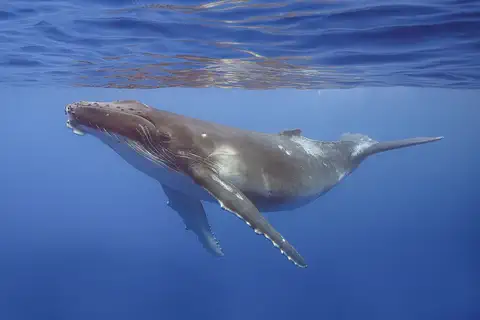
Humpback whale
The humpback whale is a baleen whale famous for leaping out of the water, slapping its giant flippers and singing long, complex songs. It lives in every ocean and makes one of the longest journeys of any mammal, between cold feeding waters and warm waters where calves are born. Once hunted almost to extinction, it is now recovering.
-
 Watch
Animal
Gray whale
The gray whale is a baleen whale of the North Pacific Ocean. It sucks up mud from the seafloor to catch tiny animals, and it makes one of the longest yearly journeys of any mammal: about 16,000 kilometers there and back between Arctic feeding seas and shallow lagoons in Mexico.
-
 Watch
3D
Animal
Bowhead whale
The bowhead whale is a giant baleen whale that spends its whole life in cold Arctic waters. Its enormous bow-shaped head can push through sea ice, its blubber is thicker than any other whale's, and some bowheads may live for more than 200 years.
-
 Watch
Animal
Blue whale
The blue whale is the largest animal ever to live on Earth, bigger than any dinosaur. It is a baleen whale: instead of teeth it has bristly plates that strain huge mouthfuls of seawater to catch krill. Blue whales live in every ocean except the Arctic, and their deep calls are among the loudest sounds made by any animal.
-
 Watch
Animal
Aardvark
The aardvark is a shy night digger of African savannas. It sniffs out ant and termite nests, rips them open with its spade-like claws and laps up the insects with a sticky tongue about 30 centimeters long. Its name means 'earth pig' in Afrikaans.
-
 Watch
Animal
African buffalo
The African buffalo is a huge, cow-like grazer with heavy, curving horns. It lives in herds that can number in the thousands, and a herd will rush to protect a calf in danger. It lives across much of Africa south of the Sahara, from open savannas to rainforests.
For parents & teachers
What children will learn
- Describe the right whale's body, including callosities and baleen.
- Explain how scientists identify and count individual right whales.
- Describe the right whale's travels between feeding and calving areas.
- Understand why the species is critically endangered and how people are helping it recover.
Recommended ages: 3 to 17 · About 15 minutes
Talk about it
- Why is it important for scientists to recognize individual whales?
- Why might slowing down ships help whales, even if the captain cannot see them?
- What could fishers, ship crews and beachgoers each do to help right whales?
Try at home or in class
- Measure 500 yards (about 460 meters) on a map of your neighborhood to see how far boats must stay from a right whale.
- Draw five 'whale heads' with different patterns of white patches, mix them up, and see if a friend can match each one again.
Key vocabulary: callosity, copepod, baleen, entanglement, critically endangered, calf
Where these facts come from
- The IUCN Red List of Threatened Species , International Union for Conservation of Nature (IUCN terms of use (no redistribution of Red List data or range maps))
- GBIF Backbone Taxonomy and GBIF Occurrence Search , Global Biodiversity Information Facility (CC0 1.0 (backbone); occurrence counts are facts derived from records under CC0, CC BY and CC BY-NC)
- North Atlantic Right Whale , NOAA Fisheries
- North Atlantic Right Whales Spotted off the Southeast Coast , NOAA Fisheries
- Eubalaena glacialis (North Atlantic Right Whale), 2020 global assessment , IUCN Red List of Threatened Species
- Wikidata , Wikimedia Foundation (CC0 1.0)
- Wikimedia Commons , Wikimedia Foundation (Per file: Public domain, CC0, CC BY or CC BY-SA only (credited on each page))
Checked, not yet human-reviewed. Last updated October 24, 2026. Spotted a mistake? Tell us.