
Animal
Chinook salmon
The Chinook salmon is a big fish. It hatches in a river, grows up in the ocean, and swims all the way home again.
The Chinook salmon, also called the king salmon, is the largest Pacific salmon. It hatches in a cold river, travels to the ocean to feed and grow for a few years, then swims back up its home river to lay eggs.
Oncorhynchus tshawytscha, the Chinook or king salmon, is the largest of the Pacific salmon. It is anadromous, hatching in fresh water, maturing at sea and returning to its natal stream to spawn once and die. The IUCN lists the species as Least Concern worldwide, while several US populations are protected under the Endangered Species Act.
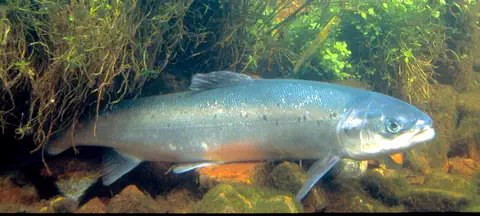
Photo: USFWS Fish and Aquatic Conservation, public domain, via Wikimedia Commons
Meet the Chinook salmon
The Chinook salmon is a big, strong fish.
It starts life in a river. Then it swims to the salty sea to eat and grow. When it is grown up, it swims back to the river where it hatched.
The Chinook salmon is the biggest of the Pacific salmon, which is why many people call it the king salmon. A typical grown-up fish is about 90 centimeters (3 feet) long and weighs about 14 kilograms (30 pounds).
Chinook salmon live two lives. They hatch in cold, fresh rivers, then swim out to the salty ocean to feed for a few years. When they are ready to lay eggs, they swim all the way back to the stream where they hatched. Alaska made the Chinook its official state fish in 1963.
Oncorhynchus tshawytscha is the largest of the Pacific salmon. NOAA Fisheries gives a typical mature size of about 3 feet (0.9 m) and 30 pounds (13.6 kg), with exceptional fish up to 4.9 feet and 129 pounds; the IUCN assessment gives a maximum of 149 cm and 61.4 kg.
Like all Pacific salmon it is anadromous: it hatches in fresh water, migrates to sea to feed and grow, then returns to its natal stream to spawn. It is also semelparous, meaning each fish spawns once and then dies. The species has many local names, including king, spring, quinnat, tyee and blackmouth.
Quick facts
- Group
- Fish
- Length
- up to 0.9 m
- Weight
- up to 13.6 kg
- Lifespan in the wild
- 3 to 7 years
Where it lives
Chinook salmon live in the cold north Pacific Ocean.
They lay their eggs in rivers in North America and in Asia. People have also brought them to some faraway places.
Wild Chinook salmon come from the rivers and coasts of the North Pacific. In North America they range from the Monterey Bay area of California north to the Chukchi Sea in Alaska. On the Asian side they live from the Anadyr River in Siberia, Russia, south to Hokkaido in Japan.
People have also released Chinook salmon in other places for fishing. Since 1967 they have been stocked in the Great Lakes, and populations now live wild in New Zealand, Australia, Chile and Argentina, where they were brought by people.
The IUCN assessment lists the native range as the Pacific Ocean and its tributary drainages: in North America from the Sacramento-San Joaquin system north to Point Hope, Alaska, and in northeastern Asia from northern Japan to the Anadyr River, with native populations in Canada, Japan, Russia and the United States and vagrants in Mexico. In Asian waters Chinook are found most often in the rivers of Kamchatka.
The species has been widely stocked elsewhere. The US Geological Survey records stockings in many US states from 1874, and the first large stockings in the Great Lakes, in Lake Michigan and Lake Superior in 1967. FishBase lists established introduced populations in New Zealand (from 1876), Australia, Chile, Argentina and the Kerguelen Islands in the southern Indian Ocean. The map shows the native countries and, separately, those introductions.
Continents
Its habitat

Where can you find this animal?
- Brought here by people · Countries and seas named by a scientific source
- Lives here naturally · Countries and seas named by a scientific source
- Sightings recorded · Records of wild sightings (GBIF)
Brought here by people · Countries and seas named by a scientific source
Established populations brought by people: New Zealand (from 1876), Australia, Chile, Argentina and the Kerguelen Islands (French Southern Territories). Chinook have also been stocked far outside their native rivers in the United States, with large stockings in the Great Lakes since 1967.
Places: New Zealand, Australia, Chile, Argentina and Fr. Southern Lands.
Source: https://www.fishbase.se/Introductions/IntroductionsList.php?ID=244&GenusName=Onc · checked October 2026
Lives here naturally · Countries and seas named by a scientific source
Rivers and coastal waters of the North Pacific: from California's Sacramento-San Joaquin rivers north to Point Hope, Alaska, and in Asia from northern Japan (Hokkaido and northern Honshu) to the Anadyr River in Russia, with most Asian fish in Kamchatka. Each country is shaded, but the fish live only in its Pacific and Arctic drainages.
Places: United States, Canada, Russia, Japan and Pacific Ocean.
Source: iucn-red-list · checked October 2026
Sightings recorded · Records of wild sightings (GBIF)
Counts of GBIF records of wild observations (human and machine) and preserved specimens. Records include introduced populations, vagrants, escaped or released animals and misidentifications, so a country with records is not necessarily part of the native range.
Wild sightings have been recorded in United States, Canada, New Zealand, Australia, Chile, Japan, Argentina, Türkiye and 14 more places.
Source: gbif · checked October 2026
Range maps show where scientists say an animal lives, often country by country. An animal may live in only part of a country shown, and sightings records can include animals that wandered far from home.
What it eats
Baby salmon eat tiny bugs in the river.
Big salmon in the ocean eat other fish. On the trip home up the river, they stop eating.
Young Chinook salmon in rivers eat insects that fall into the water or live in it, plus tiny shrimp-like animals. Once they reach the ocean, older Chinook mostly eat other fish, such as herring and sand lance, and they also catch squid. Salmon grow fast in the ocean and often double their weight in a single summer.
Here is a surprise: when grown-up Chinook swim back up the river to lay eggs, they stop eating. They live on the fat and energy stored in their bodies.
Juveniles in fresh water start on plankton and then eat terrestrial and aquatic insects, amphipods and other crustaceans. At sea the diet shifts mainly to fish; the Alaska Department of Fish and Game lists herring, pilchard, sand lance, squid and crustaceans, and notes that salmon often double their weight in one summer at sea.
Adults do not feed during the freshwater spawning migration, so their condition declines as they use stored energy to travel and to develop their eggs or milt. Chinook are food for others at every stage: fish and birds eat juveniles, while orcas, sea lions and sharks eat adults. NOAA notes that salmon are primary prey for the endangered Southern Resident killer whales.
Did you know?
Salmon help the river even after they die.
After salmon spawn and die, their bodies add food to the stream that helps the next baby salmon grow.
NOAA reports that salmon carcasses add nitrogen and phosphorus compounds to streams and have been shown to improve the growth and survival of newly hatched salmon.
An ocean-and-river body
In the ocean, a Chinook is silver with a blue-green back.
It has small black spots on its back and tail. When it goes back to its river, its body turns red or brown.
In the ocean a Chinook salmon is blue-green on the back, silver on the sides and white underneath. Small black spots cover its back and both halves of its tail fin. It also has black gums, which gave it the nickname blackmouth.
When Chinook return to fresh water to lay eggs, their colors change to olive brown, red or purple. The change is strongest in males, which also grow a hooked upper jaw. Females have a torpedo-shaped body and a blunt nose.
At sea the body is streamlined and countershaded: dark blue-green dorsally, silvery on the flanks and white ventrally. Diagnostic features include small black spots on the back, dorsal fin and both lobes of the caudal fin, and black pigment along the gum line of the lower jaw, the origin of the name blackmouth.
Approaching spawning in fresh water, Chinook turn olive brown, red or purplish, most markedly in males. Older spawning males develop a hooked upper jaw and a ridged back, while females keep a torpedo-shaped body with a robust midsection and a blunt nose.
Growing up: river, ocean, river
A mother salmon digs a nest in the river gravel.
She lays thousands of eggs. Tiny babies hatch and hide in the stones. They grow, swim to the sea, and come back home years later to lay eggs too.
A female Chinook digs nests called redds in the gravel of a river bottom and lays between 3,000 and 14,000 eggs. Newly hatched babies, called alevins, stay hidden in the gravel and live on a yolk sac attached to their bellies. When the yolk is used up, the young fish, now called fry, wiggle up out of the stones.
Fry have dark bars on their sides for camouflage. Before they head to sea they turn silver and are called smolts. After one to five years feeding in the ocean, they swim back to their home stream to spawn. All Chinook salmon die after spawning, and their bodies feed the river.
Each female excavates several redds in relatively deep, fast water and deposits 3,000 to 14,000 eggs in Alaska (4,200 to 20,000 in the Kamchatka River, according to the IUCN). Alevins remain in the gravel for several weeks, absorbing their yolk sacs, before emerging as fry with vertical parr marks.
Juveniles follow two strategies. Ocean-type fish migrate to sea in their first year, often within months of emerging; stream-type fish, typical of northern populations, spend a full year in fresh water. As smolts they lose their parr marks and turn silver. Fish mature between ages 2 and 7, usually returning at 3 or 4. All die after spawning, and NOAA reports that their carcasses add nitrogen and phosphorus to streams, improving the growth and survival of the next generation of young salmon.
The long swim home
Grown-up salmon swim up rivers, against the water.
They find the very same stream where they hatched. Some swim a very, very long way.
Chinook salmon are famous for their journeys. After years in the ocean, they find their way back to the very stream where they hatched. Some make huge trips: Chinook heading for the far upper Yukon River in Canada swim more than 2,000 miles (about 3,200 kilometers) upstream in about 60 days, all without eating.
Different groups of Chinook return at different times of year. In Alaska most rivers get one run, between May and July. Elsewhere there are spring, summer, fall and even winter runs.
Homing to the natal stream is central to salmon biology and is why local populations differ genetically and in run timing. The Alaska Department of Fish and Game reports that Yukon River Chinook bound for the headwaters in Canada's Yukon Territory travel more than 2,000 river miles in about 60 days without feeding.
Run timing varies by population: Alaska streams usually receive a single run from May through July, while US West Coast stocks include spring, summer, fall and winter runs that are managed and protected separately. Some males, called jacks, return after only one winter at sea, and in some stream-type populations males occasionally mature without ever going to sea.
Did you know?
Chinook salmon stop eating when they swim back up their river.
On their way up the river to spawn, Chinook salmon do not eat at all. They live on energy stored in their bodies.
Adults stop feeding on entering fresh water and draw on stored reserves for both swimming and developing eggs or milt, so their condition declines during the run.
Wild salmon, hatcheries and protection
There are still many Chinook salmon in the wild.
But some rivers have far fewer than before. People are building fish paths around dams and cleaning up rivers to help them.
Worldwide, the IUCN lists the Chinook salmon as Least Concern, because it lives in many rivers across a huge area. But that hides real problems. Dams can block salmon from their home streams, and logging, mining and changes in the ocean have hurt some runs. At least 50 Chinook stocks in the lower 48 United States have disappeared.
In the United States, NOAA Fisheries protects two Chinook populations as endangered and seven as threatened. Hatcheries raise young salmon and release them into rivers, and one hatchery program has helped keep California's endangered winter-run Chinook alive.
The IUCN assessed the species as Least Concern on 18 September 2020 (published 2024), citing its large range and many subpopulations, but warns that species-level treatment masks many significant, well-documented declines. It names logging, mining, irrigation withdrawals, overfishing and hydroelectric dams as causes of decline, and notes that losses of some native populations may have been masked by releases of non-native hatchery stock.
As of NOAA Fisheries' page updated in August 2026, two evolutionarily significant units (Sacramento River winter-run and Upper Columbia River spring-run) are listed as endangered under the US Endangered Species Act and seven as threatened. The last winter-run population persists largely thanks to cold-water releases from Shasta Reservoir and a conservation program at Livingston Stone National Fish Hatchery. NOAA Fisheries rates US Chinook fisheries as not subject to overfishing (page updated June 2026), although its assessments list two West Coast stocks, Klamath River fall (2024) and Queets spring/summer (2023), as overfished.
IUCN Red List
How is the chinook salmon doing in the wild?
- Least Concern (this animal)
- Near Threatened
- Vulnerable
- Endangered
- Critically Endangered
- Extinct in the Wild
- Extinct
Least Concern
Not at risk of disappearing from the wild right now.
Amazing facts
-
Chinook salmon stop eating when they swim back up their river.
On their way up the river to spawn, Chinook salmon do not eat at all. They live on energy stored in their bodies.
Adults stop feeding on entering fresh water and draw on stored reserves for both swimming and developing eggs or milt, so their condition declines during the run.
-
The Chinook is the state fish of Alaska.
Alaska made the Chinook salmon its official state fish on March 25, 1963.
The Chinook became Alaska's official state fish on March 25, 1963. The Alaska Department of Fish and Game lists many other names for it, including chins, quinnat, tyee, tule and spring salmon.
-
Salmon help the river even after they die.
After salmon spawn and die, their bodies add food to the stream that helps the next baby salmon grow.
NOAA reports that salmon carcasses add nitrogen and phosphorus compounds to streams and have been shown to improve the growth and survival of newly hatched salmon.
-
Some Chinook swim up a river for two months.
Yukon River Chinook heading for Canada swim more than 2,000 miles upstream in about 60 days.
Headwater-bound Yukon River Chinook travel more than 2,000 river miles in roughly 60 days without feeding (Alaska Department of Fish and Game).
Words to know
- anadromous
- hatching in fresh water, living in the sea, then returning to fresh water to lay eggs
- spawn
- to lay and fertilize eggs
- redd
- a nest a salmon digs in river gravel for its eggs
- alevin
- a just-hatched salmon that still lives on its yolk sac
- smolt
- a young silver salmon ready to swim to the sea
- hatchery
- a place where people raise young fish to release into rivers
Discovery challenge
-
Where does a Chinook salmon hatch?
Where do Chinook salmon hatch from their eggs?
In what kind of water do Chinook salmon eggs hatch?
- In the deep ocean
- In a river
- In a pond on a farm
Show the answer
In a river
Salmon hatch in rivers, then swim to the sea to grow.
Eggs are laid in gravel nests in rivers. The young fish later swim to the ocean.
Chinook are anadromous: eggs incubate in river gravel redds, and juveniles migrate to sea to feed and mature.
-
What happens to Chinook salmon after they lay eggs?
What happens to Chinook salmon after they spawn?
What happens to adult Chinook after spawning?
- They swim back to the sea
- They die
- They stay in the river for years
Show the answer
They die
All Chinook salmon die after they lay their eggs. Their bodies help the river.
All Chinook salmon die after spawning. Their bodies add nutrients that help the next young salmon grow.
Chinook are semelparous: every adult dies after spawning, and the carcasses supply nitrogen and phosphorus to the stream.
-
Where does a Chinook have black spots?
Where on its body does a Chinook have black spots?
Which spot pattern helps identify a Chinook salmon?
- Only on its belly
- On its back and both halves of its tail
- It has no spots
Show the answer
On its back and both halves of its tail
Chinook have little black spots on the back and tail.
Small black spots cover the back and both the top and bottom halves of the tail.
Black spots on the back, dorsal fin and both caudal lobes, together with black gums, identify Chinook.
-
What is another name for the Chinook salmon?
Why is the Chinook also called the king salmon?
What does the name king salmon refer to?
- It wears a crown
- It is the biggest Pacific salmon
- It lives only in palaces
Show the answer
It is the biggest Pacific salmon
It is called the king salmon because it is the biggest!
The Chinook is the largest of the Pacific salmon, so people call it the king salmon.
NOAA Fisheries explains that the name king salmon comes from the Chinook being the largest Pacific salmon.
Places where you might see it
-
 Watch
 Country
United States
The United States is a large country in North America made of 50 states, from icy Alaska to the warm islands of Hawaii. It has the Grand Canyon, the Mississippi River and Yellowstone, and about 342 million people live there.
-
 Watch
 Country
Canada
Canada is the second-largest country in the world, stretching across the north of North America from the Atlantic to the Pacific and up into the Arctic. It has the Rocky Mountains, thousands of islands and about 42 million people, who speak English, French and many other languages.
-
 Watch
 Country
Russia
Russia is the largest country in the world. It stretches across eastern Europe and all of northern Asia, through 11 time zones, from the Baltic Sea to the Pacific Ocean. It has frozen tundra, huge forests, Lake Baikal and the big cities of Moscow and Saint Petersburg.
Explore next
-
 Watch
3D
Animal
Sockeye salmon
The sockeye salmon is a Pacific salmon that usually grows up in a lake, spends a few years in the North Pacific Ocean, and then returns to the place it hatched to lay its eggs. On the way home it turns bright red with a green head.
-
 Watch
Animal
Atlantic salmon
The Atlantic salmon hatches in a river, swims out to the North Atlantic Ocean to feed and grow, then returns to the very river where it was born to lay its eggs. Along the way it changes color and shape several times.
-
 Watch
Animal
Rainbow trout
The rainbow trout gets its name from the pink-red band along each side. It comes from the cool rivers and lakes of western North America and far eastern Russia. Some rainbows stay in fresh water all their lives, while others, called steelhead, swim out to the ocean and come back to spawn.
-
 Watch
3D
Animal
Orca
The orca, also called the killer whale, is the largest member of the dolphin family and the ocean's top predator. Orcas live in every ocean, in close family groups called pods, made up of orcas related through their mothers. Each group has its own favorite foods, hunting tricks and even its own calls, which young orcas learn from their families.
-
Watch
Country
United States
The United States is a large country in North America made of 50 states, from icy Alaska to the warm islands of Hawaii. It has the Grand Canyon, the Mississippi River and Yellowstone, and about 342 million people live there.
-
Watch
Country
Canada
Canada is the second-largest country in the world, stretching across the north of North America from the Atlantic to the Pacific and up into the Arctic. It has the Rocky Mountains, thousands of islands and about 42 million people, who speak English, French and many other languages.
-
Watch
Country
Russia
Russia is the largest country in the world. It stretches across eastern Europe and all of northern Asia, through 11 time zones, from the Baltic Sea to the Pacific Ocean. It has frozen tundra, huge forests, Lake Baikal and the big cities of Moscow and Saint Petersburg.
-
 Watch
Animal
Steller's sea eagle
Steller's sea eagle is one of the largest sea and fish eagles. Dark brown with bright white shoulders, tail and legs and an enormous orange-yellow beak, it nests in far eastern Russia and feeds mainly on salmon. In winter many fly south to Japan.
For parents & teachers
What children will learn
- Describe the Chinook salmon's life cycle from egg in river gravel to ocean adult and back.
- Explain what anadromous means and why salmon change color for spawning.
- Identify features that tell a Chinook from other salmon (spots on both tail lobes, black gums).
- Understand why a species can be Least Concern worldwide while some of its populations are endangered.
Recommended ages: 3 to 17 · About 15 minutes
Talk about it
- Why might it matter that each salmon returns to the very stream where it hatched?
- How can salmon that die after spawning still help the next generation?
- What might a dam mean for a fish that has to swim upstream to lay its eggs?
Try at home or in class
- Measure 90 centimeters (3 feet) on the floor with tape to see how long a typical grown-up Chinook is.
- Draw the six life stages (egg, alevin, fry, smolt, ocean adult, spawner) around a circle and connect them with arrows.
Key vocabulary: anadromous, spawn, redd, alevin, smolt, hatchery
Where these facts come from
- The IUCN Red List of Threatened Species , International Union for Conservation of Nature (IUCN terms of use (no redistribution of Red List data or range maps))
- GBIF Backbone Taxonomy and GBIF Occurrence Search , Global Biodiversity Information Facility (CC0 1.0 (backbone); occurrence counts are facts derived from records under CC0, CC BY and CC BY-NC)
- Wikidata , Wikimedia Foundation (CC0 1.0)
- Chinook Salmon , NOAA Fisheries
- Chinook Salmon (Protected) , NOAA Fisheries
- Chinook Salmon (Oncorhynchus tshawytscha) Species Profile , Alaska Department of Fish and Game
- Oncorhynchus tshawytscha (Chinook Salmon), assessment 2024 , IUCN Red List of Threatened Species
- Chinook salmon (Oncorhynchus tshawytscha) fact sheet , US Geological Survey, Nonindigenous Aquatic Species
- Introductions of Oncorhynchus tshawytscha , FishBase
- Wikimedia Commons , Wikimedia Foundation (Per file: Public domain, CC0, CC BY or CC BY-SA only (credited on each page))
Checked, not yet human-reviewed. Last updated October 27, 2026. Spotted a mistake? Tell us.
Picture credits
- Photo: USFWS Fish and Aquatic Conservation, public domain, via Wikimedia Commons · source