
Animal
Clouded leopard
The clouded leopard is a wild cat that lives in the forests of Asia. Its fur has big dark patches shaped like clouds.
The clouded leopard is a forest cat of mainland Southeast Asia and the Himalayan foothills. It is named for the cloud-shaped patches on its coat, and it is an amazing climber that can creep headfirst down a tree trunk. It is Vulnerable, and fewer of them are left each year.
Neofelis nebulosa, the Mainland clouded leopard, is a medium-sized cat of forests from Nepal to Peninsular Malaysia and southern China, separated from the Sunda clouded leopard of Sumatra and Borneo in 2006. It has very long canines and tail and is highly arboreal. The IUCN lists it as Vulnerable (assessed 2020), declining through snaring, hunting for trade and forest loss.
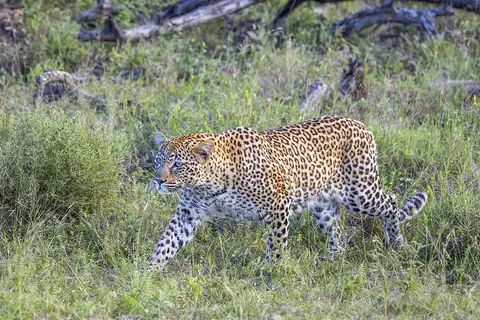
Photo: Ian Dugdale, CC BY 4.0, via Wikimedia Commons
Meet the clouded leopard
The clouded leopard is a wild cat from Asia.
It is bigger than a pet cat but smaller than a leopard. Its fur has big dark shapes like clouds. It has a very long, fluffy tail.
The clouded leopard is a beautiful wild cat of Asian forests. Its name comes from the large, cloud-shaped patches on its coat. It is not a kind of leopard: the Smithsonian's National Zoo explains that it is a separate species, most closely related to the big cats.
It is a medium-sized cat, about 50 to 60 centimeters tall at the shoulder, with short legs, big paws and a tail almost as long as its body. Scientists now know there are two clouded leopards: this one, on the mainland of Asia, and the Sunda clouded leopard on the islands of Sumatra and Borneo.
Neofelis nebulosa was long treated as one species with the island populations. In 2006, analyses of mitochondrial DNA, microsatellites and morphology led scientists to split it in two: the Mainland clouded leopard (N. nebulosa) of mainland Southeast Asia and the Sunda clouded leopard (N. diardi) of Sumatra and Borneo (IUCN). This page is about the mainland species.
It sits between the large and small cats in size: wild adults in Thailand weighed 11.5 to 13.5 kilograms (females) and 16 to 18 kilograms (males). Genetic research places it with the big cats of the subfamily Pantherinae, and the National Zoo notes it may have branched off from them first, more than 6 million years ago.
Quick facts
- Group
- Mammal
- Length
- 75 to 105 cm
- Height
- 50 to 60 cm
- Weight
- 11.5 to 18 kg
- Lifespan in the wild
- 11 years
Where it lives
Clouded leopards live in forests in Asia.
They live in warm, green rainforests and on the sides of big mountains. They are very hard to find.
Clouded leopards live from the foothills of the Himalaya mountains in Nepal, through India, Bhutan and Myanmar, to Thailand, Cambodia, Laos, Peninsular Malaysia and southern China.
They are forest cats. They like thick evergreen rainforest best, but they also live in drier forests and in forests that have been logged. In the Himalayas they have been recorded higher than 3,500 meters. They are so shy that scientists mostly learn about them from camera traps, cameras in the forest that take a picture when an animal walks past.
The IUCN's global assessment (assessed 2020, published 2021) lists the Mainland clouded leopard as resident in Bangladesh, Bhutan, Cambodia, China, India, Lao PDR, Peninsular Malaysia, Myanmar, Nepal and Thailand; it is possibly still present in Viet Nam, with no confirmed record since 2003, and extinct on the island of Taiwan. Annapurna in Nepal marks the western edge of its known range, and in China it now appears restricted mostly to Yunnan near the borders with Lao PDR and Myanmar.
It is highly arboreal and strongly tied to forest, especially primary evergreen tropical rainforest, but also uses dry, deciduous, secondary and logged forest, and less often grassland, scrub and mangrove. Records in the Himalayas reach above 3,500 meters (IUCN); the IUCN Cat Specialist Group cites a recent detection at 4,500 meters.
Continent
Its habitats


Where can you find this animal?
- Used to live here · Countries and seas named by a scientific source
- Lives here naturally · Countries and seas named by a scientific source
- Sightings recorded · Records of wild sightings (GBIF)
Used to live here · Countries and seas named by a scientific source
Clouded leopards once lived on the island of Taiwan; the IUCN lists them as extinct there.
Places: Taiwan.
Source: iucn-red-list · checked October 2026
Lives here naturally · Countries and seas named by a scientific source
Forests from the Himalayan foothills of Nepal through northeastern India, Bhutan and Myanmar to Thailand, Indochina, Peninsular Malaysia and southern China. In Malaysia it lives only on the peninsula (clouded leopards on Borneo and Sumatra are the Sunda clouded leopard). Clouded leopards live in only part of each country shown; in China mainly in Yunnan, and in Bangladesh perhaps only in very smal
Places: Bangladesh, Bhutan, Cambodia, China, India, Laos, Malaysia, Myanmar and 2 more places.
Source: iucn-red-list · checked October 2026
Sightings recorded · Records of wild sightings (GBIF)
Counts of GBIF records of wild observations (human and machine) and preserved specimens. Records include introduced populations, vagrants, escaped or released animals and misidentifications, so a country with records is not necessarily part of the native range.
Wild sightings have been recorded in Indonesia, Cambodia, United States, India, China, Thailand, Taiwan, Myanmar and 10 more places.
Source: gbif · checked October 2026
Range maps show where scientists say an animal lives, often country by country. An animal may live in only part of a country shown, and sightings records can include animals that wandered far from home.
What it eats
Clouded leopards eat meat.
They catch monkeys, small deer, squirrels and birds. They hunt in the trees and on the ground.
Clouded leopards are carnivores. They hunt animals that live in trees and on the ground: monkeys such as macaques and gibbons, small deer, squirrels, porcupines, pangolins and birds.
People once thought these cats did most of their hunting up in the trees. Today scientists think that much of their hunting happens on the ground. A clouded leopard creeps quietly toward its prey, then pounces quickly. Its strong legs and very long teeth let it catch animals that are quite large for a cat its size.
The diet spans arboreal and terrestrial vertebrates. In Thailand's Phu Khieo Wildlife Sanctuary, recorded prey included hog deer, slow lorises, brush-tailed porcupines, Malayan pangolins and Indochinese ground squirrels (IUCN). The IUCN Cat Specialist Group notes a preference for primates such as pig-tailed macaques and gibbons, as well as muntjac deer and great argus pheasants.
Although it is a superb climber, the National Zoo reports that current thinking places most hunting on the ground, with some ambushes from trees. Clouded leopards stalk quietly and then pounce (Animal Diversity Web), and their strong legs, large canines and wide gape, about 100 degrees, let them take sizeable prey.
Did you know?
A clouded leopard can't roar like a lion.
Clouded leopards cannot roar. In zoos, friendly clouded leopards greet each other with a soft snorting sound called prusten.
Clouded leopards cannot roar; captive animals make a low-intensity snort called prusten during friendly interactions.
An amazing body
The clouded leopard is a super climber.
It has big, wide paws and a very long tail for balance. It can even climb down a tree head first!
A clouded leopard's body is built for the trees. Its legs are short and strong, and its paws are big, with special pads that grip branches. Its long, thick tail, about as long as its body, helps it balance on narrow branches.
Its ankles can twist in unusual ways, so it can climb down a tree trunk headfirst, and it can even hang from a branch by its back feet. It also has very long canine teeth: for the size of its skull, they are longer than those of any other wild cat.
Short, sturdy legs end in broad paws with specialized footpads, and the hind legs are longer than the forelegs. Flexible ankle joints allow headfirst descents of vertical trunks, and clouded leopards have been seen hanging from branches by their hind feet (IUCN Cat Specialist Group). The tail, typically about equal to head-and-body length, aids balance.
The skull is long, and the canines are longer relative to skull size than in any other living cat (Smithsonian's National Zoo; the Cat Specialist Group says the same of both clouded leopard species), reaching 4 centimeters or more. The coat carries large dark-edged "clouds" with paler centers, two bold bars on the back of the neck and a ringed tail. Clouded leopards cannot roar.
Growing up
Baby clouded leopards are called cubs.
A mother usually has two cubs. They are born with solid black spots. Soon they climb trees, and later they learn to hunt.
Most of what we know about baby clouded leopards comes from zoos, because wild ones are so hard to watch. A mother is pregnant for about three months and usually has two cubs, though she can have one to five. A newborn weighs only about 140 to 280 grams, less than a can of soup.
Cubs start walking at about 20 days old and can climb trees at six weeks. Their spots are solid black at first and turn into clouds at about six months. In the wild, young clouded leopards stay with their mother for about ten months.
Breeding data come almost entirely from captive animals, and from before the 2006 split, so they may not exactly match wild Mainland clouded leopards. In zoos, gestation usually lasts 88 to 95 days (range 85 to 109; Animal Diversity Web), and litters hold one to five kittens, most often two, each weighing 140 to 280 grams.
Eyes open at 2 to 11 days, kittens walk at about 20 days and climb at six weeks, and they are weaned at 10 to 14 weeks. Juvenile spots are solid until about six months. In the wild, young stay with their mother for about ten months. Captive clouded leopards mature at 20 to 30 months, and the average wild lifespan is estimated at about 11 years.
A secret life in the forest
Clouded leopards like to live alone.
They are very shy and hard to see. They rest up in the trees. They hunt at night, and early and late in the day.
Clouded leopards are solitary, which means they mostly live alone, and they are very secretive. They are most active at night and at dawn and dusk, though they can be out at any time.
They often rest in trees but travel long distances on the ground. In Thailand, scientists who followed clouded leopards with radio collars found that each one used an area of about 30 to 40 square kilometers. They mark their areas with scent. Clouded leopards cannot roar like a lion, but they can growl and hiss.
Radio-tracking in Thailand found that males and females had similar home ranges of 30 to 40 square kilometers, with core areas of 3 to 5 square kilometers and substantial overlap between individuals; in one park, cats travelled about twice as far each day (on average 2 kilometers) as in another (IUCN). Activity peaks at night and around dawn and dusk.
Clouded leopards may occur at higher densities where tigers and leopards are scarce. In captivity they communicate by scent marking and by growls, hisses and a friendly snorting sound called prusten (Animal Diversity Web). A long moaning call heard in the wild may be a mating or territorial call; its purpose is not known.
Did you know?
Baby clouded leopards have plain black spots at first.
Cubs are born with solid black spots, which change into cloud shapes by the time they are about six months old.
Juvenile flank spots are solid; the clouded pattern develops by about six months of age (Animal Diversity Web).
Helping clouded leopards
There are fewer clouded leopards than there used to be.
Their forests are being cut down. People are working to protect them in parks and keep them safe.
The clouded leopard is Vulnerable, which means it is at risk of dying out in the wild. Its forests are being cut down fast, and many clouded leopards are hunted illegally or caught by accident in wire traps called snares that people set for other animals.
It is protected by law in most of the countries where it lives, and it lives in many national parks and tiger reserves. Rangers who stop snaring and poaching in these parks help clouded leopards too.
The IUCN assessed the Mainland clouded leopard as Vulnerable in November 2020 (published 2021), with a decreasing population. The assessors inferred a decline of more than 30 percent over three generations (1999 to 2019) and estimated that probably fewer than 10,000 mature animals remain, likely about 3,700 to 5,580. Habitat strongholds shrank by about 34 percent between 2000 and 2018.
The main driver of recent decline is illegal hunting: snares set for other animals, especially in Lao PDR and Cambodia, and targeted hunting for the wildlife trade, in which skins, bones, meat and live animals are sold (IUCN). The species is on CITES Appendix I and protected by national law over most of its range; better-protected parks and transboundary planning are recommended.
IUCN Red List
How is the clouded leopard doing in the wild?
- Least Concern
- Near Threatened
- Vulnerable (this animal)
- Endangered
- Critically Endangered
- Extinct in the Wild
- Extinct
Vulnerable
At high risk of disappearing from the wild.
Amazing facts
-
A clouded leopard can climb down a tree head first.
Thanks to its bendy ankles, a clouded leopard can climb headfirst down a tree trunk and even hang from a branch by its back feet.
Flexible ankle joints let clouded leopards descend vertical trunks headfirst and hang from branches by the hind feet (IUCN Cat Specialist Group).
-
Clouded leopards have very long teeth for their size.
For the size of its skull, the clouded leopard has longer canine teeth than any other wild cat.
Canines are longer relative to skull size than in any other living felid, reaching 4 centimeters or more.
-
Baby clouded leopards have plain black spots at first.
Cubs are born with solid black spots, which change into cloud shapes by the time they are about six months old.
Juvenile flank spots are solid; the clouded pattern develops by about six months of age (Animal Diversity Web).
-
A clouded leopard can't roar like a lion.
Clouded leopards cannot roar. In zoos, friendly clouded leopards greet each other with a soft snorting sound called prusten.
Clouded leopards cannot roar; captive animals make a low-intensity snort called prusten during friendly interactions.
Words to know
- arboreal
- living or spending a lot of time in trees
- carnivore
- an animal that eats other animals
- canine teeth
- long, pointed teeth near the front of the mouth
- camera trap
- a camera in the wild that takes a picture when an animal walks past
- snare
- a wire trap that catches an animal by the leg or neck
- vulnerable
- at risk of dying out in the wild
Discovery challenge
-
How did the clouded leopard get its name?
Why is it called a clouded leopard?
What gives Neofelis nebulosa its common name?
- It lives above the clouds
- Its fur has cloud-shaped patches
- It only comes out on cloudy days
Show the answer
Its fur has cloud-shaped patches
Its fur has big dark shapes like clouds.
Its coat is covered in large patches with dark edges and lighter middles that look like clouds.
Cloud-like rosettes with dark outlines and paler centers give the species its name.
-
What special climbing trick can a clouded leopard do?
Which climbing trick can a clouded leopard do?
Which climbing ability do flexible ankle joints give the clouded leopard?
- Climb down a tree head first
- Fly from tree to tree
- Stick to trees with sticky feet
Show the answer
Climb down a tree head first
It can climb down a tree head first!
Its bendy ankles let it climb down trunks headfirst and hang from branches by its back feet.
Flexible ankles allow headfirst descents of vertical trunks and hanging by the hind feet.
-
Where do clouded leopards live?
On which continent do clouded leopards live in the wild?
Where is the Mainland clouded leopard's native range?
- Africa
- Asia
- South America
Show the answer
Asia
Clouded leopards live in the forests of Asia.
They live in forests from Nepal and India to Southeast Asia and southern China.
Forests of mainland South and Southeast Asia and southern China; the island cats are the Sunda clouded leopard.
-
What helps a clouded leopard balance on branches?
Which body part helps a clouded leopard balance on narrow branches?
Which feature, about as long as its head and body, helps a clouded leopard balance?
- Its whiskers
- Its ears
- Its long tail
Show the answer
Its long tail
Its long tail helps it balance.
Its thick tail is about as long as its body and helps it balance in the trees.
The tail, 79 to 90 centimeters long and about equal to head-and-body length, aids balance on branches.
Places where you might see it
-
 Watch
 Country
Thailand
Thailand is a tropical country in the middle of mainland Southeast Asia, with forested mountains in the north, rice fields on its central plains and a long, narrow peninsula in the south. Its capital is Bangkok, and about 65.8 million people were on its civil register at the end of 2025.
-
 Watch
 Country
Nepal
Nepal is a landlocked country in South Asia, between India and China. It climbs from flat, warm farmland in the south to the snowy Himalaya in the north, where Mount Everest stands, and about 29.6 million people lived there in 2025.
-
 Watch
 Country
India
India is a huge country in South Asia, shaped like a big triangle pointing into the Indian Ocean. The Himalayas rise along its north, heavy monsoon rains arrive every summer, and about 1.46 billion people (2025) live there, speaking hundreds of languages.
Explore next
-
 Watch
Animal
Snow leopard
The snow leopard lives high in the mountains of Central Asia, where it is freezing cold and the ground is steep and rocky. Thick fur, huge furry paws and a tail almost as long as its body help it survive. It is so hard to spot that people call it the ghost cat of the mountains.
-
 Watch
3D
Animal
Leopard
The leopard is a strong, spotted big cat and the best climber of them all. It can carry its food high up into a tree, away from lions and hyenas. Leopards live in more kinds of places than any other big cat, from deserts to rainforests, across Africa and Asia.
-
 Watch
3D
Animal
Tiger
The tiger is a huge cat with orange fur and dark stripes that help it hide in tall grass and forest shadows. It lives alone, hunts deer and wild pigs, and loves to swim. Wild tigers live only in Asia, and they are endangered.
-
Watch
Country
Thailand
Thailand is a tropical country in the middle of mainland Southeast Asia, with forested mountains in the north, rice fields on its central plains and a long, narrow peninsula in the south. Its capital is Bangkok, and about 65.8 million people were on its civil register at the end of 2025.
-
Watch
Country
Nepal
Nepal is a landlocked country in South Asia, between India and China. It climbs from flat, warm farmland in the south to the snowy Himalaya in the north, where Mount Everest stands, and about 29.6 million people lived there in 2025.
-
Watch
Country
India
India is a huge country in South Asia, shaped like a big triangle pointing into the Indian Ocean. The Himalayas rise along its north, heavy monsoon rains arrive every summer, and about 1.46 billion people (2025) live there, speaking hundreds of languages.
-
 Watch
Animal
Fishing cat
The fishing cat is a stocky, spotted wild cat of the wetlands of South and Southeast Asia. It is an excellent swimmer and diver, and fish are its main food. It lives in marshes, swamps, mangroves and along rivers, and it is Vulnerable because so many of these wetlands are being lost.
-
 Watch
Animal
Aardvark
The aardvark is a shy night digger of African savannas. It sniffs out ant and termite nests, rips them open with its spade-like claws and laps up the insects with a sticky tongue about 30 centimeters long. Its name means 'earth pig' in Afrikaans.
For parents & teachers
What children will learn
- Describe how the clouded leopard's paws, ankles, legs and tail help it climb.
- Explain that the clouded leopard is a carnivore that hunts both in trees and on the ground.
- Locate the Mainland clouded leopard's range in Asia and know that the island cats are a separate species.
- Understand why the species is Vulnerable and how protecting forests and removing snares helps.
Recommended ages: 3 to 17 · About 15 minutes
Talk about it
- Why might a cat that spends time in trees need a very long tail?
- How do camera traps help scientists study animals that are almost never seen?
- Why can a wire trap set for a deer still harm a clouded leopard?
Try at home or in class
- Measure 85 centimeters with a tape measure to see how long a clouded leopard's tail can be, then compare it with your arm.
- Draw a cloud pattern: dark outlines with lighter middles. Cut it out and see how well it hides against a photo of leaves and shadows.
Key vocabulary: arboreal, carnivore, canine teeth, camera trap, snare, vulnerable
Where these facts come from
- The IUCN Red List of Threatened Species , International Union for Conservation of Nature (IUCN terms of use (no redistribution of Red List data or range maps))
- GBIF Backbone Taxonomy and GBIF Occurrence Search , Global Biodiversity Information Facility (CC0 1.0 (backbone); occurrence counts are facts derived from records under CC0, CC BY and CC BY-NC)
- Neofelis nebulosa, global Red List assessment (assessed 2020, published 2021) , IUCN Red List of Threatened Species
- Mainland clouded leopard (Neofelis nebulosa) , IUCN SSC Cat Specialist Group
- Neofelis nebulosa (clouded leopard) , Animal Diversity Web, University of Michigan Museum of Zoology
- Clouded leopard , Smithsonian's National Zoo and Conservation Biology Institute
- Wikidata , Wikimedia Foundation (CC0 1.0)
- Wikimedia Commons , Wikimedia Foundation (Per file: Public domain, CC0, CC BY or CC BY-SA only (credited on each page))
Checked, not yet human-reviewed. Last updated October 27, 2026. Spotted a mistake? Tell us.