
Animal
Common eastern firefly
The common eastern firefly is a beetle that glows. On summer evenings, it flashes yellow lights to find a friend.
The common eastern firefly, or big dipper firefly, is a beetle that makes its own light. On summer evenings, males fly over lawns and fields, drawing a J-shaped flash in the air, and females on the ground flash back. Most of its life is spent as a glowing larva in damp soil, hunting snails and worms.
Photinus pyralis is a lampyrid beetle and probably the most commonly seen firefly in the eastern United States. Males court at dusk with a species-specific J-shaped flash; larvae are nocturnal soil predators for one to two years. Its bioluminescence, produced by the enzyme luciferase, is highly efficient and its luciferase gene is used as a tool in genetic research. The IUCN lists it as Least Concern.
Photo: Katja Schulz from Washington, D. C., USA, CC BY 2.0, via Wikimedia Commons
Meet the firefly
The common eastern firefly is a small beetle that can glow.
It is not really a fly. On warm summer evenings, it flashes yellow light. Many people call it a lightning bug.
Despite its name, the firefly is not a fly, and despite its other name, lightning bug, it is not a true bug either. It is a beetle, with hard wing covers. The common eastern firefly is about 10 to 14 millimeters long, with dark wing covers edged in yellow and a pink-and-black shield over its head.
Its big trick is light. The end of its abdomen holds a light organ that flashes yellow. This firefly is called the big dipper firefly because of the J shape its flash draws in the evening air.
Photinus pyralis belongs to the Lampyridae, a beetle family whose name means 'shining fire'; Illinois Extension counts more than 2,000 firefly species worldwide. Adults are soft, finely hairy beetles of about 10 to 14 millimeters, with dark elytra bordered in yellow and a large pronotum that extends over the head. LSU AgCenter notes that the pronotum's center is always pink with a black central dot, though the pattern varies.
Because color and size vary within populations, dissection is needed to separate it confidently from other Photinus species; in the field, the male's J-shaped flash is the key. Males carry light organs on two abdominal segments, females on one.
Quick facts
- Group
- Invertebrate
- Length
- 10 to 14 mm
- Lifespan in the wild
- 5 to 30 days
Where it lives
This firefly lives in North America.
You can see it in yards, fields and at the edges of woods. Baby fireflies live in damp soil.
The common eastern firefly lives in eastern North America, from Ontario in Canada through much of the eastern and central United States, and in parts of Mexico. It is probably the firefly you are most likely to see in a yard in the eastern United States.
Adults are found in open places such as lawns, meadows and fields, along roadsides and at woodland edges. The larvae need moist places: wet meadows and woods, stream banks and the edges of lakes.
The IUCN global assessment (assessed 2020, published 2021) lists the species in Ontario, ten Mexican states including Jalisco, Michoacán and Nuevo León, and more than 30 US states and the District of Columbia, and considers it possibly extinct in Arizona and Colorado. LSU AgCenter describes the core range as southern Texas to southern New York and west to Kansas and Nebraska, with isolated records farther west.
Adults occupy open habitats from yards and fields to roadsides and woodland edges, from late spring to early fall. Larvae need moist conditions in wet meadows, woodlands and along lakes and streams, where they live in leaf litter, soil and under bark.
Continent
Its habitats


Where can you find this animal?
- Lives here naturally · Countries and seas named by a scientific source
- Sightings recorded · Records of wild sightings (GBIF)
Lives here naturally · Countries and seas named by a scientific source
Eastern and central North America: Ontario in Canada, much of the eastern and central United States, and ten Mexican states, as listed by the IUCN. It lives in only part of each country shown.
Places: Canada, United States and Mexico.
Source: iucn-red-list · checked October 2026
Sightings recorded · Records of wild sightings (GBIF)
Counts of GBIF records of wild observations (human and machine) and preserved specimens. Records include introduced populations, vagrants, escaped or released animals and misidentifications, so a country with records is not necessarily part of the native range.
Wild sightings have been recorded in United States, Mexico, Canada, Cuba, Colombia, Georgia and Peru.
Source: gbif · checked October 2026
Range maps show where scientists say an animal lives, often country by country. An animal may live in only part of a country shown, and sightings records can include animals that wandered far from home.
Hunters in the soil
Baby fireflies are hunters.
They live in the soil and eat snails, slugs and worms. Grown-up fireflies hardly eat at all.
Firefly larvae are hunters that live in damp soil and leaf litter. They eat soft-bodied animals such as snails, slugs and earthworms. A larva bites its prey with its jaws and injects a substance that stops it moving and turns its insides soft, so the larva can drink its meal.
Adult big dipper fireflies hardly eat at all. They live on the fat they stored as larvae. Once in a while, adults have been seen sipping flower nectar, especially from milkweed.
Larvae are solitary predators of soft-bodied invertebrates, chiefly snails, slugs and earthworms. Animal Diversity Web describes them injecting a toxin that immobilizes and liquefies the prey, which is then sucked up; Illinois Extension notes that this makes larvae a natural control of garden slugs and snails.
Sources differ on adults. LSU AgCenter reports reduced mouthparts and no feeding, with adult activity fueled by larval fat reserves, while the USA National Phenology Network notes occasional nectar feeding, especially on milkweed. Animal Diversity Web describes both stages as carnivorous; this page follows the more specific LSU account.
Did you know?
Scientists use firefly light to study living things.
Scientists can add the firefly's light-making gene to other living things, then watch for the glow to track other genes.
The luciferase gene is spliced into other organisms as a reporter, letting researchers trace the inheritance of linked genes (ADW).
A beetle with a lantern
A firefly has a pink and black shield over its head.
Its wing covers are dark with yellow edges. Its light is at the end of its tummy. Firefly light is cool, not hot.
From above, you can hardly see a firefly's head: it is tucked under a shield called the pronotum, pink with a black spot in the middle. Behind it are two dark wing covers with yellow edges, which protect the flying wings.
The light comes from the underside of the last segments of the abdomen. Inside, a chemical reaction makes light with almost no heat. Firefly light is called cold light: over 90 percent of the energy becomes light, while an old-fashioned light bulb turns most of its energy into heat.
Bioluminescence comes from light organs on the ventral surface of the terminal abdominal segments. The enzyme luciferase acts on luciferin in the presence of magnesium ions, ATP and oxygen to emit light; Illinois Extension describes the reaction as more than 90 percent efficient, compared with about 10 percent for incandescent bulbs.
The large pronotum shields the head; the elytra are dark with narrow yellow margins. Animal Diversity Web notes that males use their hindwings to fly while females usually have short wings and do not fly, although other descriptions show females perched and flashing on low vegetation. All life stages glow, which LSU AgCenter interprets as a warning of chemical defense.
Two years as a glowing larva
A firefly starts as a tiny egg in damp soil.
The baby is a larva that glows too. It lives in the soil for one or two years. Then it rests as a pupa and comes out as a grown-up firefly.
Fireflies go through complete metamorphosis: egg, larva, pupa and adult. A female lays her eggs in damp soil, and the eggs even glow faintly. After a few weeks, tiny larvae hatch, only about 1.6 millimeters long.
The larva is the longest stage. It hunts in the soil for one to two years and spends the winters burrowed underground. Then it builds a little chamber in the soil and becomes a pupa for 9 to 15 days. The adult that comes out lives only about 5 to 30 days.
Females lay about 500 eggs on damp soil in summer (ADW). LSU AgCenter gives Photinus eggs as about 0.8 millimeters across, glowing faintly at first and hatching in 18 to 25 days; ADW gives about four weeks. Larvae hatch at about 1.6 millimeters and grow to about 10.3 millimeters over one to two years, overwintering in soil and building cells of organic matter in which to molt.
Pupation takes place in moist soil chambers and lasts 9 to 15 days depending on temperature; pupae glow, more brightly when disturbed, and the glow fades as eclosion approaches. Adults live about 5 to 30 days, so nearly the whole life is spent as a larva.
Talking with light
At dusk, boy fireflies fly and flash.
Girl fireflies wait on the grass. If a girl likes a flash, she flashes back. That is how fireflies find each other.
Each firefly species has its own flash code. At dusk, big dipper males fly in U-shaped swoops, flashing a long yellow J about every 5 to 7 seconds. Females wait on grass or low plants. If a female likes a male's flash, she answers with a single flash, and he flies down to her.
Temperature changes the code: on warm evenings, males flash more often, and on cool evenings, less often. Females seem to prefer males with the longest flashes.
Courtship is a dialogue. Illinois Extension and the USA-NPN describe the male flash as a single yellow J lasting 0.6 to 0.8 seconds, repeated every 5 to 7 seconds (at 72 to 78 °F, Illinois adds, and faster when warmer); females reply with one flash of about 0.7 seconds, and the delay helps males recognize their own species (ADW gives a shorter 0.3-second flash every 5.5 seconds and a reply about two seconds later). LSU AgCenter reports that females prefer longer flashes.
Flashing starts with fading light: in dark woods up to 20 minutes before sunset, in open fields up to 11 minutes after, and continues for about 90 minutes. Larvae are nocturnal. Females of the predatory genus Photuris mimic Photinus replies to lure and eat males.

Keeping the night dark
Fireflies need dark nights and damp, wild places.
Bright lights make it hard for them to see each other. Turning off outside lights helps fireflies.
The IUCN lists the common eastern firefly as Least Concern, but many people notice fewer fireflies than in the past. Experts name habitat loss, light pollution and pesticides as the main threats to fireflies.
Bright outdoor lights can drown out firefly flashes, so males and females cannot find each other. You can help by turning off outdoor lights on summer evenings, mowing less, leaving fallen leaves where larvae can live, and avoiding pesticides, especially snail and slug killers, which take away the larvae's food.
The IUCN global assessment lists P. pyralis as Least Concern with an unknown population trend, naming livestock farming and ranching and agricultural and forestry effluents as threats. Illinois Extension summarizes a 2020 expert study that identified habitat degradation and loss, light pollution and pesticide use as the main threats to fireflies generally.
LSU AgCenter reports that bright, broad-spectrum outdoor lighting can virtually eliminate fireflies from an area by disrupting courtship, while low-intensity red light is less disruptive. Recommended actions include reducing outdoor lighting, leaving leaf litter and taller vegetation, limiting pesticides and joining citizen-science counts such as Firefly Watch.
IUCN Red List
How is the common eastern firefly doing in the wild?
- Least Concern (this animal)
- Near Threatened
- Vulnerable
- Endangered
- Critically Endangered
- Extinct in the Wild
- Extinct
Least Concern
Not at risk of disappearing from the wild right now.
See the IUCN Red List assessment · The IUCN Red List of Threatened Species 2022.2
Amazing facts
-
Firefly eggs can glow too.
Firefly eggs glow faintly when they are first laid, and the larvae and pupae glow as well.
All four life stages of Photinus can glow; LSU AgCenter interprets the light as a warning of chemical defense.
-
Firefly light is cool, not hot like a light bulb.
Over 90 percent of the energy in a firefly's light reaction becomes light, so it makes almost no heat.
Firefly bioluminescence is over 90 percent efficient, versus about 10 percent for incandescent bulbs (Illinois Extension).
-
Fireflies are beetles, not flies.
Fireflies are beetles in a family whose name means 'shining fire'.
Lampyridae, 'shining fire', includes more than 2,000 species worldwide.
-
Scientists use firefly light to study living things.
Scientists can add the firefly's light-making gene to other living things, then watch for the glow to track other genes.
The luciferase gene is spliced into other organisms as a reporter, letting researchers trace the inheritance of linked genes (ADW).
Words to know
- bioluminescence
- light made by a living thing
- larva
- the young, wormlike stage of an insect
- pupa
- the resting stage when an insect changes into its adult form
- nocturnal
- active at night
- light pollution
- too much artificial light at night
- luciferase
- the chemical helper inside a firefly that makes light
Discovery challenge
-
What kind of animal is a firefly?
What kind of insect is a firefly really?
To which insect order and family does the firefly belong?
- A beetle
- A fly
- A butterfly
Show the answer
A beetle
A firefly is a beetle that glows.
Fireflies are beetles with hard wing covers, not flies.
Fireflies are beetles (Coleoptera) in the family Lampyridae.
-
Why do fireflies flash their lights?
Why do adult big dipper fireflies flash at dusk?
What is the main function of the adult flash in Photinus pyralis?
- To find a mate
- To cook food
- To keep warm
Show the answer
To find a mate
Fireflies flash to find each other.
Males flash a J-shaped code and females answer, so they can find each other.
It is a species-specific courtship dialogue between flying males and perched females.
-
What do baby fireflies eat?
What do firefly larvae hunt in the soil?
What is the main prey of Photinus larvae?
- Snails, slugs and worms
- Flowers
- Seeds
Show the answer
Snails, slugs and worms
Baby fireflies eat snails, slugs and worms.
Larvae hunt soft-bodied animals such as snails, slugs and earthworms.
Soft-bodied invertebrates, immobilized and liquefied by injected toxin.
-
What makes it hard for fireflies to find each other?
Which of these makes it harder for fireflies to find mates?
Which human change most directly disrupts firefly courtship?
- Bright outdoor lights
- Rain clouds
- Tall trees
Show the answer
Bright outdoor lights
Bright lights make it hard to see firefly flashes.
Bright outdoor lights drown out the flashes fireflies use to find each other.
Light pollution; bright broad-spectrum lighting can virtually eliminate fireflies locally.
Places where you might see it
Experiments to try
Explore next
-
 Watch
 Country
United States
The United States is a large country in North America made of 50 states, from icy Alaska to the warm islands of Hawaii. It has the Grand Canyon, the Mississippi River and Yellowstone, and about 342 million people live there.
-
 Watch
3D
Animal
Seven-spot ladybird
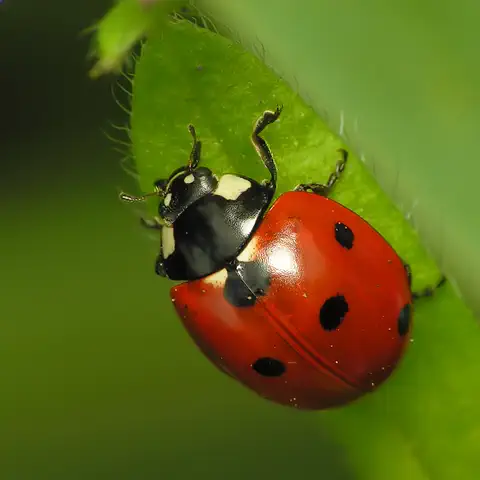
The seven-spot ladybird, or ladybug, is a domed red beetle with seven black spots. Both the young and the adults hunt aphids, small insects that suck plant juices, so gardeners and farmers are glad to see them. Its bright colors warn predators that it tastes horrible.
-
 Watch
3D
Animal
Western honey bee
The western honey bee lives in big families called colonies, with one queen and many workers. Workers collect nectar and pollen from flowers, turn nectar into honey, and tell each other where food is by dancing. As they travel, they pollinate many plants, including crops people eat.
- Watch What If? Lab What if plants glowed in the dark? Some living things make their own light: fireflies, a few kinds of mushrooms, and many animals in the deep sea. It's called bioluminescence. Garden plants don't glow, but scientists have now made a few plants that do. Imagine a world of glowing plants: how bright would it be, and what might it change?
-
 Watch
3D
Animal
Luna moth
The luna moth is a large green moth of the forests of eastern North America. Its long, twisting wing tails may help it escape hungry bats. Grown-up luna moths have no working mouth, so they live only about a week, just long enough to find a mate and lay eggs.
-
 Watch
3D
Animal
Periodical cicada
The periodical cicada spends 17 years underground as a nymph, sipping juice from tree roots. Then, in late spring, millions of them dig out on the same few nights, turn into winged adults and fill the trees with their loud songs, all within a few weeks.
-
 Watch
Animal
American lobster
The American lobster is a big crustacean that lives on the rocky sea floor of the northwest Atlantic Ocean. It has two very different claws, one for crushing and one for tearing, and it must climb out of its hard shell again and again to grow.
-
 Watch
3D
Animal
Antarctic krill
Antarctic krill are small, shrimp-like crustaceans about 6 centimeters long that live in the icy Southern Ocean around Antarctica. They gather in enormous swarms, and almost all the bigger animals of the Antarctic, from penguins to blue whales, depend on them for food.
For parents & teachers
What children will learn
- Explain that fireflies are beetles that make light by a chemical reaction.
- Describe how males and females use flash patterns to find each other.
- Name the four life stages and recognize that the larva lives longest.
- Identify ways people can help fireflies, such as reducing outdoor lighting.
Recommended ages: 3 to 17 · About 12 minutes
Talk about it
- Why might each firefly species need its own flash code?
- What could your family or neighborhood do to make nights darker for fireflies?
- Why do you think firefly larvae glow even though they are not looking for mates?
Try at home or in class
- With a small flashlight, practice a firefly code: one child flashes a J shape every 6 seconds, and a partner answers with one flash.
- On a summer evening, count firefly flashes in your yard for five minutes with the outdoor lights on, then off, and compare.
Key vocabulary: bioluminescence, larva, pupa, nocturnal, light pollution, luciferase
Where these facts come from
- The IUCN Red List of Threatened Species , International Union for Conservation of Nature (IUCN terms of use (no redistribution of Red List data or range maps))
- GBIF Backbone Taxonomy and GBIF Occurrence Search , Global Biodiversity Information Facility (CC0 1.0 (backbone); occurrence counts are facts derived from records under CC0, CC BY and CC BY-NC)
- Photinus pyralis (Big Dipper Firefly), global assessment , IUCN Red List of Threatened Species
- Photinus pyralis (common eastern firefly) , Animal Diversity Web, University of Michigan Museum of Zoology
- Photinus pyralis, Big Dipper Firefly (Coleoptera: Lampyridae) , LSU AgCenter
- Sparks in the night: fireflies and tips for conserving them , University of Illinois Extension
- Photinus pyralis phenophases , USA National Phenology Network
- Wikidata , Wikimedia Foundation (CC0 1.0)
- Wikimedia Commons , Wikimedia Foundation (Per file: Public domain, CC0, CC BY or CC BY-SA only (credited on each page))
Checked, not yet human-reviewed. Last updated October 27, 2026. Spotted a mistake? Tell us.