
Animal
Blue sea star
The blue sea star is a bright blue sea star with five long, round arms. It lives on sunny coral reefs in warm seas.
The blue sea star is easy to spot on Indian and Pacific Ocean reefs: bright blue, with five smooth, tube-shaped arms. It cleans up the reef by eating dead animals, tiny creatures and the thin film that grows on rocks, and it can grow back an arm it loses.
Linckia laevigata is a tropical Indo-Pacific sea star (family Ophidiasteridae) of sunlit reef flats and slopes to 60 m. A detritivore and scavenger, it gets its blue from the pigment linckiacyanin, reproduces both by spawning and by splitting through its disc, and regenerates lost arms.
Photo: Diego Delso, CC BY-SA 4.0, via Wikimedia Commons
Meet the blue sea star
The blue sea star is very, very blue!
It has five long arms that are round, like fat noodles. It lives on coral reefs where the sun shines on the water.
The blue sea star is famous for its color: most are bright or light blue, though some are green, pink or yellow. Its five arms are long and round, like tubes, instead of flat like many sea stars' arms. Large ones can be up to 40 centimeters across.
It often lies out in the open on reef flats and rubble, which makes it easy for divers and snorkelers to see. Its blue color comes from a special blue pigment in its skin.
Linckia laevigata (Linnaeus, 1758) belongs to the family Ophidiasteridae in the order Valvatida. ADW describes five cylindrical arms, usually bright or light blue, with green, pink and yellow individuals also recorded; SeaLifeBase gives a maximum length of 40 centimeters, while Reef Life Survey lists 22 centimeters as its maximum.
ADW explains the color as a blue pigment, linckiacyanin, together with accessory yellow carotenoids; the exact ratio of pigments in each animal changes its shade.
Quick facts
- Group
- Invertebrate
- Length
- up to 40 cm
Where it lives
Blue sea stars live on coral reefs in warm seas.
They like shallow places where the sun shines. Young ones hide under corals and rocks.
Blue sea stars live on tropical reefs of the Indian and Pacific Oceans, from the western Indian Ocean to the islands of southeastern Polynesia, and even reach cooler waters in temperate Australasia.
They are found in shallow, sunny reef areas on rocks, dead coral and rubble, and sometimes among sponges, seaweed and seagrass, from the surface down to about 60 meters. Young blue sea stars hide under corals and rocks.
ADW gives a range across the tropical Indian and Pacific Oceans, from the western Indian Ocean to southeastern Polynesia; Reef Life Survey lists the tropical Indo-Pacific and temperate Australasia, with records in sea temperatures of 20.8 to 31.3 °C, and found it at 18.6 percent of its survey sites within its range.
SeaLifeBase describes shallow, sunlit reef areas on rocks, dead coral or rubble from 0 to 60 meters, also reef slopes and areas among sponges, macroalgae and seagrasses, with juveniles hiding under corals and rocks. The map shades the Indian and Pacific Oceans, not the exact reefs.
Its habitat

Where can you find this animal?
- Lives here naturally · Countries and seas named by a scientific source
- Sightings recorded · Records of wild sightings (GBIF)
Lives here naturally · Countries and seas named by a scientific source
Shallow, sunlit reefs of the tropical Indian and Pacific Oceans, from the western Indian Ocean to southeastern Polynesia, reaching temperate Australasia; 0 to 60 m. Shading is by ocean, not the exact reefs.
Places: Indian Ocean and Pacific Ocean.
Source: https://animaldiversity.org/accounts/Linckia_laevigata/ · checked October 2026
Sightings recorded · Records of wild sightings (GBIF)
Counts of GBIF records of wild observations (human and machine) and preserved specimens. Records include introduced populations, vagrants, escaped or released animals and misidentifications, so a country with records is not necessarily part of the native range.
Wild sightings have been recorded in Indonesia, Australia, Fiji, Philippines, Papua New Guinea, New Caledonia, Solomon Is., Vanuatu and 40 more places.
Source: gbif · checked October 2026
Range maps show where scientists say an animal lives, often country by country. An animal may live in only part of a country shown, and sightings records can include animals that wandered far from home.
The reef's cleaner
Blue sea stars eat bits of dead animals and tiny creatures.
They help keep the reef clean.
Blue sea stars do not hunt big prey. They eat detritus, which is bits of dead plants and animals, along with dead animals and tiny invertebrates living in mats of algae. Scientists think they also graze on thin turf algae and the film of bacteria that coats hard reef surfaces.
Like other sea stars, they push their stomach out of their body and digest food outside. By breaking down dead material, they help recycle it on the reef.
SeaLifeBase lists detritus, small invertebrates living on algal mats and dead animals, and notes that it likely feeds on turf algae and bacterial films over hard substrates. ADW describes it as an opportunistic scavenger and detritivore that everts its stomach and begins digestion externally.
ADW notes its tube feet act as chemoreceptors used to locate food, and that by breaking down the tissues of dead animals it plays a role in biodegradation on the reef.
Did you know?
A tiny snail lives only on blue sea stars.
A tiny limpet called Thyca crystallina lives only on blue sea stars and feeds on their body fluid.
Linckia laevigata is the obligate host of the parasitic limpet Thyca crystallina (ADW).
Regrowing arms
If a blue sea star loses an arm, it can grow a new one!
Some can even split in two and grow into two sea stars.
A blue sea star has no brain, but it can sense touch, light and the water around it. The tube feet underneath help it move, grip and find food by smell.
Its most amazing trick is regrowing. If a predator grabs an arm, the sea star can drop it and escape, then grow it back. Blue sea stars can also split through the middle of their body, and each half grows into a whole new sea star.
ADW notes that, like other sea stars, it can sever a limb to escape predators (autotomy) and regenerate lost parts, and that it also reproduces asexually by dividing through the disc, producing genetically identical clones; this is the main form of reproduction in captivity.
It lacks a brain but responds to touch, light and orientation; pedicellariae help keep the surface free of sediment. ADW suggests its blue coloring may warn potential predators of toxicity, a hypothesis rather than a demonstrated fact.
Eggs, larvae and tiny stars
Blue sea stars let out eggs and sperm into the sea.
The babies drift for about a month. Then they settle on the reef and turn into tiny blue sea stars.
Blue sea stars usually spawn once a year. Males and females gather in groups and release eggs and sperm into the water, which makes it more likely that eggs will be fertilized.
The fertilized eggs become larvae within a couple of days. The larvae drift in the open water for about 28 to 30 days, then settle on a hard surface on the reef and change into tiny sea stars. ADW reports that they become adults at about 2 years old and keep growing after that.
ADW describes external fertilization during group spawning, typically once a year, larvae forming within a couple of days and spending about 28 to 30 days in the plankton before settling on hard reef substrate and metamorphosing into a miniature five-armed star. The juvenile-to-adult transition is estimated at about 2 years.
Recruitment may be very low: ADW cites a study that found only 10 offspring in one year class. Asexual fission adds clones to populations. SeaLifeBase notes that sea stars in general reproduce both sexually and by regeneration and cloning.
Neighbors and hitchhikers
Some tiny animals live on the blue sea star.
A little snail and a small shrimp can ride on it.
Blue sea stars usually live alone and move slowly over the reef. Some small animals depend on them. A tiny limpet, a kind of snail, lives only on blue sea stars and feeds on their body fluid. A small shrimp also lives on them.
Animals that eat sea stars include pufferfish, triton snails and harlequin shrimp. Losing an arm to a predator is not the end, because the sea star can grow it back.
ADW describes the species as mobile and solitary and lists it as the obligate host of the parasitic limpet Thyca crystallina, which feeds on its hemolymph, and as a host of the shrimp Periclimenes soror. Reported predators include pufferfishes, triton shells (Charonia), harlequin shrimp (Hymenocera), sea anemones and damselfish.
ADW also reports that it hides in rocks during the day and is nocturnal, though it is often seen in the open on reefs.
Did you know?
Its blue color comes from a special blue paint inside its skin.
The blue comes from a pigment called linckiacyanin, mixed with some yellow pigments.
The ratio of blue linckiacyanin to accessory yellow carotenoids sets each animal's shade (ADW).
Look, but leave it
Blue sea stars are not in danger.
If you see one while snorkeling, look but do not touch or take it. It belongs on the reef.
The blue sea star has not been assessed for the IUCN Red List, and Reef Life Survey divers find it often in the places where it lives.
People do collect blue sea stars for home aquariums and as dried souvenirs. They are hard to keep alive in tanks, because they need very steady water conditions. The kindest thing to do when you see one is to enjoy it where it is.
Linckia laevigata has not been evaluated for the IUCN Red List (Reef Life Survey and ADW: Not Evaluated). Reef Life Survey records it as frequent (18.6 percent of sites) but at low abundance (about 2 per transect).
ADW notes that it is collected for the aquarium trade and as dried decorations and souvenirs, that mortality in captivity is high because it needs precise conditions and careful acclimation, and that it is sensitive to changes in temperature, oxygen and pH. It is also being investigated as a source of potential antitumor and antibacterial compounds.
Did you know?
Baby blue sea stars float in the sea for about a month.
Blue sea star larvae drift in the open water for about 28 to 30 days before settling on a reef.
The planktonic larval period is about 28 to 30 days (ADW).
Amazing facts
-
A blue sea star can split in two and make two sea stars.
Blue sea stars can split through the middle of their body, and each half grows into a whole new sea star.
Fission through the disc yields genetically identical clones (ADW).
-
Its blue color comes from a special blue paint inside its skin.
The blue comes from a pigment called linckiacyanin, mixed with some yellow pigments.
The ratio of blue linckiacyanin to accessory yellow carotenoids sets each animal's shade (ADW).
-
A tiny snail lives only on blue sea stars.
A tiny limpet called Thyca crystallina lives only on blue sea stars and feeds on their body fluid.
Linckia laevigata is the obligate host of the parasitic limpet Thyca crystallina (ADW).
-
Baby blue sea stars float in the sea for about a month.
Blue sea star larvae drift in the open water for about 28 to 30 days before settling on a reef.
The planktonic larval period is about 28 to 30 days (ADW).
Words to know
- sea star
- a sea animal with arms around a central body, also called a starfish
- detritus
- tiny bits of dead plants and animals
- regenerate
- to grow back a lost body part
- pigment
- a substance that gives something its color
- clone
- a living thing that is an exact genetic copy of another
- larva
- a young stage that looks very different from the adult
Discovery challenge
-
How many arms does the blue sea star in the photo have?
How many arms does a blue sea star usually have?
How many cylindrical arms does Linckia laevigata typically have?
- Three
- Five
- Ten
Show the answer
Five
It has five long, round arms.
Five long arms, round like tubes.
Five cylindrical arms (ADW).
-
What can a blue sea star do if it loses an arm?
What happens when a blue sea star loses an arm?
What allows Linckia laevigata to recover from losing an arm to a predator?
- It grows a new arm
- It stops moving forever
- It turns into a fish
Show the answer
It grows a new arm
It grows a new one!
It can drop an arm to escape and then grow it back.
Autotomy followed by regeneration (ADW).
-
What does a blue sea star eat?
What does the blue sea star mainly eat?
Which food does SeaLifeBase list for Linckia laevigata?
- Bits of dead plants and animals
- Big sharks
- Leaves from trees
Show the answer
Bits of dead plants and animals
It eats bits of dead things and tiny creatures.
Detritus, dead animals and tiny invertebrates living on algae mats.
Detritus, small invertebrates on algal mats and dead animals; probably also turf algae and bacterial films.
-
Where do blue sea stars live?
Where does the blue sea star live?
Which describes the range of Linckia laevigata?
- On warm reefs in the Indian and Pacific Oceans
- In icy Arctic seas
- In rivers
Show the answer
On warm reefs in the Indian and Pacific Oceans
On warm, sunny coral reefs.
On reefs from the western Indian Ocean to southeastern Polynesia.
Tropical Indo-Pacific, reaching temperate Australasia, at 0 to 60 meters.
Places where you might see it
Explore next
-
 Watch
Animal
Crown-of-thorns starfish
The crown-of-thorns starfish is a large sea star of Indian and Pacific Ocean reefs, with up to 21 arms and hundreds of sharp, toxic spines. It eats living coral by pushing its stomach out over it. Usually it is a normal part of the reef, but sometimes huge numbers appear, called outbreaks, and they can eat much of a reef's coral.
-
 Watch
Animal
Ochre sea star
The ochre sea star lives on wave-washed rocky shores along the Pacific coast of North America. It can be purple, orange or brown, and it pries open mussels to eat them with a stomach it pushes out of its body. It is so important to its shore that scientists call it a keystone species.
-
 Watch
Animal
Common starfish
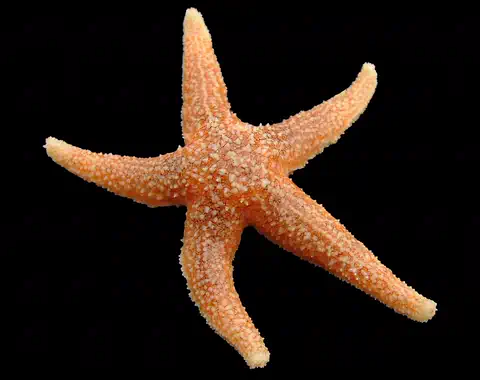
The common starfish is the most familiar starfish of the north-east Atlantic coasts. It has five arms, an eye spot at the tip of each one, and many tube feet. It can pull open a mussel shell and push its own stomach inside to eat.
-
 Watch
Animal
Magnificent sea anemone
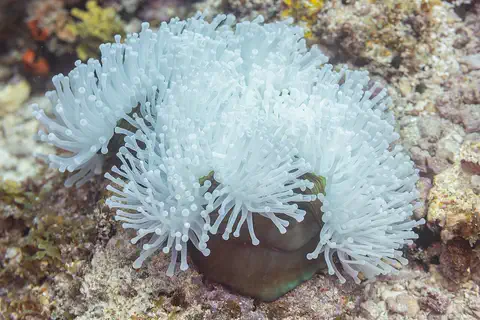
The magnificent sea anemone is a large sea anemone of warm Indian and Pacific Ocean reefs. Its body is a soft column topped with hundreds of finger-shaped tentacles, and it often perches on top of rocks in plain view. Many kinds of clownfish live safely among its stinging tentacles.
-
 Watch
 Country
Philippines
The Philippines is an island country in Southeast Asia, in the western Pacific Ocean. It has more than 7,000 islands, about 50 volcanoes and rich coral reefs, and about 112.7 million people were counted there in 2024.
-
 Watch
Animal
Purple sea urchin
The purple sea urchin is a spiny, ball-shaped animal of North America's Pacific coast, up to about 10 centimeters across. It scrapes algae with a mouth of five teeth, walks on tiny tube feet, and can even carve a hollow in solid rock. Since 2014 its numbers have exploded in parts of California, and hungry urchins have eaten away large areas of kelp forest.
-
 Watch
Animal
American lobster
The American lobster is a big crustacean that lives on the rocky sea floor of the northwest Atlantic Ocean. It has two very different claws, one for crushing and one for tearing, and it must climb out of its hard shell again and again to grow.
-
 Watch
3D
Animal
Antarctic krill
Antarctic krill are small, shrimp-like crustaceans about 6 centimeters long that live in the icy Southern Ocean around Antarctica. They gather in enormous swarms, and almost all the bigger animals of the Antarctic, from penguins to blue whales, depend on them for food.
For parents & teachers
What children will learn
- Describe the blue sea star's color, arms and where it lives.
- Explain how it feeds on detritus and helps recycle reef material.
- Describe regeneration and reproduction by splitting.
- Understand why reef animals should be left in the wild.
Recommended ages: 3 to 17 · About 12 minutes
Talk about it
- How might being able to regrow an arm help a sea star survive?
- Why might an animal that splits in two have copies of itself nearby?
- Why is it better to photograph a sea star than to take it home?
Try at home or in class
- Make a blue sea star from five rolled clay tubes, then remove one arm and model a small new arm growing back.
- Mark a 30-day calendar to see how long a blue sea star larva drifts at sea.
Key vocabulary: sea star, detritus, regenerate, pigment, clone, larva
Where these facts come from
- GBIF Backbone Taxonomy and GBIF Occurrence Search , Global Biodiversity Information Facility (CC0 1.0 (backbone); occurrence counts are facts derived from records under CC0, CC BY and CC BY-NC)
- Linckia laevigata (blue sea star) , Animal Diversity Web, University of Michigan Museum of Zoology
- Linckia laevigata , SeaLifeBase
- Linckia laevigata , Reef Life Survey
- Wikidata , Wikimedia Foundation (CC0 1.0)
- Wikimedia Commons , Wikimedia Foundation (Per file: Public domain, CC0, CC BY or CC BY-SA only (credited on each page))
Checked, not yet human-reviewed. Last updated October 27, 2026. Spotted a mistake? Tell us.