Animal
Common starfish
The common starfish lives in the sea. It has five arms and no head. Lots of tiny tube feet help it creep along.
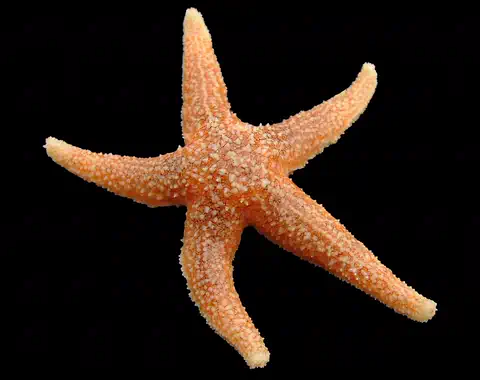
The common starfish is the most familiar starfish of the north-east Atlantic coasts. It has five arms, an eye spot at the tip of each one, and many tube feet. It can pull open a mussel shell and push its own stomach inside to eat.
Asterias rubens is an echinoderm of the north-east Atlantic, from the shore down to 650 meters. It feeds by prying bivalves apart with suction-tipped tube feet and everting its stomach through a gap of less than 0.1 millimeter, it can regrow lost arms, and its free-swimming larvae drift for weeks before settling.
Photo: © Hans Hillewaert, CC BY-SA 4.0, via Wikimedia Commons
Meet the common starfish
The common starfish lives in the sea.
It is shaped like a star with five arms. It is often orange. It has no head and no bones like ours.
The common starfish is the starfish you are most likely to meet on the coasts of the north-east Atlantic Ocean. Most are about 10 to 30 centimeters across, and a big one can reach about 52 centimeters.
It has a small middle part, called the central disc, and five tapering arms. It is usually orange, pale brown or violet. A starfish is not a fish at all. It belongs to a group called echinoderms, together with sea urchins and sea cucumbers.
Asterias rubens is the most common and familiar starfish in the north-east Atlantic, according to the Marine Life Information Network (MarLIN). It belongs to the phylum Echinodermata, class Asteroidea, alongside brittlestars, sea urchins and sea cucumbers.
Adults usually measure 10 to 30 centimeters across and can reach 52 centimeters, but size depends strongly on food supply, so a big starfish is not necessarily an old one. It normally has five arms, rarely four to eight. Adults show radial symmetry, arranged around a center, while the larvae are bilaterally symmetrical, with matching left and right sides.
Quick facts
- Group
- Invertebrate
- Length
- 10 to 30 cm
- Lifespan in the wild
- 5 to 10 years
Where it lives
Common starfish live along rocky and sandy shores.
Some live in pools on the beach. Others live deep under the sea. They like places with lots of mussels to eat.
Common starfish live in the north-east Atlantic Ocean, from Arctic Norway down the coasts of Europe and south to Senegal in West Africa. A few turn up in the Mediterranean Sea.
They live everywhere from the seashore, where the tide goes in and out, to about 650 meters deep. You can find them on rocks, gravel, sand and mud, and especially in beds of mussels and barnacles. They live on every coast of Britain and Ireland.
MarLIN describes the species as abundant throughout the north-east Atlantic, from Arctic Norway along Atlantic coasts to Senegal, and only occasionally in the Mediterranean; Animal Diversity Web extends the northern limit to the White Sea. It ranges from the intertidal zone to 650 meters on rock, coarse and shelly gravel, sand and mud, and is common in mussel and barnacle beds.
Densities vary enormously: MarLIN reports 2 to 31 starfish per square meter on fine sand and hundreds per square meter on algal carpets. MarLIN notes that Asterias vulgaris of the North American east coast has been considered the same species, but records from North America are not included here.
Did you know?
Sometimes huge crowds of starfish gather together.
In Morecambe Bay in England, one huge gathering of common starfish was estimated to clear away 3,500 to 4,000 tonnes of mussels in three months.
A Morecambe Bay aggregation of at least 2.4 million starfish, at feeding densities of 300 to 400 per square meter, was estimated to clear 3,500 to 4,000 tonnes of mussels between June and August.
Where can you find this animal?
- Lives here naturally · Countries and seas named by a scientific source
- Sightings recorded · Records of wild sightings (GBIF)
Lives here naturally · Countries and seas named by a scientific source
Coasts and coastal seas of the north-east Atlantic, from the shore to 650 meters deep, from Arctic Norway and the White Sea down the coasts of Europe. Only the coasts of each country shown. The range continues south along West Africa to Senegal, where few records exist; those countries are not shaded.
Places: Norway, Sweden, Denmark, Germany, Netherlands, Belgium, France, UK and 4 more places.
Source: https://www.marlin.ac.uk/species/detail/1194 · checked October 2026
Sightings recorded · Records of wild sightings (GBIF)
Counts of GBIF records of wild observations (human and machine) and preserved specimens. Records include introduced populations, vagrants, escaped or released animals and misidentifications, so a country with records is not necessarily part of the native range.
Wild sightings have been recorded in UK, Netherlands, Canada, Ireland, Norway, Sweden, United States, France and 29 more places.
Source: gbif · checked October 2026
Range maps show where scientists say an animal lives, often country by country. An animal may live in only part of a country shown, and sightings records can include animals that wandered far from home.
What it eats
The common starfish eats mussels, snails and worms.
It holds a shell with its feet and pulls. When the shell opens a tiny bit, it starts to eat.
Common starfish are carnivores. They eat mussels and other shellfish, sea snails, worms, other echinoderms and dead animals they find.
To eat a mussel, a starfish wraps its arms around the shell. The suction tips of its tube feet grip both halves and pull them apart. A gap of less than a tenth of a millimeter is enough: the starfish pushes its own stomach out of its mouth and into the shell, and digests the mussel right there.
Asterias rubens takes a wide range of prey, including bivalve and gastropod molluscs, polychaete worms and other echinoderms, and it scavenges carrion; small crustaceans are sometimes caught on its tube feet. It lacks jaws and teeth.
To feed on a bivalve it grips each valve with suction-tipped tube feet and pulls. Once a gap of less than 0.1 millimeter opens, it everts its stomach lobes between the valves and digests the soft tissue outside its body. Experiments show a well-developed sense of smell: it moves into water currents, more strongly when they carry the scent of live mussels. In Morecambe Bay, UK, one dense aggregation was estimated to clear 3,500 to 4,000 tonnes of mussels in three months.

A body without a head
A starfish has no head.
Its mouth is underneath, in the middle. Under each arm are lots of tiny tube feet. At the end of each arm is an eye spot.
A starfish has no head. Its mouth is on the underside, in the middle of the central disc. Under each arm is a groove packed with tube feet, tiny tubes with suckers on the end. The starfish uses them to walk, to grip and even to breathe.
At the very tip of each arm is an eye spot that can sense light. The top of the body is covered in little spines. Under the skin are hard plates called ossicles, yet the body is very bendy.
The body is a small central disc with five arms; there is no head, and the mouth lies on the oral (under) side where the ambulacral grooves of the arms meet. A radial canal runs along each arm as part of the water-vascular system, feeding the ampullae and tube feet that are used for locomotion, attachment and respiration; MarLIN notes that oxygen is taken up through the tube feet and the body wall.
An eye spot at each arm tip senses light. The upper surface carries major spines, often in rows, and the body wall is highly flexible. Beneath the skin lie hard calcium plates called ossicles.
From tiny larva to star
A mother starfish lets millions of eggs go into the sea.
The babies are tiny and drift in the water. Later they sink down and change into little stars.
Common starfish spawn from about February to April. Males and females release sperm and eggs into the sea, where the eggs are fertilized. A female about 14 centimeters across can release around 2.5 million eggs.
The young are larvae, tiny drifting creatures that look nothing like a star. They float in the plankton for weeks, and are ready to settle on the sea floor after about 87 days. There they change shape into a small starfish. Common starfish can breed after about a year and live 5 to 10 years.
The sexes are separate and fertilization is external; MarLIN gives a spawning season of February to April. A female 140 millimeters across can spawn about 2.5 million eggs, which develop into planktotrophic (plankton-feeding) larvae. After a long metamorphosis in open water, advanced brachiolaria larvae are ready to settle about 87 days after fertilization, and some can stay in the plankton for more than 100 days.
In a three-year study on a reef in Torbay, UK, young starfish grew fastest in their first year and became mature in their second, at about 5 centimeters across. Life span is given as 5 to 10 years. Starfish cannot be aged from growth rings, and a starving starfish can even shrink.
Slow but tough
Starfish move very slowly on their tiny feet.
If a starfish loses an arm, it can grow a new one. If it gets flipped over, it turns itself back.
Common starfish move slowly, about 15 centimeters a minute, gliding on many tube feet working together. If one gets flipped over, it twists one arm under, grips the ground with its tube feet and rolls itself the right way up. In stormy water it holds on tight and flattens itself against the rock.
A starfish can lose an arm to escape a predator and grow a new one. Growing back an arm can take one to two years.
Each tube foot can only extend or retract, but when many work in unison the starfish moves at around 15 centimeters (6 inches) a minute, and MarLIN records individuals crawling 5 to 7 meters a day. Overturned animals right themselves by twisting one arm until its tube feet grip, then rolling the body over as other arms join in. In heavy surf they clamp down and flatten their bodies.
Arms can be shed to escape predators and regrown; Animal Diversity Web reports regeneration of up to four lost arms, and MarLIN gives one to two years to regrow an arm. In shallow water the species sometimes gathers in dense aggregations of up to 100 starfish per square meter.
Did you know?
A starfish eats by pushing its tummy out of its mouth.
A common starfish can push its stomach out through its mouth and into a mussel shell through a gap less than a tenth of a millimeter wide.
Asterias rubens everts its stomach lobes into a bivalve once the valves part by less than 0.1 millimeter, digesting the prey outside its own body.
Starfish and people
There are lots of common starfish in the sea.
Scientists have not given them a danger rating. If you find one in a rock pool, look gently and leave it in the water.
The common starfish is not on any endangered list, and the IUCN Red List, which rates the risk to wild species, has no assessment for it. In many places it is very common.
Starfish can be hurt when fishing nets are dragged over the sea floor, but their ability to regrow arms helps them recover. They eat a lot of mussels, the same mussels people gather and sell as food, so starfish can cost the shellfish business money. Pollution with the metal cadmium can harm how their eggs develop.
No IUCN Red List category has been assigned to Asterias rubens: MarLIN lists no global red list category and Animal Diversity Web lists no special status. The species is widespread, fecund and has long-lived larvae that disperse more than 10 kilometers, so MarLIN rates its ability to recover from disturbance as high.
Bottom trawling damages arms, and the share of starfish with regenerating arms has been suggested as an indicator of fishing disturbance; at the same time, discarded and damaged animals give these scavengers extra food. MarLIN calls it a voracious consumer of the marketable mussel Mytilus edulis, which gives it considerable negative economic importance. Experiments found that cadmium pollution slows ovary growth and causes defects in offspring.
Did you know?
A starfish has an eye spot at the end of every arm.
Each arm of a common starfish ends in an eye spot that can sense light.
Light-sensitive eye spots sit at the tip of each of the five arms.
Amazing facts
-
A starfish eats by pushing its tummy out of its mouth.
A common starfish can push its stomach out through its mouth and into a mussel shell through a gap less than a tenth of a millimeter wide.
Asterias rubens everts its stomach lobes into a bivalve once the valves part by less than 0.1 millimeter, digesting the prey outside its own body.
-
A starfish has an eye spot at the end of every arm.
Each arm of a common starfish ends in an eye spot that can sense light.
Light-sensitive eye spots sit at the tip of each of the five arms.
-
One mother starfish can let go of millions of eggs.
A female common starfish about 14 centimeters across can release around 2.5 million eggs at one time.
MarLIN cites an estimate of 2.5 million eggs for a female 140 millimeters across, released for external fertilization.
-
Sometimes huge crowds of starfish gather together.
In Morecambe Bay in England, one huge gathering of common starfish was estimated to clear away 3,500 to 4,000 tonnes of mussels in three months.
A Morecambe Bay aggregation of at least 2.4 million starfish, at feeding densities of 300 to 400 per square meter, was estimated to clear 3,500 to 4,000 tonnes of mussels between June and August.
Words to know
- echinoderm
- a sea animal such as a starfish, sea urchin or sea cucumber
- tube feet
- tiny tubes with suckers under a starfish's arms, used to move and grip
- regenerate
- to grow back a lost body part
- larva
- a young animal that looks very different from its parents
- plankton
- tiny living things that drift in the water
- intertidal zone
- the part of the shore covered by the sea at high tide and uncovered at low tide
Discovery challenge
-
How many arms does a common starfish usually have?
How many arms does a common starfish usually have?
How many arms does Asterias rubens normally have?
- Three
- Five
- Ten
Show the answer
Five
A common starfish usually has five arms.
It normally has five tapering arms around a small central disc.
Five is normal; MarLIN notes that four to eight occur only rarely.
-
What does a starfish use to walk?
What does a starfish use to move and to grip shells?
Which structures does a starfish use for locomotion, attachment and gas exchange?
- Tube feet
- Fins
- Legs with claws
Show the answer
Tube feet
Lots of tiny tube feet help it creep along.
Many tube feet with suction tips let it move, grip and pull shells open.
Tube feet, part of the water-vascular system, serve locomotion, suction and respiration.
-
What is at the end of each starfish arm?
What is at the tip of each arm of a common starfish?
Which sense organ sits at each arm tip?
- A mouth
- An eye spot
- A tail
Show the answer
An eye spot
Each arm has an eye spot at the end. The mouth is in the middle, underneath.
An eye spot that senses light. The mouth is under the central disc.
A light-sensitive eye spot; the mouth is on the oral side of the disc.
-
What can a starfish do if it loses an arm?
What can a common starfish do after losing an arm?
How does Asterias rubens respond to losing an arm?
- Grow a new one
- Nothing at all
- Turn into two fish
Show the answer
Grow a new one
It can grow a new arm. It takes a long time.
It can regrow the arm, which takes about one to two years.
It regenerates the arm, within one to two years according to MarLIN.
Places where you might see it
-
 Watch
 Country
Norway
Norway stretches along the western side of the Scandinavian Peninsula, far into the Arctic. Deep, narrow inlets of the sea called fjords cut into its mountains, and about 5.6 million people live there, many of them near Oslo, the capital.
-
 Watch
 Country
United Kingdom
The United Kingdom, or UK, lies on islands off the northwest coast of Europe. It is made up of four parts, England, Scotland, Wales and Northern Ireland, and about 69.5 million people live there. Its capital is London.
Explore next
-
 Watch
Animal
Ochre sea star
The ochre sea star lives on wave-washed rocky shores along the Pacific coast of North America. It can be purple, orange or brown, and it pries open mussels to eat them with a stomach it pushes out of its body. It is so important to its shore that scientists call it a keystone species.
-
 Watch
Animal
Crown-of-thorns starfish
The crown-of-thorns starfish is a large sea star of Indian and Pacific Ocean reefs, with up to 21 arms and hundreds of sharp, toxic spines. It eats living coral by pushing its stomach out over it. Usually it is a normal part of the reef, but sometimes huge numbers appear, called outbreaks, and they can eat much of a reef's coral.
-
 Watch
Animal
Purple sea urchin
The purple sea urchin is a spiny, ball-shaped animal of North America's Pacific coast, up to about 10 centimeters across. It scrapes algae with a mouth of five teeth, walks on tiny tube feet, and can even carve a hollow in solid rock. Since 2014 its numbers have exploded in parts of California, and hungry urchins have eaten away large areas of kelp forest.
-
Watch
Country
Norway
Norway stretches along the western side of the Scandinavian Peninsula, far into the Arctic. Deep, narrow inlets of the sea called fjords cut into its mountains, and about 5.6 million people live there, many of them near Oslo, the capital.
-
Watch
Country
United Kingdom
The United Kingdom, or UK, lies on islands off the northwest coast of Europe. It is made up of four parts, England, Scotland, Wales and Northern Ireland, and about 69.5 million people live there. Its capital is London.
-
 Watch
Animal
Blue sea star
The blue sea star is easy to spot on Indian and Pacific Ocean reefs: bright blue, with five smooth, tube-shaped arms. It cleans up the reef by eating dead animals, tiny creatures and the thin film that grows on rocks, and it can grow back an arm it loses.
-
 Watch
Animal
American lobster
The American lobster is a big crustacean that lives on the rocky sea floor of the northwest Atlantic Ocean. It has two very different claws, one for crushing and one for tearing, and it must climb out of its hard shell again and again to grow.
-
 Watch
3D
Animal
Antarctic krill
Antarctic krill are small, shrimp-like crustaceans about 6 centimeters long that live in the icy Southern Ocean around Antarctica. They gather in enormous swarms, and almost all the bigger animals of the Antarctic, from penguins to blue whales, depend on them for food.
For parents & teachers
What children will learn
- Describe the starfish's body plan: central disc, five arms, tube feet and eye spots.
- Explain how a starfish opens a mussel and digests it outside its body.
- Describe the life cycle from drifting larva to settled starfish, and the ability to regrow arms.
- Locate the north-east Atlantic coasts where the common starfish lives.
Recommended ages: 3 to 17 · About 12 minutes
Talk about it
- How is a body with no head and five arms different from ours? What might be easier or harder?
- Why might people who gather mussels for food and starfish not always get along?
- Why is it kinder to look at rock pool animals and leave them where they are?
Try at home or in class
- Press a small suction cup onto a smooth tile and try to pull it off: feel how many tiny suckers working together could hold on to a shell.
- Draw a starfish from above and from below, and label the mouth, the arms, the tube feet and the eye spots.
Key vocabulary: echinoderm, tube feet, regenerate, larva, plankton, intertidal zone
Where these facts come from
- GBIF Backbone Taxonomy and GBIF Occurrence Search , Global Biodiversity Information Facility (CC0 1.0 (backbone); occurrence counts are facts derived from records under CC0, CC BY and CC BY-NC)
- Common starfish (Asterias rubens) , Marine Life Information Network (MarLIN), Marine Biological Association
- Asterias rubens , Animal Diversity Web, University of Michigan Museum of Zoology
- Wikidata , Wikimedia Foundation (CC0 1.0)
- Wikimedia Commons , Wikimedia Foundation (Per file: Public domain, CC0, CC BY or CC BY-SA only (credited on each page))
Checked, not yet human-reviewed. Last updated October 24, 2026. Spotted a mistake? Tell us.