
Animal
Epaulette shark
The epaulette shark is a small, spotty shark that lives on coral reefs. It can walk on its fins! It has a big black spot on each side, like a pretend eye.
The epaulette shark is a small, slender shark of Australia's Great Barrier Reef. It has a big black spot ringed with white above each front fin, and it can 'walk' along the reef, and even out of the water, by wriggling and pushing with its paddle-shaped fins. It can survive for a while in water with very little oxygen.
Hemiscyllium ocellatum is a small longtail carpet shark of shallow coral reefs in northeastern Australia, named for the large ocellus above each pectoral fin. It walks with its paired fins, in and out of water, forages at night by smell and electroreception, and tolerates hypoxia and even anoxia on reef flats isolated by low tide.
Photo: © Citron, CC BY-SA 3.0, via Wikimedia Commons
Meet the epaulette shark
The epaulette shark is a small shark with lots of dark spots.
It has a long tail and a big black spot behind its head. It lives on coral reefs in Australia. It can walk on its fins!
The epaulette shark is a small, slim shark, usually less than a meter long. It is pale with dark spots, and it has a very long tail.
Its name comes from the big black spot, ringed with white, above each of its front fins. To some people the spots look like epaulettes, the decorations on the shoulders of a fancy uniform. The epaulette shark spends its life on the bottom of shallow coral reefs, and it is famous for walking on its fins.
Hemiscyllium ocellatum is a cartilaginous fish (class Chondrichthyes, order Orectolobiformes) of the longtail carpet shark family, Hemiscylliidae. It is slender, reaching up to about 107 centimeters, though at Heron Island Reef none of 497 measured sharks exceeded 76 centimeters or 900 grams (IUCN).
The Australian Museum describes a large black ocellus (an eye-like spot with a pale ring) above each pectoral fin, widely spaced black spots on the body, two similar-sized dorsal fins and an anal fin just in front of the tail. It also has a groove joining mouth and nostrils, small triangular teeth and short nasal barbels. It can be told from the similar speckled carpet shark by the lack of small dark spots just behind the ocellus. The photographed shark lives in an aquarium, Océanopolis in France.
Quick facts
- Group
- Fish
- Length
- up to 1.07 m
- Weight
- up to 0.9 kg
Shallow coral reefs
Epaulette sharks live on coral reefs near Australia.
They like warm, shallow water. Sometimes the water is so shallow that their backs are almost out of it.
Epaulette sharks live on coral reefs in warm, shallow water off northeastern Australia, especially along the Great Barrier Reef. They stay near the bottom, on reef flats and among the coral.
At low tide, some reef flats are cut off from the sea and become small, warm pools only about 15 centimeters deep. At night the water in these pools can run very low on oxygen, but epaulette sharks can cope.
The Australian Museum describes the species as endemic to the Great Barrier Reef, from about the northern tip of Cape York Peninsula to the Capricorn Group. That account (updated 2023) draws on a 2016 review of the genus. The IUCN's 2015 assessment, still the current one but flagged as needing an update, gives a wider range: Queensland, the Northern Territory, northern Western Australia, possibly New South Wales, and New Guinea (Papua New Guinea and Indonesian Papua). The two sources disagree; the map shades only Australia, where both agree the shark lives, and GBIF holds just a handful of New Guinea records.
It is commonly found in shallow coral reef waters and reef flats and descends to at least 40 meters between reefs. A large population lives in the Capricorn-Bunker group, with part of it on a small area of Heron Island Reef estimated in the low thousands (IUCN).
Continent
Its habitat

Where can you find this animal?
- Lives here naturally · Countries and seas named by a scientific source
- Sightings recorded · Records of wild sightings (GBIF)
Lives here naturally · Countries and seas named by a scientific source
Shallow coral reefs and reef flats of northeastern Australia: the Australian Museum (2023) treats the species as endemic to the Great Barrier Reef, Cape York to the Capricorn Group. The IUCN's 2015 assessment (still current, needs updating) also lists the Northern Territory, Western Australia and New Guinea; Papua New Guinea and Indonesia are not shaded.
Places: Australia.
Source: https://australian.museum/learn/animals/fishes/epaulette-shark-hemiscyllium-ocel · checked October 2026
Sightings recorded · Records of wild sightings (GBIF)
Counts of GBIF records of wild observations (human and machine) and preserved specimens. Records include introduced populations, vagrants, escaped or released animals and misidentifications, so a country with records is not necessarily part of the native range.
Wild sightings have been recorded in Australia, Papua New Guinea, Solomon Is., Indonesia, Netherlands, Pacific Ocean, Indian Ocean, Atlantic Ocean and 2 more places.
Source: gbif · checked October 2026
Range maps show where scientists say an animal lives, often country by country. An animal may live in only part of a country shown, and sightings records can include animals that wandered far from home.
A night-time reef hunter
Epaulette sharks eat small animals on the reef.
They eat worms, crabs, shrimp and little fish. They find food by smell.
Epaulette sharks hunt along the reef floor for worms, crabs, shrimp, tiny shellfish called amphipods, and small fish.
They are most active at dusk and at night, and especially at low tide. They find their prey by smell, and they can also sense tiny electric signals given off by other animals.
The Australian Museum lists worms, crabs, shrimp, amphipods and small fishes as prey, detected by olfaction and by electroreception, the ability to sense weak electric fields. The IUCN notes that activity depends on tide and light: the sharks are more active at low water and, although they hunt by day, most active after dark and around dawn and dusk.
Newly hatched sharks live off a yolk sac stored in a bulging belly; as it is used up, juveniles become more slender and start foraging for worms, crustaceans and small fishes (Florida Atlantic University).
Did you know?
Its big black spots look like eyes.
Each big black spot on its sides is called an ocellus, an eye-like spot with a ring around it.
The ocellus is an eye-like spot with a marginal ring (Australian Museum).
Fins for walking, spots for show
The epaulette shark has a big black spot on each side, near its front fin.
Its fins are shaped like paddles. It uses them like legs to walk on the reef.
The big black spots ringed with white look a little like eyes, and scientists call each one an ocellus, an eye-like spot. Dark spots also dot the rest of the body.
The pectoral and pelvic fins are shaped like paddles. The shark uses them a bit like legs, wriggling its body from side to side and pushing with its fins to walk. Its two fins on the back are about the same size, and its tail is very long.
The large black ocellus with a white margin above each pectoral fin gives the species its name; small, widely spaced spots cover the body (Australian Museum). Florida Atlantic University researchers describe walking by body undulation combined with pushing by the paddle-shaped paired fins, used in slow-to-medium walking, fast walking and swimming.
A 2022 study of newly hatched and juvenile sharks found that walking and swimming movements stayed the same as the body changed shape. The species can also survive complete anoxia for about two hours without harm, and at a higher temperature than most other hypoxia-tolerant animals.
Eggs in the coral
Epaulette sharks lay eggs.
Each egg is in a tough case. The case is hidden in the coral. A little shark hatches out after about four months.
The epaulette shark lays eggs. Each egg is inside a tough case about 10 centimeters long. A female lays two cases at a time, at night, tucked among the coral.
She can lay a new pair about every two weeks, so she may have up to about 20 babies in a year. Each baby grows inside its case for about four months, then hatches as a tiny shark about 15 centimeters long.
The species is oviparous. In the wild, mating probably takes place from July to November, and females carrying egg cases have been found from August to December. Two egg capsules are laid among coral at night; a pair may be produced every 14 days, giving up to about 20 potential offspring per female each year (IUCN). Captive sharks have been noted to breed continuously.
Eggs, about 10 by 4 centimeters (Australian Museum), hatch after about 120 days (IUCN; the Australian Museum gives about 130), producing young 14 to 16 centimeters long. Growth is slow at first but reaches about 5 centimeters a year after about three months. Males mature at about 54 centimeters and females at about 62.
The shark that walks
Epaulette sharks walk across the reef on their fins.
They can even walk out of the water. They hide in small holes in the coral.
The epaulette shark is a walking shark. It wriggles its body and pushes with its paddle-like fins to walk along the sea floor, and it can even walk out of the water.
When the tide goes out, it can be trapped in warm, shallow pools with very little oxygen. Scientists found it can survive about two hours with no oxygen at all. It also squeezes into small crevices in the reef to hide from birds and bigger fish.
Epaulette sharks walk both in and out of water. On reef flats isolated by the outgoing tide they face short periods of high carbon dioxide, hypoxia and fluctuating temperature; the IUCN notes they live in waters about 15 centimeters deep and around 30 °C that become severely hypoxic at night.
The senior author of the 2022 study, Marianne Porter of Florida Atlantic University, described locomotion as key to survival for a small, bottom-dwelling mesopredator that maneuvers into small reef crevices to avoid aerial and aquatic predators. The researchers suggest these abilities may matter for coping with climate change, a question for future study.
Did you know?
A mother can lay two egg cases every two weeks.
A female can lay a pair of egg cases about every two weeks, up to about 20 babies a year.
Paired egg capsules every 14 days give up to about 20 potential offspring per female per year (IUCN).
Safe in a marine park
Epaulette sharks are not in danger.
Many live in a big protected ocean park. People keep the reef healthy so the sharks have a home.
The IUCN lists the epaulette shark as Least Concern. Much of its home on Australia's east coast is inside marine parks, including the Great Barrier Reef Marine Park, where it is common on some reefs.
A small number are collected for aquariums. Protecting coral reefs protects their home.
The IUCN's 2015 assessment classes the species as Least Concern globally and in Australia, with a stable trend and no major identified fishing pressure; marine parks protect much of its critical habitat on the east coast. A small aquarium trade targets it. The assessment is flagged as needing an update.
The same assessment treated sharks around New Guinea as a separate subpopulation, Near Threatened because of destructive fishing and pollution of coral reef habitat; the Australian Museum's current account treats the species as endemic to the Great Barrier Reef. Its tolerance of low oxygen may help it survive in areas of poor water quality (IUCN).
IUCN Red List
How is the epaulette shark doing in the wild?
- Least Concern (this animal)
- Near Threatened
- Vulnerable
- Endangered
- Critically Endangered
- Extinct in the Wild
- Extinct
Least Concern
Not at risk of disappearing from the wild right now.
See the IUCN Red List assessment · The IUCN Red List of Threatened Species 2022.2
Amazing facts
-
This shark can walk out of the water!
Epaulette sharks can walk out of the water by wriggling and pushing with their fins.
The species walks both in and out of water using body undulation and its paddle-shaped paired fins (Florida Atlantic University).
-
It can stay alive for a while with no air in the water.
Scientists found that epaulette sharks can survive about two hours with no oxygen at all.
Complete anoxia is tolerated for about two hours without adverse effects, at higher temperatures than most hypoxia-tolerant animals.
-
Its big black spots look like eyes.
Each big black spot on its sides is called an ocellus, an eye-like spot with a ring around it.
The ocellus is an eye-like spot with a marginal ring (Australian Museum).
-
A mother can lay two egg cases every two weeks.
A female can lay a pair of egg cases about every two weeks, up to about 20 babies a year.
Paired egg capsules every 14 days give up to about 20 potential offspring per female per year (IUCN).
Words to know
- ocellus
- a round spot that looks like an eye (plural: ocelli)
- reef flat
- the flat, shallow top of a coral reef, often uncovered at low tide
- egg case
- a tough covering that protects a baby shark as it grows outside its mother
- electroreception
- the ability to sense tiny electric signals made by other animals
- hypoxia
- too little oxygen in the water or air
- low tide
- the time when the sea is at its lowest level along the shore
Discovery challenge
-
What can the epaulette shark do with its fins?
What unusual thing can epaulette sharks do with their fins?
Which form of locomotion is the epaulette shark known for?
- Walk
- Fly
- Dig tunnels
Show the answer
Walk
It walks on its fins!
It walks along the reef, and even out of the water, by wriggling and pushing with its paddle-shaped fins.
Walking, in and out of water, by body undulation combined with pushing by the paired fins.
-
Where does the epaulette shark live?
Where do epaulette sharks live?
Which habitat do epaulette sharks mainly use?
- Snowy mountains
- Shallow coral reefs
- Desert sand dunes
Show the answer
Shallow coral reefs
It lives on coral reefs in warm, shallow sea.
They live on shallow coral reefs and reef flats of the Great Barrier Reef.
Shallow coral reef waters and reef flats, down to at least 40 meters between reefs.
-
How do baby epaulette sharks start life?
How are epaulette shark babies born?
What is the epaulette shark's mode of reproduction?
- They hatch from egg cases
- They grow on trees
- They hatch from bird nests
Show the answer
They hatch from egg cases
They hatch from tough egg cases hidden in the coral.
The mother lays egg cases in the coral, and the babies hatch after about four months.
Oviparity: paired egg capsules laid among coral hatch after about 120 to 130 days.
-
What is special about the black spot?
Why is it called an epaulette shark?
What feature does the name 'epaulette' refer to?
- A big black spot on each side
- A long nose like a sword
- Wings on its back
Show the answer
A big black spot on each side
It has a big black spot near each front fin.
Its big black spots above the front fins look a bit like epaulettes on a uniform's shoulders.
The large white-ringed ocellus above each pectoral fin.
Places where you might see it
Explore next
-
 Watch
3D
Animal
Whale shark
The whale shark is the largest fish in the world. This gentle giant swims through warm seas with its huge mouth open, filtering tiny plankton and small fish from the water, and every whale shark has its own pattern of pale spots.
-
 Watch
3D
Animal
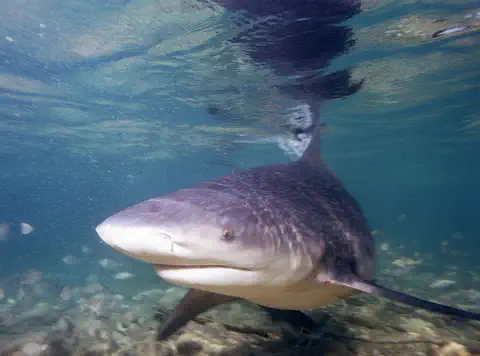
Bull shark
The bull shark is a large, stout shark of warm coasts around the world. It is one of very few sharks that can swim from the salty sea into fresh water, and it has been found thousands of kilometers up big rivers like the Amazon and the Mississippi.
-
 Watch
 Country
Australia
Australia is a country and the smallest continent, surrounded by ocean in the Southern Hemisphere. Much of its middle is dry and flat, most people live near the coast, and its animals include kangaroos, koalas and the platypus, a mammal that lays eggs.
-
 Watch
Animal
Ocellaris clownfish
The ocellaris clownfish is a small orange-and-white reef fish from the Indian and Pacific Oceans. It shelters among the stinging tentacles of a sea anemone, protected by a slimy coat, and every clownfish starts life as a male.
-
 Watch
3D
Animal
Reef stonefish
The reef stonefish is a master of disguise. Its lumpy, warty skin and rocky colors make it look like a stone or a piece of coral on the sea floor. It waits without moving until a small fish or shrimp comes near, then gulps it in a flash. Sharp spines on its back protect it from enemies.
-
 Watch
Animal
Alligator gar
The alligator gar is one of the largest freshwater fish in North America. It has a broad snout lined with teeth, armor-like scales, and a swim bladder that works like a lung, so it can gulp air in warm, still water. It lives in the big rivers, swamps and bayous of the southern United States, Mexico and Central America.
-
 Watch
Animal
Arapaima
The arapaima is one of the biggest freshwater fish in the world, longer than a grown-up is tall. It lives in the warm, slow rivers and flooded lakes of the Amazon, and it must swim up to the surface to gulp air every few minutes.
-
 Watch
Animal
Atlantic bluefin tuna
The Atlantic bluefin tuna is the largest of all tunas: big ones can be about 4 meters long. Its torpedo-shaped body is built for long journeys, and it can keep its body warmer than the water around it. Bluefin tuna were badly overfished, but with fishing limits set by countries working together, the numbers caught are now controlled.
For parents & teachers
What children will learn
- Describe how the epaulette shark walks and why that helps on a reef flat.
- Explain what low tide does to shallow reef pools and how this shark copes with low oxygen.
- Describe the shark's egg-laying life cycle.
- Understand that scientists revise where a species lives as they learn more.
Recommended ages: 3 to 17 · About 10 minutes
Talk about it
- Why might walking be more useful than swimming in a very shallow reef pool?
- Why do you think some animals have spots that look like eyes?
- What could happen to animals in tide pools if the sea gets warmer?
Try at home or in class
- Lie on your tummy and try to move forward by wriggling and pushing with your hands and feet, like an epaulette shark walking.
- Draw a shark with two big eye-spots and ask a friend which spots are the real eyes.
Key vocabulary: ocellus, reef flat, egg case, electroreception, hypoxia, low tide
Where these facts come from
- The IUCN Red List of Threatened Species , International Union for Conservation of Nature (IUCN terms of use (no redistribution of Red List data or range maps))
- GBIF Backbone Taxonomy and GBIF Occurrence Search , Global Biodiversity Information Facility (CC0 1.0 (backbone); occurrence counts are facts derived from records under CC0, CC BY and CC BY-NC)
- Hemiscyllium ocellatum (Epaulette Shark), 2015 global assessment , IUCN Red List of Threatened Species
- Epaulette Shark, Hemiscyllium ocellatum , Australian Museum
- Study First to Explore 'Walking' Shark Movements in Early Life Stages , Florida Atlantic University
- Wikidata , Wikimedia Foundation (CC0 1.0)
- Wikimedia Commons , Wikimedia Foundation (Per file: Public domain, CC0, CC BY or CC BY-SA only (credited on each page))
Checked, not yet human-reviewed. Last updated October 27, 2026. Spotted a mistake? Tell us.