Animal
Bull shark
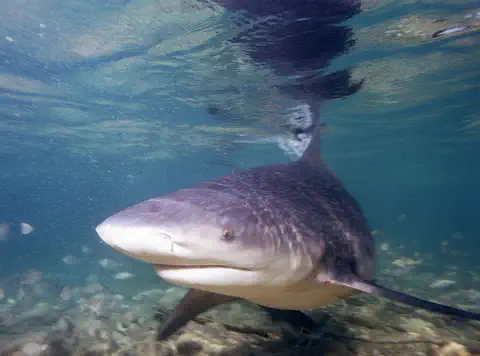
The bull shark is a big, chunky shark with a short, round nose. It can swim in the salty sea and in rivers too.
The bull shark is a large, stout shark of warm coasts around the world. It is one of very few sharks that can swim from the salty sea into fresh water, and it has been found thousands of kilometers up big rivers like the Amazon and the Mississippi.
Carcharhinus leucas is a heavy-bodied requiem shark of tropical and subtropical coasts that readily enters estuaries, rivers and some lakes, tolerating everything from fresh water to very salty lagoons. The IUCN lists it as Vulnerable with a decreasing population, threatened by fishing and by changes to the coastal and river habitats its young depend on.
Photo: Albert Kok, CC BY-SA 3.0, via Wikimedia Commons
Meet the bull shark
The bull shark is a big, chunky shark.
It is gray on top and pale underneath. It has a short, round nose and small eyes. It got its name because it is thick and strong, like a bull.
The bull shark is a large, heavy-bodied shark that lives along warm coasts all over the world. It can grow to about 3.4 meters long, and its body is thick and stout from nose to tail.
Its name comes from that bulky shape. Bull sharks are gray on top and pale cream underneath, with a short, blunt, rounded snout. What makes them really special is that they can leave the salty sea and swim far up rivers into fresh water.
Carcharhinus leucas is a requiem shark (family Carcharhinidae) that can reach a total length of about 3.4 meters; the longest reported was 4 meters. The Florida Museum explains that the common name comes from its stout build and its reputation for aggressive behavior.
It goes by many regional names that hint at its unusual range: Zambezi shark in southern Africa, Nicaragua shark in Central America, and freshwater whaler or Swan River whaler in Australia. Several of these are the names of rivers or a lake, places where bull sharks are found.
Quick facts
- Group
- Fish
- Length
- up to 3.4 m
- Top speed
- up to 19 km/h
- Lifespan in the wild
- from 25 years
From sea to river
Bull sharks live in warm, shallow water near the coast.
Some swim up rivers, far from the sea. They have even been found in a big lake.
Bull sharks live in warm, shallow coastal waters around the world, usually less than 30 meters deep. They often swim into bays, harbors, lagoons and river mouths, where fresh river water mixes with the salty sea.
They are one of very few sharks that move readily into fresh water. Bull sharks have been found about 3,700 kilometers up the Amazon River in Peru and more than 3,000 kilometers up the Mississippi River. A group in Lake Nicaragua reaches the sea through rivers.
The species occurs in tropical to subtropical coastal waters worldwide, preferring depths of less than 30 meters; the Florida Museum gives a range of 1 to 150 meters and the IUCN a lower limit of 164 meters. It commonly enters estuaries, bays, harbors, lagoons and river mouths, and it is one of very few sharks (with river sharks of the genus Glyphis) that readily enter fresh water and remain there for long periods.
Records include about 3,700 kilometers up the Amazon in Peru and over 3,000 kilometers up the Mississippi in Illinois. The Lake Nicaragua population was once thought landlocked, until it was shown to reach the ocean through rivers and estuaries. Bull sharks also tolerate hypersaline water up to 53 parts per thousand, saltier than the open sea.
Its habitat

Where can you find this animal?
- Lives here naturally · Countries and seas named by a scientific source
- Sightings recorded · Records of wild sightings (GBIF)
Lives here naturally · Countries and seas named by a scientific source
Warm, shallow coastal waters of the tropics and subtropics worldwide, including estuaries, river mouths and lagoons, and far up some rivers and into lakes (the Amazon, the Mississippi and Lake Nicaragua among them). Shading is by whole ocean, so it is much wider than where bull sharks actually live, and inland rivers are not shaded.
Places: Atlantic Ocean, Indian Ocean and Pacific Ocean.
Source: iucn-red-list · checked October 2026
Sightings recorded · Records of wild sightings (GBIF)
Counts of GBIF records of wild observations (human and machine) and preserved specimens. Records include introduced populations, vagrants, escaped or released animals and misidentifications, so a country with records is not necessarily part of the native range.
Wild sightings have been recorded in Australia, Mozambique, South Africa, United States, Brazil, Mexico, Cameroon, Fiji and 54 more places.
Source: gbif · checked October 2026
Range maps show where scientists say an animal lives, often country by country. An animal may live in only part of a country shown, and sightings records can include animals that wandered far from home.
What it eats
Bull sharks eat mostly fish.
They also eat small sharks and stingrays. Sometimes they catch turtles, squid or sea birds.
Bull sharks mainly eat bony fish and small sharks. Along the coasts of the western Atlantic, they catch fish such as mullet, tarpon, catfish, snook, jacks and mackerel, and they also eat stingrays.
They are opportunists, which means they will eat whatever they come across. Now and then they eat sea turtles, dolphins, crabs, shrimp, sea birds or squid.
Bony fishes and small sharks make up the great majority of the diet. In the western Atlantic, the Florida Museum lists mullet, tarpon, catfishes, menhaden, gar, snook, jacks, mackerel, snappers and other schooling fish, along with stingrays and juvenile sharks, including young bull sharks in nursery areas.
Less often, bull sharks take sea turtles, dolphins, crabs, shrimp, seabirds and squid, and even land mammals. They look sluggish as they cruise slowly near the bottom, but they can accelerate in quick bursts to catch smaller, agile prey, reaching over 19 kilometers per hour over short distances.
Did you know?
Bull sharks have lots of different names.
Bull sharks have many names: Zambezi shark in southern Africa, Nicaragua shark in Central America and Swan River whaler in Australia.
Regional names such as Zambezi shark, Nicaragua shark, Ganges shark and Swan River whaler include the names of rivers and a lake where the shark is found.
A stout, strong body
A bull shark has a short, round nose and small eyes.
It has a big fin on its back and wide fins on its sides. Its teeth are sharp, with tiny bumps like a saw.
The bull shark's snout is short, blunt and rounded. Its eyes are small for a shark its size. Scientists think this may be because it often lives in muddy, cloudy water where seeing far is not much use.
The first fin on its back is large and triangle-shaped, and its side fins are big and broad. The teeth in its upper jaw are wide, triangle-shaped and edged with tiny saw-like points. Young bull sharks have dark tips on their fins, which fade as they grow.
Bull sharks are very stout-bodied, with a blunt, rounded snout and no ridge between the dorsal fins. The first dorsal fin is large and broadly triangular with a pointed tip; the second is much smaller. The pectoral fins are large, broad and angular. The Florida Museum notes that the eyes are small compared with most other carcharhinid sharks, which suggests vision may matter less to a species that often lives in murky water.
Upper teeth are broad, triangular and heavily serrated; lower teeth are narrower with fine serrations. Coloration is pale to dark gray above, fading to pale cream below. Juveniles have dark fin tips that become a more diffuse dusky color with age.
Growing up
Bull shark babies are called pups.
They grow inside their mother for almost a year. They are born in shallow water, in lagoons and river mouths.
Bull shark pups grow inside their mother for 10 to 11 months, fed through a special connection a little like a placenta. A mother has 1 to 13 pups at a time, each about 56 to 81 centimeters long.
Pups are born in shallow, less salty water such as coastal lagoons and river mouths. Places like these, where young animals grow up, are called nurseries. Bull sharks grow slowly: females are not ready to have pups until they are about 18 years old.
Bull sharks are viviparous: one to thirteen pups develop on a yolk-sac placenta for 10 to 11 months and are born free-swimming, 56 to 81 centimeters long. In the Gulf of Mexico mating takes place in summer and pups are born the following April to June, while in the warmest parts of the range breeding happens all year.
Coastal lagoons, river mouths and other low-salinity estuaries serve as nurseries. Growth is about 16 to 18 centimeters a year for the first two years, then slows to 4 to 5 centimeters. Males mature at 14 to 15 years (1.57 to 2.26 meters) and females at about 18 years (1.8 to 2.3 meters); the known lifespan is over 25 years.
A traveler of coasts and rivers
Bull sharks often cruise slowly near the bottom.
In summer, some swim along the coast to cooler places. When the water gets cold, they swim back to warm seas.
Bull sharks often look slow and lazy as they cruise near the bottom, but they can speed up in a flash to catch fast fish. Adults have few natural enemies, though young bull sharks can be eaten by bigger sharks.
In the western Atlantic, many bull sharks travel north along the coast of the United States in summer, as far as Massachusetts. When the coastal water cools, they swim back to warmer, tropical seas.
Adult bull sharks have few natural predators; juveniles are taken by tiger sharks, sandbar sharks and larger bull sharks. In the western Atlantic they migrate north along the U.S. coast in summer, as far as Massachusetts, and return to tropical waters as the coast cools.
Bull sharks are common in shallow water close to where people live. The Florida Museum, citing the International Shark Attack File (2018), reports that the species has been linked to at least 100 unprovoked bites on people worldwide, 27 of them fatal, and that many more may go unrecorded or unassigned to a species. It notes that many consider the bull shark the most dangerous shark, because of its size, its use of fresh water and how close it lives to people.
Did you know?
Bull sharks can live in water that is saltier than the sea.
Bull sharks can live in fresh river water, and also in lagoons that are much saltier than the ocean.
The species tolerates everything from fresh water to hypersaline lagoons of 53 parts per thousand.
Protecting bull sharks
There are fewer bull sharks than there used to be.
Many are caught in fishing gear. The river mouths where their babies grow up need protecting too.
The bull shark is listed as Vulnerable, which means it is at risk of becoming endangered, and its numbers are going down.
Because it lives in shallow water near towns and cities, it is easy for people to affect. Many are caught on fishing lines for meat, fins and skin. Building along coasts and rivers, and changes from storms and a warming climate, can harm the calm river mouths where pups grow up.
The IUCN assessed the bull shark in November 2020 (published 2021) as Vulnerable under criteria A2bcd, with a decreasing population and a generation length of 18 to 27 years. Listed threats include fishing, housing and commercial development, and habitat shifting, storms and flooding linked to climate change.
It is not a target of most commercial fisheries but is regularly caught on bottom longlines and is often targeted by small-scale fisheries; meat, fins and skin are all used. The Florida Museum stresses that inshore nursery grounds are especially at risk, and reports that the average size of bull sharks caught in the Natal Sharks Board's beach nets in South Africa has fallen.
IUCN Red List
How is the bull shark doing in the wild?
- Least Concern
- Near Threatened
- Vulnerable (this animal)
- Endangered
- Critically Endangered
- Extinct in the Wild
- Extinct
Vulnerable
At high risk of disappearing from the wild.
See the IUCN Red List assessment · The IUCN Red List of Threatened Species 2022.2
Amazing facts
-
Bull sharks can swim in rivers, far from the sea.
A bull shark was found about 3,700 kilometers up the Amazon River in Peru.
River records include about 3,700 kilometers up the Amazon in Peru and over 3,000 kilometers up the Mississippi in Illinois.
-
Baby bull sharks have dark tips on their fins.
Young bull sharks have dark tips on their fins, which fade to a dusky color as they grow up.
Juveniles have dark fin tips that become a more diffuse dusky color with age.
-
Bull sharks have lots of different names.
Bull sharks have many names: Zambezi shark in southern Africa, Nicaragua shark in Central America and Swan River whaler in Australia.
Regional names such as Zambezi shark, Nicaragua shark, Ganges shark and Swan River whaler include the names of rivers and a lake where the shark is found.
-
Bull sharks can live in water that is saltier than the sea.
Bull sharks can live in fresh river water, and also in lagoons that are much saltier than the ocean.
The species tolerates everything from fresh water to hypersaline lagoons of 53 parts per thousand.
Words to know
- estuary
- the place where a river meets the sea and fresh and salt water mix
- fresh water
- water that is not salty, like most rivers and lakes
- nursery
- a sheltered place where young animals grow up
- snout
- the front part of an animal's head, around its nose and mouth
- opportunist
- an animal that eats whatever food it comes across
- vulnerable
- at risk of becoming endangered in the wild
Discovery challenge
-
Where can bull sharks swim?
What makes bull sharks unusual among sharks?
Which ability sets the bull shark apart from most sharks?
- They can fly over waves
- They can swim in the sea and in rivers
- They live only in icy water
Show the answer
They can swim in the sea and in rivers
Bull sharks can swim in the salty sea and in rivers too.
Bull sharks are one of very few sharks that can move from salty sea water into fresh water, far up rivers.
It readily moves between marine, estuarine and fresh water and can stay in fresh water for long periods.
-
How did the bull shark get its name?
How did the bull shark get its name?
What is the bull shark's common name based on?
- It has horns
- It eats grass
- Its body is thick and strong
Show the answer
Its body is thick and strong
Bull sharks are thick and strong, like a bull.
Its body is stout and heavy, like a bull's.
The name derives from its stout build (and, the Florida Museum adds, its reputation for aggressive behavior).
-
Where are bull shark babies born?
Where are bull shark pups usually born?
Which habitats serve as bull shark nurseries?
- Deep in the open ocean
- In lagoons and river mouths
- On sandy beaches
Show the answer
In lagoons and river mouths
Bull shark pups are born in shallow water, in lagoons and river mouths.
Pups are born in shallow, less salty water such as coastal lagoons and river mouths.
Coastal lagoons, river mouths and other low-salinity estuaries are common nursery habitats.
-
What do bull sharks mostly eat?
What makes up most of a bull shark's diet?
What makes up the great majority of the bull shark's diet?
- Fish and small sharks
- Seaweed
- Fruit
Show the answer
Fish and small sharks
Bull sharks mostly eat fish and small sharks.
Bony fish and small sharks make up most of what bull sharks eat, along with stingrays.
Bony fishes and small sharks dominate the diet; turtles, dolphins, crustaceans, seabirds and squid are taken occasionally.
Places where you might see it
-
 Watch
 Country
Australia
Australia is a country and the smallest continent, surrounded by ocean in the Southern Hemisphere. Much of its middle is dry and flat, most people live near the coast, and its animals include kangaroos, koalas and the platypus, a mammal that lays eggs.
-
 Watch
 Country
Mozambique
Mozambique stretches along the Indian Ocean coast of southeastern Africa. The great Zambezi River cuts through its middle, its beaches face the island of Madagascar, and parks like Gorongosa are home to elephants and lions. About 35.6 million people lived there in 2025, and Portuguese is the official language.
Explore next
-
 Watch
3D
Animal
Tiger shark
The tiger shark is one of the biggest sharks in the sea. Young tiger sharks have dark spots and stripes like a tiger, which fade as they grow. It eats an amazing range of food, and it travels long distances between warm and cooler seas.
-
 Watch
3D
Animal
Great white shark
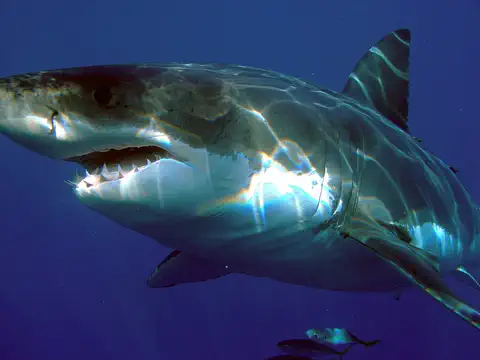
The great white shark is the largest of the mackerel sharks: a strong, torpedo-shaped fish with a gray back and a white belly. It hunts fish, seals and sea lions, and it is partly warm-blooded, which helps it stay active in cool water.
-
 Watch
Animal
Great hammerhead
The great hammerhead is the biggest of the hammerhead sharks. Its wide, flat head, called a cephalofoil, holds its eyes far apart and is packed with senses that help it find stingrays hiding in the sand of warm, shallow seas.
-
Watch
Country
Australia
Australia is a country and the smallest continent, surrounded by ocean in the Southern Hemisphere. Much of its middle is dry and flat, most people live near the coast, and its animals include kangaroos, koalas and the platypus, a mammal that lays eggs.
-
Watch
Country
Mozambique
Mozambique stretches along the Indian Ocean coast of southeastern Africa. The great Zambezi River cuts through its middle, its beaches face the island of Madagascar, and parks like Gorongosa are home to elephants and lions. About 35.6 million people lived there in 2025, and Portuguese is the official language.
-
 Watch
3D
Animal
Epaulette shark
The epaulette shark is a small, slender shark of Australia's Great Barrier Reef. It has a big black spot ringed with white above each front fin, and it can 'walk' along the reef, and even out of the water, by wriggling and pushing with its paddle-shaped fins. It can survive for a while in water with very little oxygen.
-
 Watch
3D
Animal
Scalloped hammerhead
The scalloped hammerhead is a large shark with a wide, flat head shaped like a hammer, with wavy notches along the front edge. It lives in warm coastal seas around the world, gathers in big schools, and hunts fish and squid. It is now critically endangered because so many are caught.
-
 Watch
Animal
Alligator gar
The alligator gar is one of the largest freshwater fish in North America. It has a broad snout lined with teeth, armor-like scales, and a swim bladder that works like a lung, so it can gulp air in warm, still water. It lives in the big rivers, swamps and bayous of the southern United States, Mexico and Central America.
For parents & teachers
What children will learn
- Explain what an estuary is and why moving between salt and fresh water is unusual for a shark.
- Identify the bull shark's main features: stout body, rounded snout, small eyes and broad fins.
- Describe how bull sharks use river mouths and lagoons as nurseries.
- Explain why a slow-growing shark that lives near people is vulnerable to fishing and habitat change.
Recommended ages: 3 to 17 · About 15 minutes
Talk about it
- Why might calm river mouths be good places for baby sharks to grow up?
- Bull sharks have small eyes and often live in muddy water. Which other senses might help them find food?
- What could towns along rivers and coasts do to keep nursery areas healthy?
Try at home or in class
- Stir several spoonfuls of salt into one glass of water and leave a second glass plain. Gently lower a fresh egg into each: with enough salt, the egg floats in the salty glass. Talk about how salt water and fresh water are different.
- Find the Amazon and Mississippi Rivers on a map or globe and trace how far a bull shark has traveled from the sea.
Key vocabulary: estuary, fresh water, nursery, snout, opportunist, vulnerable
Where these facts come from
- The IUCN Red List of Threatened Species , International Union for Conservation of Nature (IUCN terms of use (no redistribution of Red List data or range maps))
- GBIF Backbone Taxonomy and GBIF Occurrence Search , Global Biodiversity Information Facility (CC0 1.0 (backbone); occurrence counts are facts derived from records under CC0, CC BY and CC BY-NC)
- Carcharhinus leucas (Bull Shark), 2020 global assessment , IUCN Red List of Threatened Species
- Bull Shark (Carcharhinus leucas) species profile , Florida Museum of Natural History
- Shark anatomy , Fisheries and Oceans Canada
- Wikidata , Wikimedia Foundation (CC0 1.0)
- Wikimedia Commons , Wikimedia Foundation (Per file: Public domain, CC0, CC BY or CC BY-SA only (credited on each page))
Checked, not yet human-reviewed. Last updated October 27, 2026. Spotted a mistake? Tell us.