
Animal
Gray wolf
The gray wolf is a wild dog that lives in a family called a pack. Wolves howl to talk to each other. Pet dogs came from wolves long ago.
The gray wolf is the largest member of the dog family and the wild ancestor of pet dogs. Wolves live in family packs that hunt big animals like elk and moose together, and their howls can carry about 10 kilometers. After being wiped out in many places, wolves are coming back in parts of North America and Europe.
Canis lupus once had the largest natural range of any land mammal apart from humans, across North America and Eurasia. It is a cooperative hunter living in family packs led by a breeding pair. Persecution removed it from much of its range, but legal protection and reintroductions, as in Yellowstone from 1995, have brought recoveries, and the IUCN lists it as Least Concern.
Photo: User:Mas3cf, CC BY-SA 4.0, via Wikimedia Commons
Meet the gray wolf
The gray wolf is a big, wild dog.
It has thick fur, pointy ears and a bushy tail. Wolves live in families called packs. Wolves are the great-great-grandparents of pet dogs.
The gray wolf is the biggest wild member of the dog family. Males weigh about 30 to 80 kilograms and females about 23 to 55, and from nose to tail a wolf can be up to about 2 meters long.
Despite the name, gray wolves are not always gray. Depending on where they live, they can be white, black, brown or gray, and their color helps them stay hidden while they hunt. Pet dogs are descended from gray wolves, so every dog has a little wolf inside.
Canis lupus is the largest wild canid: the Smithsonian's National Zoo gives male weights of 30 to 80 kilograms, females 23 to 55, and total lengths of 130 to 205 centimeters. Coat color ranges from white in Arctic populations to black, with light brown or gray most common, and it provides camouflage during hunts.
The domestic dog descends from wolf lineages, and many authorities classify it as a subspecies, Canis lupus familiaris. Wolves vary widely across their range, from large northern animals to smaller wolves of hot, dry regions, and several regional forms are recognized as subspecies.
Quick facts
- Group
- Mammal
- Length
- 1.3 to 2.05 m
- Weight
- 23 to 80 kg
- Lifespan in the wild
- 7 to 8 years
Where it lives
Wolves live in the north of the world.
Some live in forests. Some live in mountains. Some live in the cold Arctic, where there is lots of snow.
Gray wolves live across North America, Europe and Asia, in forests, mountains, grasslands, deserts and the Arctic tundra. Long ago, they lived in more places than any other land mammal except people.
People hunted and poisoned wolves until they disappeared from many countries, including the United Kingdom, Ireland and Japan, and from most of the United States by the early 1900s. Today wolves are returning to parts of Europe and the American West.
Historically the gray wolf had the greatest natural range of any terrestrial mammal other than humans, across most of North America and Eurasia. The IUCN Red List (2025 assessment) lists it as extant in about seventy countries, from Canada, the United States and Mexico through Europe to the Middle East, Central Asia, India, China and Russia, and extinct in Ireland, Japan and the United Kingdom.
Habitat loss and extermination programs removed wolves from most of the contiguous United States by the early 1900s. Legal protection and reintroductions have since restored populations in parts of western North America, and Britannica reports that the small populations of southern Europe and Scandinavia are increasing. Shading is by country; within many shaded countries wolves occupy only part of the land.
Continents
Its habitats


Where can you find this animal?
- Used to live here · Countries and seas named by a scientific source
- Lives here naturally · Countries and seas named by a scientific source
- Sightings recorded · Records of wild sightings (GBIF)
Used to live here · Countries and seas named by a scientific source
Countries where wild wolves used to live but are now gone: Ireland, Japan and the United Kingdom.
Places: Ireland, Japan and UK.
Source: iucn-red-list · checked October 2026
Lives here naturally · Countries and seas named by a scientific source
Forests, mountains, grasslands, deserts and Arctic tundra across North America, Europe and Asia. In many countries shown, wolves live only in some regions; in the contiguous United States only in some regions, such as the northern Rocky Mountains, where wolves were reintroduced, and Minnesota.
Places: Afghanistan, Albania, Armenia, Austria, Azerbaijan, Belarus, Belgium, Bhutan and 56 more places.
Source: iucn-red-list · checked October 2026
Sightings recorded · Records of wild sightings (GBIF)
Counts of GBIF records of wild observations (human and machine) and preserved specimens. Records include introduced populations, vagrants, escaped or released animals and misidentifications, so a country with records is not necessarily part of the native range.
Wild sightings have been recorded in France, Australia, United States, Switzerland, Norway, Colombia, Chile, Spain and 150 more places.
Source: gbif · checked October 2026
Range maps show where scientists say an animal lives, often country by country. An animal may live in only part of a country shown, and sightings records can include animals that wandered far from home.
What it eats
Wolves eat meat.
The pack hunts big animals together, like deer and elk. Sometimes wolves also catch rabbits and fish, and eat berries.
Wolves are carnivores that hunt as a team. Working together, a pack can catch animals much bigger than a single wolf, such as caribou, moose, deer, elk and bison. Wolves also catch smaller animals like beavers, rabbits and fish, and sometimes eat berries.
In Yellowstone National Park, about nine out of every ten animals wolves eat in winter are elk. When wolves make a kill, ravens, magpies and coyotes come to share the leftovers, so wolves help feed many other animals.
Wolves are cursorial, cooperative hunters: packs chase prey and sometimes drive it toward other pack members waiting in a trap, using speed, teeth and claws. Large ungulates such as caribou, moose, deer, elk and bison dominate the diet, with beavers, hares and rabbits, fish and occasionally berries as extras.
In Yellowstone, the National Park Service reports that about 90 percent of winter prey is elk, with more deer in summer and bison of growing importance. Kills feed a whole community: ravens and magpies arrive almost immediately and coyotes wait nearby, which is part of why wolves are studied as a key influence on ecosystems.
Did you know?
Wolf howls can be heard very far away.
Other wolves can hear a wolf's howl 10 to 11 kilometers away.
Individual howls differ and carry 10 to 11 kilometers, letting packs coordinate and mark territory over large areas.
Built to travel and hunt
Wolves have long legs for running far.
They have sharp teeth and a great sense of smell. Their thick fur keeps them warm in the snow.
A wolf's body is made for traveling long distances and hunting big animals. Long legs and big feet carry it over snow and rough ground, and strong jaws with sharp teeth hold on to prey.
Thick fur keeps wolves warm in freezing winters. Their coats can be white, gray, brown or black, which helps them blend in with snow, rocks or forest. Their ears stand up to catch sounds, and their howls can be heard by other wolves 10 to 11 kilometers away.
Wolves combine endurance with power: long limbs and large paws for covering ground, speed to close on fleeing prey, and teeth and claws to bring it down. A dense winter coat insulates against extreme cold in northern populations, and coat color, from white to black, is tuned to local surroundings.
Communication shapes the body too. Erect ears and tail positions signal status within the pack: the National Zoo describes dominant wolves holding the tail partly erect and the head high, and raising their hackles. Individual howls differ and can be heard by other wolves 10 to 11 kilometers away.
Growing up
Baby wolves are called pups.
They are born in a den underground. At first they cannot see or hear. The whole pack helps to look after them.
Usually only the leading pair in a pack has pups. After about two months, the mother gives birth to around six pups in a den, often an underground burrow. Newborn pups weigh about 450 grams and are blind and deaf.
Their eyes open after 11 to 15 days, and at about 3 weeks old they come out of the den for the first time. The whole pack helps raise them. At about 2 years old, a young wolf may leave to find a mate and start a pack of its own.
In most packs only the dominant pair breeds. Gestation lasts 62 to 63 days and the average litter is six. Pups weigh about 450 grams at birth, are blind and deaf, open their eyes at 11 to 15 days and leave the den at about three weeks. Maternity dens, usually burrows dug or enlarged by the parents, are among the few shelters wolves use and may be reused for years.
The parents teach the pack's young how to hunt, avoid threats and mark territory, and older siblings help with care. Young wolves mature at about two years, often exploring the territory's edges before dispersing, and may found a new pack at about three. Wild wolves typically live seven to eight years.

Pack life and howling
A wolf pack is a family.
There is a mom, a dad and their young. Wolves howl to call their family together. A lost wolf howls so the pack can find it.
A wolf pack is a family: a mother and father, called the dominant pair, and their young from the last few years. Most packs have five to eight wolves, but some have had as many as 36. The pack shares a territory and defends it from other packs.
Howling is how wolves talk over long distances. A howl can gather the pack, start a hunt or warn other packs to stay away. A wolf that is separated from its pack makes a special 'lonesome howl', and when the pack answers, it howls back so they can find each other.
The pack is essentially a family group: a breeding pair, sometimes mated for life, and their offspring, typically five to eight animals but occasionally up to 36. Social living brings measurable benefits documented in Yellowstone: cooperative care of pups, group hunting of large prey, defense of territory and carcasses, and support for injured members.
Vocalizations include growls, barks and howls. Howling reassembles the pack, stimulates hunting and advertises territory; a rising 'lonesome howl' from a separated wolf, if answered, gives way to deep, even howls that help the pack locate it. Territories are also maintained by scratching, urine and scent marks, and howling increases in the January to April breeding season.
Did you know?
Wolves help feed other animals.
When wolves catch an elk, ravens, magpies and coyotes soon come to eat the leftovers.
In Yellowstone, ravens and magpies arrive at wolf kills almost immediately, followed by coyotes, so wolves supply food to many scavengers.
The wolf's comeback
Long ago, people chased wolves away from many places.
Now people are helping wolves come back. In Yellowstone Park, wolves were brought back home.
For hundreds of years, people hunted and poisoned wolves to protect farm animals, and wolves disappeared from many countries. By the early 1900s they were gone from most of the United States.
Then people began to protect them. From 1995 to 1997, 41 wild wolves from Canada and Montana were released in Yellowstone National Park, where wolves had been missing for decades. Today wolves are listed as Least Concern worldwide, but some populations are still small, and people work to share the land with them.
The IUCN Red List (2025 assessment) lists the gray wolf as Least Concern with a stable trend and about 145,000 to 200,000 mature individuals. Regional pictures differ: the Smithsonian notes that the U.S. Fish and Wildlife Service has listed several populations with statuses from Endangered to Delisted due to recovery.
Yellowstone is the best-known recovery. After extermination by the early 1900s, the northern Rocky Mountain wolf was listed as endangered, and 41 wolves were released in 1995 to 1997; numbers in the park have fluctuated between about 83 and 123 since 2009. Competition with livestock farming remains a major concern where wolves return, and programs that compensate ranchers for losses aim to reduce it.
IUCN Red List
How is the gray wolf doing in the wild?
- Least Concern (this animal)
- Near Threatened
- Vulnerable
- Endangered
- Critically Endangered
- Extinct in the Wild
- Extinct
Least Concern
Not at risk of disappearing from the wild right now.
See the IUCN Red List assessment · The IUCN Red List of Threatened Species 2022.2
Amazing facts
-
Wolf howls can be heard very far away.
Other wolves can hear a wolf's howl 10 to 11 kilometers away.
Individual howls differ and carry 10 to 11 kilometers, letting packs coordinate and mark territory over large areas.
-
A lost wolf howls so its family can find it.
A wolf separated from its pack gives a 'lonesome howl'. When the pack answers, it howls back so they can find each other.
The rising 'lonesome howl' of a separated wolf, if answered, switches to deep, even howls that help the pack locate it.
-
Wolves help feed other animals.
When wolves catch an elk, ravens, magpies and coyotes soon come to eat the leftovers.
In Yellowstone, ravens and magpies arrive at wolf kills almost immediately, followed by coyotes, so wolves supply food to many scavengers.
-
Gray wolves can be white or black too.
Gray wolves can be white, black, brown or gray, depending on where they live.
Coat color in Canis lupus ranges from white to black, with gray and light brown most common, and helps with camouflage.
Words to know
- pack
- a family group of wolves that live and hunt together
- howl
- a long, loud call wolves use to talk over long distances
- den
- a hidden home, often underground, where wolf pups are born
- territory
- the area a pack lives in and defends
- reintroduction
- bringing an animal back to a place where it used to live
- scavenger
- an animal that eats leftovers from other animals' meals
Discovery challenge
-
What is a wolf family called?
What is a wolf pack, usually?
What is the usual structure of a wolf pack?
- A family
- A group of strangers
- A herd of deer
Show the answer
A family
A wolf pack is a family!
A pack is usually a mother and father and their young.
A breeding pair and their offspring from recent years.
-
Why do wolves howl?
Which is NOT a reason wolves howl?
Which function of howling is NOT described for wolves?
- To call the pack together
- To keep their fur clean
- To tell other packs to stay away
Show the answer
To keep their fur clean
Wolves howl to call their family and say, this is our home!
Howls gather the pack, start a hunt and warn other packs, but they don't clean fur.
Howling reassembles the pack, stimulates hunting and advertises territory.
-
Which pet came from wolves?
Which animal is descended from the gray wolf?
Which domestic animal descends from Canis lupus?
- The dog
- The cat
- The rabbit
Show the answer
The dog
Pet dogs came from wolves long ago.
Dogs descended from gray wolves over thousands of years.
The domestic dog, often classed as Canis lupus familiaris.
-
Where were wolves brought back home?
Where were 41 wolves released from 1995 to 1997?
Which reintroduction released 41 wolves from 1995 to 1997?
- Yellowstone National Park
- The Sahara Desert
- Antarctica
Show the answer
Yellowstone National Park
Wolves came back to Yellowstone Park.
Wolves from Canada and Montana were released in Yellowstone National Park.
The Yellowstone reintroduction, within the northern Rocky Mountain recovery area.
Places where you might see it
-
 Watch
 Country
Türkiye (Turkey)
Türkiye, also called Turkey, lies partly in Asia and partly in Europe. A narrow waterway called the Bosporus runs through its biggest city, Istanbul, and its land is mostly mountains and high plains. About 86 million people live there.
-
 Watch
Natural wonder
Denali
Denali is North America's highest mountain, 6,190 meters (20,310 feet) tall, in the Alaska Range. It rises about 5.6 kilometers from its base, more than Mount Everest does from its own high base. Huge glaciers spread from it in every direction, and the national park around it is home to grizzly bears, moose, caribou, Dall sheep and wolves.
-
Watch
 Country
Moldova
Moldova is a small landlocked country in eastern Europe, squeezed between Romania and Ukraine. Most of it lies between two rivers, the Prut and the Dniester, and its rich black soil grows grapes, sunflowers, grain and fruit. About 2.4 million people were counted there in 2024.
-
 Watch
 Country
Croatia
Croatia is a crescent-shaped country in southeastern Europe. Its long coast on the Adriatic Sea is fringed by more than 1,100 islands, limestone mountains rise behind it, fertile plains lie in the north, and about 3.87 million people lived there in mid-2025.
-
 Watch
 Country
Romania
Romania is a country in southeastern Europe. The Carpathian Mountains curve around its middle, the Danube River runs along its southern edge to a huge delta on the Black Sea, and about 19 million people lived there at the start of 2026.
-
 Watch
 Country
Bosnia and Herzegovina
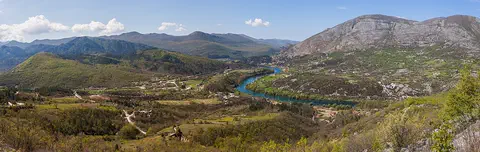
Bosnia and Herzegovina is a mountainous country in southeastern Europe. It has forests, limestone hills and many rivers, and famous old stone bridges cross some of them. Its capital is Sarajevo. It touches the Adriatic Sea along only about 20 kilometers of coast.
-
 Watch
Natural wonder
Lake Superior
Lake Superior is the largest of North America's five Great Lakes, shared by the United States and Canada. It covers about 82,100 square kilometers, reaches 406 meters deep, and holds more water than the other four Great Lakes put together. It sits in an ancient crack in the continent that glaciers scooped out.
-
 Watch
 Country
Portugal
Portugal is a country on the Atlantic coast of the Iberian Peninsula in southwestern Europe, with Spain as its only land neighbor. It also includes the Azores and Madeira islands far out in the ocean. About 11.4 million people lived there at the start of 2026, and its capital is Lisbon, on the Tagus River.
-
 Watch
 Country
Georgia
Georgia is a country at the eastern end of the Black Sea, below the high, icy Greater Caucasus mountains. It has warm, wet coasts, dry eastern plains and old monasteries, and about 3.9 million people lived there at the start of 2026.
-
 Watch
 Country
Montenegro
Montenegro is a small country in the Balkans, on the Adriatic Sea. High, rocky mountains rise right behind its narrow coast, the Tara River has cut Europe's deepest gorge, and about 624,000 people lived there at the 2023 census.
-
 Watch
Natural wonder
Mount Olympus
Mount Olympus is the highest mountain in Greece, about 2,918 meters tall, rising almost straight up from the shore of the Aegean Sea. It is made of limestone that formed in a warm, shallow sea long ago. Greece's first national park was created here in 1938, and nearly 2,000 kinds of plants grow on its slopes.
-
 Watch
Natural wonder
Yellowstone National Park
Yellowstone National Park sits on top of a giant volcano in the western United States. Heat from melted rock deep underground powers more than 10,000 hot springs, geysers, mudpots and steam vents, and the park is home to bison, wolves and two kinds of bears.
Experiments to try
- Watch Try it What If? Lab What if wolves returned to a park? For nearly 70 years, Yellowstone National Park had no wolf packs. In 1995, people brought wolves back. Start with a model park that has no wolves, put the wolves back into its food web, and see what changes for the elk, the willows and the animals that need them. Then find out what scientists in the real park are still working out.
- Watch Try it What If? Lab What if there were no predators? In a meadow, rabbits have babies and foxes hunt them, so both numbers rise and fall in turns. Take every fox away in our model and watch what the rabbits do, then find out what happened in a real park when its wolves were taken away and brought back.
Explore next
-
 Watch
3D
Animal
Domestic dog
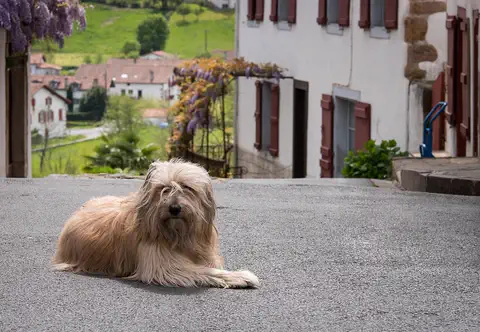
The domestic dog has lived with people for more than 12,000 years. Dogs came from gray wolves, and today there are more than 400 breeds, from tiny Chihuahuas to giant Irish wolfhounds. They live with people all over the world as pets, helpers and friends.
-
 Watch
3D
Animal
Coyote
The coyote is a clever, adaptable wild dog that lives from Alaska and Canada to Panama. It is smaller than a wolf and bigger than a fox. Coyotes eat mostly mice, voles and rabbits, howl and yip to keep in touch, and live everywhere from deserts and forests to city parks.
-
 Watch
3D
Animal
Ethiopian wolf
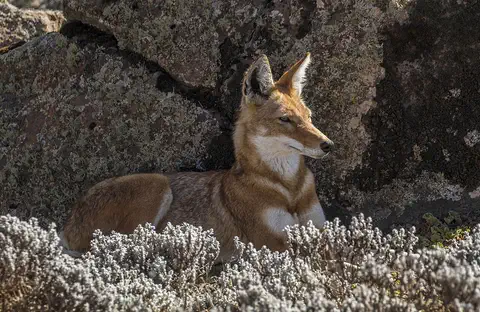
The Ethiopian wolf is a slender red wolf that lives only in the high mountains of Ethiopia. Wolf families share a territory, but each wolf hunts alone for rats and mole-rats. It is one of the rarest wild dogs on Earth.
-
 Watch
Animal
Moose
The moose is the largest member of the deer family. It lives in northern forests, wades and even dives into lakes to eat water plants, and bull moose grow enormous new antlers every year. In Europe it is called an elk.
-
 Watch
Animal
Common raven
The common raven is the biggest member of the crow family and the largest songbird. It lives across most of the Northern Hemisphere, from deserts to Arctic tundra. Ravens eat almost anything, play games in the air, and have solved puzzles that scientists designed to test how well they can plan ahead.
-
Watch
Country
Türkiye (Turkey)
Türkiye, also called Turkey, lies partly in Asia and partly in Europe. A narrow waterway called the Bosporus runs through its biggest city, Istanbul, and its land is mostly mountains and high plains. About 86 million people live there.
-
 Watch
Animal
Muskox
Muskoxen are shaggy Arctic grazers with long coats that nearly reach the ground and a super-warm underwool called qiviut. Herds protect their calves by standing in a ring with their horns facing out. Despite the name, they are more closely related to goats and sheep than to oxen.
-
Watch
Natural wonder
Denali
Denali is North America's highest mountain, 6,190 meters (20,310 feet) tall, in the Alaska Range. It rises about 5.6 kilometers from its base, more than Mount Everest does from its own high base. Huge glaciers spread from it in every direction, and the national park around it is home to grizzly bears, moose, caribou, Dall sheep and wolves.
For parents & teachers
What children will learn
- Describe how a wolf pack works as a family and why wolves howl.
- Explain how wolves hunt together and how their kills feed other animals.
- Locate where wolves live today and where they have disappeared.
- Understand how protection and reintroduction helped wolves return.
Recommended ages: 3 to 17 · About 15 minutes
Talk about it
- Why might hunting as a family help wolves catch big animals like elk?
- How could ranchers and wolves share the same land?
- How is a pet dog like a wolf, and how is it different?
Try at home or in class
- Play a 'lonesome howl' game: one person hides and calls, the others answer and find them by sound.
- Draw a food web for Yellowstone with wolves, elk, ravens and coyotes, and talk about who depends on whom.
Key vocabulary: pack, howl, den, territory, reintroduction, scavenger
Where these facts come from
- The IUCN Red List of Threatened Species , International Union for Conservation of Nature (IUCN terms of use (no redistribution of Red List data or range maps))
- GBIF Backbone Taxonomy and GBIF Occurrence Search , Global Biodiversity Information Facility (CC0 1.0 (backbone); occurrence counts are facts derived from records under CC0, CC BY and CC BY-NC)
- Wikidata , Wikimedia Foundation (CC0 1.0)
- Canis lupus (Grey Wolf), 2025 assessment , IUCN Red List of Threatened Species
- Gray wolf , Smithsonian's National Zoo and Conservation Biology Institute
- Wolf Ecology , National Park Service, Yellowstone National Park
- Gray wolf , Encyclopaedia Britannica
- Wikimedia Commons , Wikimedia Foundation (Per file: Public domain, CC0, CC BY or CC BY-SA only (credited on each page))
Checked, not yet human-reviewed. Last updated October 28, 2026. Spotted a mistake? Tell us.