
Animal
Gaboon viper
The Gaboon viper is a big, heavy snake of African forests. Its colors look just like fallen leaves!
The Gaboon viper is a large, heavy snake of the forests of central, eastern and southern Africa. Its pattern of browns, buff, purple and pink makes it almost invisible among fallen leaves, where it lies still and waits for food to pass. It is venomous, so it must never be touched.
Bitis gabonica (family Viperidae) is a heavy-bodied, nocturnal ambush predator of moist and dry forest and forest mosaics from Nigeria to the Democratic Republic of the Congo and Uganda, with scattered populations east to Kenya and Tanzania and south to Angola, Zambia and northern Zululand. Luiselli and colleagues listed it as Vulnerable (A2abd) for the IUCN Red List (assessed 24 October 2019, published 2021): it is heavily harvested for food and trade, and its habitat is shrinking. Its West African relative, Bitis rhinoceros, is now treated as a separate species.
Photo: H. Zell, CC BY-SA 3.0, via Wikimedia Commons
Meet the Gaboon viper
The Gaboon viper is a big, heavy snake.
It has a wide head shaped like a triangle.
It is venomous, so people never touch it.
The Gaboon viper is a big, thick-bodied snake. Grown-ups are about 1.2 meters long on average, and some reach 2 meters. The Toronto Zoo calls it the heaviest venomous snake in Africa, and females are usually bigger and heavier than males.
It has a large, wide head shaped like a triangle. The Gaboon viper is venomous: never touch one, and keep well away.
Bitis gabonica, described by Duméril, Bibron and Duméril in 1854 from Gabon, is a viper (family Viperidae). Animal Diversity Web gives an average adult length of about 1.2 m; the Toronto Zoo gives lengths up to 2 m, calls it the heaviest member of the viper family and the heaviest venomous snake in Africa, and notes that females are generally larger and heavier than males. The head is large and triangular. The species is venomous (Reptile Database): it should never be handled or approached.
Quick facts
- Group
- Reptile
- Length
- 1.2 m
Forest floors of Africa
Gaboon vipers live in African forests.
They hide among the fallen leaves on the ground.
Gaboon vipers live in forests: rainforest, drier forest, forest that is growing back, and patchworks of forest, savanna and farmland. They are found from Nigeria across central Africa to Uganda, with smaller groups in Kenya and Tanzania, and south to Angola, Zambia, Mozambique, Zimbabwe and a strip of coastal forest in South Africa.
They live from sea level up to about 2,100 meters. They need some forest or bush cover nearby: where it is all cleared, they soon disappear.
The IUCN gives a range from Nigeria to the Democratic Republic of the Congo and Uganda, with sporadic records in South Sudan and disjunct populations further east in Uganda, Kenya and eastern Tanzania (where it is restricted to coastal and montane forest fragments), south to Angola and Mbala in Zambia, and apparently isolated populations in southeastern Africa as far as coastal northern Zululand, South Africa. West of the coastal savanna zone of Benin it is replaced by Bitis rhinoceros. Habitat: moist and dry forest, mature and secondary, and forest-plantation mosaics with Guinean savanna; even gardens in towns surrounded by forest; more closely tied to rainforest than most Bitis species and lost rapidly where no forest or bush cover is left; in South Africa mainly coastal dune forest. Elevation 0 to 2,100 m (IUCN).
Continent
Did you know?
Baby Gaboon vipers look like tiny grown-ups.
Newborn Gaboon vipers are 23 to 37 centimeters long and already have the same patterns as their parents.
Neonates 23 to 37 cm, 25 to 45 g, replicas of adults (Toronto Zoo).
Where can you find this animal?
- Lives here naturally · Countries and seas named by a scientific source
- Sightings recorded · Records of wild sightings (GBIF)
Lives here naturally · Countries and seas named by a scientific source
Forests from Nigeria to the Democratic Republic of the Congo and Uganda, with scattered populations in South Sudan, Kenya and eastern Tanzania, south to Angola and northern Zambia, and isolated populations in Mozambique, eastern Zimbabwe and coastal northern KwaZulu-Natal, South Africa (IUCN). It lives only in parts of most of these countries. Cameroon, the Central African Republic and Equatorial
Places: Angola, Cameroon, Central African Rep., Congo, DR Congo, Eq. Guinea, Gabon, Kenya and 8 more places.
Source: iucn-red-list · checked November 2026
Sightings recorded · Records of wild sightings (GBIF)
Counts of GBIF records of wild observations (human and machine) and preserved specimens. Records include introduced populations, vagrants, escaped or released animals and misidentifications, so a country with records is not necessarily part of the native range.
Wild sightings have been recorded in Zambia, South Africa, DR Congo, Cameroon, Ghana, Congo, Zimbabwe, Tanzania and 22 more places.
Source: gbif · checked October 2026
Range maps show where scientists say an animal lives, often country by country. An animal may live in only part of a country shown, and sightings records can include animals that wandered far from home.
Waiting in the leaves
The Gaboon viper lies very still.
When a mouse or a rat comes close, it catches it.
A Gaboon viper is an ambush hunter. It lies perfectly still among the fallen leaves, sometimes for a long time, until an animal walks close enough to catch.
It eats mostly small mammals such as rats, and also birds that feed on the ground, frogs and lizards. It can even eat a small forest antelope.
The IUCN gives a diet mainly of small mammals, with lizards, birds and frogs also taken, and even small forest antelopes (Luiselli and Akani). ADW lists rodents, ground-feeding birds such as francolins and doves, frogs and toads, and records of giant rats (Cricetomys gambianus), brush-tailed porcupines (Atherurus africanus) and royal antelopes (Neotragus pygmeus) eaten. It is mostly an ambush predator, camouflaged in leaf litter and motionless for long periods until prey comes within reach (Toronto Zoo).
Did you know?
A Gaboon viper can look forward and backward with its eyes.
A Gaboon viper's large eyes are set well forward, and it can move them to look both forward and backward.
Wider range of eye movement than other snakes (Toronto Zoo).
A pattern like fallen leaves
Its back has shapes in brown, cream, purple and pink.
On the forest floor, it looks like a pile of leaves.
The Gaboon viper's pattern is made of geometric shapes: pale blocks along the middle of the back, dark hourglass shapes between them, and triangles along the sides, in browns, buff, purple and pink. Lying still among fallen leaves, it becomes nearly invisible.
Its cream-colored head has a thin dark line down the middle and a dark triangle behind and below each eye.
The Toronto Zoo describes a broad buff vertebral stripe broken into quadrangles, separated by dark, yellow-edged hourglass shapes; fawn or brown rhomboids with light central bars and brown-and-purple triangles on the flanks; a light yellow belly with dark spots. The head is buff or cream with a fine dark central line, dark spots at the rear corners above the angle of the jaw, and a dark triangle behind and below each eye. In the eastern form (B. gabonica) that triangle is divided in two and the nasal horns are small, while in the western form (now B. rhinoceros) the nasal horns are large and there is a single triangle (Toronto Zoo; Reptile Database, after Chippaux).
Eyes that look both ways
The Gaboon viper has big eyes.
It can look forward and backward.
A Gaboon viper's eyes are large and set well forward on its head. It can move them so that it looks forward and backward, a wider range of eye movement than other snakes have.
When it is asleep, its eyes stay still and its pupils become very small; when it wakes, they suddenly open wide and start moving again. Like other vipers, it also notices vibrations and smells.
Toronto Zoo: the eyes are large, movable and set well forward, so the snake can look forward and backward, a wider range of eye movement than other snakes; they often flick back and forth, and in sleep the eyes stay still with strongly contracted pupils, which dilate suddenly on waking; the iris may be cream, yellow-white, orange or silvery. ADW notes that, like other vipers, it detects vibrations, chemical signals and visual cues.
Did you know?
A Gaboon viper can eat a small antelope!
Gaboon vipers mostly eat rats and other small mammals, but they can even eat small forest antelopes.
Small forest antelopes recorded in the diet (IUCN; ADW: royal antelope).
Live babies
The mother has live babies, not eggs.
The babies look like little grown-ups.
Gaboon vipers usually mate in the rainy season. The young grow inside the mother for about 7 months or more, and she gives birth to live babies: often 13 to 15, though bigger litters have been recorded.
The newborns are 23 to 37 centimeters long, look just like small adults and soon look after themselves. Females are ready to have young at 5 to 8 years old and then breed every 2 to 3 years.
Viviparous, giving birth to 13 to 15 young (IUCN, after Luiselli et al. 1998 and Chippaux 2006); the Toronto Zoo reports average litters of 15 to 47 (once 63), and ADW 20 to 50. Mating usually starts in the rainy season (Toronto Zoo; ADW); gestation about 7 months (ADW) to a year (Toronto Zoo). Newborns are 23 to 37 cm and 25 to 45 g, replicas of the adults, independent soon after birth (Toronto Zoo). Females mature at 5 to 8 years and reproduce every 2 to 3 years, males at 4 to 6 years, so a generation is at least five and probably 6 to 8 years (IUCN, L. Luiselli unpubl.).
Still by day, active at dusk
The Gaboon viper rests in the day.
It comes out when the sun goes down.
Gaboon vipers are active at night and live alone. They are most active around sunset, when they come out of a dark hiding place to hunt.
They are not aggressive snakes. If one feels threatened, it may hiss loudly and steadily as a warning. It is venomous, so keep well away.
Nocturnal (IUCN; ADW) and solitary, most active around sunset when it leaves a dark shelter to hunt, then lies motionless on the forest floor (ADW). The Toronto Zoo describes it as not aggressive; when threatened it may hiss loudly in a deep, steady rhythm, slightly flattening the head with each breath out. In the mating season males perform ritual contests, rubbing chins along each other's backs, intertwining necks and pushing until one tires (Toronto Zoo).
Hunted and losing its forests
There are fewer Gaboon vipers than before.
They need their forests to stay.
The Gaboon viper is listed as vulnerable: its numbers are thought to be going down. In many places it is caught for food and sold in markets, and its skin is made into leather goods. It is also lost when forest is cleared for big plantations, because it cannot live where no wild plants are left. Some are caught for the pet trade, but that is not a major threat.
In South Africa, where most of its forest is protected, there were thought to be 2,000 to 3,500 adults (a 2009 estimate), and that population is presumed to be stable.
Vulnerable A2abd (Luiselli, Beraduccii, Howell, Msuya, Ngalason, Chirio, Kusamba, Gonwouo, LeBreton, Zassi-Boulou and Chippaux; Global; assessed 24 October 2019, published 2021; trend decreasing): a decline provisionally estimated at up to 30% over three generations, particularly in Nigeria and the Democratic Republic of the Congo, from heavy harvesting for food and sale in bushmeat markets and continuing habitat loss. At four well-protected Nigerian sites, numbers fell by about 79 to 82% between 1999 and 2003 (Reading et al. 2010), for reasons not established. Skins are used for leather goods; the pet trade involves moderate numbers and is not a major threat; monoculture plantations remove the native vegetation it needs; disease has caused local losses in the DRC. South Africa: 2,000 to 3,500 mature individuals, presumed stable. Not listed by CITES; IUCN recommends monitoring trade and harvest, limiting habitat loss and further genetic research.
IUCN Red List
How is the gaboon viper doing in the wild?
- Least Concern
- Near Threatened
- Vulnerable (this animal)
- Endangered
- Critically Endangered
- Extinct in the Wild
- Extinct
Vulnerable
At high risk of disappearing from the wild.
Amazing facts
-
A Gaboon viper can look forward and backward with its eyes.
A Gaboon viper's large eyes are set well forward, and it can move them to look both forward and backward.
Wider range of eye movement than other snakes (Toronto Zoo).
-
A Gaboon viper can eat a small antelope!
Gaboon vipers mostly eat rats and other small mammals, but they can even eat small forest antelopes.
Small forest antelopes recorded in the diet (IUCN; ADW: royal antelope).
-
A Gaboon viper hisses to say: go away!
Gaboon vipers are not aggressive. A threatened one may hiss loudly and steadily as a warning.
Loud, deep, rhythmic warning hiss (Toronto Zoo).
-
Baby Gaboon vipers look like tiny grown-ups.
Newborn Gaboon vipers are 23 to 37 centimeters long and already have the same patterns as their parents.
Neonates 23 to 37 cm, 25 to 45 g, replicas of adults (Toronto Zoo).
Words to know
- camouflage
- colors or patterns that help an animal blend in with its surroundings
- ambush
- to wait hidden and then attack by surprise
- venomous
- able to make venom, a harmful liquid some animals use to catch food or defend themselves
- leaf litter
- the layer of fallen leaves on the forest floor
- bushmeat
- meat from wild animals hunted for food
- vulnerable
- at high risk of dying out in the wild
Discovery challenge
-
Where does a Gaboon viper hide?
Where does a Gaboon viper wait for its food?
In which microhabitat does Bitis gabonica ambush its prey?
- Among fallen leaves
- High in a tree
- Under water
Show the answer
Among fallen leaves
Among fallen leaves!
It lies perfectly still in the leaf litter on the forest floor.
Leaf litter of the forest floor (ADW; Toronto Zoo).
-
How are baby Gaboon vipers born?
How are Gaboon viper babies born?
What is the reproductive mode of Bitis gabonica?
- Born alive
- From eggs in a nest
- From eggs in water
Show the answer
Born alive
They are born alive!
The mother gives birth to live young, often 13 to 15.
Viviparous; 13 to 15 young (IUCN).
-
When are Gaboon vipers most busy?
When are Gaboon vipers most active?
What is the activity pattern of Bitis gabonica?
- Around sunset and at night
- At noon
- Only in winter
Show the answer
Around sunset and at night
When the sun goes down!
They are active at night and most active around sunset.
Nocturnal, most active around sunset (ADW; IUCN).
-
What should you do if you see a Gaboon viper?
What should you do if you see a Gaboon viper?
What is the safe thing to do on meeting a Gaboon viper?
- Keep away; it is venomous
- Pick it up
- Touch its head
Show the answer
Keep away; it is venomous
Keep away!
It is venomous: never touch one, and keep well away.
It is a venomous viper (Reptile Database).
Places where you might see it
-
 Watch
 Country
Democratic Republic of the Congo
The Democratic Republic of the Congo, or DR Congo, is the second-largest country in Africa. The mighty Congo River curves through its rainforests, volcanoes rise in the east, and its capital, Kinshasa, is a center of music, fashion and popular culture.
-
 Watch
 Country
Nigeria
Nigeria is a large country in West Africa, named after the Niger River. It has rainforests in the south and dry grasslands in the north, and it is Africa's most populous country, with about 238 million people in 2025 who speak hundreds of languages.
-
 Watch
 Country
Uganda
Uganda is a landlocked country in East Africa, on the shores of Lake Victoria, Africa's largest freshwater lake. The Victoria Nile flows out of the lake here, snowy mountains rise in the west, and its forests are home to mountain gorillas and chimpanzees. About 51.4 million people lived there in 2025.
-
 Watch
 Country
South Africa
South Africa is the southernmost country in Africa, with the Atlantic Ocean on one side and the Indian Ocean on the other. A high plateau covers most of it, about 63.5 million people (2026) live there, and it has 12 official languages and three capital cities.
Explore next
-
 Watch
Animal
Black mamba
The black mamba is a long, slender, very fast snake of the savannas and rocky hills of sub-Saharan Africa. It is gray to brown, gets its name from its inky-black mouth, hunts small mammals by day, and is shy: it would almost always rather slip away from people. It is also highly venomous, so it is a snake to admire from far away.
-
 Watch
Animal
Sidewinder
The sidewinder is a small rattlesnake of the sandy deserts of the southwestern United States and northwestern Mexico. It is named for the way it moves: it throws its body sideways across the sand, leaving J-shaped tracks. It has a pointed scale like a little horn above each eye. Like all rattlesnakes it is venomous, so people should keep a safe distance.
-
Watch
Country
Democratic Republic of the Congo
The Democratic Republic of the Congo, or DR Congo, is the second-largest country in Africa. The mighty Congo River curves through its rainforests, volcanoes rise in the east, and its capital, Kinshasa, is a center of music, fashion and popular culture.
-
Watch
Country
Nigeria
Nigeria is a large country in West Africa, named after the Niger River. It has rainforests in the south and dry grasslands in the north, and it is Africa's most populous country, with about 238 million people in 2025 who speak hundreds of languages.
-
Watch
Country
Uganda
Uganda is a landlocked country in East Africa, on the shores of Lake Victoria, Africa's largest freshwater lake. The Victoria Nile flows out of the lake here, snowy mountains rise in the west, and its forests are home to mountain gorillas and chimpanzees. About 51.4 million people lived there in 2025.
-
Watch
Country
South Africa
South Africa is the southernmost country in Africa, with the Atlantic Ocean on one side and the Indian Ocean on the other. A high plateau covers most of it, about 63.5 million people (2026) live there, and it has 12 official languages and three capital cities.
-
 Watch
Animal
Aldabra giant tortoise
The Aldabra giant tortoise is one of the largest land tortoises on Earth. Wild ones live on Aldabra Atoll, a ring of coral islands in the Indian Ocean, where about 180,000 of them graze, browse and shape the land like elephants do in Africa. They can live for more than 100 years.
-
 Watch
Animal
Alligator snapping turtle
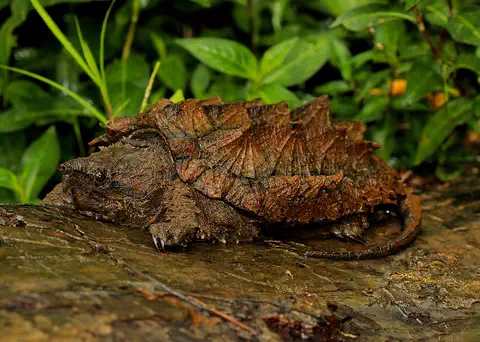
The alligator snapping turtle is the largest freshwater turtle in the United States. It lies still on the bottom of rivers and lakes with its mouth open, wiggling a worm-like lure on its tongue to trick fish into swimming close. Its numbers have fallen, and it is now endangered.
For parents & teachers
What children will learn
- Explain how camouflage helps an ambush hunter.
- Describe how a Gaboon viper's young are born.
- Name two reasons Gaboon vipers are becoming fewer.
- Explain why venomous animals should be watched from a distance and never touched.
Recommended ages: 3 to 17 · About 15 minutes
Talk about it
- Why might lying still be a good way to catch food?
- How could clearing forests for plantations affect animals that live on the forest floor?
- What makes a pattern good at hiding an animal among dead leaves?
Try at home or in class
- Leaf hide-and-seek: draw a snake pattern with brown, buff and purple shapes on paper, cut it out and lay it on a pile of dry leaves. How far away can you still see it?
- Pattern study: collect a few fallen leaves and copy their colors and shapes with crayons. Which colors would help a snake hide best?
Key vocabulary: camouflage, ambush, venomous, leaf litter, bushmeat, vulnerable
Where these facts come from
- GBIF Backbone Taxonomy and GBIF Occurrence Search , Global Biodiversity Information Facility (CC0 1.0 (backbone); occurrence counts are facts derived from records under CC0, CC BY and CC BY-NC)
- Wikidata , Wikimedia Foundation (CC0 1.0)
- The IUCN Red List of Threatened Species , International Union for Conservation of Nature (IUCN terms of use (no redistribution of Red List data or range maps))
- Bitis gabonica (Luiselli et al., assessed 24 October 2019, published 2021) , IUCN Red List of Threatened Species
- Bitis gabonica: taxonomy, justification, range, population, habitat, threats, trade and conservation text , IUCN Red List of Threatened Species
- Bitis gabonica: IUCN Red List global assessment record (Luiselli et al. 2021), IUCN checklist on GBIF , GBIF
- Bitis gabonica , The Reptile Database
- Gaboon viper , Toronto Zoo
- Bitis gabonica (Howard, Kalamazoo College) , Animal Diversity Web
- File:Bitis gabonica - Wilhelma 01.jpg (H. Zell, 19 July 2022) , Wikimedia Commons
- Wikimedia Commons , Wikimedia Foundation (Per file: Public domain, CC0, CC BY or CC BY-SA only (credited on each page))
Checked, not yet human-reviewed. Last updated November 1, 2026. Spotted a mistake? Tell us.