
Animal
Sidewinder
The sidewinder is a small rattlesnake of sandy deserts. It moves sideways over the sand and has little horns over its eyes!
The sidewinder is a small rattlesnake of the sandy deserts of the southwestern United States and northwestern Mexico. It is named for the way it moves: it throws its body sideways across the sand, leaving J-shaped tracks. It has a pointed scale like a little horn above each eye. Like all rattlesnakes it is venomous, so people should keep a safe distance.
Crotalus cerastes (family Viperidae) is a rattlesnake of open sandy desert, from southeastern California, southern Nevada and extreme southwestern Utah through southwestern Arizona to northeastern Baja California, northwestern Sonora and Isla Tiburón, from below sea level to about 1,830 m. Its name comes from its sidewinding movement, and its raised supraocular scales give it its other name, horned rattlesnake. Frost, Hammerson and Gadsden listed it as Least Concern for the IUCN Red List (assessed 1 March 2007, published 2007; marked as needing an update).
Photo: derivative work: Victorrocha (talk · contribs) Crotalus_cerastes_mesquite_springs_CA.JPG: Tigerhawkvok (talk · contribs), CC BY-SA 3.0, via Wikimedia Commons
Meet the sidewinder
The sidewinder is a small rattlesnake.
It has a little horn over each eye.
It has a rattle at the end of its tail.
The sidewinder is a small rattlesnake: most are about 46 centimeters (1.5 feet) long or less, but they can reach 3 feet. Above each eye it has a pointed scale that sticks up like a little horn, which is why it is also called the horned rattlesnake.
At the tip of its tail is a rattle. Each time the snake sheds its skin, a new piece is added to the rattle.
Sidewinders, like all rattlesnakes, are venomous. Never touch one: keep a safe distance.
Crotalus cerastes, described by Hallowell in 1854, is a rattlesnake (family Viperidae). The National Park Service at Death Valley gives a typical length of 1.5 feet or less, up to 3 feet; Animal Diversity Web gives an average adult snout-vent length of 50 cm (44.6 to 61.5 cm) and adult mass of 93.8 to 304 g. The raised, horn-like supraocular scales set it apart among rattlesnakes. The rattle gains a segment with each shed, so the number of segments counts sheds, not years (ADW). Like all rattlesnakes it is venomous, and the Park Service advises keeping a safe distance.
Quick facts
- Group
- Reptile
- Length
- up to 0.46 m
- Weight
- 93.8 to 304 g
Sand dunes and desert flats
Sidewinders live in hot, sandy deserts.
They like soft sand and dunes.
Sidewinders live in the deserts of the southwestern United States and northwestern Mexico: in southeastern California, southern Nevada, a tiny corner of Utah, southwestern Arizona, northeastern Baja California and northwestern Sonora.
They like open places with fine, windblown sand, sandy washes and dunes with a few creosote bushes or mesquite. They live from below sea level up to about 1,830 meters, but most are found below 1,200 meters.
The IUCN gives a range from southeastern California, southern Nevada and extreme southwestern Utah through southwestern Arizona to northeastern Baja California, northwestern Sonora and Isla Tiburón; in Sonora it occurs north and west of the Nogales-Hermosillo-Guaymas highway, most of all in the Desierto de Altar. Habitat is open desert with fine windblown sand, flats with sandy washes, or dunes sparsely grown with creosote bush or mesquite, sometimes rocky or gravelly ground. In the Mojave Desert, sidewinders concentrated near washes and denser vegetation where mammal burrows were common. Elevation from below sea level to about 1,830 m, most localities below 1,200 m (IUCN).
Continent
Its habitat

Where can you find this animal?
- Lives here naturally · Countries and seas named by a scientific source
- Sightings recorded · Records of wild sightings (GBIF)
Lives here naturally · Countries and seas named by a scientific source
Deserts of the southwestern United States (southeastern California, southern Nevada, extreme southwestern Utah and southwestern Arizona) and northwestern Mexico (northeastern Baja California, northwestern Sonora and Isla Tiburón) (IUCN). It lives only in these parts of the two countries.
Places: United States and Mexico.
Source: iucn-red-list · checked November 2026
Sightings recorded · Records of wild sightings (GBIF)
Counts of GBIF records of wild observations (human and machine) and preserved specimens. Records include introduced populations, vagrants, escaped or released animals and misidentifications, so a country with records is not necessarily part of the native range.
Wild sightings have been recorded in United States, Mexico, Honduras, Canada, Iraq and Namibia.
Source: gbif · checked October 2026
Range maps show where scientists say an animal lives, often country by country. An animal may live in only part of a country shown, and sightings records can include animals that wandered far from home.
Lizards and little mammals
Sidewinders eat lizards and mice.
Sometimes a big one eats a bird.
Sidewinders eat mostly lizards and small mammals such as mice, and big sidewinders sometimes eat birds. Lizards make up more than half of what they eat.
A sidewinder often waits just under the sand for an animal to come close. In late spring and summer, when it hunts at night, it eats more mammals; in early spring and fall it catches more lizards that are out in the day. After eating, it may stay still for 5 to 10 days.
ADW: over 50% of the diet is lizards (e.g. zebra-tailed lizards, western whiptails, Colorado Desert fringe-toed lizards) and over 40% mammals (e.g. pocket mice, house mice, Botta's pocket gopher); large sidewinders also take birds. More mammals are eaten when the snakes are nocturnal in late spring and summer, more diurnal lizards in early spring and fall. Snakes may stay inactive for 5 to 10 days after feeding. The NPS lists lizards, small mammals and birds, and describes sidewinders waiting for prey while buried in the sand; the North Carolina Zoo notes that they often sit just under the sand to ambush prey.
Did you know?
A sidewinder leaves tracks shaped like the letter J!
Sidewinding leaves a row of J-shaped tracks in the sand. Death Valley National Park suggests looking for them in sandy places such as the Mesquite Flat Sand Dunes.
J-shaped tracks, sometimes ending in the depression of a 'cratered' snake (NPS).
Horns, colors and a rattle
A sidewinder is sandy brown and cream.
Its colors help it hide on the sand.
Sidewinders are sandy colored: tan, with lighter cream down the back between darker blotches. Their colors can be light brown, gray or cream, depending on where they live, which helps them blend in with the ground.
Female sidewinders grow larger than males. That is unusual, because in most rattlesnakes males and females are about the same size.
Coloration: tan with lighter cream along the back between dark dorsal blotches (NPS); shades of light brown, gray and cream vary with habitat and give camouflage (ADW). Females grow larger than males, unusual among rattlesnakes (ADW; the North Carolina Zoo calls females much larger). The Park Service describes Death Valley's sidewinders as the Mojave desert sidewinder, subspecies C. c. cerastes.
Heat, smell and touch
A sidewinder smells with its tongue.
It can feel the warmth of animals nearby.
Like other rattlesnakes, a sidewinder has a pit on each side of its head that senses heat, which helps it find warm-bodied prey. It flicks its tongue to pick up smells, and a special smell organ, the vomeronasal organ, reads them. It relies on smell more than sight.
Sidewinders can even detect a substance in the skin of kingsnakes, a snake that eats them, and stay away.
ADW: facial pits detect infrared radiation and are used to find prey; tongue flicking delivers chemical cues to the vomeronasal organ, which sidewinders rely on more than sight to detect prey; they have been shown to detect substances in kingsnake (Lampropeltis) skin and so avoid them. Males use touch in mate searching, courtship and catching prey, and all three ways of moving (sidewinding, rectilinear motion and lateral undulation) need the snake to feel the ground.
Did you know?
A sidewinder can hide by sinking into the sand.
A sidewinder can wiggle side to side until almost its whole body is under the sand. This keeps it cool and hidden while it waits for food.
'Cratering': shifting side to side until almost fully buried, for cooling and ambush (NPS).
Born alive
Sidewinder babies are born alive, not in eggs.
They soon look after themselves.
Sidewinders mate in spring and summer. The mother does not lay eggs: her babies are born alive, on average 8 to 10 at a time. She stays with them for up to about 3 hours after they are born, and then the young are on their own.
Like most snakes, sidewinders keep growing all their lives, fastest when they are young.
Viviparous (NPS; ADW). The NPS gives breeding in spring and summer and an average of eight to ten live young; ADW gives litters of 4 to 11, a breeding season of April to July in which females' readiness depends on warm temperatures, males able to mate up to three times a year, and young independent within about 3 hours, the female guarding them until then. Growth is indeterminate and slows with age (ADW). Males find females by travelling in straight lines across the desert and by scent (ADW).
Sidewinding
A sidewinder moves sideways over the sand.
It leaves tracks shaped like the letter J.
A sidewinder moves by throwing its body sideways in loops. This lets it move quickly across loose sand, and because only a little of its body touches the hot sand at a time, it helps it keep cool. Its tracks look like a row of J shapes.
Sidewinders are most active at dawn and dusk, and at night in hot weather. In the heat of the day they hide in rodent burrows, or wiggle down into the sand until they are almost buried. In winter they rest in the burrows of rodents or desert tortoises.
The NPS describes sidewinding as fast travel over sand that also keeps the snake cool by limiting how long any part of the body touches hot sand, and the J-shaped tracks that may end in a small depression where a snake has 'cratered': shifting side to side until almost buried. Sidewinders are crepuscular, also nocturnal in warm periods (NPS); by day they shelter in burrows or under bushes, or stay partly buried in sand until it gets too hot; they hibernate in rodent or tortoise burrows and rarely climb into vegetation (IUCN). When threatened, a sidewinder shakes its rattle (ADW).
Did you know?
A sidewinder's rattle does not tell its age.
A sidewinder's rattle gets a new piece each time it sheds its skin, so counting the pieces does not tell you how old it is.
Rattle segments equal sheds, not age (ADW).
A common desert snake
There are lots of sidewinders.
Some live in national parks.
The sidewinder is listed as least concern. It lives across a wide area, there are probably more than 100,000 adults, and its numbers are probably fairly steady. No major threats to it are known, and sidewinders are found in a number of protected places, such as national parks.
If you see one in the wild, enjoy it from far away and leave it alone.
Frost, Hammerson and Gadsden assessed Crotalus cerastes as Least Concern (Global; assessed 1 March 2007, published 2007; needs updating): wide distribution, many occurrences, adult population unknown but presumably over 100,000, locally common in suitable habitat, extent, occupancy, subpopulations and population probably relatively stable; no major threats known; several to many occurrences in protected areas (IUCN). Predators include California kingsnakes, coyotes and red-tailed hawks (ADW).
IUCN Red List
How is the sidewinder doing in the wild?
- Least Concern (this animal)
- Near Threatened
- Vulnerable
- Endangered
- Critically Endangered
- Extinct in the Wild
- Extinct
Least Concern
Not at risk of disappearing from the wild right now.
Amazing facts
-
A sidewinder leaves tracks shaped like the letter J!
Sidewinding leaves a row of J-shaped tracks in the sand. Death Valley National Park suggests looking for them in sandy places such as the Mesquite Flat Sand Dunes.
J-shaped tracks, sometimes ending in the depression of a 'cratered' snake (NPS).
-
A sidewinder can hide by sinking into the sand.
A sidewinder can wiggle side to side until almost its whole body is under the sand. This keeps it cool and hidden while it waits for food.
'Cratering': shifting side to side until almost fully buried, for cooling and ambush (NPS).
-
A sidewinder's rattle does not tell its age.
A sidewinder's rattle gets a new piece each time it sheds its skin, so counting the pieces does not tell you how old it is.
Rattle segments equal sheds, not age (ADW).
-
Female sidewinders are bigger than males.
Female sidewinders grow larger than males, which is unusual for a rattlesnake.
Female-biased size dimorphism, unusual among rattlesnakes (ADW; North Carolina Zoo).
Words to know
- sidewinding
- moving by throwing loops of the body sideways, so only a little of it touches the ground at a time
- venomous
- able to make venom, a harmful liquid some animals use to catch food or defend themselves
- rattle
- the hard, hollow pieces at the end of a rattlesnake's tail that buzz when shaken
- crepuscular
- most active at dawn and dusk
- heat-sensing pit
- a small hollow on a snake's face that can feel warmth from animals
- least concern
- not currently at serious risk of dying out in the wild
Discovery challenge
-
How does a sidewinder move?
How does a sidewinder move across sand?
Which kind of movement gives Crotalus cerastes its common name?
- Sideways, in loops
- By hopping
- By swimming
Show the answer
Sideways, in loops
Sideways!
It throws its body sideways in loops, leaving J-shaped tracks.
Sidewinding, which also limits contact with hot sand (NPS).
-
What is over a sidewinder's eyes?
What does a sidewinder have above each eye?
Which head feature gives the sidewinder the name horned rattlesnake?
- A little horn
- Long eyelashes
- Feathers
Show the answer
A little horn
A little horn!
A pointed scale that sticks up like a horn.
A raised, horn-like supraocular scale (ADW).
-
How are baby sidewinders born?
How are sidewinder babies born?
What is the reproductive mode of Crotalus cerastes?
- Born alive
- From eggs in a nest
- From eggs in water
Show the answer
Born alive
They are born alive!
The mother gives birth to live young, on average 8 to 10.
Viviparous (NPS; ADW).
-
What should you do if you see a sidewinder?
What should you do if you see a sidewinder in the wild?
What does the National Park Service advise if you meet a sidewinder?
- Stay far away and just watch
- Pick it up
- Poke it with a stick
Show the answer
Stay far away and just watch
Stay far away!
It is venomous, so never touch it: keep a safe distance.
Like all rattlesnakes it is venomous: keep a safe distance (NPS).
Places where you might see it
-
 Watch
 Country
United States
The United States is a large country in North America made of 50 states, from icy Alaska to the warm islands of Hawaii. It has the Grand Canyon, the Mississippi River and Yellowstone, and about 342 million people live there.
-
 Watch
 Country
Mexico
Mexico is a large country in southern North America, between the Pacific Ocean and the Gulf of Mexico. It has smoking volcanoes, ancient cities built by the Maya and other peoples, and about 132 million people, many of them in and around Mexico City.
Explore next
-
 Watch
Animal
Western diamondback rattlesnake
The western diamondback rattlesnake is a heavy-bodied snake of the deserts and dry grasslands of the southwestern United States and Mexico. It has diamond patterns, a black-and-white striped tail and a rattle that buzzes as a warning. It is venomous, so it is a snake to admire from far away, but it would much rather hide or slip away than meet a person.
-
 Watch
Animal
Common chuckwalla
The common chuckwalla is a large lizard of the rocky deserts of the southwestern United States and northwestern Mexico. It eats plants, such as the leaves and fruit of the creosote bush. When a predator comes near, it hides in a rock crack, fills its lungs and puffs up its skin, so it is wedged in tight.
-
 Watch
Animal
Texas horned lizard
The Texas horned lizard is a wide, flat lizard covered in pointed scales, with big horns at the back of its head. It lives in dry, open country in the south-central United States and northern Mexico, where it eats mostly ants, especially harvester ants. It hides by blending in with the soil, and it can even catch rainwater on its back to drink.
-
Watch
Country
United States
The United States is a large country in North America made of 50 states, from icy Alaska to the warm islands of Hawaii. It has the Grand Canyon, the Mississippi River and Yellowstone, and about 342 million people live there.
-
Watch
Country
Mexico
Mexico is a large country in southern North America, between the Pacific Ocean and the Gulf of Mexico. It has smoking volcanoes, ancient cities built by the Maya and other peoples, and about 132 million people, many of them in and around Mexico City.
-
 Watch
Animal
Gaboon viper
The Gaboon viper is a large, heavy snake of the forests of central, eastern and southern Africa. Its pattern of browns, buff, purple and pink makes it almost invisible among fallen leaves, where it lies still and waits for food to pass. It is venomous, so it must never be touched.
-
 Watch
Animal
Aldabra giant tortoise
The Aldabra giant tortoise is one of the largest land tortoises on Earth. Wild ones live on Aldabra Atoll, a ring of coral islands in the Indian Ocean, where about 180,000 of them graze, browse and shape the land like elephants do in Africa. They can live for more than 100 years.
-
 Watch
Animal
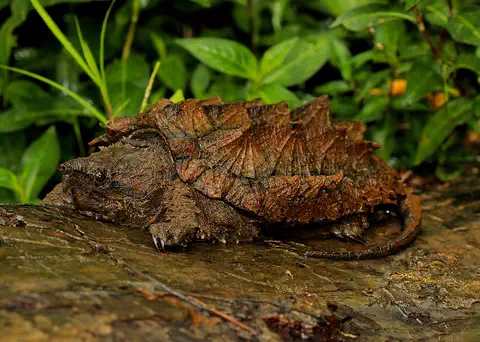
Alligator snapping turtle
The alligator snapping turtle is the largest freshwater turtle in the United States. It lies still on the bottom of rivers and lakes with its mouth open, wiggling a worm-like lure on its tongue to trick fish into swimming close. Its numbers have fallen, and it is now endangered.
For parents & teachers
What children will learn
- Describe how sidewinding helps a snake move on loose, hot sand.
- Name two ways a sidewinder stays cool in the desert.
- Explain how a sidewinder finds its food.
- Explain why venomous animals should be watched from a safe distance and never touched.
Recommended ages: 3 to 17 · About 15 minutes
Talk about it
- Why might moving sideways work better than moving straight ahead on soft sand?
- How does hiding under the sand help a sidewinder in two different ways?
- Why is it important to leave wild snakes alone?
Try at home or in class
- Sand tracks: in a tray of sand, draw a row of J shapes with your finger, then a straight wiggly line. Which track looks like a sidewinder's?
- Hot and cool: on a sunny day, feel the top of the sand in a sandbox, then dig a finger down a little way. Is it cooler under the surface?
Key vocabulary: sidewinding, venomous, rattle, crepuscular, heat-sensing pit, least concern
Where these facts come from
- GBIF Backbone Taxonomy and GBIF Occurrence Search , Global Biodiversity Information Facility (CC0 1.0 (backbone); occurrence counts are facts derived from records under CC0, CC BY and CC BY-NC)
- Wikidata , Wikimedia Foundation (CC0 1.0)
- The IUCN Red List of Threatened Species , International Union for Conservation of Nature (IUCN terms of use (no redistribution of Red List data or range maps))
- Crotalus cerastes (Frost, Hammerson and Gadsden, assessed 1 March 2007, published 2007) , IUCN Red List of Threatened Species
- Crotalus cerastes: justification, range, population, habitat, threats and conservation text , IUCN Red List of Threatened Species
- Crotalus cerastes: IUCN Red List global assessment record (Frost, Hammerson and Gadsden 2007), IUCN checklist on GBIF , GBIF
- Sidewinder , National Park Service, Death Valley National Park
- Crotalus cerastes (Faulkner, Radford University) , Animal Diversity Web
- Sidewinder , North Carolina Zoo
- File:Crotalus cerastes mesquite springs CA-2.jpg (Tigerhawkvok; retouched by Victorrocha, 2008) , Wikimedia Commons
- Wikimedia Commons , Wikimedia Foundation (Per file: Public domain, CC0, CC BY or CC BY-SA only (credited on each page))
Checked, not yet human-reviewed. Last updated November 1, 2026. Spotted a mistake? Tell us.