
Animal
Giant anteater
The giant anteater has a very long nose, no teeth and a huge, bushy tail. It eats ants and termites with its long, sticky tongue.
The giant anteater is the biggest of the four kinds of anteater. It has no teeth at all, but its sticky tongue, about 60 centimeters long, flicks in and out up to 150 times a minute to slurp up ants and termites. Babies ride on their mothers' backs.
Myrmecophaga tridactyla is a toothless, highly specialized insectivore of Central and South American grasslands, wetlands and forests. Large, slow-breeding and dependent on ants and termites, it has vanished from parts of its range and was assessed as Vulnerable, with a decreasing population, by the IUCN in 2024.
Photo: © Giles Laurent, gileslaurent.com, License CC BY-SA, CC BY-SA 4.0, via Wikimedia Commons
Meet the giant anteater
The giant anteater has a long, thin nose and a big, bushy tail.
It has a black stripe with white edges on its side. It has no teeth at all! It eats ants and termites.
The giant anteater is the largest of the four anteater species. From the tip of its long snout to the end of its bushy tail it can be 1.8 to 2.4 meters long, about the size of a golden retriever but looking bigger because of all that hair.
Its coarse gray-brown fur has a bold black stripe, edged in white, running from its front legs up over its shoulders. Its front legs are white, and its tail is nearly as long as its body. It has no teeth at all.
Myrmecophaga tridactyla is the largest of the four living anteaters; the others are the silky anteater and the northern and southern tamanduas. Animal Diversity Web gives a head and body length of 1.0 to 1.2 meters and a tail of 0.65 to 0.9 meter, and a snout up to 45 centimeters long; the Smithsonian's National Zoo gives a total of 1.8 to 2.4 meters and 27 to 45 kilograms. Males and females are hard to tell apart from outside.
The skull is streamlined, with small eyes and ears and no teeth. The coarse coat lacks an insulating undercoat, is short on the shoulders and long on the legs and tail, and carries a black-and-white shoulder stripe and a crest along the back.
Quick facts
- Group
- Mammal
- Length
- 1.8 to 2.4 m
- Weight
- 27 to 45 kg
- Top speed
- up to 48 km/h
Grasslands, wetlands and forests
Giant anteaters live in Central America and South America.
They walk through tall grass, wet places and forests. They sleep in quiet, hidden spots.
Giant anteaters live in Central and South America, from Honduras down to northern Argentina. They are found in grasslands, savannas, wetlands and forests, wherever there are plenty of ants and termites.
They do not build nests or burrows. Instead, they wander their home areas and sleep in hidden places such as thick plants, hollows in the ground or burrows left by other animals, covering themselves with their bushy tails. Our photo shows one in a state park in Brazil.
The IUCN's 2024 global assessment lists the giant anteater as extant from Honduras and Nicaragua through Panama to Colombia, Venezuela, the Guianas, Ecuador, Peru, Bolivia, Brazil, Paraguay and northern Argentina, up to 2,000 meters. It is possibly extinct in Belize, Costa Rica, El Salvador, Guatemala and Uruguay, and in several southern Brazilian and Argentine provinces.
Habitats include grasslands, savannas, swamps and forests. Giant anteaters make no permanent nests; they sleep in abandoned burrows, dense vegetation or ground depressions. The Smithsonian's National Zoo reports home ranges of about 1.6 square kilometers for males and 2.4 for females, though Animal Diversity Web describes ranges up to 90 square kilometers and extensive wandering. The hero photo was taken in Encontro das Águas State Park, Brazil.
Continents
Its habitats


Where can you find this animal?
- Lives here naturally · Countries and seas named by a scientific source
- Sightings recorded · Records of wild sightings (GBIF)
Lives here naturally · Countries and seas named by a scientific source
Grasslands, savannas, wetlands and forests from Nicaragua and Panama through northern and central South America to Paraguay and northern Argentina. The species has disappeared from parts of several countries shown.
Places: Nicaragua, Panama, Colombia, Venezuela, Guyana, Suriname, Ecuador, Peru and 4 more places.
Source: iucn-red-list · checked October 2026
Sightings recorded · Records of wild sightings (GBIF)
Counts of GBIF records of wild observations (human and machine) and preserved specimens. Records include introduced populations, vagrants, escaped or released animals and misidentifications, so a country with records is not necessarily part of the native range.
Wild sightings have been recorded in Colombia, Brazil, Argentina, Ecuador, Paraguay, Guyana, Peru, Bolivia and 14 more places.
Source: gbif · checked October 2026
Range maps show where scientists say an animal lives, often country by country. An animal may live in only part of a country shown, and sightings records can include animals that wandered far from home.
Thousands of ants a day
Giant anteaters eat ants and termites.
They rip open the nests with their big claws. Then their long, sticky tongue flicks in and out to catch the bugs.
Giant anteaters eat almost only ants and termites. They sniff out a nest, tear it open with their front claws and flick their long, sticky tongue in and out up to 150 times a minute. With no teeth, they crush the insects against the roof of the mouth, and a strong stomach does the rest.
An anteater stays at each nest for only about a minute, because the ants bite back. Then it moves on to another nest. It may eat up to 30,000 insects in a day.
The diet is almost exclusively ants and termites, plus soft-bodied grubs and occasionally fruit. Researchers have found that giant anteaters can identify the species of ant or termite by smell before opening a nest. The tongue, about 60 centimeters long, is attached to the sternum, covered with tiny backward-pointing spines and coated with sticky saliva, and flicks up to 150 times a minute.
Feeding at any one colony is brief, about a minute, because defending soldier ants arrive; the Smithsonian's National Zoo reports only about 140 insects taken per mound, while the San Diego Zoo Wildlife Alliance estimates up to 30,000 insects a day. Food is crushed against the palate and ground in a muscular stomach. Giant anteaters rarely drink, getting water from their food and possibly from rain left on plants.
Did you know?
A giant anteater can swim.
Giant anteaters are good swimmers and use their long snouts like a snorkel.
The San Diego Zoo Wildlife Alliance describes giant anteaters swimming freestyle with the snout raised like a snorkel.
Knuckle-walkers with a super nose
Giant anteaters have long, sharp claws on their front feet.
To keep the claws sharp, they curl them up and walk on their knuckles. Their nose is super good at smelling.
A giant anteater's front feet have huge, sharp claws for ripping open termite mounds. To keep them sharp, it tucks them in and walks on its knuckles, in a slow, shuffling way. When it needs to, it can gallop at more than 48 kilometers an hour.
Its eyes and ears are small and not very sharp, but its sense of smell is amazing, about 40 times better than a person's. It can also swim, using its long snout like a snorkel.
Each forefoot has five claws, the inner three very long and sharp; weight is carried on the knuckles and wrist with the claws curled out of the way, while the hind feet are more bear-like. The gait is a slow shuffle, but the Smithsonian's National Zoo reports gallops above 48 kilometers an hour, and anteaters can swim and climb.
Sight and hearing are reduced, while Animal Diversity Web describes smell as about 40 times as sensitive as a human's. The San Diego Zoo Wildlife Alliance gives a body temperature of 32.7 °C, which it calls one of the lowest for a mammal and presumably linked to the low-calorie insect diet. The long, bushy tail serves as a blanket or sunshade and as a prop when the anteater rears up.
A ride on mom's back
A baby giant anteater is called a pup.
Right after it is born, the pup climbs onto its mother's back. It rides there for a long time. Its stripe matches hers, so it is hard to see.
A mother giant anteater is pregnant for about six months and has one baby, called a pup, weighing about 1.3 kilograms. She gives birth standing up, and the pup climbs straight onto her back.
The pup rides there for many months, and its black-and-white stripe lines up with its mother's, so it is hard to spot. Pups drink milk for several months and leave their mothers at about two years old. Their first months are risky, and many do not survive.
Gestation is about 180 days (the Smithsonian's National Zoo and Wikidata; Animal Diversity Web gives about 190), producing a single young of about 1.3 kilograms, fully furred and marked like an adult. The mother gives birth standing, supported by her tail, and the young climbs onto her back, where the matching stripe helps it blend in. Breeding can be year-round or seasonal depending on region, and births can be as little as nine months apart.
Sources differ on timing: Animal Diversity Web gives 2 to 6 months of suckling and back-riding until the young is almost half the mother's size, at 6 to 9 months; the Smithsonian's National Zoo gives about six months of nursing and up to a year on the mother's back, and the San Diego Zoo Wildlife Alliance weaning at about nine months. Young become independent at about two years, and maturity comes at 2.5 to 4 years. The San Diego Zoo Wildlife Alliance reports 50 percent pup mortality in the first three months.

A quiet wanderer
Giant anteaters like to be alone.
They are usually awake in the day. Near towns, they come out at night instead. If one is scared, it stands up tall on its back legs.
Giant anteaters usually live alone, except for mothers with pups. When two meet, they often ignore each other or move away. They are mostly active by day, but where many people live they switch to being active at night.
An anteater would rather run away than fight. If it must defend itself, it rears up on its back legs, leans on its tail for balance and swings its big front claws. Adults are very quiet animals; pups give a shrill grunt when they need their mothers.
Giant anteaters are solitary apart from mother-young pairs and brief courtship or aggressive encounters. Usually diurnal, they become nocturnal in areas of high human density and in some weather. The Smithsonian's National Zoo notes that they do not keep permanent resting places and wander their ranges.
The usual response to danger is flight. Cornered, an anteater rears into a bipedal stance, balancing on its tail and striking with its forelimbs; its size leaves only the largest predators, chiefly jaguars and pumas, as natural threats. Communication is limited: snorts, sniffs and hisses, roars during fights, and the shrill, high-pitched grunt of a distressed pup.
Did you know?
Anteaters use their tails as blankets.
A giant anteater's bushy tail can be used as a blanket or a sunshade when it rests.
The long-haired tail, with hairs up to 40 centimeters, covers the resting animal like a blanket or sunshade.
Protecting the giant anteater
There are fewer giant anteaters than before.
People are working to protect the grasslands and forests where they live, and to keep them safe from cars and fires.
The IUCN lists the giant anteater as Vulnerable, and its numbers are going down. It has already disappeared from many places, especially in Central America and the south of its range. Grassland fires, farms and towns that replace its home, cars on roads, hunting and pet dogs all harm it.
Scientists at the Smithsonian's National Zoo say that losing its home is especially hard on the giant anteater because it eats only ants and termites, has few babies and is a big animal. Protecting wild grasslands and forests, and driving carefully where anteaters cross roads, can help.
The IUCN assessed the giant anteater as Vulnerable (criteria A2cd) in 2024, with a decreasing population. Listed threats include housing and urban areas, crops, livestock ranching, roads, hunting, fire, problematic species and agricultural pollution. The San Diego Zoo Wildlife Alliance adds vehicle collisions, grassland fires and attacks by dogs.
The Smithsonian's National Zoo notes many recorded local extinctions, especially in Central America and the south of the range, and points to the combination of habitat loss with a specialized diet, low reproductive rate and large body size. Trade is controlled under CITES Appendix II. More research is needed to measure the total population loss.
IUCN Red List
How is the giant anteater doing in the wild?
- Least Concern
- Near Threatened
- Vulnerable (this animal)
- Endangered
- Critically Endangered
- Extinct in the Wild
- Extinct
Vulnerable
At high risk of disappearing from the wild.
See the IUCN Red List assessment · The IUCN Red List of Threatened Species 2022.2
Amazing facts
-
A giant anteater can swim.
Giant anteaters are good swimmers and use their long snouts like a snorkel.
The San Diego Zoo Wildlife Alliance describes giant anteaters swimming freestyle with the snout raised like a snorkel.
-
An anteater can tell which ants are inside a nest by smell.
Scientists found that giant anteaters can smell which kind of ant or termite lives in a nest before they open it.
Research summarized by the Smithsonian's National Zoo shows giant anteaters identify the prey species by smell before breaking into a nest.
-
Anteaters use their tails as blankets.
A giant anteater's bushy tail can be used as a blanket or a sunshade when it rests.
The long-haired tail, with hairs up to 40 centimeters, covers the resting animal like a blanket or sunshade.
-
Giant anteaters do not have any teeth.
Giant anteaters have no teeth. They crush insects against the roof of their mouth, and their strong stomach grinds them up.
Lacking teeth, giant anteaters crush prey against the palate and rely on a very muscular stomach to pulverize it.
Words to know
- snout
- an animal's long nose and mouth
- termite
- a small insect that lives in big groups, often in mounds of earth
- knuckle-walking
- walking on bent fingers or toes instead of flat feet
- pup
- a baby anteater
- vulnerable
- an IUCN Red List category for animals at high risk of dying out in the wild
Discovery challenge
-
How many teeth does a giant anteater have?
How many teeth does a giant anteater have?
How many teeth does an adult giant anteater have?
- None
- About 30
- About 100
Show the answer
None
None at all! It uses its long, sticky tongue.
None. It crushes insects against the roof of its mouth, and its strong stomach grinds them.
None: it is toothless, relying on its tongue, palate and muscular stomach.
-
Why does an anteater walk on its knuckles?
Why does a giant anteater walk on its knuckles?
What is the purpose of the giant anteater's knuckle-walking?
- To keep its claws sharp
- To stay warm
- To sneak up on ants
Show the answer
To keep its claws sharp
Curling up its claws keeps them sharp for digging.
It tucks its big claws in, so they stay sharp for ripping open nests and for defense.
Carrying weight on the knuckles and wrists protects the long front claws used for opening colonies and defense.
-
Where does a baby anteater ride?
Where does a giant anteater pup ride?
How does a young giant anteater travel in its first months?
- On its mother's back
- In a pouch
- In its mother's mouth
Show the answer
On its mother's back
On mom's back! It holds on tight.
On its mother's back, where its stripe lines up with hers.
Riding on the mother's back, until it is nearly half her size at 6 to 9 months.
-
How does an anteater find ants?
Which sense does a giant anteater use most to find food?
Which sense is most developed in the giant anteater?
- Smell
- Sight
- Hearing
Show the answer
Smell
It sniffs them out with its long nose.
Smell. Its nose is about 40 times better than ours, while its eyes and ears are weak.
Olfaction, about 40 times as sensitive as a human's; sight and hearing are diminished.
Places where you might see it
-
 Watch
 Country
Brazil
Brazil covers about half of South America and is the fifth-largest country in the world. It holds most of the Amazon River basin and much of the world's largest rainforest, and about 214 million people lived there in 2026, most of them near the Atlantic coast.
-
 Watch
Natural wonder
Pantanal
The Pantanal is one of the world's largest freshwater wetlands, mostly in Brazil and reaching into Bolivia and Paraguay. Each rainy season its rivers overflow and flood the lowlands, making shallow lakes and marshes; in the dry season the water slowly drains away. This rhythm feeds an amazing number of animals, from jaguars and giant otters to about 600 kinds of birds.
-
 Watch
 Country
Paraguay
Paraguay is a landlocked country in the heart of South America. The Paraguay River divides it into a hilly east, where most people live, and the hot, flat Chaco in the west. Guaraní and Spanish are both official languages, and about 7 million people lived there in 2025.
Experiments to try
Explore next
-
 Watch
Animal
Aardvark
The aardvark is a shy night digger of African savannas. It sniffs out ant and termite nests, rips them open with its spade-like claws and laps up the insects with a sticky tongue about 30 centimeters long. Its name means 'earth pig' in Afrikaans.
-
 Watch
Animal
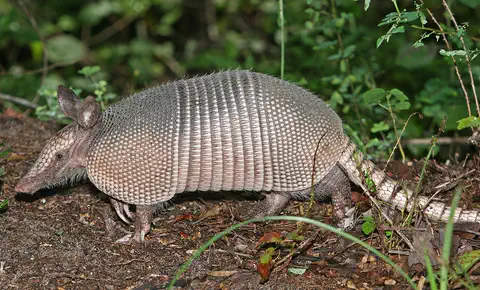
Nine-banded armadillo
The nine-banded armadillo is a small, armored digger that lives from Argentina all the way to the United States. It sniffs out beetles and other bugs in the soil, can hold its breath for six minutes, and almost always has four identical babies at once.
-
 Watch
Animal
Brown-throated sloth
The brown-throated sloth is a three-toed sloth of the rainforests of Central and South America. It eats leaves, saves energy by moving very slowly, and its shaggy fur can turn green with tiny algae that grow in it.
-
Watch
Country
Brazil
Brazil covers about half of South America and is the fifth-largest country in the world. It holds most of the Amazon River basin and much of the world's largest rainforest, and about 214 million people lived there in 2026, most of them near the Atlantic coast.
-
Watch
Natural wonder
Pantanal
The Pantanal is one of the world's largest freshwater wetlands, mostly in Brazil and reaching into Bolivia and Paraguay. Each rainy season its rivers overflow and flood the lowlands, making shallow lakes and marshes; in the dry season the water slowly drains away. This rhythm feeds an amazing number of animals, from jaguars and giant otters to about 600 kinds of birds.
-
 Watch
3D
Animal
Jaguar
The jaguar is the largest cat in North and South America. It lives near rivers and swamps, swims well, and has such a powerful bite that it can crack a turtle's shell. Most jaguars live in the Amazon rainforest.
-
Watch
Country
Paraguay
Paraguay is a landlocked country in the heart of South America. The Paraguay River divides it into a hilly east, where most people live, and the hot, flat Chaco in the west. Guaraní and Spanish are both official languages, and about 7 million people lived there in 2025.
- Watch What If? Lab What if you had no teeth? Your teeth cut, tear and grind food into small pieces so you can swallow it. Imagine eating with no teeth at all! Find out what each kind of tooth does, how baby teeth make way for adult teeth, and how birds manage without any teeth, using a muscly stomach called a gizzard.
For parents & teachers
What children will learn
- Describe how the giant anteater's snout, tongue, claws and senses suit a diet of ants and termites.
- Explain why an anteater feeds only briefly at each nest.
- Describe the giant anteater's life cycle, including back-riding.
- Understand why the species is Vulnerable and what threatens it.
Recommended ages: 3 to 17 · About 15 minutes
Talk about it
- Why might eating a little from many nests be smarter than finishing one nest?
- Why would an animal that has only one baby at a time recover slowly from losses?
- What could people do to make roads safer for animals like anteaters?
Try at home or in class
- Measure 60 centimeters with a tape measure and compare it with your arm to see how long an anteater's tongue is.
- Count how many times you can stick out your tongue in one minute, then compare with an anteater's 150.
Key vocabulary: snout, termite, knuckle-walking, pup, vulnerable
Where these facts come from
- The IUCN Red List of Threatened Species , International Union for Conservation of Nature (IUCN terms of use (no redistribution of Red List data or range maps))
- GBIF Backbone Taxonomy and GBIF Occurrence Search , Global Biodiversity Information Facility (CC0 1.0 (backbone); occurrence counts are facts derived from records under CC0, CC BY and CC BY-NC)
- Giant anteater , Smithsonian's National Zoo and Conservation Biology Institute
- Giant anteater , San Diego Zoo Wildlife Alliance
- Myrmecophaga tridactyla (giant anteater) , Animal Diversity Web, University of Michigan
- Myrmecophaga tridactyla (global assessment 2024) , IUCN Red List
- Wikidata , Wikimedia Foundation (CC0 1.0)
- Wikimedia Commons , Wikimedia Foundation (Per file: Public domain, CC0, CC BY or CC BY-SA only (credited on each page))
Checked, not yet human-reviewed. Last updated October 24, 2026. Spotted a mistake? Tell us.