Animal
Nine-banded armadillo
The nine-banded armadillo wears a coat of armor. It digs for bugs at night with its long nose and strong claws.
The nine-banded armadillo is a small, armored digger that lives from Argentina all the way to the United States. It sniffs out beetles and other bugs in the soil, can hold its breath for six minutes, and almost always has four identical babies at once.
Dasypus novemcinctus is the only armadillo found in the United States, where its range has spread northeast since the late 1800s. It is notable for bony armor of osteoderms, a low body temperature and regular polyembryony: one fertilized egg usually splits to give identical quadruplets.
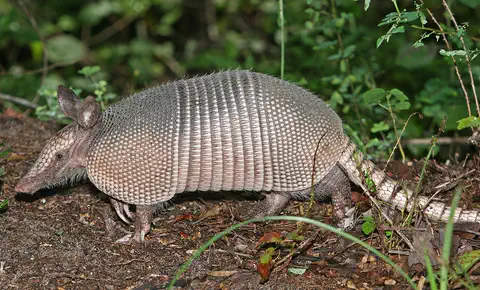
Photo: http://www.birdphotos.com, CC BY 3.0, via Wikimedia Commons
Meet the nine-banded armadillo
The armadillo has a hard shell, like a suit of armor.
It has a long, pink nose, big ears and a long, stripy tail. In the middle of its back, the shell has bands that bend when it moves.
The nine-banded armadillo is about the size of a big house cat, 60 to 80 centimeters long including its tail. Its body is covered with armor: a hard shield over the shoulders, another over the hips, and flexible bands in between. Most have nine bands, which gives the animal its name, but some have eight to eleven.
Its belly has no armor, only soft, pale skin with small tufts of hair. It has a long, pinkish, pig-like snout, hairless ears and short legs with strong claws.
Dasypus novemcinctus belongs to the armadillos, a group of 20 species that, with anteaters and sloths, are xenarthrans. Animal Diversity Web gives a total length of 0.615 to 0.8 meters and a weight of 3.6 to 7.7 kilograms, males slightly heavier than females.
The armor is made of osteoderms, bony plates covered in tough keratinous skin, forming a shoulder shield, a pelvic shield and typically nine movable bands (eight to eleven occur). It makes up about 16 percent of body weight, grows continuously and is never shed. The head is partly armored, but the ears are bare and bumpy, and the underside is soft. The teeth are simple pegs without enamel that grow throughout life.
Quick facts
- Group
- Mammal
- Length
- 0.62 to 0.8 m
- Weight
- 3.6 to 7.7 kg
- Lifespan in the wild
- 7 to 20 years
From Argentina to the United States
Nine-banded armadillos live in North, Central and South America.
They like woods and brushy places with soft soil. They sleep in burrows under the ground.
Nine-banded armadillos live from Argentina and Uruguay through Central America and Mexico into the southern United States. They like forests and brushy places with soft soil and enough rain, and they are rarely found in dry deserts.
In about 1850 they lived no farther north than Texas. Since then they have spread north and east, as far north as Missouri, crossing rivers on new bridges and moving along roads. People also carried armadillos to new places, including Florida, where they now live too. Our photo was taken in the Green Swamp of central Florida.
The IUCN's 2013 assessment lists the species as native from the southern United States through Mexico, Central America, the Caribbean islands of Trinidad and Tobago and Grenada, and South America to Argentina and Uruguay, up to 2,000 meters. Animal Diversity Web notes a preference for forest and scrub with at least 38 centimeters of rain a year, where soft soil and leaf litter make digging and foraging easier.
In the United States, armadillos were no farther north than Texas as late as 1850. Since the late 19th century they have spread northeast and are common as far north as Missouri; Animal Diversity Web notes that roads and bridges also helped people introduce armadillos to new areas, and that Florida's armadillos were introduced; Britannica notes sightings in Nebraska, Iowa and Illinois. Cold limits them: they are uncommon where more than 24 days a year freeze or January averages below −2 °C. Roads, bridges and declining predators appear to have helped the spread.
Continents
Its habitats


Where can you find this animal?
- Lives here naturally · Countries and seas named by a scientific source
- Sightings recorded · Records of wild sightings (GBIF)
Lives here naturally · Countries and seas named by a scientific source
Forests, scrub and grassland edges from the southern and southeastern United States through Mexico and Central America to Argentina and Uruguay. In the United States it has spread north and east since the 1800s, and people introduced it to Florida.
Places: United States, Mexico, Belize, Guatemala, El Salvador, Honduras, Nicaragua, Costa Rica and 13 more places.
Source: iucn-red-list · checked October 2026
Sightings recorded · Records of wild sightings (GBIF)
Counts of GBIF records of wild observations (human and machine) and preserved specimens. Records include introduced populations, vagrants, escaped or released animals and misidentifications, so a country with records is not necessarily part of the native range.
Wild sightings have been recorded in Colombia, Brazil, Ecuador, United States, Uruguay, Mexico, Costa Rica, Argentina and 20 more places.
Source: gbif · checked October 2026
Range maps show where scientists say an animal lives, often country by country. An animal may live in only part of a country shown, and sightings records can include animals that wandered far from home.
Bugs, beetles and grubs
Armadillos eat bugs.
They sniff the ground with their long noses. They dig up beetles, worms and ants with their claws. Sometimes they eat fruit too.
Nine-banded armadillos eat almost 500 different kinds of food, but more than nine-tenths of their diet is small animals. Beetles and their grubs may be the biggest part, along with termites, ants, millipedes, centipedes, grasshoppers, spiders and earthworms. Fruit, seeds and mushrooms make up a small part.
They find food by smell, walking with the nose just above the ground. They can smell bugs as deep as 20 centimeters underground, then dig them out with their claws.
Animal Diversity Web describes a generalist, opportunistic forager: almost 500 food items recorded, over 90 percent of the diet by volume animal matter. Adult and larval beetles may be the largest component, with termites, ants, millipedes, centipedes, grasshoppers, arachnids and earthworms; less than 10 percent is plant matter such as fruit, seeds and fungi. Carrion is visited, probably mainly for its maggots.
Foraging relies on olfaction. Armadillos travel with the nose just above the ground, detect invertebrates up to 20 centimeters below the surface, and may stand on their hind legs, braced on the tail, to sniff the air. Small prey is swallowed unchewed. After raiding ant nests, armadillos often roll vigorously, presumably to remove ants.

Armor, claws and a super nose
The armadillo's shell is made of bony plates covered in tough skin.
Smell is its most important sense. It can smell bugs under the ground. Its eyes are not very good.
The armadillo's armor is made of small bony plates covered in tough skin, like a flexible coat of tiles. It can curl up, but unlike the three-banded armadillo it cannot roll into a perfect ball. Instead, it relies on speed, burrows and a surprise jump.
Its sense of smell is excellent and its hearing is good, but its eyesight is poor. Its front feet have four toes and its back feet five, all with strong claws for digging. Its body stays cooler than ours, at about 30 to 35 °C.
Osteoderms form a hard but flexible covering; it can curl up but, unlike three-banded armadillos, cannot form a perfect ball. Each forefoot has four toes and each hind foot five, all strongly clawed, the middle claws the largest. The skull is flattened from top to bottom, and the 28 to 32 peg-like teeth lack enamel.
Body temperature is low for a mammal, usually 30 to 35 °C, and the basal metabolic rate is low for its size. With little hair or body fat, the armadillo copes poorly with cold: it begins to shiver below 22 °C, and Animal Diversity Web reports that a large adult can survive no longer than about 10 days at 0 °C before starving. Smell dominates perception, matched by well-developed olfactory parts of the forebrain.
Always four of a kind
A mother armadillo usually has four babies at once.
The four babies are exactly alike. They are born with soft skin. It gets hard like armor after a few weeks.
Nine-banded armadillos do something amazing: a mother almost always has four babies at once, and all four are identical. They all grow from one single egg that splits into four.
Armadillos mate in summer, but the tiny embryo waits about 14 weeks before it starts to grow, so the babies are born in spring. Newborns look like small adults, but their skin is soft and leathery. It hardens into armor after a few weeks. They drink milk for two to three months.
Females ovulate about once a year in early summer. A single fertilized egg develops into a blastocyst that floats in the uterus for about 14 weeks before implanting (delayed implantation), then buds into four genetically identical embryos, each in its own amniotic cavity: monozygotic polyembryony. After about four months of gestation the quadruplets are born in early spring.
Young are well developed, with eyes that open quickly, but the leathery skin takes a few weeks to harden. They emerge after at least a few weeks to forage with the mother, nurse for up to 2 to 3 months, and may stay with her a few months longer. Some breed the following summer, though full sexual maturity can take two years and full development three or four. Reported life expectancies range from 7 to 8 years to more than 20.
Jumping, digging and swimming
Armadillos come out at night to look for food.
If an armadillo is scared, it can jump straight up in the air! It can also swim across a river.
Nine-banded armadillos mostly live alone and come out at night or around dawn and dusk. They dig several burrows, up to 5 meters long, and carry leaves inside for a nest by hugging them and hopping on their back legs.
When startled, an armadillo may freeze, or jump straight up in the air and dash away. In its burrow, it arches its back and braces its feet so it is hard to pull out. It can swim by gulping air to float, or walk across the bottom of a stream holding its breath for up to six minutes.
Armadillos are mostly solitary, nocturnal or crepuscular, foraging earlier on cold or cloudy days; they do not hibernate. Each may use up to 12 den sites, four or five on average, with burrows 1 to 5 meters long and up to 2 meters deep. Nest material is carried by clutching it to the chest and hopping bipedally. Unrelated adults have occasionally been found sharing a nest in cold weather.
Defenses include freezing, a vertical leap, short sprints into thorny cover, and bracing inside a burrow with arched back. A large oxygen debt lets an armadillo hold its breath for up to six minutes and walk along stream beds, while swallowed air adds buoyancy for swimming. Mating pairs communicate with a 'chucking' sound. Natural predators include pumas, coyotes, black bears, jaguars, bobcats, alligators and birds of prey.
Did you know?
An armadillo's four babies are exactly alike.
A nine-banded armadillo almost always gives birth to four identical babies, all grown from one egg.
Monozygotic polyembryony is regular in this species: one blastocyst buds into four genetically identical embryos.
Common and spreading
Nine-banded armadillos are doing well.
They are even moving into new places. But cars on roads are a danger for them.
The IUCN lists the nine-banded armadillo as Least Concern, with a stable population, and in the United States its range has been spreading. Cold winters and dry deserts seem to be what limit it.
Some people see armadillos as pests, because farm animals can step into their burrows, the burrows can weaken roadsides, and they sometimes eat crops such as peanuts and corn. Thousands are hit by cars every year. In parts of South America people hunt them for meat. Their burrows are also useful to other animals, which use them for shelter.
The IUCN assessed the nine-banded armadillo as Least Concern in 2013, with a stable population trend; hunting and trapping is the only threat it lists. Because of their burrowing, armadillos are considered pests in many regions, and their meat is eaten in parts of South America. People kill them both deliberately and accidentally, including on roads.
The species also matters to medicine. Britannica notes that it is naturally susceptible to leprosy, whose bacterium cannot be grown in laboratory media, which makes armadillos important in leprosy research. Animal Diversity Web links the northern edge of the range to cold winters and suggests that, if winters become milder, armadillos may continue moving north.
IUCN Red List
How is the nine-banded armadillo doing in the wild?
- Least Concern (this animal)
- Near Threatened
- Vulnerable
- Endangered
- Critically Endangered
- Extinct in the Wild
- Extinct
Least Concern
Not at risk of disappearing from the wild right now.
See the IUCN Red List assessment · The IUCN Red List of Threatened Species 2022.2
Amazing facts
-
An armadillo's four babies are exactly alike.
A nine-banded armadillo almost always gives birth to four identical babies, all grown from one egg.
Monozygotic polyembryony is regular in this species: one blastocyst buds into four genetically identical embryos.
-
Armadillos can walk under water.
An armadillo can hold its breath for up to six minutes and walk across the bottom of a stream.
A tolerance for a large oxygen debt allows breath-holding of up to six minutes; swallowing air adds buoyancy for swimming.
-
A scared armadillo can jump straight up.
When startled, a nine-banded armadillo can leap straight up into the air before running away.
Britannica notes that the nine-banded armadillo leaps vertically when startled, then may run, burrow or claw at attackers.
-
Armadillos hop to carry leaves home.
To carry leaves to its nest, an armadillo hugs them to its chest and hops on its back legs.
Nest material is carried by clutching it with the forelimbs and hopping bipedally; rotting material may be cleared out after heavy rain.
Words to know
- armor
- a hard covering that protects the body
- burrow
- a hole or tunnel in the ground where an animal lives
- quadruplets
- four babies born at the same time to one mother
- identical
- exactly the same
- nocturnal
- active at night and resting in the day
- osteoderm
- a bony plate that grows in an animal's skin
Discovery challenge
-
How many babies does a mother armadillo usually have?
How many babies does a nine-banded armadillo usually have at once?
How many identical young does polyembryony usually produce in this species?
- Four
- One
- Ten
Show the answer
Four
Four! And they all look the same.
Four identical babies, all grown from one single egg.
Four: a single blastocyst buds into four genetically identical embryos.
-
What does an armadillo use to find bugs?
Which sense does an armadillo use most to find food?
Which is the nine-banded armadillo's primary sense?
- Smell
- Sight
- Taste
Show the answer
Smell
Its nose! It smells bugs under the ground.
Smell. It can sniff out bugs up to 20 centimeters underground.
Olfaction; vision is poor and taste is thought to be poor too.
-
What does a scared armadillo do?
What does a nine-banded armadillo do when it is startled?
Which escape behavior is typical of the nine-banded armadillo?
- Jumps straight up and runs
- Rolls into a perfect ball
- Climbs a tall tree
Show the answer
Jumps straight up and runs
It jumps straight up, then runs away to hide.
It may freeze, or jump straight up and dash to a burrow or thorny bush.
A vertical leap and sprint to cover; unlike three-banded armadillos, it cannot curl into a perfect ball.
-
What do armadillos mostly eat?
What makes up most of a nine-banded armadillo's diet?
Which food type makes up most of the nine-banded armadillo's diet by volume?
- Bugs and other small animals
- Grass
- Fish
Show the answer
Bugs and other small animals
Bugs! Beetles, grubs, ants and worms.
More than nine-tenths of what it eats is bugs, worms and other small animals.
Animal matter, over 90 percent by volume, especially adult and larval beetles.
Places where you might see it
-
 Watch
 Country
United States
The United States is a large country in North America made of 50 states, from icy Alaska to the warm islands of Hawaii. It has the Grand Canyon, the Mississippi River and Yellowstone, and about 342 million people live there.
-
 Watch
 Country
Brazil
Brazil covers about half of South America and is the fifth-largest country in the world. It holds most of the Amazon River basin and much of the world's largest rainforest, and about 214 million people lived there in 2026, most of them near the Atlantic coast.
Explore next
-
 Watch
Animal
Giant anteater
The giant anteater is the biggest of the four kinds of anteater. It has no teeth at all, but its sticky tongue, about 60 centimeters long, flicks in and out up to 150 times a minute to slurp up ants and termites. Babies ride on their mothers' backs.
-
 Watch
Animal
Brown-throated sloth
The brown-throated sloth is a three-toed sloth of the rainforests of Central and South America. It eats leaves, saves energy by moving very slowly, and its shaggy fur can turn green with tiny algae that grow in it.
-
Watch
Country
United States
The United States is a large country in North America made of 50 states, from icy Alaska to the warm islands of Hawaii. It has the Grand Canyon, the Mississippi River and Yellowstone, and about 342 million people live there.
-
Watch
Country
Brazil
Brazil covers about half of South America and is the fifth-largest country in the world. It holds most of the Amazon River basin and much of the world's largest rainforest, and about 214 million people lived there in 2026, most of them near the Atlantic coast.
-
 Watch
3D
Animal
American alligator
The American alligator is a large, armored reptile of the swamps, marshes and lakes of the southeastern United States. Alligator mothers guard their nests and carry their babies to the water, and the holes alligators dig help many other animals survive dry seasons.
-
 Watch
Animal
Ground pangolin
The ground pangolin is a shy African mammal covered in overlapping scales. It sniffs out ants and termites at night and licks them up with a long, sticky tongue. Pangolins are in trouble because people take them illegally, and many people are working to protect them.
-
 Watch
Animal
Aardvark
The aardvark is a shy night digger of African savannas. It sniffs out ant and termite nests, rips them open with its spade-like claws and laps up the insects with a sticky tongue about 30 centimeters long. Its name means 'earth pig' in Afrikaans.
-
 Watch
Animal
African buffalo
The African buffalo is a huge, cow-like grazer with heavy, curving horns. It lives in herds that can number in the thousands, and a herd will rush to protect a calf in danger. It lives across much of Africa south of the Sahara, from open savannas to rainforests.
For parents & teachers
What children will learn
- Describe how the nine-banded armadillo's armor, claws and sense of smell help it survive.
- Explain the armadillo's unusual reproduction: identical quadruplets from one egg.
- Describe how the species has spread north in the United States and what limits it.
- Understand that the armadillo is Least Concern and how it interacts with people.
Recommended ages: 3 to 17 · About 15 minutes
Talk about it
- Why might jumping straight up be a useful surprise for a predator?
- Why do you think cold winters stop armadillos from moving farther north?
- What would be different about a family where all four children are identical?
Try at home or in class
- Make an armadillo shell from overlapping strips of paper taped together, and see how bands let it bend.
- Bury a few small toys in sand and try to find them by digging where you guess, then think about how an armadillo's nose would help.
Key vocabulary: armor, burrow, quadruplets, identical, nocturnal, osteoderm
Where these facts come from
- The IUCN Red List of Threatened Species , International Union for Conservation of Nature (IUCN terms of use (no redistribution of Red List data or range maps))
- GBIF Backbone Taxonomy and GBIF Occurrence Search , Global Biodiversity Information Facility (CC0 1.0 (backbone); occurrence counts are facts derived from records under CC0, CC BY and CC BY-NC)
- Dasypus novemcinctus (nine-banded armadillo) , Animal Diversity Web, University of Michigan
- Armadillo , Encyclopaedia Britannica
- Nine-banded armadillo , Encyclopaedia Britannica
- Dasypus novemcinctus (global assessment) , IUCN Red List
- Wikidata , Wikimedia Foundation (CC0 1.0)
- Wikimedia Commons , Wikimedia Foundation (Per file: Public domain, CC0, CC BY or CC BY-SA only (credited on each page))
Checked, not yet human-reviewed. Last updated October 24, 2026. Spotted a mistake? Tell us.