
Animal
Ground pangolin
The ground pangolin is covered in hard scales, like a walking pine cone. When it is scared, it rolls up into a tight ball.
The ground pangolin is a shy African mammal covered in overlapping scales. It sniffs out ants and termites at night and licks them up with a long, sticky tongue. Pangolins are in trouble because people take them illegally, and many people are working to protect them.
Smutsia temminckii, Temminck's ground pangolin, is a scaled, toothless insectivore of eastern and southern African savannas. Like all eight pangolin species it is threatened by illegal hunting and trade; the IUCN listed it as Vulnerable in 2019, and all international commercial trade in pangolins has been banned under CITES since 2016.
Photo: U.S. Fish and Wildlife Service Headquarters, CC BY 2.0, via Wikimedia Commons
Meet the ground pangolin
The ground pangolin is a mammal covered in scales.
It looks a bit like a pine cone with legs. It has a small head, tiny eyes, strong claws and a long tail.
The ground pangolin is a mammal, even though it is covered in scales like a reptile. Its brown, overlapping scales make it look like a big walking pine cone, which helps it blend in. Only its face, throat and belly are soft and scale-free.
It has a small, pointed head, tiny eyes, no teeth, five strong claws on each foot and a long tail. Its body is about 40 to 70 centimeters long, and its tail is about as long again.
Smutsia temminckii belongs to the order Pholidota, whose name means 'scaled animals', and to the family Manidae, the eight living pangolin species of Africa and tropical Asia. The IUCN places it in the genus Smutsia, while some older accounts, such as Animal Diversity Web's, still call it Manis temminckii. Animal Diversity Web gives a head and body length of about 40 to 70 centimeters, a tail of about the same, and a weight of 7 to 18 kilograms, males larger than females.
Sharp, movable scales cover the body except the snout, chin, throat, sides of the face and belly; their dark olive brown helps camouflage the animal. Pangolins were once grouped with anteaters, sloths and armadillos because of superficial likenesses, but Britannica notes that they differ in many fundamental features; the oldest pholidotan fossils come from the Eocene of Germany.
Quick facts
- Group
- Mammal
- Length
- 0.4 to 0.7 m
- Weight
- 7 to 18 kg
Where it lives
Ground pangolins live in Africa.
They live in grasslands, bushy places and woods. In the daytime they rest in holes in the ground.
Ground pangolins live in eastern and southern Africa. Their range curves like a backwards letter C, from Chad and Sudan down through Kenya and Tanzania to South Africa and Namibia.
They live in many habitats, in both rainy and dry areas: forests, thick brush, open grasslands and savannas. By day they rest in burrows several meters long, coming out at night to feed.
Animal Diversity Web describes a range shaped like a backwards 'C', from Chad and Sudan through Kenya and Tanzania to southern Africa. The IUCN's 2019 global assessment lists it as extant in 18 countries from Chad, Sudan and South Sudan to Angola, Namibia, Botswana, Zimbabwe, Mozambique and South Africa, possibly extant in the Democratic Republic of the Congo and possibly extinct in Eswatini, up to about 1,700 meters.
It occupies both high- and low-rainfall habitats, including forest, thick brush, open grassland and savanna. Daytime dens are underground, often about 15 to 20 centimeters wide and several meters long. Ground pangolins spend most of their time on the ground but can also climb and swim.
Continent
Its habitats


Where can you find this animal?
- Lives here naturally · Countries and seas named by a scientific source
- Sightings recorded · Records of wild sightings (GBIF)
Lives here naturally · Countries and seas named by a scientific source
Savannas, grasslands, brush and woodland in a backward C-shaped arc from Chad and Sudan through East Africa to Namibia and South Africa.
Places: Chad, Sudan, South Sudan, Central African Rep., Uganda, Kenya, Tanzania, Malawi and 7 more places.
Source: iucn-red-list · checked October 2026
Sightings recorded · Records of wild sightings (GBIF)
Counts of GBIF records of wild observations (human and machine) and preserved specimens. Records include introduced populations, vagrants, escaped or released animals and misidentifications, so a country with records is not necessarily part of the native range.
Wild sightings have been recorded in South Africa, Mozambique, Namibia, Tanzania, Botswana, Zimbabwe, Zambia, Kenya and 14 more places.
Source: gbif · checked October 2026
Range maps show where scientists say an animal lives, often country by country. An animal may live in only part of a country shown, and sightings records can include animals that wandered far from home.
Ants and termites only
Ground pangolins eat ants and termites.
They sniff out the nests at night. They dig them open with their claws. Then they lick up the insects with a long, sticky tongue.
Ground pangolins eat almost only ants and termites, plus the odd soft insect grub. They find nests by smell, then tear them open with their long, strong front claws.
As the insects run out, the pangolin flicks its sticky tongue in and out. The tongue can be up to 25 centimeters long, longer than a pencil, but only half a centimeter thick. Pangolins have no teeth, so they swallow their food whole.
The diet consists mainly of termites and ants, with occasional larvae and other soft-bodied insects. Colonies are located by a keen sense of smell and opened with the powerful forelimbs; fleeing insects are caught by rapid flicks of a sticky tongue up to 25 centimeters long and about 0.5 centimeters across.
With no teeth, the pangolin swallows prey whole. Its stomach has exceptionally thick, muscular walls that crush the insects, and Animal Diversity Web notes that pangolins may swallow small stones that help with this grinding. By eating large numbers of colonial insects, ground pangolins are important insect predators in their ecosystems.
Did you know?
The name pangolin means 'rolling over'.
The name pangolin comes from a Malay word meaning 'rolling over', because pangolins curl up into a ball.
From the Malay for 'rolling over', the name describes the curling defense shared by all pangolins.
A suit of scales
Pangolin scales are hard and sharp.
They are made of the same stuff as your fingernails. The pangolin can curl up so only its scales show.
A pangolin's scales are made of keratin, the same material as your hair and fingernails. They overlap like the tiles on a roof, and they are sharp at the edges and can move.
When danger comes, the pangolin rolls into a tight ball, wrapping its tail and legs around its soft belly. It is almost impossible to unroll. Its small eyes are protected by thick eyelids, and its long tail can grip.
The scales are made of keratin, the protein of human hair and nails; Britannica describes them as cemented hairs. Animal Diversity Web notes that they are sharp and movable, and that thick keratinized scales plus powerful muscles let the pangolin roll into a nearly impenetrable ball, tail and limbs wrapped around the body.
Other features include small eyes guarded by thick eyelids, toothless jaws, five long claws on each foot and a prehensile tail. Britannica adds a second defense: an odorous secretion from large anal glands. Even so, it notes that large predators such as lions and hyenas are sometimes strong enough to get through the armor.
A baby on board
A mother pangolin has one baby.
The baby is born underground with soft scales. Soon it rides on its mother's back or tail when she goes out.
A mother ground pangolin is pregnant for about four and a half months and usually has one baby, weighing only 200 to 500 grams. It is born underground, and its scales start out soft.
At 2 to 4 weeks old, the baby first goes outside, riding on its mother's back or tail. It begins finding its own food at about three months, but she keeps carrying it until it weighs about 3 kilograms. The mother does all the caring.
Animal Diversity Web gives a gestation of about 139 days, usually producing a single young of 200 to 500 grams, born in an underground shelter; Britannica notes that young pangolins are soft-scaled at birth. Females can breed at any time of year, even while still rearing a young one.
The young is first carried outside on the mother's back or tail at 2 to 4 weeks, begins to forage for itself at about three months, and is carried until it reaches about 3 kilograms. Care is entirely maternal: nursing, carrying and protecting. When a mother rolls up in danger, a small young can be sheltered inside her curled body, as the African Wildlife Foundation describes for pangolins.
A shy night walker
Ground pangolins are shy and like to be alone.
They come out at night. They walk slowly, with their tail dragging behind them.
Ground pangolins are timid and live alone, meeting others only to mate. They come out at night and walk slowly, often with the tail dragging behind.
Because their sense of smell is so good, they leave smelly messages for other pangolins, by marking trees with urine and with scent from a gland under the tail. When something frightens them, they curl into a tight ball.
Temminck's pangolins are solitary and nocturnal, joining others only to mate. Social communication revolves around smell: Animal Diversity Web describes spreading feces and marking trees with urine or an anal-gland secretion, and notes that males may compete for mates. Little is known about other forms of communication.
At the slightest threat a pangolin rolls up, presenting sharp, movable scales; few predators attempt to open the ball, although some large ones may. Pangolins walk slowly, the tail often dragging, rest in underground dens by day, and can climb and swim.

Protecting pangolins
Some people take pangolins from the wild, which is against the law.
Rangers and sniffer dogs help keep pangolins safe. Kind people all over the world help too.
The IUCN lists the ground pangolin as Vulnerable, and its numbers are falling. A big problem is that people catch pangolins illegally and sell their meat and scales. Some buyers think the scales are medicine, but they are made of keratin, like fingernails. Pangolins are also harmed by farms and mines replacing their homes, by fires, and by electric fences.
Many people are helping. Since 2016, a worldwide agreement has banned the international trade in pangolins. Rangers patrol parks, trained sniffer dogs find hidden scales at airports and seaports, and campaigns teach people not to buy pangolin products.
The IUCN assessed Temminck's ground pangolin as Vulnerable (criteria A4cd) in 2019, with a decreasing population. Listed threats include crop and livestock farming, mining, roads, hunting and habitat change linked to climate change. Britannica notes that all eight pangolin species are threatened because they are hunted for meat and for body parts used in traditional medicine; Animal Diversity Web adds deaths in brush fires and on electric fences.
Responses operate at every scale. In 2016 parties to CITES, meeting in Johannesburg, banned all international trade in pangolins and their parts. Britannica describes patrols by game wardens and governments destroying confiscated scales. The African Wildlife Foundation trains sniffer-dog teams for airports, seaports and trafficking hubs, runs consumer campaigns stressing that pangolin scales have no medicinal value, and helps communities adopt farming that reduces hunting.
IUCN Red List
How is the ground pangolin doing in the wild?
- Least Concern
- Near Threatened
- Vulnerable (this animal)
- Endangered
- Critically Endangered
- Extinct in the Wild
- Extinct
Vulnerable
At high risk of disappearing from the wild.
See the IUCN Red List assessment · The IUCN Red List of Threatened Species 2022.2
Amazing facts
-
Pangolin scales are made of the same stuff as your fingernails.
Pangolin scales are made of keratin, the same material as your hair and fingernails.
Pangolin scales are keratin, which Britannica describes as cemented hairs; the African Wildlife Foundation estimates they make up about 20 percent of a pangolin's weight.
-
The name pangolin means 'rolling over'.
The name pangolin comes from a Malay word meaning 'rolling over', because pangolins curl up into a ball.
From the Malay for 'rolling over', the name describes the curling defense shared by all pangolins.
-
Pangolins swallow little stones to help them digest.
Pangolins have no teeth. Their strong stomach grinds up insects, and they may swallow small stones to help.
A thick-walled, muscular stomach crushes unchewed prey, sometimes aided by swallowed stones.
-
Sniffer dogs help find stolen pangolin scales.
Trained sniffer dogs and their handlers search airports and seaports in Africa to find smuggled pangolin scales.
The African Wildlife Foundation's Canines for Conservation teams have intercepted pangolin scales at trafficking hubs across Africa.
Words to know
- scales
- hard, flat plates that cover and protect an animal's body
- keratin
- the tough material that makes hair, fingernails and pangolin scales
- nocturnal
- active at night and resting in the day
- trafficking
- buying and selling animals or their parts against the law
- vulnerable
- an IUCN Red List category for animals at high risk of dying out in the wild
Discovery challenge
-
What does a pangolin do when it is scared?
What does a ground pangolin do when danger comes?
What is the ground pangolin's main defense against predators?
- Rolls into a tight ball
- Runs away very fast
- Changes color
Show the answer
Rolls into a tight ball
It rolls up into a ball, with its hard scales outside.
It curls into a tight ball, wrapping its tail around its body, and is almost impossible to unroll.
Rolling into a nearly impenetrable ball of sharp, movable scales, backed by an odorous gland secretion.
-
What are pangolin scales made of?
What material are pangolin scales made of?
Which protein makes up pangolin scales?
- Keratin, like fingernails
- Wood
- Glass
Show the answer
Keratin, like fingernails
The same stuff as your fingernails!
Keratin, the same material as your hair and fingernails. Campaigns teach that the scales have no medicinal power.
Keratin, the protein of hair and nails; campaigns stress that the scales have no medicinal value.
-
What does a ground pangolin eat?
What does a ground pangolin mostly eat?
What makes up most of the ground pangolin's diet?
- Ants and termites
- Grass
- Fish
Show the answer
Ants and termites
Ants and termites! It licks them up with its long tongue.
Ants and termites, which it finds by smell and licks up with a sticky tongue up to 25 centimeters long.
Termites and ants, with occasional larvae and soft-bodied insects, swallowed whole.
-
Where does a baby pangolin ride?
How does a young ground pangolin travel when it first goes outside?
How is a young ground pangolin carried in its first months?
- On its mother's back or tail
- In a pouch
- In its mother's mouth
Show the answer
On its mother's back or tail
On mom's back or tail!
It rides on its mother's back or tail from about 2 to 4 weeks old.
On the mother's back or tail, from 2 to 4 weeks until it weighs about 3 kilograms.
Places where you might see it
-
 Watch
 Country
South Africa
South Africa is the southernmost country in Africa, with the Atlantic Ocean on one side and the Indian Ocean on the other. A high plateau covers most of it, about 63.5 million people (2026) live there, and it has 12 official languages and three capital cities.
-
 Watch
 Country
Namibia
Namibia lies on the southwestern coast of Africa. The Namib, a desert of huge dunes kept alive by sea fog, runs along its coast, a high plateau with farms and wildlife fills its middle, and the dry Kalahari lies to the east. Namibia became independent in 1990.
Explore next
-
 Watch
Animal
Aardvark
The aardvark is a shy night digger of African savannas. It sniffs out ant and termite nests, rips them open with its spade-like claws and laps up the insects with a sticky tongue about 30 centimeters long. Its name means 'earth pig' in Afrikaans.
-
 Watch
Animal
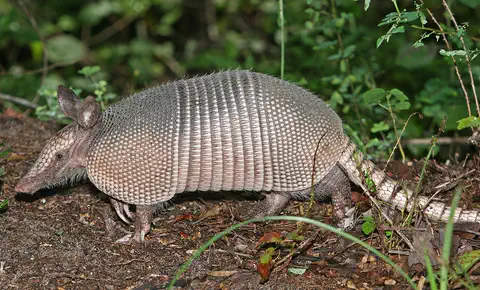
Nine-banded armadillo
The nine-banded armadillo is a small, armored digger that lives from Argentina all the way to the United States. It sniffs out beetles and other bugs in the soil, can hold its breath for six minutes, and almost always has four identical babies at once.
-
Watch
Country
South Africa
South Africa is the southernmost country in Africa, with the Atlantic Ocean on one side and the Indian Ocean on the other. A high plateau covers most of it, about 63.5 million people (2026) live there, and it has 12 official languages and three capital cities.
-
Watch
Country
Namibia
Namibia lies on the southwestern coast of Africa. The Namib, a desert of huge dunes kept alive by sea fog, runs along its coast, a high plateau with farms and wildlife fills its middle, and the dry Kalahari lies to the east. Namibia became independent in 1990.
-
 Watch
Animal
African buffalo
The African buffalo is a huge, cow-like grazer with heavy, curving horns. It lives in herds that can number in the thousands, and a herd will rush to protect a calf in danger. It lives across much of Africa south of the Sahara, from open savannas to rainforests.
-
 Watch
Animal
African forest elephant
The African forest elephant is a separate species from the bigger bush elephant. It lives in the rainforests of central and western Africa, eats lots of fruit and spreads the seeds of forest trees in its dung. It is Critically Endangered.
-
 Watch
3D
Animal
African wild dog
The African wild dog, or painted dog, has a patchy coat unlike any other dog's, big round ears and only four toes on its front feet. It lives in close packs that hunt together, share food and care for the pups. It is endangered: the IUCN estimated in 2025 that only about 1,676 adults are left in the wild.
-
 Watch
Animal
Alpaca
Alpacas are small, woolly members of the camel family from the high Andes Mountains of South America. People bred them from wild vicuñas thousands of years ago, mainly for their soft, warm fleece. Every alpaca lives with people.
For parents & teachers
What children will learn
- Describe how a pangolin's scales, claws, tongue and stomach suit a diet of ants and termites.
- Explain how the ground pangolin defends itself.
- Describe the pangolin life cycle and maternal care.
- Understand why pangolins are threatened and the actions people take to protect them.
Recommended ages: 3 to 17 · About 15 minutes
Talk about it
- Why might a slow animal depend on armor rather than speed?
- Why does it matter that pangolin scales are made of the same material as fingernails?
- What can people everywhere do to help animals that are traded illegally?
Try at home or in class
- Make a pangolin from a paper cone covered in overlapping paper scales, and see how the scales slide when you bend it.
- Look at your fingernails and think about how pangolin scales are made of the same material.
Key vocabulary: scales, keratin, nocturnal, trafficking, vulnerable
Where these facts come from
- The IUCN Red List of Threatened Species , International Union for Conservation of Nature (IUCN terms of use (no redistribution of Red List data or range maps))
- GBIF Backbone Taxonomy and GBIF Occurrence Search , Global Biodiversity Information Facility (CC0 1.0 (backbone); occurrence counts are facts derived from records under CC0, CC BY and CC BY-NC)
- Pangolin , Encyclopaedia Britannica
- Manis temminckii (ground pangolin) , Animal Diversity Web, University of Michigan
- Pangolin , African Wildlife Foundation
- Smutsia temminckii (global assessment) , IUCN Red List
- Wikidata , Wikimedia Foundation (CC0 1.0)
- Wikimedia Commons , Wikimedia Foundation (Per file: Public domain, CC0, CC BY or CC BY-SA only (credited on each page))
Checked, not yet human-reviewed. Last updated October 24, 2026. Spotted a mistake? Tell us.