
Animal
Indian cobra
The Indian cobra is a snake from South Asia. When it feels worried, it lifts its head and spreads a wide hood. The hood has a pattern that looks like glasses.
The Indian cobra, or spectacled cobra, lives across South Asia, from Pakistan to Sri Lanka. It raises its head and spreads a hood marked with a pattern like a pair of glasses, it eats lots of rats and mice, and it is venomous, so it is an animal to admire from far away.
Naja naja is a medium-sized, highly adaptable elapid found from Pakistan through India to Bangladesh, Nepal, Bhutan and Sri Lanka, in habitats from forests to rice paddies and villages. An important predator of rodents and one of the snakes behind many bites in India, it is common and listed by the IUCN as Least Concern.
Photo: Dr. Raju Kasambe, CC BY-SA 4.0, via Wikimedia Commons
Meet the Indian cobra
The Indian cobra is a long, smooth snake.
When it feels worried, it lifts up its head and spreads its neck into a wide hood. On the back of the hood is a pattern that looks like a pair of glasses.
The Indian cobra is also called the spectacled cobra, because the back of its hood has a pattern like a pair of spectacles, or glasses: two rings joined by a curved line. These markings look a bit like eyes, which might help fool an animal behind it.
It is a smooth-scaled snake that can be black, dark brown or creamy white, and large adults can grow to about 2 meters long. Like all cobras, it is venomous. It uses its venom to catch food, and when it feels threatened it first puts on a warning display.
Naja naja is an elapid snake, related to the mambas and the king cobra. Animal Diversity Web describes it as smooth-scaled, with black eyes, a wide head and neck, a body colored from black or dark brown to creamy white, often with a spectacled white or yellow pattern, a wide black band under the neck, and adults that may grow to 1.8 to 2.2 meters.
The hood is formed by spreading long, flexible neck ribs and loose skin. On its back is the famous spectacle mark: two rings joined by a curved line, which the San Diego Zoo describes as patterns meant to look like eyes that may fool an enemy. The IUCN notes that genetic studies are needed to decide whether the Indian and Sri Lankan populations are separate species.
Quick facts
- Group
- Reptile
- Length
- 1.8 to 2.2 m
- Lifespan in the wild
- up to 24 years
Where it lives
Indian cobras live in South Asia.
They live in forests, grasslands and farm fields, and sometimes near villages. They hide in holes, rock piles and old termite mounds.
Indian cobras live in Pakistan, India, Nepal, Bhutan, Bangladesh and Sri Lanka. In India they live across most of the country.
They are very adaptable. You can find them in damp forests, dry forests, grasslands, scrub, rice paddies and other farmland, and even near houses. During the day they shelter in places such as old termite mounds, rock piles, earth dams and grain stores.
The IUCN's assessment (made in 2019, published in 2021) lists the species as native in Pakistan, India, Bangladesh, Nepal, Bhutan and Sri Lanka, at elevations of about 100 to 2,000 meters. It is not known west of Duki in Pakistan; older reports from Afghanistan probably refer to the Central Asian cobra, Naja oxiana, and a Vietnamese record is presumed to be a different species once included in N. naja.
Habitats range from moist evergreen and dry deciduous forest to grassland, dry scrub, rice paddies and other farmland, and the species also lives near human settlements. Daytime shelters include granaries, degraded termite mounds, earth dams and rock piles.
Continent
Its habitats


Where can you find this animal?
- Lives here naturally · Countries and seas named by a scientific source
- Sightings recorded · Records of wild sightings (GBIF)
Lives here naturally · Countries and seas named by a scientific source
Forests, grasslands, scrub, farmland and villages across South Asia, from Pakistan through most of India to Nepal, Bhutan, Bangladesh and Sri Lanka, at about 100 to 2,000 meters.
Places: Pakistan, India, Nepal, Bhutan, Bangladesh and Sri Lanka.
Source: iucn-red-list · checked October 2026
Sightings recorded · Records of wild sightings (GBIF)
Counts of GBIF records of wild observations (human and machine) and preserved specimens. Records include introduced populations, vagrants, escaped or released animals and misidentifications, so a country with records is not necessarily part of the native range.
Wild sightings have been recorded in India, Sri Lanka, Pakistan, Thailand, Indonesia, Taiwan, Nepal, Malaysia and 24 more places.
Source: gbif · checked October 2026
Range maps show where scientists say an animal lives, often country by country. An animal may live in only part of a country shown, and sightings records can include animals that wandered far from home.
What it eats
Indian cobras eat rats and mice.
They also eat frogs, lizards and other snakes. Farmers' fields have lots of rats, so cobras help keep the number of rats down.
Indian cobras mostly hunt rodents, such as rats and mice. They also eat lizards, frogs, other snakes, small birds and birds' eggs. Because rats and mice live near people and their crops, cobras sometimes come into fields and even buildings to hunt them.
A cobra bites its prey quickly, then waits while its venom stops the animal from moving. Then it swallows its meal whole, as all snakes do.
The diet includes rodents, lizards, other snakes, frogs, and small birds and their eggs (IUCN). The cobra bites quickly and then waits while its venom, which acts on the nervous system, paralyzes the prey, which is swallowed whole (Animal Diversity Web).
Because it eats so many rodents in farmland, the IUCN calls the Indian cobra an important agent of pest control, and the San Diego Zoo describes it as an important predator that consumes large numbers of rats. The same habits bring it into contact with people, since it may enter buildings in search of rodents.
Did you know?
Cobras help farmers by eating rats.
By eating lots of rats and mice, Indian cobras help protect farmers' crops and stored grain.
The IUCN describes the Indian cobra as an important agent of pest control in farmland because it feeds on rodents.
The famous hood
The cobra makes its hood by spreading its neck.
It lifts the front of its body off the ground. This says, "Stay back!" It is a warning, so the best thing to do is move away.
Look at the photo: this cobra has lifted the front part of its body and spread its hood, so you can see the spectacle pattern on the back. The hood is made by long, bendy neck ribs that spread out and stretch the loose skin.
Raising the front of its body, spreading its hood and hissing are the cobra's way of saying "Back off!" They help it scare away animals that might harm it. Even baby cobras can spread their hoods on the day they hatch.
When threatened, the Indian cobra raises the front third of its body and spreads its long, flexible neck ribs and loose skin into the hood (Animal Diversity Web). The San Diego Zoo describes cobras rearing up, spreading the hood and hissing loudly to scare off most threats; the posture is defensive.
Hatchlings can rear up and spread their hoods as soon as they leave the egg. Indian cobra venom is also studied in medicine: the IUCN notes uses for its anticoagulant properties and clinical testing for treating some cancers.
Growing up
A mother cobra lays her eggs in a hole in the ground.
She stays close to guard them. The babies hatch after about two months and look after themselves.
Indian cobras lay their eggs between April and July. A female lays 12 to 50 eggs in a burrow underground or another hidden spot, and she stays to guard them, leaving only to feed.
The eggs hatch after about 48 to 69 days. The babies can already spread their hoods, and within one or two weeks they leave and go their own ways. Females can lay eggs more than once a year.
The species is oviparous. Eggs are laid between April and July, 12 to 50 per clutch, in underground burrows, and hatch after 48 to 69 days; the young disperse one or two weeks later, and females may lay more than once a year (IUCN). Animal Diversity Web adds that the female guards the eggs through incubation, leaving only to feed, unusual among snakes.
Hatchlings are fully capable of rearing, spreading the hood and striking as soon as they emerge, and the San Diego Zoo notes that newly hatched cobras can live for a time on the yolk inside their bodies before they must find food.
Living near people
Indian cobras often live near farms and villages.
They would rather slip away than meet people. If you ever see a snake, stay well back, leave it alone and tell a grown-up.
Indian cobras are active mostly in the daytime, though they are often seen in the late evening. Because they hunt rats and mice, they often live near farms and villages, and that means people and cobras meet.
A cobra's hood display is a warning, not an attack: it is telling you to keep away. The safest thing is to stay well back, leave the snake alone and tell an adult.
The Indian cobra is diurnal, though often seen in the late evening (IUCN), and its hunting of rodents brings it into fields, villages and buildings. The World Health Organization describes snakebite as a neglected public health issue in many tropical and subtropical countries, most of them in Africa, Asia and Latin America; agricultural workers and children are the most affected, and the WHO stresses that highly effective treatment exists.
In India, the spectacled cobra is one of the so-called big four snakes to which a significant number of snakebites are attributed, and India's commercial antivenom is made against the venoms of these four species (PLOS Neglected Tropical Diseases, 2019). Cobra venom for antivenom production is collected from snakes kept on farms, according to the IUCN.
Did you know?
A mother cobra guards her eggs.
Most snakes leave their eggs, but a mother Indian cobra guards hers until they hatch.
Females guard the clutch throughout incubation, leaving only to feed, which Animal Diversity Web notes is unusual among snakes.
A common snake, protected
There are many Indian cobras.
In India they are protected by law. People should leave wild cobras alone so they can keep catching rats.
The Indian cobra is common and widespread, so it is listed as least concern, and its numbers seem stable. In India it is protected by law, and it lives in many protected areas.
It still faces some problems: people catch cobras for their skins and to collect their venom, sometimes illegally, and because they are venomous and common on farmland, cobras are sometimes killed by people.
The IUCN lists Naja naja as Least Concern (assessed 2019, published 2021) with a stable trend, citing its wide range, abundance and adaptability despite harvesting pressure. In India it is protected under the Wildlife (Protection) Act of 1972, and it occurs in many protected areas; all Naja species are listed under CITES.
Local pressures include collection for the leather trade (India has controlled the export of cobra skins since 1973, yet skins are still processed in large numbers), illegal collection for venom, and persecution of venomous snakes in farmland. Snake charmers have also kept cobras, defanged, as a livelihood; the San Diego Zoo notes that India's wildlife protection law has banned snake charming since 1991.
IUCN Red List
How is the indian cobra doing in the wild?
- Least Concern (this animal)
- Near Threatened
- Vulnerable
- Endangered
- Critically Endangered
- Extinct in the Wild
- Extinct
Least Concern
Not at risk of disappearing from the wild right now.
See the IUCN Red List assessment · The IUCN Red List of Threatened Species 2022.2
Amazing facts
-
The pattern on a cobra's hood looks like glasses.
The Indian cobra is also called the spectacled cobra, because of the pattern on the back of its hood.
The binocellate hood mark, two rings joined by a curved line, gives the species its other name, spectacled cobra.
-
Baby cobras can spread their hoods right away.
A baby Indian cobra can rear up and spread its hood as soon as it hatches.
Hatchlings are capable of rearing, spreading the hood and striking immediately after emerging (Animal Diversity Web).
-
Cobras help farmers by eating rats.
By eating lots of rats and mice, Indian cobras help protect farmers' crops and stored grain.
The IUCN describes the Indian cobra as an important agent of pest control in farmland because it feeds on rodents.
-
A mother cobra guards her eggs.
Most snakes leave their eggs, but a mother Indian cobra guards hers until they hatch.
Females guard the clutch throughout incubation, leaving only to feed, which Animal Diversity Web notes is unusual among snakes.
Words to know
- venomous
- able to make venom, a harmful substance passed on by a bite or sting
- hood
- the wide flap a cobra makes by spreading the ribs in its neck
- spectacles
- an old word for glasses
- rodent
- a small gnawing mammal, such as a rat or mouse
- antivenom
- a medicine that treats a venomous bite
- oviparous
- laying eggs
Discovery challenge
-
What does a cobra spread out when it is worried?
What does an Indian cobra spread when it feels threatened?
Which structure does an Indian cobra spread in its defensive display?
- Its hood
- Its wings
- Its tail fin
Show the answer
Its hood
It spreads its neck into a wide hood.
It spreads its hood by stretching out long neck ribs, and raises the front of its body.
The hood, formed by spreading elongated neck ribs and loose skin, with the forebody raised.
-
What does the pattern on the back of the hood look like?
Why is the Indian cobra also called the spectacled cobra?
What gives the spectacled cobra its name?
- A pair of glasses
- A star
- A number
Show the answer
A pair of glasses
It looks like a pair of glasses!
The mark on the back of its hood looks like a pair of glasses, or spectacles.
The binocellate mark on the back of the hood: two rings joined by a curved line.
-
What do Indian cobras like to eat?
What are the Indian cobra's main prey?
Which prey makes the Indian cobra important for pest control?
- Leaves
- Rats and mice
- Fish from the sea
Show the answer
Rats and mice
They eat rats and mice.
They mostly eat rodents such as rats and mice, plus frogs, lizards, snakes and birds.
Rodents in farmland; the IUCN calls it an important agent of pest control.
-
What should you do if you see a snake?
What is the safest thing to do if you see a cobra?
What does a cobra's hood display mean, and how should people respond?
- Stay back, leave it alone and tell an adult
- Try to pick it up
- Poke it with a stick
Show the answer
Stay back, leave it alone and tell an adult
Stay back and tell a grown-up.
The hood is a warning. Stay well back, leave the snake alone and tell an adult.
The display is defensive, a warning to keep away; give the snake space and keep away.
Places where you might see it
-
 Watch
 Country
India
India is a huge country in South Asia, shaped like a big triangle pointing into the Indian Ocean. The Himalayas rise along its north, heavy monsoon rains arrive every summer, and about 1.46 billion people (2025) live there, speaking hundreds of languages.
-
 Watch
 Country
Sri Lanka
Sri Lanka is an island country in the Indian Ocean, just south of India. Green highlands rise in the middle, surrounded by plains and sandy beaches. About 22 million people live there, and the island is famous for its tea, its ancient cities and its wild elephants.
-
 Watch
 Country
Pakistan
Pakistan is a country in South Asia that stretches from icy mountain peaks in the north down the fertile valley of the Indus River to the Arabian Sea. It has busy cities such as Karachi and Lahore, its capital is Islamabad, and its 2023 census counted 241.49 million people.
Explore next
-
 Watch
Animal
King cobra
The king cobra is the largest venomous snake in the world, growing to more than 5 meters long. It lives in forests and near streams in South and Southeast Asia, eats mainly other snakes, and the mother builds a nest of leaves and guards her eggs.
-
 Watch
Animal
Black mamba
The black mamba is a long, slender, very fast snake of the savannas and rocky hills of sub-Saharan Africa. It is gray to brown, gets its name from its inky-black mouth, hunts small mammals by day, and is shy: it would almost always rather slip away from people. It is also highly venomous, so it is a snake to admire from far away.
-
Watch
Country
India
India is a huge country in South Asia, shaped like a big triangle pointing into the Indian Ocean. The Himalayas rise along its north, heavy monsoon rains arrive every summer, and about 1.46 billion people (2025) live there, speaking hundreds of languages.
-
Watch
Country
Sri Lanka
Sri Lanka is an island country in the Indian Ocean, just south of India. Green highlands rise in the middle, surrounded by plains and sandy beaches. About 22 million people live there, and the island is famous for its tea, its ancient cities and its wild elephants.
-
Watch
Country
Pakistan
Pakistan is a country in South Asia that stretches from icy mountain peaks in the north down the fertile valley of the Indus River to the Arabian Sea. It has busy cities such as Karachi and Lahore, its capital is Islamabad, and its 2023 census counted 241.49 million people.
-
 Watch
3D
Animal
Tiger
The tiger is a huge cat with orange fur and dark stripes that help it hide in tall grass and forest shadows. It lives alone, hunts deer and wild pigs, and loves to swim. Wild tigers live only in Asia, and they are endangered.
-
 Watch
Animal
Gharial
The gharial is a crocodile relative with a long, skinny snout full of sharp teeth, perfect for snapping up fish. It lives in a few big rivers of northern India and Nepal, and it is one of the most threatened crocodilians on Earth.
-
 Watch
Animal
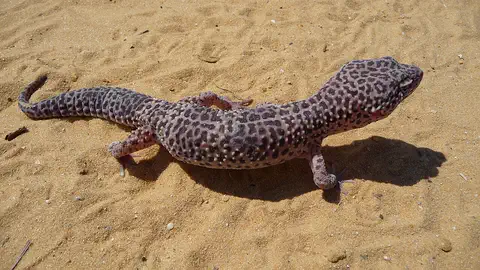
Leopard gecko
The leopard gecko is a spotted lizard from the rocky deserts and dry grasslands of Pakistan, Afghanistan, northwestern India and Nepal. It hunts insects and scorpions at night, stores fat in its thick tail, and has real eyelids. It is also one of the most popular pet lizards in the world.
For parents & teachers
What children will learn
- Describe how the Indian cobra makes its hood and what the spectacle mark is.
- Explain the cobra's role as a predator of rodents on farms.
- Describe the Indian cobra's life cycle, including the mother guarding her eggs.
- Know simple snake safety: keep a distance, leave snakes alone and tell an adult.
Recommended ages: 3 to 17 · About 15 minutes
Talk about it
- How can an animal be both helpful to farmers and dangerous to people?
- Why might a warning display be better for a snake than biting?
- What can people do to stay safe in places where snakes live?
Try at home or in class
- Make a paper cobra hood: cut a wide paper oval, draw two rings joined by a curve on the back, and fold it around a cardboard tube to see how a hood opens.
- Measure 2 meters along the floor with a tape measure and lie down beside it to see how long a big Indian cobra can be.
Key vocabulary: venomous, hood, spectacles, rodent, antivenom, oviparous
Where these facts come from
- The IUCN Red List of Threatened Species , International Union for Conservation of Nature (IUCN terms of use (no redistribution of Red List data or range maps))
- GBIF Backbone Taxonomy and GBIF Occurrence Search , Global Biodiversity Information Facility (CC0 1.0 (backbone); occurrence counts are facts derived from records under CC0, CC BY and CC BY-NC)
- Naja naja (Indian Cobra), global Red List assessment 2021 , IUCN Red List of Threatened Species
- Naja naja (Indian Cobra) , Animal Diversity Web, University of Michigan Museum of Zoology
- Cobra , San Diego Zoo Wildlife Alliance
- Snakebite envenoming (fact sheet) , World Health Organization
- Beyond the 'big four': Venom profiling of the medically important yet neglected Indian snakes reveals disturbing antivenom deficiencies , PLOS Neglected Tropical Diseases (2019)
- Wikidata , Wikimedia Foundation (CC0 1.0)
- Wikimedia Commons , Wikimedia Foundation (Per file: Public domain, CC0, CC BY or CC BY-SA only (credited on each page))
Checked, not yet human-reviewed. Last updated October 27, 2026. Spotted a mistake? Tell us.