Animal
Leopard gecko
The leopard gecko is a small, spotty lizard from dry, rocky places in South Asia. Unlike many geckos, it can blink and close its eyes.
The leopard gecko is a spotted lizard from the rocky deserts and dry grasslands of Pakistan, Afghanistan, northwestern India and Nepal. It hunts insects and scorpions at night, stores fat in its thick tail, and has real eyelids. It is also one of the most popular pet lizards in the world.
Eublepharis macularius is a nocturnal, ground-dwelling eyelid gecko of arid South Asia, from south of the Hindu Kush to western India, with records in Nepal since 2019. Common in the wild and widely bred in captivity, it is assessed by the IUCN as Least Concern with a stable population.
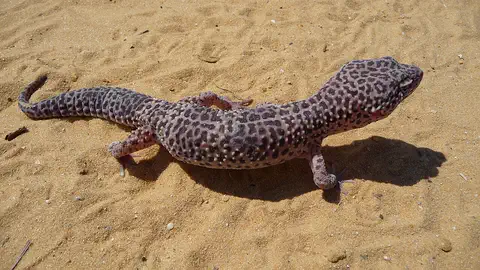
Photo: George Chernilevsky, public domain, via Wikimedia Commons
Meet the leopard gecko
The leopard gecko is a small lizard covered in spots, like a leopard.
It lives where it is dry and rocky. It has a fat tail and big eyes, and it can blink!
The leopard gecko is a lizard about 17 to 25 centimeters long, covered in dark spots like a leopard. Wild ones are usually yellowish with black spots and a white belly, and their skin is covered in little bumps.
Many geckos have no eyelids and cannot blink, but the leopard gecko can. Its scientific name, Eublepharis macularius, means "well-made eyelid" and "spotted." It also has claws instead of sticky toe pads, and its clawed toes help it climb rocks and branches.
Eublepharis macularius belongs to the eyelid geckos (family Eublepharidae). Adults measure about 17.5 to 25 centimeters (SeaWorld); the wild coloration is usually a yellow ground with irregular black spots and a white belly (Animal Diversity Web). Unlike many geckos it has movable eyelids, vertical slit pupils and clawed toes without adhesive pads.
The genus name means "well-made eyelid" and the species name "spotted" (SeaWorld). Pet leopard geckos come in other color forms too, such as bright "high color" or "yellow phase" and albino geckos, which Animal Diversity Web links to the species' popularity in the pet trade.
Quick facts
- Group
- Reptile
- Length
- 17.5 to 25 cm
- Lifespan in the wild
- up to 20 years
Where it lives
Wild leopard geckos live in South Asia.
They live in dry, rocky places and grasslands. In the day they hide under rocks. At night they come out.
In the wild, leopard geckos live in Pakistan, eastern Afghanistan, northwestern India and, as scientists discovered in 2019, Nepal. They live in rocky deserts, dry grasslands and stony hills, up to about 2,500 meters high.
In Pakistan they often live in colonies in the stone walls built around fields and houses. In the daytime they hide in rock cracks or burrows, out of the heat, and they come out at night.
The IUCN's assessment (made in 2019, published in 2021) describes a range from south of the Hindu Kush in Afghanistan and northwestern Pakistan through Pakistan to Rajasthan and the Khandesh district of western India, up to about 2,500 meters. Its presence in Iran rests on one lost early-1900s specimen and is uncertain.
In 2019 the species was recorded in Nepal for the first time, in the Kamdi Biological Corridor, about 500 kilometers east of the nearest known Indian locality; the two males found were hibernating in a dead tree in mixed hardwood forest. Elsewhere it uses open alluvial soils, rocky desert, sparse grassland and crevices in rock walls, and in Pakistan colonies favor stone boundary walls around fields and houses.
Continent
Its habitats


Where can you find this animal?
- Lives here naturally · Countries and seas named by a scientific source
- Sightings recorded · Records of wild sightings (GBIF)
Lives here naturally · Countries and seas named by a scientific source
Rocky deserts, dry grasslands and stony hills from eastern Afghanistan through Pakistan to northwestern India (Jammu and Kashmir, Punjab, Rajasthan), with scattered records in Nepal since 2019. Pet leopard geckos are kept worldwide, but wild ones live only here.
Places: Pakistan, Afghanistan, India and Nepal.
Source: iucn-red-list · checked October 2026
Sightings recorded · Records of wild sightings (GBIF)
Counts of GBIF records of wild observations (human and machine) and preserved specimens. Records include introduced populations, vagrants, escaped or released animals and misidentifications, so a country with records is not necessarily part of the native range.
Wild sightings have been recorded in Pakistan, United States, India, Iran, Afghanistan, Japan, Belgium, Brazil and 7 more places.
Source: gbif · checked October 2026
Range maps show where scientists say an animal lives, often country by country. An animal may live in only part of a country shown, and sightings records can include animals that wandered far from home.
What it eats
Leopard geckos eat bugs.
At night they hunt beetles, spiders and even scorpions! They also eat their own old skin after they shed.
Leopard geckos are hunters. In the wild they eat insects and other small animals such as beetles, spiders, centipedes and even scorpions. They hunt at night, when it is cooler, coming out of holes and cracks to look for food.
Like other reptiles, leopard geckos shed their skin from time to time as they grow. They often eat the old skin they have shed.
Wild diets include scorpions, centipedes, spiders and beetles (Animal Diversity Web); SeaWorld notes they will also eat other lizards. Hunting is strictly nocturnal, starting after dark when the gecko emerges from holes and crevices.
The thick tail is a fat store for lean periods (SeaWorld). Leopard geckos shed periodically and eat the sloughed skin.
Did you know?
Leopard geckos were found in Nepal only a few years ago.
Scientists first recorded leopard geckos in Nepal in 2019, about 500 kilometers east of where anyone had found them before.
Records published in 2019 from the Kamdi Biological Corridor and two other Nepalese sites extended the known range about 500 kilometers east of the nearest Indian locality (IUCN).
Eyelids, claws and a fat tail
The leopard gecko can close its eyes to sleep.
It has claws for climbing rocks. Its fat tail stores food. If something grabs the tail, it can break off.
Look closely at the eye in the photo: leopard geckos have eyelids that move. Many geckos cannot blink, but leopard geckos can, and they close their eyes while they sleep. Their pupils are thin, up-and-down slits.
Instead of sticky toe pads they have clawed toes, good for climbing rocks and branches. Their thick tail stores fat for hard times. If a predator grabs the tail, it breaks off so the gecko can escape, but the gecko loses its stored food.
Movable, translucent eyelids allow the leopard gecko to blink and close its eyes while sleeping (SeaWorld), a key difference from many geckos, whose eyelids are fused. Pupils are vertical slits, and the clawed toes, without adhesive pads, let this ground-dweller climb rocks and branches (Animal Diversity Web).
The segmented tail stores fat and can be shed (autotomized) when grabbed. SeaWorld points out the cost: the gecko escapes but leaves behind its fat reserve.
Growing up
A mother leopard gecko lays two eggs at a time.
She buries them in damp ground. The warmth of the ground decides if the babies are boys or girls.
Leopard geckos sleep through the cold months, from about October to February. Then they become active again and breed. A female lays several clutches, each of one or two eggs, and buries them in damp ground.
The eggs hatch after about one to two months, depending on how warm they are. The temperature also decides whether the babies are boys or girls. Hatchlings are about 8.5 centimeters long, and they are grown up at about a year and a half.
Leopard geckos hibernate from about October to February over much of their range (IUCN). Females lay several clutches of one or two eggs, almost always two according to Animal Diversity Web, buried in damp substrate. The IUCN gives about a month to hatch; Animal Diversity Web gives 45 to 53 days at 28 degrees Celsius, and SeaWorld 52 days.
Sex is determined by incubation temperature. Hatchlings measure about 85 millimeters, and maturity comes at around 18 months. In captivity, females have laid four clutches at four-week intervals in a year.
Night life
Leopard geckos sleep in the day and wake up at night.
On warm, rainy nights, lots of them come out together to hunt.
Leopard geckos are strictly nocturnal. They spend the hot days in burrows or under rocks and come out after dark. When they are active, they are curious explorers.
They often live in groups called colonies, and on warm, humid nights in the rainy season large numbers of them can be seen. When winter comes, they hibernate for several months.
The species is nocturnal and terrestrial, sheltering under rocks or in burrows by day. It lives in colonies, and on warm, humid nights in the wet season it can appear in large numbers (IUCN, citing Khan 2006). In much of its range it hibernates between October and February, though in warmer areas it may stay active into November.
Though ground-dwelling, it climbs rocks and branches, where Animal Diversity Web notes it can absorb heat through its belly.
Did you know?
Leopard geckos eat their old skin.
When a leopard gecko sheds its skin, it often eats the old skin.
Leopard geckos shed periodically and eat the sloughed skin (Animal Diversity Web).
Wild geckos and pet geckos
There are lots of wild leopard geckos.
Many people keep leopard geckos as pets. Most pet geckos are born to pet parents, not caught in the wild.
Wild leopard geckos are common, so they are listed as least concern, and their numbers seem steady.
Leopard geckos are also extremely popular pets. Most pet leopard geckos today are bred by people, but some are still caught in the wild, legally and illegally. Pakistan has strict rules about sending them out of the country, and in Nepal, where the species was found only recently, its forest home is being logged and geckos seized at the border may come from there.
The IUCN lists the leopard gecko as Least Concern with a stable trend (assessed 2019, published 2021), noting its wide distribution and presumed large population, and no major threats to the species as a whole.
It is extremely common in the international pet trade and widely captive-bred, and the IUCN suggests most pet-trade animals may now be captive-bred; Animal Diversity Web reports that captive stock is mainly of Pakistani origin. Legal and illegal collection from the wild continues, Pakistan requires strict export permits, and animals are often confiscated at the Nepal-India border, some perhaps from the newly found Nepalese populations, which also face logging and gravel extraction.
IUCN Red List
How is the leopard gecko doing in the wild?
- Least Concern (this animal)
- Near Threatened
- Vulnerable
- Endangered
- Critically Endangered
- Extinct in the Wild
- Extinct
Least Concern
Not at risk of disappearing from the wild right now.
See the IUCN Red List assessment · The IUCN Red List of Threatened Species 2022.2
Amazing facts
-
Leopard geckos can close their eyes to sleep.
Unlike many geckos, leopard geckos have eyelids that move, so they can blink and close their eyes when they sleep.
Movable eyelids, rather than the fused, transparent lids of many geckos, let leopard geckos blink and close their eyes while sleeping (SeaWorld).
-
A leopard gecko keeps food in its tail.
A leopard gecko's thick tail is like a lunch box: it stores fat for times when food is scarce.
The tail is a fat reserve for lean periods; shedding it to escape a predator costs the gecko that reserve.
-
Leopard geckos eat their old skin.
When a leopard gecko sheds its skin, it often eats the old skin.
Leopard geckos shed periodically and eat the sloughed skin (Animal Diversity Web).
-
Leopard geckos were found in Nepal only a few years ago.
Scientists first recorded leopard geckos in Nepal in 2019, about 500 kilometers east of where anyone had found them before.
Records published in 2019 from the Kamdi Biological Corridor and two other Nepalese sites extended the known range about 500 kilometers east of the nearest Indian locality (IUCN).
Words to know
- nocturnal
- active at night
- eyelid
- a fold of skin that can close over the eye
- hibernate
- to rest deeply through the cold months
- colony
- a group of animals of the same kind living close together
- captive-bred
- born to parents kept by people, not caught in the wild
- shed
- to lose an old outer layer of skin
Discovery challenge
-
What can a leopard gecko do that many geckos cannot?
What can a leopard gecko do with its eyes that many geckos cannot?
Which feature sets the leopard gecko apart from many other geckos?
- Blink and close its eyes
- See through walls
- Glow in the dark
Show the answer
Blink and close its eyes
It has eyelids, so it can blink.
It has movable eyelids, so it can blink and close its eyes to sleep.
Movable eyelids, the trait behind the name Eublepharis, well-made eyelid.
-
What does a leopard gecko keep in its fat tail?
What does a leopard gecko store in its thick tail?
What is the leopard gecko's tail used to store?
- Water
- Fat
- Eggs
Show the answer
Fat
Its tail stores fat, like food for later.
It stores fat for times when food is scarce.
Fat reserves for lean periods and the long hibernation.
-
When does a leopard gecko hunt?
When are leopard geckos active?
What is the leopard gecko's daily activity pattern?
- At night
- Only at noon
- Only under water
Show the answer
At night
It hunts at night, when it is cool.
They are nocturnal: they hide by day and come out after dark.
Strictly nocturnal, sheltering under rocks or in burrows by day.
-
Where do wild leopard geckos live?
Where do leopard geckos live in the wild?
Which region is the leopard gecko native to?
- Rainforests of Brazil
- Dry, rocky lands of South Asia
- Icy islands near the North Pole
Show the answer
Dry, rocky lands of South Asia
They live in dry, rocky places in Pakistan and nearby.
They live in rocky deserts and dry grasslands in Pakistan, Afghanistan, northwestern India and Nepal.
Arid South Asia, from south of the Hindu Kush to western India, with Nepalese records since 2019.
Places where you might see it
-
 Watch
 Country
Pakistan
Pakistan is a country in South Asia that stretches from icy mountain peaks in the north down the fertile valley of the Indus River to the Arabian Sea. It has busy cities such as Karachi and Lahore, its capital is Islamabad, and its 2023 census counted 241.49 million people.
-
 Watch
 Country
India
India is a huge country in South Asia, shaped like a big triangle pointing into the Indian Ocean. The Himalayas rise along its north, heavy monsoon rains arrive every summer, and about 1.46 billion people (2025) live there, speaking hundreds of languages.
Explore next
-
 Watch
Animal
Tokay gecko
The tokay gecko is one of the biggest geckos in the world, a blue-gray lizard covered in orange spots. It lives in forests and on houses across South and Southeast Asia, hunts insects at night, climbs walls and ceilings with special toe pads, and gets its name from the male's loud to-kay call.
-
Watch
Country
Pakistan
Pakistan is a country in South Asia that stretches from icy mountain peaks in the north down the fertile valley of the Indus River to the Arabian Sea. It has busy cities such as Karachi and Lahore, its capital is Islamabad, and its 2023 census counted 241.49 million people.
-
Watch
Country
India
India is a huge country in South Asia, shaped like a big triangle pointing into the Indian Ocean. The Himalayas rise along its north, heavy monsoon rains arrive every summer, and about 1.46 billion people (2025) live there, speaking hundreds of languages.
-
 Watch
Animal
Central bearded dragon
The central bearded dragon is a lizard of the dry woodlands, scrub and deserts of eastern inland Australia. It eats plants and small animals, basks on fence posts and logs, waves its arm and bobs its head to talk to other dragons, and puffs out a spiky beard to look big. It is also a very popular pet lizard.
-
 Watch
Animal
Indian cobra
The Indian cobra, or spectacled cobra, lives across South Asia, from Pakistan to Sri Lanka. It raises its head and spreads a hood marked with a pattern like a pair of glasses, it eats lots of rats and mice, and it is venomous, so it is an animal to admire from far away.
-
 Watch
Animal
Aldabra giant tortoise
The Aldabra giant tortoise is one of the largest land tortoises on Earth. Wild ones live on Aldabra Atoll, a ring of coral islands in the Indian Ocean, where more than 100,000 of them graze, browse and shape the land like elephants do in Africa. They can live for more than 100 years.
-
 Watch
Animal
Alligator snapping turtle
The alligator snapping turtle is the largest freshwater turtle in the United States. It lies still on the bottom of rivers and lakes with its mouth open, wiggling a worm-like lure on its tongue to trick fish into swimming close. Its numbers have fallen, and it is now endangered.
-
 Watch
3D
Animal
American alligator
The American alligator is a large, armored reptile of the swamps, marshes and lakes of the southeastern United States. Alligator mothers guard their nests and carry their babies to the water, and the holes alligators dig help many other animals survive dry seasons.
For parents & teachers
What children will learn
- Describe the leopard gecko's eyelids, clawed toes and fat-storing tail.
- Explain how a nocturnal lifestyle and hibernation help it survive in a dry, seasonal climate.
- Describe its life cycle, including temperature-dependent sex.
- Discuss the difference between wild and captive-bred animals in the pet trade.
Recommended ages: 3 to 17 · About 15 minutes
Talk about it
- Why might coming out only at night help an animal that lives in a hot, dry place?
- What are the good and bad sides of a tail that can break off?
- Why is it better for pet animals to be bred by people than taken from the wild?
Try at home or in class
- Measure 25 centimeters with a ruler and compare it with your hand to see how big a grown-up leopard gecko is.
- Make a leopard gecko "year" wheel: divide a paper plate into 12 months and color October to February as winter sleep.
Key vocabulary: nocturnal, eyelid, hibernate, colony, captive-bred, shed
Where these facts come from
- The IUCN Red List of Threatened Species , International Union for Conservation of Nature (IUCN terms of use (no redistribution of Red List data or range maps))
- GBIF Backbone Taxonomy and GBIF Occurrence Search , Global Biodiversity Information Facility (CC0 1.0 (backbone); occurrence counts are facts derived from records under CC0, CC BY and CC BY-NC)
- Eublepharis macularius (Common Leopard Gecko), global Red List assessment 2021 , IUCN Red List of Threatened Species
- Eublepharis macularius (Common Leopard Gecko) , Animal Diversity Web, University of Michigan Museum of Zoology
- Leopard Gecko Facts and Information , SeaWorld Parks and Entertainment
- Wikidata , Wikimedia Foundation (CC0 1.0)
- Wikimedia Commons , Wikimedia Foundation (Per file: Public domain, CC0, CC BY or CC BY-SA only (credited on each page))
Checked, not yet human-reviewed. Last updated October 27, 2026. Spotted a mistake? Tell us.
Picture credits
- Photo: George Chernilevsky, public domain, via Wikimedia Commons · source