
Animal
Indian star tortoise
The Indian star tortoise has yellow stars on its dark shell. It lives in dry, grassy places in India, Sri Lanka and Pakistan.
The Indian star tortoise is named for the yellow star shapes on its dark shell. It lives in dry scrub, grasslands and farmland in India, Sri Lanka and a small part of Pakistan, and it eats grasses, leaves, flowers and fruits. Collection for the pet trade has made it vulnerable.
Geochelone elegans (family Testudinidae) lives in three separate areas of South Asia: northwestern India with adjoining southeastern Pakistan, eastern and southern India, and Sri Lanka's dry zone. Choudhury, de Silva and Shepherd assessed it as Vulnerable (A4cd) for the IUCN Red List (assessed 13 March 2018, published 2020), mainly because of large-scale illegal collection for the international pet trade.
Photo: Jacob.jose, CC BY-SA 3.0, via Wikimedia Commons
Meet the Indian star tortoise
The Indian star tortoise has a dark shell.
Yellow lines on it look like stars.
The females are bigger than the males.
The Indian star tortoise gets its name from its shell. In the middle of each shell plate is a yellowish patch, and yellow or tan lines spread out from it like the points of a star. Between the lines the shell is brown to black.
Females are often much bigger than males. A male's shell usually grows to about 15 to 20 centimeters long, and a female's to about 25 to 30 centimeters.
Geochelone elegans belongs to the tortoise family, Testudinidae. The Animal Diversity Web describes scutes ranging from smooth to almost pyramidal, each with a yellowish areola and radiating yellow or tan lines on a brown to black background, incomplete stars on the marginals, and a plastron with dark radiating lines on a lighter yellowish background. It gives typical adult carapace lengths of 15 to 20 centimeters in males and 25 to 30 in females; the IUCN gives typical maximums of 26 and 32 centimeters (Moll 1989). The largest known star tortoise, a female from Lunugamwehera National Park in Sri Lanka, had a curved carapace length of 57.5 centimeters and weighed 14 kilograms (de Silva et al. 2017, via IUCN).
The IUCN notes three separate areas of occurrence that may be taxonomically recognizable (Gaur et al. 2006); the Animal Diversity Web recognizes no subspecies but describes regional differences in color and size.
Quick facts
- Group
- Reptile
- Length
- 0.15 to 0.3 m
- Weight
- 1 to 6.6 kg
Dry scrub and grassland
Indian star tortoises live in dry places.
They live in bushes, grassy places and farm fields.
Indian star tortoises live in three separate areas: northwestern India and a neighboring corner of southeastern Pakistan, eastern and southern India, and the dry lowlands of Sri Lanka.
They live in dry scrub forests, grasslands and coastal scrub, at the edges of deserts, and in farm country with fields, hedges and plantations. Most places where they live are lower than 200 meters above sea level.
The IUCN gives three broadly disjunct areas: northwestern India (Gujarat, Rajasthan and Madhya Pradesh) and adjoining southeastern Pakistan; eastern and southern India from Tamil Nadu, Andhra Pradesh and eastern Karnataka to Odisha; and Sri Lanka, mainly in the dry-zone lowlands. It describes a highly generalized habitat preference: scrub forests, grasslands and some coastal scrublands of arid and semi-arid regions (Das 2002), desert edges, and agricultural landscapes of fields, hedgerows and plantations (de Silva 2003; Fyfe 2007). Most localities are below 200 meters, with records from 450 and even 900 meters; in Sri Lanka it occurs mainly up to 270 meters.
The IUCN considers the population relatively large (more than 10,000), with Pakistan's subpopulation small and extremely localized, and Frazier estimated 4 to 12.5 tortoises per hectare in Gujarat.
Continent
Its habitat

Where can you find this animal?
- Lives here naturally · Countries and seas named by a scientific source
- Sightings recorded · Records of wild sightings (GBIF)
Lives here naturally · Countries and seas named by a scientific source
The IUCN lists Indian star tortoises as resident in India, Pakistan and Sri Lanka. They live only in parts of these countries: northwestern India and a neighboring corner of southeastern Pakistan, eastern and southern India, and the dry lowlands of Sri Lanka. Whole countries are shaded.
Places: India, Sri Lanka and Pakistan.
Source: iucn-red-list · checked October 2026
Sightings recorded · Records of wild sightings (GBIF)
Counts of GBIF records of wild observations (human and machine) and preserved specimens. Records include introduced populations, vagrants, escaped or released animals and misidentifications, so a country with records is not necessarily part of the native range.
Wild sightings have been recorded in Sri Lanka, India, Japan, Pakistan, United States, Germany, Ecuador, Madagascar and 4 more places.
Source: gbif · checked October 2026
Range maps show where scientists say an animal lives, often country by country. An animal may live in only part of a country shown, and sightings records can include animals that wandered far from home.
Grasses, leaves and fruit
Indian star tortoises eat plants.
They munch grasses, leaves, flowers and fruit.
Indian star tortoises eat mostly plants: grasses, leafy plants, juicy succulent plants, flowers and fruits. Now and then they also eat some animal food, such as insects or the remains of dead animals.
In the hottest, driest part of the year, when food is hard to find, they can stay still for a long time without eating.
The IUCN describes a diet mainly of grasses, herbaceous and succulent vegetation and fruits, supplemented with some animal matter (Das 1991; de Silva 2003); Choudhury and Rao (2005) recorded several preferred native plants at a release site in Andhra Pradesh. The Animal Diversity Web lists grasses, herbaceous leaves, fruit and flowers, with insects, carrion and dung also taken, and notes that in seasonally dry, hot periods when food is scarce the tortoises become inactive and go long periods without eating.
Did you know?
The biggest star tortoise known weighed 14 kilograms.
The largest known star tortoise, a female from a national park in Sri Lanka, weighed 14 kilograms.
Largest known: a female from Lunugamwehera National Park, Sri Lanka, curved carapace 57.5 cm, 14 kg (de Silva et al. 2017, via IUCN).
A shell full of stars
Its shell has star shapes.
In tall grass, the stars help it hide.
Its head and legs are yellow, often with dark spots.
The star pattern looks bright when you hold a tortoise, but in tall grass the lines break up its outline, so it is hard to see. Its head, legs and tail are yellow to tan, often with dark spots.
Baby star tortoises do not have stars yet: their shells are dark with yellow or orange patches. Grown-up males have a longer, thicker tail and a slightly hollow bottom shell; females have a flat bottom shell.
The Animal Diversity Web notes that the star-like pattern, conspicuous in the hand, breaks up and obscures the tortoise's shape in tall grass. Head, limbs and tail are yellow to tan, often with dark spots or blotches. Hatchlings lack the radiating stars: the carapace is black or brown with rectangular yellow or orange blotches on each scute. Adult males have longer, thicker tails, a concave plastron and more elongate, more widely separated anal scutes; females have shorter tails and flat plastrons. It describes northern Indian tortoises as larger and darker with less contrasting shells, southern Indian ones as smaller with more contrasting stars, and Sri Lankan ones with broader yellow markings, while noting much individual variation; the IUCN text adds that northwestern populations appear less attractively colored.
Eggs in the rainy season
The mother lays her eggs in the rainy season.
The eggs take months to hatch.
The babies have no stars yet.
Star tortoises nest in the rainy, monsoon season. When that is depends on the place: May to June in western India, for example. A female usually lays two clutches a year, each with about 2 to 10 eggs.
The warmth of the nest decides whether the babies will be males or females. Most eggs hatch after about 90 to 170 days. Females are ready to breed at about 6 to 7 years old, perhaps earlier.
The IUCN gives nesting seasons that coincide with the monsoons and vary by region (May to June in western India; March to June and October to January in southeastern India; Das 2002), typically two clutches a year (exceptionally up to four) of 2 to 10 eggs (exceptionally up to 24), female maturity at about 6 to 7 years (possibly earlier; by three years in captivity), and a generation time of around 10 years. The Animal Diversity Web gives up to nine clutches in a rainy season, eggs of 12 to 21 grams and 35 to 52 millimeters, mostly males from incubation at 28 to 30 °C and mostly females at 31 to 32 °C, incubation of mostly 90 to 170 days (known range 47 to 180), and, unlike the IUCN, sexual maturity in the wild at 8 to 12 years in females and 6 to 8 years in males. It notes that no studies of natural lifespan are available.
Busy in the rains
On hot, dry days, star tortoises rest in the shade.
When the rain comes, they are busy for much of the day!
In hot, dry weather, Indian star tortoises are mostly active in the early morning and late afternoon. The rest of the day they shelter under plants or other cover. In the rainy season they become much more active, moving around and feeding for much of the day.
In western India and Pakistan they rest during the colder winter months. Males compete by shoving rivals and trying to flip them onto their backs.
The Animal Diversity Web describes early-morning and late-afternoon activity in dry, hot weather, with shelter under vegetation or other cover for the rest of the day; a large increase in activity, movement and feeding during the rainy season; and inactivity during the colder winter months in western India and Pakistan. Males compete by shoving rivals or trying to flip them onto their backs; courtship is fairly subdued, and males make grunt-like sounds during mating.
It reports that eggs and young tortoises suffer heavy losses to mammals such as jackals, foxes and mongooses, to birds of prey and to large reptiles, while adults are protected by their heavy shells and by staying under cover.
Did you know?
The warmth of the eggs decides if babies are males or females.
Eggs kept at 28 to 30 °C reportedly hatch mostly as males, and at 31 to 32 °C mostly as females.
Temperature-dependent sex determination: mostly males at 28 to 30 °C, mostly females at 31 to 32 °C (ADW).
Vulnerable
Indian star tortoises are in danger.
Many are taken from the wild to be sold as pets.
Laws now protect them.
The Indian star tortoise is listed as vulnerable. Its biggest problem is people collecting wild tortoises, mostly young ones, to sell as pets, many of them in other countries. In 2014, more than 55,000 were collected from just one area of 16 villages in India in a single year.
Its scrubland is also being turned into orchards and crop fields, and tortoises are killed on roads. Since 2019, international trade in the species has been banned, and it is protected by law in India and Sri Lanka and in Pakistan's Sindh province.
Choudhury, de Silva and Shepherd assessed Geochelone elegans as Vulnerable (A4cd) for the IUCN Red List (assessed 13 March 2018, published 2020): population reductions of more than 30% over three generations are likely if exploitation, road kill, brush clearing and other threats continue. Illegal collection for the international pet trade is the main concern, mostly to Southeast and East Asia: at least 55,000 mostly juvenile tortoises were collected from one location (16 villages) in Andhra Pradesh in one year (D'Cruze et al. 2015); over 13,000 were confiscated in India between 2011 and 2015 (Mendiratta et al. 2017); and Thailand seized 5,966 in 15 cases between 2008 and 2013 (Chng 2014). Local collection for food and the conversion of scrub to orchards and cash crops add to the pressure.
The species was moved to CITES Appendix I in 2019 (in effect from 26 November 2019), which the IUCN says prohibits all international trade. The IUCN text also names protection under India's Wildlife (Protection) Act 1972, Sri Lanka's 1993 amendment giving total protection to all chelonians, and Sindh's 2014 wildlife schedule in Pakistan, while noting weak enforcement in Sri Lanka.
IUCN Red List
How is the indian star tortoise doing in the wild?
- Least Concern
- Near Threatened
- Vulnerable (this animal)
- Endangered
- Critically Endangered
- Extinct in the Wild
- Extinct
Vulnerable
At high risk of disappearing from the wild.
Amazing facts
-
The stars on its shell help it hide in tall grass.
The star pattern looks bright in your hand, but in tall grass it breaks up the tortoise's outline.
The radiating pattern, conspicuous in the hand, obscures the tortoise's shape in tall grass (ADW).
-
Baby star tortoises have no stars yet.
Hatchlings have dark shells with yellow or orange patches; the stars come later.
Hatchlings lack radiating lines: black or brown carapace with rectangular yellow or orange blotches on each scute (ADW).
-
The biggest star tortoise known weighed 14 kilograms.
The largest known star tortoise, a female from a national park in Sri Lanka, weighed 14 kilograms.
Largest known: a female from Lunugamwehera National Park, Sri Lanka, curved carapace 57.5 cm, 14 kg (de Silva et al. 2017, via IUCN).
-
The warmth of the eggs decides if babies are males or females.
Eggs kept at 28 to 30 °C reportedly hatch mostly as males, and at 31 to 32 °C mostly as females.
Temperature-dependent sex determination: mostly males at 28 to 30 °C, mostly females at 31 to 32 °C (ADW).
Words to know
- carapace
- the top part of a turtle's or tortoise's shell
- scute
- one of the hard plates that cover a tortoise's shell
- monsoon
- a season of heavy rain that comes at the same time each year
- clutch
- a group of eggs laid at one time
- camouflage
- colors or patterns that help an animal blend in with its surroundings
- vulnerable
- at high risk of dying out in the wild
Discovery challenge
-
What shapes are on this tortoise's shell?
What gives the Indian star tortoise its name?
What pattern on the carapace gives Geochelone elegans its common name?
- Stars
- Stripes like a zebra
- Polka dots
Show the answer
Stars
Stars!
Yellow lines spread out from the middle of each shell plate like a star.
Yellow or tan lines radiating from each scute's areola (ADW).
-
When are star tortoises busiest?
In which season are Indian star tortoises most active?
When does the Indian star tortoise's activity increase most?
- The rainy season
- The coldest winter days
- Only at midnight
Show the answer
The rainy season
The rainy season!
In the rains they move around and feed for much of the day.
Activity increases greatly in the rainy season (ADW); nesting coincides with the monsoons (IUCN).
-
What does a star tortoise eat?
What does an Indian star tortoise mostly eat?
How does the IUCN describe the Indian star tortoise's diet?
- Plants
- Fish
- Only meat
Show the answer
Plants
Plants!
Grasses, leafy plants, flowers and fruits.
Mainly grasses, herbaceous and succulent vegetation and fruits, with some animal matter (IUCN).
-
Why are star tortoises in danger?
What is the biggest threat to Indian star tortoises?
Which threat does the IUCN call the most major concern for Geochelone elegans?
- People taking them to sell as pets
- Too much snow
- Sharks
Show the answer
People taking them to sell as pets
People take them from the wild to sell!
Huge numbers are collected from the wild for the pet trade.
Illegal collection for the international wildlife trade (IUCN).
Places where you might see it
-
 Watch
 Country
India
India is a huge country in South Asia, shaped like a big triangle pointing into the Indian Ocean. The Himalayas rise along its north, heavy monsoon rains arrive every summer, and about 1.46 billion people (2025) live there, speaking hundreds of languages.
-
 Watch
 Country
Sri Lanka
Sri Lanka is an island country in the Indian Ocean, just south of India. Green highlands rise in the middle, surrounded by plains and sandy beaches. About 22 million people live there, and the island is famous for its tea, its ancient cities and its wild elephants.
-
 Watch
 Country
Pakistan
Pakistan is a country in South Asia that stretches from icy mountain peaks in the north down the fertile valley of the Indus River to the Arabian Sea. It has busy cities such as Karachi and Lahore, its capital is Islamabad, and its 2023 census counted 241.49 million people.
Explore next
-
 Watch
Animal
Radiated tortoise
The radiated tortoise lives only in the dry spiny forests of southern and southwestern Madagascar. Yellow lines spread out from the middle of each plate of its high, domed shell. It grazes mostly on grasses. Collection for food and the pet trade, and the loss of its forest, have made it critically endangered.
-
 Watch
Animal
Leopard tortoise
The leopard tortoise is a big land tortoise of eastern and southern Africa, named for the dark spots and blotches on its tall, domed shell. It eats grasses, succulents and fruits, spreads their seeds, and can live for decades. It is still common in most places.
-
 Watch
Animal
Hermann's tortoise
Hermann's tortoise lives in sunny, stony hills and open woods around the Mediterranean in southern Europe. Its high shell is yellow and black and usually about 13 to 18 centimeters long. It eats leaves, flowers and fruits, and it spends the winter hibernating. It is listed as vulnerable.
-
Watch
Country
India
India is a huge country in South Asia, shaped like a big triangle pointing into the Indian Ocean. The Himalayas rise along its north, heavy monsoon rains arrive every summer, and about 1.46 billion people (2025) live there, speaking hundreds of languages.
-
Watch
Country
Sri Lanka
Sri Lanka is an island country in the Indian Ocean, just south of India. Green highlands rise in the middle, surrounded by plains and sandy beaches. About 22 million people live there, and the island is famous for its tea, its ancient cities and its wild elephants.
-
Watch
Country
Pakistan
Pakistan is a country in South Asia that stretches from icy mountain peaks in the north down the fertile valley of the Indus River to the Arabian Sea. It has busy cities such as Karachi and Lahore, its capital is Islamabad, and its 2023 census counted 241.49 million people.
-
 Watch
Animal
Aldabra giant tortoise
The Aldabra giant tortoise is one of the largest land tortoises on Earth. Wild ones live on Aldabra Atoll, a ring of coral islands in the Indian Ocean, where about 180,000 of them graze, browse and shape the land like elephants do in Africa. They can live for more than 100 years.
-
 Watch
Animal
Alligator snapping turtle
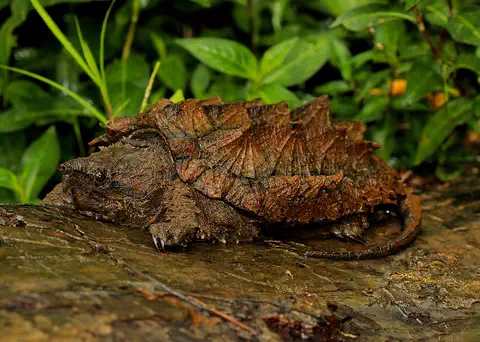
The alligator snapping turtle is the largest freshwater turtle in the United States. It lies still on the bottom of rivers and lakes with its mouth open, wiggling a worm-like lure on its tongue to trick fish into swimming close. Its numbers have fallen, and it is now endangered.
For parents & teachers
What children will learn
- Describe the star pattern on the tortoise's shell and how it can help the tortoise hide.
- Explain how the monsoon shapes the star tortoise's year.
- Compare the sizes of male and female star tortoises.
- Explain why collecting wild animals for the pet trade can put a species in danger.
Recommended ages: 3 to 17 · About 15 minutes
Talk about it
- How can a bright pattern also be good camouflage?
- Why might a tortoise rest during the hottest, driest weeks?
- Why might banning international trade help a wild tortoise?
Try at home or in class
- Star camouflage: draw a dark oval with yellow star lines, cut it out and lay it among long strips of green and yellow paper. Is it easier or harder to see than a plain dark oval?
- Size check: with a ruler, mark 18 centimeters for a male's shell and 28 centimeters for a female's, and compare both with your hand.
Key vocabulary: carapace, scute, monsoon, clutch, camouflage, vulnerable
Where these facts come from
- GBIF Backbone Taxonomy and GBIF Occurrence Search , Global Biodiversity Information Facility (CC0 1.0 (backbone); occurrence counts are facts derived from records under CC0, CC BY and CC BY-NC)
- Wikidata , Wikimedia Foundation (CC0 1.0)
- The IUCN Red List of Threatened Species , International Union for Conservation of Nature (IUCN terms of use (no redistribution of Red List data or range maps))
- Geochelone elegans (Choudhury, de Silva and Shepherd, assessed 13 March 2018, published 2020) , IUCN Red List of Threatened Species
- Geochelone elegans: justification, range, population, habitat, threats, use and trade, and conservation text , IUCN Red List of Threatened Species
- Geochelone elegans: IUCN Red List global assessment record (Choudhury, de Silva and Shepherd 2020), IUCN checklist on GBIF , GBIF
- Geochelone elegans (Indian star tortoise) , Animal Diversity Web, University of Michigan Museum of Zoology
- File:Indian star tortoise - Houston Zoo - cropped.jpg (1 October 2011, Jacob.jose) , Wikimedia Commons
- Wikimedia Commons , Wikimedia Foundation (Per file: Public domain, CC0, CC BY or CC BY-SA only (credited on each page))
Checked, not yet human-reviewed. Last updated November 1, 2026. Spotted a mistake? Tell us.