
Animal
Radiated tortoise
The radiated tortoise lives only on the island of Madagascar. Yellow lines spread out like stars on its high, dark shell!
The radiated tortoise lives only in the dry spiny forests of southern and southwestern Madagascar. Yellow lines spread out from the middle of each plate of its high, domed shell. It grazes mostly on grasses. Collection for food and the pet trade, and the loss of its forest, have made it critically endangered.
Astrochelys radiata (family Testudinidae) is endemic to the dry spiny forests of southern and southwestern Madagascar, usually within 50 to 100 kilometers of the coast. Leuteritz and Rioux Paquette assessed it as Critically Endangered (A4d; E) for the IUCN Red List (assessed 15 January 2008, published 2008; marked as needing updating), citing heavy collection, mainly for domestic consumption, and habitat loss.
Photo: Charles J. Sharp, CC BY-SA 4.0, via Wikimedia Commons
Meet the radiated tortoise
The radiated tortoise has a high, round shell.
Yellow lines spread out on it like the rays of a star.
Its legs and the sides of its head are yellow.
The radiated tortoise is a tortoise from Madagascar. Its high, domed shell is dark, and bright yellow lines spread out from the middle of each plate, which is how it got its name. Its head, legs and feet are yellow, except for a dark patch on top of its head.
An adult's shell is about 24 to 40 centimeters long, and a big one can weigh up to about 16 kilograms.
Astrochelys radiata belongs to the tortoise family, Testudinidae (formerly placed in Geochelone). The Animal Diversity Web describes a high-domed carapace, a blunt head and elephantine feet; yellow legs, feet and head apart from a variably sized black patch on top of the head; and yellow lines radiating from the center of each dark scute. Its scutes are smooth, not raised into the bumpy, pyramidal shapes common in the Indian star tortoise. It gives a carapace length of up to 16 inches and a weight of up to 35 pounds.
The IUCN cites adult carapace lengths of 24.2 to 35.6 centimeters in females and 28.5 to 39.5 centimeters in males (Pedrono 2008); males show distinct secondary sexual characters from about 26 centimeters.
Quick facts
- Group
- Reptile
- Length
- 0.24 to 0.4 m
- Weight
- 15.9 kg
The spiny forest
Radiated tortoises live in dry, spiny forests.
It does not rain much there.
They live only in the south of Madagascar.
Radiated tortoises live only in southern and southwestern Madagascar, usually within about 50 to 100 kilometers of the coast. Their home is the dry spiny forest, where rain is low and does not come regularly, and many plants are spiny and suited to dry conditions.
They live both on high plateaus inland and on sandy dunes close to the sea. Rivers seem to keep many of them apart: a genetic study found three separate groups.
The IUCN text (2008) describes a range in the dry spiny forests of southern and southwestern Madagascar, from around Amboasary in the south across the Karimbola and Mahafaly plateaus north of Tuléar to Morombe, usually in a narrow band about 50 to 100 kilometers from the coast, with a core range of about 10,000 square kilometers. The habitat has low, irregular rainfall and xerophytic spiny vegetation dominated by Didiereaceae and Euphorbia (Durrell et al. 1989), on inland high plateaus and coastal sandy dunes (Leuteritz et al. 2005).
A microsatellite study (Rioux Paquette et al. 2006) identified three distinct conservation units and supported the Menarandra and Manambovo rivers as major barriers to dispersal for most radiated tortoises.
Continent
Did you know?
By grazing the same spots, they keep the grass short.
Radiated tortoises graze the same areas again and again, keeping the plants there closely trimmed.
Regular grazing of the same areas keeps vegetation closely trimmed; new growth preferred (Behler and Iaderosa 1991, via ADW).
Where can you find this animal?
- Lives here naturally · Countries and seas named by a scientific source
- Sightings recorded · Records of wild sightings (GBIF)
Lives here naturally · Countries and seas named by a scientific source
The IUCN lists radiated tortoises only in Madagascar, where they live only in the dry south and southwest, usually within about 50 to 100 kilometers of the coast. The whole island is shaded, but they live only in this corner of it.
Places: Madagascar.
Source: iucn-red-list · checked October 2026
Sightings recorded · Records of wild sightings (GBIF)
Counts of GBIF records of wild observations (human and machine) and preserved specimens. Records include introduced populations, vagrants, escaped or released animals and misidentifications, so a country with records is not necessarily part of the native range.
Wild sightings have been recorded in Madagascar, Japan, United States, South Africa, Austria, Central African Rep., Germany, Mozambique and 2 more places.
Source: gbif · checked October 2026
Range maps show where scientists say an animal lives, often country by country. An animal may live in only part of a country shown, and sightings records can include animals that wandered far from home.
Grazing on grass
Radiated tortoises eat plants.
They munch grass and fruit.
They drink rainwater from rocks.
Radiated tortoises are plant eaters that feed mostly on grasses. In some areas they also eat prickly pear cactus, a plant that was brought to Madagascar from elsewhere. They eat fruit and juicy plants too, and once in a while some animal food.
In the rainy season, wild tortoises drink the water that collects on rocks after rain.
The IUCN describes radiated tortoises as herbivores feeding predominantly on grasses and, in some areas, on the alien invasive Opuntia, occasionally ingesting animal matter; during the rainy season wild tortoises drink from water that collects on rocks after rain (Leuteritz 2003). The Animal Diversity Web (citing Behler and Iaderosa 1991) states that grazing makes up about 80 to 90% of the diet, that they feed by day on grasses, fruit and succulent plants, and that they graze the same areas regularly, keeping the vegetation closely trimmed, preferring new growth.
Did you know?
Its shell plates are smooth, not bumpy.
Unlike the Indian star tortoise, the radiated tortoise has smooth shell plates, not bumpy, pointed ones.
Scutes smooth, not raised into the pyramidal shapes common in Geochelone elegans (ADW).
Rays of yellow
Its shell plates have yellow rays.
Its feet look a bit like an elephant's.
The top of its head is dark.
Each plate of the radiated tortoise's shell has a yellow center with yellow lines spreading out from it, like rays from the sun. The plates are smooth, not bumpy. Its feet are shaped a bit like an elephant's, and its legs are yellow and covered in scales.
Males and females look much alike, but males usually have a longer tail, and the notch in the bottom shell under the tail is easier to see.
The Animal Diversity Web describes the radiating carapace pattern as more finely detailed and intricate than that of other star-patterned tortoises such as Geochelone elegans, with smooth scutes, a blunt head and elephantine feet. Sexual dimorphism is slight: males usually have longer tails and a more noticeable notch in the plastron beneath the tail (Kirkpatrick 1992). The IUCN notes distinct secondary sexual characters in males from about 26 centimeters carapace length (Leuteritz 2002).
Slow to hatch, slow to grow
The mother lays her eggs in a hole in the ground.
The eggs take a very long time to hatch.
Radiated tortoises may live a very long time.
A female lays her eggs in a hole in the ground, about 15 to 20 centimeters deep, and then leaves. She can lay up to three clutches in a season, each with about 1 to 5 eggs.
The eggs take a long time to hatch: usually about 145 to 231 days. The babies are only about 3 to 4 centimeters long. There are no solid data on how long radiated tortoises live, but their lifespan is believed to be up to 100 years.
The IUCN gives up to three clutches per season of 1 to 5 eggs each (Leuteritz and Ravolanaivo 2005), an estimated average of two clutches of four eggs per breeding female, with about 82% of mature females breeding in an average year, a generation time of 42 years, and an estimated lifespan believed to be up to 100 years, though no solid longevity data exist (Randriamahazo et al. 2007). The Animal Diversity Web (Kirkpatrick 1992) gives 3 to 12 eggs laid in a hole 6 to 8 inches deep, incubation usually lasting 145 to 231 days, hatchlings of 32 to 40 millimeters, and males first mating at about 12 inches, with females perhaps needing a few more inches.
Daytime grazers
Radiated tortoises are busy in the daytime.
They graze on grass.
Radiated tortoises feed during the day, grazing the same patches again and again, which keeps the plants there cut short.
In courtship, a male bobs his head and sniffs the female. He may even lift her up with the front edge of his shell to stop her from walking away, and males often hiss and grunt while mating.
The Animal Diversity Web describes daytime grazing over the same areas, keeping vegetation closely trimmed (Behler and Iaderosa 1991), and a fairly noisy courtship: the male bobs his head and smells the female's hind legs and cloaca, may lift her with the front edge of his carapace to stop her moving away, and commonly hisses and grunts during mating (Kirkpatrick 1992).
The IUCN notes that the species shares its range with the spider tortoise (Pyxis arachnoides), and that radiated tortoises were once often found along roadways in the south, which by 2008 was no longer the case.
Did you know?
Radiated tortoises drink rainwater from puddles on rocks.
In the rainy season, wild radiated tortoises drink the water that collects on rocks after rain.
During the rainy season, wild tortoises drink water collected on rocks after rain (Leuteritz 2003, via IUCN).
Critically endangered
Radiated tortoises are in great danger.
Many have been taken from the wild, and much of their forest has been cut down.
Laws protect them, and people care for tortoises that were taken.
The radiated tortoise is critically endangered. The 2008 IUCN assessment found it had vanished from about 40% of its old range. Large numbers were being collected, mostly for food, by people from outside the area, and others for the pet trade. Its spiny forest was being cleared for farmland, grazed by livestock and cut for wood to burn for charcoal.
It has been protected by Madagascar's law since 1960, and international trade has been banned in most cases since 1975. A 2022 study describes a center in its homeland that cares for tortoises confiscated from illegal collection.
Leuteritz and Rioux Paquette assessed Astrochelys radiata as Critically Endangered (A4d; E) for the IUCN Red List (assessed 15 January 2008, published 2008; needs updating): it had disappeared from about 40% of its past range, a reduction of 80% over two past and one future generation (generation 42 years) was judged conservative, and population models at a 2005 workshop predicted extinction in about 45 years on average (range 20 to 100+; Randriamahazo et al. 2007). Earlier population estimates ranged from 1.6 to 4 million (Lewis 1995) to 12 million (Leuteritz et al. 2005). Collection was mainly for domestic consumption, by people from other areas: up to 45,000 adults a year (O'Brien et al. 2003), with 2005 estimates of 22,000 to 241,000 a year; there was also international collection for the pet trade. The spiny forest shrank from 29,782 to 21,322 square kilometers between 1970 and 2000 (Harper et al. 2007).
The species is protected under Malagasy law (Decree 60126, 1960) and listed on CITES Appendix I since 1975; its range includes Tsimanampetsotsa and Andohahela national parks and the Beza-Mahafaly and Cap Sainte Marie special reserves. In 2022, Brenn-White and colleagues described radiated tortoises as confiscated in alarming numbers in recent years, and reported on 120 previously confiscated subadults cared for at the Tortoise Conservation Center within the species' native habitat, part of the pathway from confiscation to release.
IUCN Red List
How is the radiated tortoise doing in the wild?
- Least Concern
- Near Threatened
- Vulnerable
- Endangered
- Critically Endangered (this animal)
- Extinct in the Wild
- Extinct
Critically Endangered
At extremely high risk of disappearing from the wild.
Amazing facts
-
Radiated tortoises drink rainwater from puddles on rocks.
In the rainy season, wild radiated tortoises drink the water that collects on rocks after rain.
During the rainy season, wild tortoises drink water collected on rocks after rain (Leuteritz 2003, via IUCN).
-
Their eggs can take more than half a year to hatch.
Radiated tortoise eggs usually take about 145 to 231 days to hatch.
Incubation usually lasts 145 to 231 days (Kirkpatrick 1992, via ADW).
-
By grazing the same spots, they keep the grass short.
Radiated tortoises graze the same areas again and again, keeping the plants there closely trimmed.
Regular grazing of the same areas keeps vegetation closely trimmed; new growth preferred (Behler and Iaderosa 1991, via ADW).
-
Its shell plates are smooth, not bumpy.
Unlike the Indian star tortoise, the radiated tortoise has smooth shell plates, not bumpy, pointed ones.
Scutes smooth, not raised into the pyramidal shapes common in Geochelone elegans (ADW).
Words to know
- carapace
- the top part of a turtle's or tortoise's shell
- scute
- one of the hard plates that cover a tortoise's shell
- spiny forest
- a dry forest of southern Madagascar full of spiny plants suited to dry conditions
- endemic
- found naturally in only one place in the world
- incubation
- the time eggs need to develop before they hatch
- critically endangered
- at extremely high risk of dying out in the wild
Discovery challenge
-
Where do radiated tortoises live in the wild?
On which island do radiated tortoises live in the wild?
To which island is Astrochelys radiata endemic?
- Madagascar
- Iceland
- Greenland
Show the answer
Madagascar
Madagascar!
Only in the dry south and southwest of Madagascar.
Southern and southwestern Madagascar's spiny forest (IUCN).
-
What do radiated tortoises mostly eat?
What makes up most of a radiated tortoise's diet?
What does the IUCN say radiated tortoises feed on predominantly?
- Grasses
- Fish
- Insects
Show the answer
Grasses
Grass!
They graze mostly on grasses, plus fruit and juicy plants.
Predominantly grasses, and in some areas the invasive Opuntia (IUCN).
-
What pattern is on its shell?
What pattern gives the radiated tortoise its name?
Which carapace feature gives Astrochelys radiata its name?
- Yellow lines spreading out like rays
- Red spots
- Plain green
Show the answer
Yellow lines spreading out like rays
Yellow rays!
Yellow lines spread out from the middle of each plate.
Yellow lines radiating from the center of each dark scute (ADW).
-
How long do its eggs take to hatch?
About how long do radiated tortoise eggs usually take to hatch?
What incubation period does the Animal Diversity Web give for radiated tortoise eggs?
- About 145 to 231 days
- About 2 days
- About 10 years
Show the answer
About 145 to 231 days
Many months!
Usually about 145 to 231 days.
Usually 145 to 231 days (Kirkpatrick 1992, via ADW).
Places where you might see it
Explore next
-
 Watch
Animal
Indian star tortoise
The Indian star tortoise is named for the yellow star shapes on its dark shell. It lives in dry scrub, grasslands and farmland in India, Sri Lanka and a small part of Pakistan, and it eats grasses, leaves, flowers and fruits. Collection for the pet trade has made it vulnerable.
-
 Watch
Animal
Aldabra giant tortoise
The Aldabra giant tortoise is one of the largest land tortoises on Earth. Wild ones live on Aldabra Atoll, a ring of coral islands in the Indian Ocean, where about 180,000 of them graze, browse and shape the land like elephants do in Africa. They can live for more than 100 years.
-
 Watch
Animal
Leopard tortoise
The leopard tortoise is a big land tortoise of eastern and southern Africa, named for the dark spots and blotches on its tall, domed shell. It eats grasses, succulents and fruits, spreads their seeds, and can live for decades. It is still common in most places.
-
 Watch
 Country
Madagascar
Madagascar is the fourth-largest island in the world, in the Indian Ocean off southeastern Africa. It split from other land more than 60 million years ago, so many of its plants and animals, such as its lemurs, live nowhere else. About 32.7 million people lived there in 2025.
-
 Watch
Animal
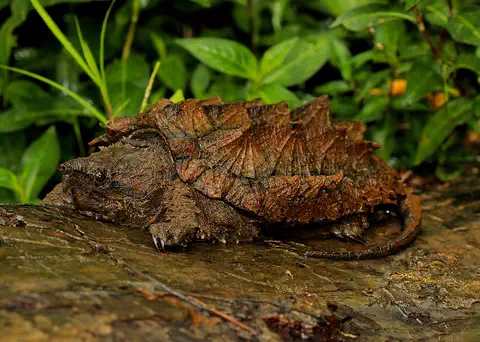
Alligator snapping turtle
The alligator snapping turtle is the largest freshwater turtle in the United States. It lies still on the bottom of rivers and lakes with its mouth open, wiggling a worm-like lure on its tongue to trick fish into swimming close. Its numbers have fallen, and it is now endangered.
-
 Watch
3D
Animal
American alligator
The American alligator is a large, armored reptile of the swamps, marshes and lakes of the southeastern United States. Alligator mothers guard their nests and carry their babies to the water, and the holes alligators dig help many other animals survive dry seasons.
-
 Watch
Animal
American crocodile
The American crocodile is a large reptile of warm coasts and mangrove swamps, from the southern tip of Florida through Mexico, Central America, the Caribbean and northern South America. It is shy, it basks in the sun to warm up, and mother crocodiles carry their babies to the water.
-
 Watch
Animal
Black caiman
The black caiman is the biggest caiman and the largest predator of the Amazon. It lives in slow rivers, lakes, flooded forests and swamps across the Amazon region of South America. People once hunted millions of them for their shiny dark skins, but since hunting was banned in the 1970s, many populations have grown again.
For parents & teachers
What children will learn
- Describe the radiated tortoise's shell pattern, head and feet.
- Describe the spiny forest habitat of southern Madagascar.
- Explain why a slow-breeding, long-lived animal is hard to protect.
- Name the main threats to radiated tortoises and how people protect them.
Recommended ages: 3 to 17 · About 15 minutes
Talk about it
- Why might an animal that lives in only one corner of one island be at special risk?
- Why could a tortoise whose eggs take months to hatch recover slowly from losses?
- How might rescue centers help animals that were taken illegally?
Try at home or in class
- Ray pattern: draw a dark six-sided shape, put a yellow dot in the middle and draw yellow lines out to the edges, then compare it with the photo.
- Hatching wait: on a calendar, count 145 days and 231 days from today to see how long radiated tortoise eggs can take to hatch.
Key vocabulary: carapace, scute, spiny forest, endemic, incubation, critically endangered
Where these facts come from
- GBIF Backbone Taxonomy and GBIF Occurrence Search , Global Biodiversity Information Facility (CC0 1.0 (backbone); occurrence counts are facts derived from records under CC0, CC BY and CC BY-NC)
- Wikidata , Wikimedia Foundation (CC0 1.0)
- The IUCN Red List of Threatened Species , International Union for Conservation of Nature (IUCN terms of use (no redistribution of Red List data or range maps))
- Astrochelys radiata (Leuteritz and Rioux Paquette, assessed 15 January 2008, published 2008) , IUCN Red List of Threatened Species
- Astrochelys radiata: justification, range, population, habitat, threats and conservation text , IUCN Red List of Threatened Species
- Astrochelys radiata: IUCN Red List global assessment record (Leuteritz and Rioux Paquette 2008), IUCN checklist on GBIF , GBIF
- Geochelone radiata (radiated tortoise) , Animal Diversity Web, University of Michigan Museum of Zoology
- Hematology and biochemistry of critically endangered radiated tortoises (Astrochelys radiata): reference intervals in previously confiscated subadults (Brenn-White, Raphael, Rakotoarisoa and Deem 2022, PLOS ONE), abstract , Europe PMC
- File:Radiated tortoise (Astrochelys radiata) Tsimanampetsotsa.jpg (27 November 2018, Charles J. Sharp) , Wikimedia Commons
- Wikimedia Commons , Wikimedia Foundation (Per file: Public domain, CC0, CC BY or CC BY-SA only (credited on each page))
Checked, not yet human-reviewed. Last updated November 1, 2026. Spotted a mistake? Tell us.