
Animal
Leopard tortoise
The leopard tortoise has a tall, round shell with spots like a leopard. It lives in Africa and eats plants. It can live a very long time.
The leopard tortoise is a big land tortoise of eastern and southern Africa, named for the dark spots and blotches on its tall, domed shell. It eats grasses, succulents and fruits, spreads their seeds, and can live for decades. It is still common in most places.
Stigmochelys pardalis is a large tortoise (family Testudinidae) of the arid and savanna regions of eastern and southern Africa, from South Sudan and Somalia to Namibia and South Africa, and the only species in its genus. Baker and colleagues assessed it as Least Concern for the IUCN Red List (assessed 29 August 2014, published 2022): it is widespread and common in most places, with no evidence of range contractions or significant declines.
Photo: Berthold Werner, CC BY-SA 3.0, via Wikimedia Commons
Meet the leopard tortoise
The leopard tortoise is a big tortoise from Africa.
Its shell has dark spots and blotches.
That is how it got its name.
The leopard tortoise is a large land tortoise from eastern and southern Africa. The South African National Biodiversity Institute (SANBI) calls it the largest tortoise in southern Africa. Its name comes from its spotted shell: the scientific name pardalis comes from a Greek word meaning "spotted."
In the savannas of East Africa, the biggest adults have shells about 30 to 45 centimeters long and weigh up to nearly 13 kilograms. Some at the northern and southern ends of the range grow even bigger.
Stigmochelys pardalis is the only species in its genus (SANBI). The genus name joins the Greek stigma, "marked," and chelone, "tortoise," and pardalis comes from pardos, "spotted" (SANBI). The IUCN notes that its placement has shifted between Geochelone, Stigmochelys, Centrochelys and Psammobates, with consensus now on Stigmochelys. SANBI says the two former subspecies are no longer recognized, because a range-wide genetic study (Fritz et al. 2010, cited by the IUCN) found seven lineages that match neither; the IUCN text still describes the subspecies question as debated.
Size varies across the range: in the central savannas of East Africa adults reach about 30 to 45 centimeters and nearly 13 kilograms, while larger animals in moister habitats at the northern and southern ends of the range can reach about 70 to 75 centimeters and, exceptionally, more than 40 kilograms (IUCN; SANBI). Females grow faster and larger than males.
Quick facts
- Group
- Reptile
- Length
- 0.3 to 0.45 m
- Lifespan in the wild
- 30 to 75 years
From savanna to mountains
Leopard tortoises live in grassy and bushy places in Africa.
Some live high up in the mountains.
Leopard tortoises live across eastern and southern Africa, from South Sudan, Ethiopia and Somalia south to Namibia and South Africa. The IUCN says they use more kinds of habitat than any other tortoise south of the Sahara: dry and moist savanna, thorny scrub, grassland, thicket and the scrubby fynbos of southern South Africa.
They live from sea level up to about 2,900 meters. In dry areas they stay where they can find water to drink. They are generally absent from the humid forests of central Africa.
The IUCN describes a range through the arid and savanna regions of eastern and southern Africa, from South Sudan and Somalia to Namibia and South Africa, generally absent from the humid forests of central Africa, from sea level to about 2,900 meters. It calls the leopard tortoise the sub-Saharan tortoise that uses the most habitat types (Branch 2008): karroid fynbos in the south, mesic thicket, arid and mesic savanna, thorn scrub and grassland to the northeast.
SANBI adds that in arid areas the species is restricted to places with water sources, and that released captive tortoises now live in areas where the species was historically absent, such as the southwestern Cape, the former Transkei, neighboring KwaZulu-Natal and Lesotho.
Continent
Its habitats


Where can you find this animal?
- Lives here naturally · Countries and seas named by a scientific source
- Sightings recorded · Records of wild sightings (GBIF)
Lives here naturally · Countries and seas named by a scientific source
Countries where the IUCN lists leopard tortoises as resident, across the dry and savanna regions of eastern and southern Africa. The IUCN also lists the Democratic Republic of the Congo, Djibouti and Rwanda, and Eritrea as uncertain, but no records from them were found, so they are not shaded. Leopard tortoises live in only parts of many countries shown.
Places: Angola, Botswana, Burundi, Eswatini, Ethiopia, Kenya, Malawi, Mozambique and 8 more places.
Source: iucn-red-list · checked October 2026
Sightings recorded · Records of wild sightings (GBIF)
Counts of GBIF records of wild observations (human and machine) and preserved specimens. Records include introduced populations, vagrants, escaped or released animals and misidentifications, so a country with records is not necessarily part of the native range.
Wild sightings have been recorded in South Africa, Kenya, Namibia, Tanzania, Botswana, Zimbabwe, Ethiopia, Eswatini and 22 more places.
Source: gbif · checked October 2026
Range maps show where scientists say an animal lives, often country by country. An animal may live in only part of a country shown, and sightings records can include animals that wandered far from home.
Grazing and gardening
Leopard tortoises eat grass, juicy plants and fruit.
They have no teeth, but a sharp beak.
They drink water too.
Leopard tortoises are plant eaters. They munch grasses, succulents (plants with thick, juicy leaves), small flowering plants and fallen fruits. A tortoise has no teeth: it shears through plants with its hard, horny beak, takes small bites and swallows them whole. Smell seems to be important for finding food.
Sometimes they gnaw bones to get calcium for their shells and eggs. Many seeds pass through a tortoise unharmed, so leopard tortoises help spread plants.
The IUCN lists a diet of seasonal annuals, grasses, succulents and forbs (leaves, flowers and seeds), with occasional dried carcass, bone, ash or feces. SANBI describes shearing grass with a horny beak (the tortoise is toothless), small bites swallowed whole, a strong role for smell in finding food, bone-gnawing for calcium for shell growth and eggshells, and a need to drink even when eating green plants.
In Addo Elephant National Park, the IUCN notes, the leopard tortoise's biomass exceeds that of most other herbivores, and because it does not chew the cud, seeds pass intact through its gut, making it a more important seed disperser there than hoofed mammals (Milton 1992; Mason 1995). SANBI adds that tortoises often leave their seed-filled droppings under bushes, where the seeds have a better chance of surviving.
Did you know?
Leopard tortoises can float and swim slowly.
Their big shell holds so much air in the lungs that leopard tortoises can float and swim slowly.
The large domed shell provides enough lung space for buoyancy; they float and swim slowly (SANBI).
A tall, spotted shell
Its shell is tall like a dome.
Young tortoises are yellow with black spots.
Old ones turn dark gray.
A leopard tortoise has a high, domed shell with steep sides. SANBI says the tall dome helps protect it from the sun's heat, so it can stay out in open country and feed for longer. Hatchlings are yellow with black spots, and the shell gets darker and more blotched with age; very old adults can be plain dark gray.
Its front legs are covered in big, spiny scales, with five claws on each front foot and four on each back foot. It has a hooked upper jaw and good eyesight. Males have much longer tails than females.
SANBI describes a high-domed carapace with steep sides, notched at the front, with no nuchal shield and, in some individuals, dorsal scutes raised like small pyramids; a moderately large head with a hooked upper jaw; forelimbs armored with large, irregular spiny scales; five claws on each forefoot and four on each hind foot; and two or three tubercles on each hind limb. Hatchlings have a flattened, serrated yellow carapace with black spots, which darkens and becomes more blotched with age; old adults are often uniform dark gray with a yellow or tan head. Populations in drier habitats have lighter shells, and males have much longer tails.
SANBI says the high dome protects against the sun's heat, letting tortoises stay longer in open habitats, and that the large shell holds enough lung space for leopard tortoises to float and swim slowly; they can also climb.
Eggs that wait for rain
The mother digs a hole and lays round white eggs.
The eggs take many months to hatch.
The babies are very small.
A female picks a sunny, well-drained spot and digs a pit about 25 centimeters deep with her back feet. She lays round, white, hard-shelled eggs, then fills the hole and pats it down. A big female may lay several clutches in a season.
The eggs take 8 to 15 months to hatch, depending on the temperature. Warm eggs (31 to 34 °C) become females, cooler ones males. The ground can bake hard, so the babies may wait for rain to soften the soil before digging out. Hatchlings are only 4 to 5 centimeters long. They can breed at about 12 to 15 years old.
The IUCN gives nesting from May to June or October to November depending on latitude, clutches of 6 to 15 eggs (exceptionally up to 30), 3 to 7 clutches in a breeding season, incubation of 8 to 15 months depending on temperature, maturity at about 12 to 15 years and a captive lifespan of 30 to 75 years. SANBI describes a flask-shaped nest pit about 250 millimeters deep dug with the hind feet in a sunny, well-drained site, up to 24 white, spherical, hard-shelled eggs (32 to 41 by 35 to 44 millimeters), females produced at 31 to 34 °C and males at lower temperatures, hatchlings of 23 to 50 grams and 40 to 50 millimeters, and hatchlings that may have to wait for rain before they can dig to the surface.
Predators of eggs and young include monitor lizards, snakes, honey badgers, jackals, mongooses, eagles and crows; adults have been reported taken by lions in Kruger National Park and hyenas in Bwabwata National Park (IUCN).
Loners that find their way home
Leopard tortoises like to be alone.
If something scares them, they pull in their heads and hiss.
In winter they rest in holes, among rocks or under logs.
Leopard tortoises are loners, except in the breeding season, when males may ram and butt each other. If a tortoise is disturbed, it pulls its head into its shell and hisses.
On hot days they push into thick bushes to keep cool. In the long, dry winter they are much less active and shelter in holes, among rocks or under logs. Tortoises that were moved away from home have walked 25 to 50 kilometers to get back.
SANBI describes leopard tortoises as solitary outside the breeding season (September to April), when males fight by ramming, butting and sometimes overturning each other; disturbed tortoises retract the head and hiss. Activity follows the seasons: tortoises feed when food is best in summer, push into thick bush to escape midday heat, reduce activity in the dry season, and from about the end of May seek holes, rock crevices or logs to overwinter, digging in until only the shell shows.
Translocated tortoises of both sexes have made return journeys of 25 to 50 kilometers. Home ranges vary with food, shelter and sex, and females have larger ranges than males. Densities range from 1.7 per 100 hectares in the semi-arid Nama Karoo to up to 85 per 100 hectares in Eastern Cape thicket (SANBI).
Did you know?
Warm eggs hatch into girl tortoises.
Eggs kept at 31 to 34 °C hatch as females; cooler eggs hatch as males.
Females are produced at 31 to 34 °C, males at lower incubation temperatures (SANBI).
Least concern, but watched
There are still many leopard tortoises.
People keep watch so that not too many are taken.
Wild tortoises should stay in the wild.
The leopard tortoise is listed as least concern: it lives in a huge area and is common in most places. Still, there are dangers. In parts of East Africa too many have been taken for the pet trade, some are killed by fires, and in South Africa electric fences can harm them.
International trade in leopard tortoises has been controlled since 1975. SANBI also warns that pet tortoises released far from home can mix with wild populations and spread diseases, and asks people not to keep wild tortoises as pets.
Baker, Kabigumila, Leuteritz, Hofmeyr and Ngwava assessed Stigmochelys pardalis as Least Concern for the IUCN Red List (assessed 29 August 2014, published 2022): widespread, common in most places, with threats not yet causing significant declines. The assessment notes declines in parts of East Africa from unsustainable pet-trade harvest, deaths in frequent fires in Kenya and Tanzania, possibly wider burning impacts in South Sudan, deaths at electric fences in South Africa, and concern about collection of adults for food.
It has been listed in Appendix II of CITES since 1975; between 1977 and 2011, 339,813 live leopard tortoises were in international trade, 80% declared captive bred, and Tanzania has had a zero export quota for wild-caught commercial specimens since 2009 (IUCN). SANBI warns that tortoises moved from the Cape to northern South Africa and released hybridize with local populations and may spread disease.
IUCN Red List
How is the leopard tortoise doing in the wild?
- Least Concern (this animal)
- Near Threatened
- Vulnerable
- Endangered
- Critically Endangered
- Extinct in the Wild
- Extinct
Least Concern
Not at risk of disappearing from the wild right now.
Amazing facts
-
Leopard tortoise eggs can take over a year to hatch.
Depending on the temperature, leopard tortoise eggs take 8 to 15 months to hatch.
Incubation 8 to 15 months, depending on temperature (IUCN; SANBI).
-
Leopard tortoises can float and swim slowly.
Their big shell holds so much air in the lungs that leopard tortoises can float and swim slowly.
The large domed shell provides enough lung space for buoyancy; they float and swim slowly (SANBI).
-
Tortoises moved away have walked all the way home.
Leopard tortoises moved away from home have walked back 25 to 50 kilometers.
Translocated tortoises of both sexes have made homing journeys of 25 to 50 kilometers (SANBI).
-
Warm eggs hatch into girl tortoises.
Eggs kept at 31 to 34 °C hatch as females; cooler eggs hatch as males.
Females are produced at 31 to 34 °C, males at lower incubation temperatures (SANBI).
Words to know
- carapace
- the top part of a turtle's shell
- scute
- one of the hard plates that cover a tortoise's shell
- succulent
- a plant with thick, juicy leaves or stems that store water
- seed disperser
- an animal that spreads plant seeds to new places
- savanna
- a warm grassland with scattered trees and bushes
- incubation
- the time an egg needs to develop before it hatches
Discovery challenge
-
Why is it called a leopard tortoise?
What gives the leopard tortoise its name?
What does the species name pardalis refer to?
- Its spotted shell
- Its sharp teeth
- Its fast running
Show the answer
Its spotted shell
Its spots!
Its shell is spotted and blotched like a leopard's coat.
Pardalis comes from the Greek pardos, "spotted," after the spotted shell (SANBI).
-
How long do its eggs take to hatch?
How long do leopard tortoise eggs take to hatch?
What is the leopard tortoise's incubation period?
- 8 to 15 months
- About 1 week
- About 1 day
Show the answer
8 to 15 months
Many months!
8 to 15 months, depending on the temperature.
8 to 15 months, temperature-dependent (IUCN; SANBI).
-
What does a leopard tortoise eat?
What kind of food does a leopard tortoise eat?
How would you describe the leopard tortoise's diet?
- Plants
- Fish
- Insects only
Show the answer
Plants
Plants!
Grasses, succulents, small flowering plants and fallen fruits.
Mainly plants: annuals, grasses, succulents and forbs (IUCN).
-
Where do leopard tortoises live?
In which part of the world do leopard tortoises live?
What is the range of the leopard tortoise?
- Eastern and southern Africa
- Northern Europe
- South America
Show the answer
Eastern and southern Africa
In Africa!
From South Sudan and Somalia down to Namibia and South Africa.
Arid and savanna regions of eastern and southern Africa (IUCN).
Places where you might see it
-
 Watch
 Country
South Africa
South Africa is the southernmost country in Africa, with the Atlantic Ocean on one side and the Indian Ocean on the other. A high plateau covers most of it, about 63.5 million people (2026) live there, and it has 12 official languages and three capital cities.
-
 Watch
 Country
Kenya
Kenya is a country in East Africa, crossed by the equator. It has the snow-capped Mount Kenya, the deep Great Rift Valley, Lake Victoria and a long Indian Ocean coast, and about 54 million people live there, many of them speaking Swahili.
Explore next
-
 Watch
Animal
Aldabra giant tortoise
The Aldabra giant tortoise is one of the largest land tortoises on Earth. Wild ones live on Aldabra Atoll, a ring of coral islands in the Indian Ocean, where about 180,000 of them graze, browse and shape the land like elephants do in Africa. They can live for more than 100 years.
-
 Watch
Animal
Gopher tortoise
The gopher tortoise lives in the southeastern United States. With its strong, shovel-like front legs it digs deep burrows in dry, sandy soil, and more than 350 other kinds of animals share them. It eats low-growing plants. Losing its habitat has made it critically endangered.
-
 Watch
Animal
Desert tortoise
The desert tortoise, also called the Mojave desert tortoise, lives in the deserts of the south-western United States. It spends most of its life in underground burrows, stores water in its body, and can live for 50 years or more. Sadly, it is now critically endangered.
-
 Watch
Animal
Honey badger
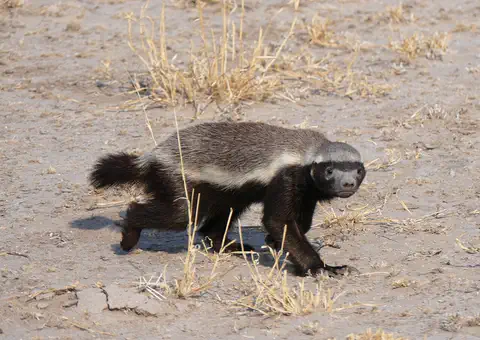
The honey badger, or ratel, is a stocky member of the weasel family that lives across Africa, the Middle East and India. Its gray or white back and black underside make it easy to spot. It digs with huge front claws, travels far to find food, and breaks into bees' nests for honey and bee grubs.
-
Watch
Country
South Africa
South Africa is the southernmost country in Africa, with the Atlantic Ocean on one side and the Indian Ocean on the other. A high plateau covers most of it, about 63.5 million people (2026) live there, and it has 12 official languages and three capital cities.
-
Watch
Country
Kenya
Kenya is a country in East Africa, crossed by the equator. It has the snow-capped Mount Kenya, the deep Great Rift Valley, Lake Victoria and a long Indian Ocean coast, and about 54 million people live there, many of them speaking Swahili.
-
 Watch
Animal
Radiated tortoise
The radiated tortoise lives only in the dry spiny forests of southern and southwestern Madagascar. Yellow lines spread out from the middle of each plate of its high, domed shell. It grazes mostly on grasses. Collection for food and the pet trade, and the loss of its forest, have made it critically endangered.
-
 Watch
Animal
Hermann's tortoise
Hermann's tortoise lives in sunny, stony hills and open woods around the Mediterranean in southern Europe. Its high shell is yellow and black and usually about 13 to 18 centimeters long. It eats leaves, flowers and fruits, and it spends the winter hibernating. It is listed as vulnerable.
For parents & teachers
What children will learn
- Describe how a leopard tortoise's shell and legs suit life on the savanna.
- Explain how tortoises help spread plant seeds.
- Explain how temperature decides whether tortoise eggs hatch as males or females.
- Discuss why wild tortoises should stay in the wild.
Recommended ages: 3 to 17 · About 15 minutes
Talk about it
- Why might a tall, domed shell help in hot, open country?
- Why might eggs that take more than a year to hatch be at risk?
- Why could releasing a pet tortoise far from where it came from cause problems?
Try at home or in class
- Seed hunt: look at a piece of fruit with a grown-up, count its seeds, and talk about how an animal that eats the fruit could carry the seeds somewhere new.
- Shell shade: put one ice cube under an upturned bowl and one in the open in a sunny spot, and compare which melts first, like a tortoise sheltering under its domed shell.
Key vocabulary: carapace, scute, succulent, seed disperser, savanna, incubation
Where these facts come from
- GBIF Backbone Taxonomy and GBIF Occurrence Search , Global Biodiversity Information Facility (CC0 1.0 (backbone); occurrence counts are facts derived from records under CC0, CC BY and CC BY-NC)
- Wikidata , Wikimedia Foundation (CC0 1.0)
- The IUCN Red List of Threatened Species , International Union for Conservation of Nature (IUCN terms of use (no redistribution of Red List data or range maps))
- Stigmochelys pardalis (Baker et al., assessed 29 August 2014, published 2022) , IUCN Red List of Threatened Species
- Stigmochelys pardalis: justification, range, population, habitat, threats and conservation text , IUCN Red List of Threatened Species
- Stigmochelys pardalis: IUCN Red List global assessment record (Baker et al. 2022), IUCN checklist on GBIF , GBIF
- Leopard tortoise (Animal of the week) , South African National Biodiversity Institute (SANBI)
- File:Geochelone pardalis bw 01.jpg (21 January 2006, Berthold Werner) , Wikimedia Commons
- Wikimedia Commons , Wikimedia Foundation (Per file: Public domain, CC0, CC BY or CC BY-SA only (credited on each page))
Checked, not yet human-reviewed. Last updated November 1, 2026. Spotted a mistake? Tell us.