
Animal
Macaroni penguin
The macaroni penguin has bright yellow-orange feathers on its head. It lives on cold, rocky islands far in the south. It eats tiny sea animals called krill.
The macaroni penguin is a crested penguin with long yellow-orange plumes on its head and a big reddish bill. It nests in huge, crowded colonies on rocky islands around Antarctica and eats mostly krill. There are millions of macaroni penguins, but their numbers have fallen fast, so they are listed as Vulnerable.
Eudyptes chrysolophus breeds in at least 258 colonies at about 55 sites on sub-Antarctic islands, in southern Chile and very locally on the Antarctic Peninsula, with an estimated 6.3 million breeding pairs (Crossin et al. 2013). It feeds mainly on krill. BirdLife International assessed it as Vulnerable for the IUCN Red List (assessed 2020, published 2020) because the population appears to have declined rapidly over three generations, for reasons that are still uncertain.
Photo: Jerzy Strzelecki, CC BY 3.0, via Wikimedia Commons
Meet the macaroni penguin
The macaroni penguin has long yellow-orange feathers on its head.
It has a big reddish beak, a black back and a white front.
The macaroni penguin stands about 70 centimeters tall and weighs 4 to 7 kilograms. It belongs to a group called crested penguins.
Its long yellow-orange plumes join on top of its head. It has a large red-to-pink bill, a black face, chin and throat, a black back and a white front. On land it tends to hop and bounce instead of waddling.
The Australian Antarctic Division gives a height of about 70 centimeters and a mass of 4 to 7 kilograms, varying with breeding stage and sex. It is a crested penguin (genus Eudyptes) with orange-yellow plumes that join on the top of the head, a large red-to-pink bill and black chin, face and throat (Animal Diversity Web, 2001; Antarctic and Southern Ocean Coalition, 2024).
It is closely related to the royal penguin; IUCN notes that recent genetic studies find little divergence between the two, so their taxonomic status may be reappraised. Where its range overlaps with the slightly smaller rockhopper penguin, the rockhopper can be told apart by its shorter head plumes (ASOC).
Quick facts
- Group
- Bird
- Height
- 0.7 m
- Weight
- 4 to 7 kg
Islands of the Southern Ocean
Macaroni penguins live on rocky islands around Antarctica.
They spend the winter out at sea.
Macaroni penguins nest on islands all around the Southern Ocean: South Georgia, the Falkland Islands, the Crozet and Kerguelen Islands, Heard Island, the Prince Edward Islands, Bouvet Island and islands off southern Chile. A few nest on the Antarctic Peninsula.
They nest on rocky beaches, hillsides and cliffs, sometimes walking hundreds of meters up steep, stony slopes to reach their nests. In winter they leave land and travel far out to sea to feed.
IUCN lists breeding colonies in southern Chile, the Falkland Islands, South Georgia and the South Sandwich Islands, the South Orkney and South Shetland Islands, Bouvet Island, the Prince Edward Islands (South Africa), the Crozet and Kerguelen Islands (French Southern Territories), Heard and McDonald Islands and, very locally, the Antarctic Peninsula; birds also occur off Argentina outside the breeding season. The largest populations are on Crozet (2.2 million pairs), Kerguelen (1.8 million), Heard Island (1 million), South Georgia (1 million) and Marion Island (290,000).
Colonies are on level to steep ground up to 200 meters above sea level, often reached across steep scree, and erosion by the birds leaves them with little or no vegetation. The species is a full migrant: tracked birds from Kerguelen winter in a narrow band of the central Indian Ocean, while South Georgia birds spread across the Scotia Sea (IUCN).
Continents
Its habitat

Where can you find this animal?
- Lives here naturally · Countries and seas named by a scientific source
- Sightings recorded · Records of wild sightings (GBIF)
- Visits for part of the year · Countries and seas named by a scientific source
Lives here naturally · Countries and seas named by a scientific source
Breeds on sub-Antarctic islands (South Georgia and the South Sandwich Islands, the South Orkney and South Shetland Islands, Bouvet Island, the Falkland Islands, the Prince Edward Islands of South Africa, the Crozet and Kerguelen Islands, Heard and McDonald Islands), in southern Chile and very locally on the Antarctic Peninsula, up to 200 meters. South Georgia, the South Sandwich Islands, Bouvet an
Places: Antarctica, Chile, Falkland Is., Fr. Southern Lands, South Africa, Southern Ocean, Atlantic Ocean and Indian Ocean.
Source: iucn-red-list · checked October 2026
Sightings recorded · Records of wild sightings (GBIF)
Counts of GBIF records of wild observations (human and machine) and preserved specimens. Records include introduced populations, vagrants, escaped or released animals and misidentifications, so a country with records is not necessarily part of the native range.
Wild sightings have been recorded in Antarctica, South Africa, Falkland Is., Chile, Australia, Fr. Southern Lands, Argentina, UK and 12 more places.
Source: gbif · checked October 2026
Visits for part of the year · Countries and seas named by a scientific source
Outside the breeding season macaroni penguins also occur in Argentine waters.
Places: Argentina.
Source: iucn-red-list · checked October 2026
Range maps show where scientists say an animal lives, often country by country. An animal may live in only part of a country shown, and sightings records can include animals that wandered far from home.
Krill eaters
Macaroni penguins eat krill. Krill are tiny animals that look like shrimp.
They also eat some small fish.
Macaroni penguins eat mostly krill, small shrimp-like animals that swarm in the Southern Ocean. They also eat other small crustaceans, small fish and a little squid. Scientists think they may take more food from the sea than any other seabird.
Most of their dives are 15 to 50 meters deep. The Australian Antarctic Division says they can dive more than 220 meters, but another source gives 115 meters as their deepest dive. A feeding trip can last from one day to three weeks.
IUCN describes the species as a pelagic forager at moderate depths, usually under 50 meters, feeding mainly on small krill: at South Georgia largely Antarctic krill (Euphausia superba), at Crozet and Kerguelen a more varied diet of small euphausiids, the amphipod Themisto gaudichaudii and small lanternfish (myctophids), with more fish after incubation and mostly crustaceans in winter. ASOC notes it is thought to be the largest consumer of marine resources among seabirds.
The Australian Antarctic Division reports most dives at 15 to 50 meters, with dives beyond 220 meters (ASOC gives lower figures: an average of 20 to 35 meters and a maximum of 115 meters), and foraging trips of 24 hours to 3 weeks covering 50 kilometers to more than 2,000 kilometers, depending on breeding stage.
Did you know?
Macaroni penguins hop and bounce on land!
On land, macaroni penguins tend to hop or bounce instead of waddling.
Macaroni penguins tend to hop or bounce on land rather than waddle (ASOC).
A golden crest
The macaroni penguin got its name from its fancy head feathers.
Sailors thought the feathers looked like a fancy hat.
British sailors named this penguin. Its yellow-orange plumes reminded them of a style called 'macaroni' in Britain in the 1700s, when fashionable people wore hats with large feathers. Its scientific name means 'good diver with a golden crest'.
Like other penguins, it is black on the back and white on the front. This countershading may help hide it from hunters in the sea, against the dark water below or the bright sky above.
Eudyptes comes from the Greek for 'good diver' and chrysolophus from 'golden' and 'crest' (Australian Antarctic Division). ASOC explains the common name: British sailors were reminded by the long orange-yellow plumes of the 'macaroni' fashion of 18th-century Britain, which included hats with large feathers.
The black-and-white plumage is countershading, which offers some protection from marine predators against the sea or sky. Macaroni penguins also 'porpoise', leaping clear of the water as they swim, which may help them build speed or confuse predators (ASOC).
Two eggs, one chick
The mother lays two eggs, one small and one big.
Usually only the big egg hatches. The father guards the chick.
Macaroni penguins come back to their colonies around October. Around November the female lays two eggs of different sizes in a shallow dip in the ground. The second egg is bigger, and usually only that one hatches.
The parents take turns keeping the egg warm, and it hatches after 33 to 37 days. For the first three to four weeks the father guards the chick while the mother brings food. Then the chicks gather in groups called crèches. At 60 to 70 days old, a chick has its grown-up feathers and goes to sea.
Birds return around October, depending on latitude, and laying in a colony is highly synchronized, spread over less than two weeks (IUCN). The female lays two eggs of different sizes in a shallow scrape; the second egg is larger and typically the only one that hatches (Australian Antarctic Division), and only the larger egg is incubated (ASOC). Both parents stay at the nest for about the first 12 days, then alternate 12-day shifts at sea and on the egg until it hatches at 33 to 37 days.
For three to four weeks the male guards the chick while the female brings food; chicks then join crèches and both parents forage. Chicks fledge at 60 to 70 days. Females first breed at 5 years and males at 6; pairs are serially monogamous, generally returning to their previous partners. Lifespan is not well known but is estimated at 20 years or more (Australian Antarctic Division).
Crowded colonies
Macaroni penguins nest close together in very big groups.
They call and slap with their flippers to chase hungry birds away.
Macaroni penguins nest in some of the largest and most crowded colonies of any penguin. One huge colony is near Cape Lockyer on Heard Island, where they nest on surprisingly steep slopes.
At sea, fur seals, leopard seals and killer whales hunt adult macaroni penguins. On land, birds called skuas, sheathbills and giant petrels take eggs and chicks. The penguins defend themselves by calling and slapping attackers with their stiff flippers.
ASOC describes some of the largest and densest breeding colonies of any penguin, and the Australian Antarctic Division notes a huge colony near Cape Lockyer on Heard Island, a World Heritage area, with nests on surprisingly steep slopes. Within a colony, breeding is highly synchronized.
Adults are taken at sea by fur seals, leopard seals and killer whales; on land, skuas, giant petrels, snowy sheathbills and gulls take eggs and chicks. Penguins defend themselves by calling and by striking predators with their rigid flippers (ASOC). At South Georgia, IUCN notes that recovering Antarctic fur seals are potential competitors for food and, in some places, predators of the penguins.
Did you know?
The macaroni penguin was named after a fancy fashion with feathered hats!
British sailors named the macaroni penguin after the 'macaroni' fashion of the 1700s, when people wore hats with big feathers.
The name refers to the 'macaroni' fashion of 18th-century Britain, which included hats with large feathers (ASOC).
Millions, but falling
There are still millions of macaroni penguins.
But their numbers have gone down, and scientists are watching them.
Macaroni penguins are listed as Vulnerable. There were about 6.3 million breeding pairs in 2013, but their numbers have fallen fast over the last few decades, and scientists are not sure exactly why.
Possible causes include changes in the climate and the sea, and competition for krill with fur seals, whose numbers have grown hugely at South Georgia. Most of their breeding islands are protected, and krill fishing near South Georgia is limited to leave food for penguins and other animals.
BirdLife International assessed Eudyptes chrysolophus as Vulnerable (criteria A2bce+3bce+4bce) for the IUCN Red List (assessed 9 September 2020, published 2020): the global population appears to have declined rapidly over the last three generations (37 years), with a decreasing trend. The drivers are uncertain but could include climatic variation, at-sea foraging in winter and competition with Antarctic fur seals, which at South Georgia increased from an estimated 30,000 to about 3 million over recent decades.
Other possible threats are krill fisheries, limited longline bycatch on the winter feeding grounds, disease outbreaks (avian cholera at Marion Island), oil spills and disturbance. Most breeding islands are reserves, Heard and McDonald Islands are a World Heritage Site, rats and mice have been eradicated at South Georgia, and krill fishing is banned around South Georgia and the South Sandwich Islands in summer and kept at least 30 and 50 kilometers offshore in winter (IUCN).
IUCN Red List
How is the macaroni penguin doing in the wild?
- Least Concern
- Near Threatened
- Vulnerable (this animal)
- Endangered
- Critically Endangered
- Extinct in the Wild
- Extinct
Vulnerable
At high risk of disappearing from the wild.
Amazing facts
-
The macaroni penguin was named after a fancy fashion with feathered hats!
British sailors named the macaroni penguin after the 'macaroni' fashion of the 1700s, when people wore hats with big feathers.
The name refers to the 'macaroni' fashion of 18th-century Britain, which included hats with large feathers (ASOC).
-
A macaroni penguin mother lays a small egg and a big egg.
The second egg is bigger than the first, and usually only the bigger egg hatches.
The clutch is two eggs of different sizes; the larger second egg is typically the only one that hatches (Australian Antarctic Division).
-
Macaroni penguins hop and bounce on land!
On land, macaroni penguins tend to hop or bounce instead of waddling.
Macaroni penguins tend to hop or bounce on land rather than waddle (ASOC).
-
Macaroni penguins can dive very deep.
The Australian Antarctic Division says a macaroni penguin can dive more than 220 meters deep, though most dives are 15 to 50 meters.
Dives can exceed 220 meters and most are 15 to 50 meters (Australian Antarctic Division); ASOC gives 115 meters as the maximum.
Words to know
- crest
- a tuft or row of feathers on top of a bird's head
- krill
- small, shrimp-like sea animals that live in huge swarms
- colony
- a group of animals of one kind that live and nest together
- crèche
- a group of young penguins that gather together while their parents fish
- sub-Antarctic
- the cold region just north of Antarctica, with many small islands
- countershading
- dark color on top and light color underneath, which makes an animal harder to see
Discovery challenge
-
What color are the macaroni penguin's head feathers?
What color are the macaroni penguin's head plumes?
What color is the crest that gives Eudyptes chrysolophus its scientific name?
- Yellow-orange
- Bright blue
- Pure white
Show the answer
Yellow-orange
Yellow-orange, like gold.
Yellow-orange plumes that join on top of the head.
Golden: chrysolophus means 'golden crest'.
-
What do macaroni penguins eat most?
What is the macaroni penguin's main food?
What prey makes up most of the macaroni penguin's diet?
- Krill
- Seaweed
- Seal pups
Show the answer
Krill
Krill, tiny animals that look like shrimp.
Krill, small shrimp-like animals, plus some fish and squid.
Small krill, especially Antarctic krill at South Georgia, with amphipods and lanternfish elsewhere (IUCN).
-
How many eggs does a macaroni penguin lay?
How many eggs does a macaroni penguin lay, and how many usually hatch?
What is unusual about the macaroni penguin's clutch?
- Two eggs, but usually only one hatches
- One huge egg that always hatches
- Ten small eggs
Show the answer
Two eggs, but usually only one hatches
Two eggs. Usually only the big one hatches.
Two eggs of different sizes; usually only the bigger second egg hatches.
Two unequal eggs; the larger second egg is typically the only one that hatches.
-
Where do macaroni penguins make their nests?
Where do most macaroni penguins nest?
Where are most macaroni penguin colonies?
- On rocky islands around Antarctica
- In tropical forests
- On sandy beaches in Florida
Show the answer
On rocky islands around Antarctica
On cold, rocky islands far in the south.
On rocky sub-Antarctic islands such as South Georgia, Crozet, Kerguelen and Heard Island.
Sub-Antarctic islands, southern Chile and very locally the Antarctic Peninsula; the largest populations are on Crozet and Kerguelen.
Places where you might see it
-
 Watch
 Country
Falkland Islands
The Falkland Islands lie in the South Atlantic, about 480 kilometers northeast of the tip of South America. They are a British Overseas Territory, and Argentina also claims them, calling them the Islas Malvinas. Several million penguins breed there. The 2021 census counted 3,662 people who usually live on the islands.
-
 Watch
 Country
Chile
Chile stretches about 4,300 kilometers along the west coast of South America, between the Andes and the Pacific Ocean, but it averages only about 180 kilometers wide. Its north holds one of the driest deserts on Earth, and its south is cold, wet and full of fjords and ice.
Explore next
-
 Watch
Animal
Southern rockhopper penguin
The southern rockhopper penguin is the smallest of the crested penguins. It has spiky yellow head feathers, bright red eyes and an orange-red bill, and it is named for the way it hops over rocks and up steep slopes. It nests on islands all around the southern oceans. Its numbers have fallen a lot, so it is listed as Vulnerable.
-
 Watch
Animal
Gentoo penguin
The gentoo penguin is the penguin with the red-orange bill, orange feet and a white band across the top of its head. It lives on the Antarctic Peninsula and on islands around Antarctica, builds nests of stones, and usually lays two eggs. National Geographic says no other diving bird swims faster.
-
 Watch
3D
Animal
King penguin
The king penguin is the second-largest penguin in the world. It lives in huge, noisy colonies on windy islands in the Southern Ocean and dives deep to catch lantern fish. Its babies grow a thick coat of brown fluff and take more than a year to raise.
-
 Watch
3D
Animal
Antarctic krill
Antarctic krill are small, shrimp-like crustaceans about 6 centimeters long that live in the icy Southern Ocean around Antarctica. They gather in enormous swarms, and almost all the bigger animals of the Antarctic, from penguins to blue whales, depend on them for food.
-
 Watch
Animal
Leopard seal
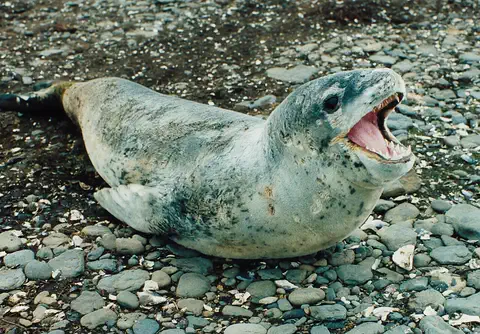
The leopard seal is a large, slender seal of the icy seas around Antarctica, named for the dark spots on its gray coat. It is a fast, powerful hunter with a big head and long teeth, and it eats everything from tiny krill to fish, penguins and young seals.
-
Watch
Country
Falkland Islands
The Falkland Islands lie in the South Atlantic, about 480 kilometers northeast of the tip of South America. They are a British Overseas Territory, and Argentina also claims them, calling them the Islas Malvinas. Several million penguins breed there. The 2021 census counted 3,662 people who usually live on the islands.
-
Watch
Country
Chile
Chile stretches about 4,300 kilometers along the west coast of South America, between the Andes and the Pacific Ocean, but it averages only about 180 kilometers wide. Its north holds one of the driest deserts on Earth, and its south is cold, wet and full of fjords and ice.
-
 Watch
Animal
Adélie penguin
The Adélie penguin is a medium-sized penguin, about 70 centimeters tall, with a black back, a white front and a bright white ring around each eye. It breeds in summer on rocky, ice-free ground all around Antarctica, building nests of pebbles, and spends the winter far out at sea among the pack ice.
For parents & teachers
What children will learn
- Identify the macaroni penguin by its crest and bill, and tell where its name comes from.
- Locate the sub-Antarctic islands around the Southern Ocean.
- Explain why krill matter to many Southern Ocean animals.
- Describe why scientists can be unsure about the causes of a population decline.
Recommended ages: 3 to 17 · About 15 minutes
Talk about it
- Why might a penguin lay two eggs but raise only one chick?
- How could fur seals and penguins compete for the same food?
- Why do you think scientists count penguins in the same colonies year after year?
Try at home or in class
- Make a paper penguin headband with yellow and orange paper strips for the crest, then compare it with the crests of other penguins in pictures.
- Find the Falkland Islands, South Georgia, Kerguelen and Heard Island on a globe and trace a circle around Antarctica that links them.
Key vocabulary: crest, krill, colony, crèche, sub-Antarctic, countershading
Where these facts come from
- GBIF Backbone Taxonomy and GBIF Occurrence Search , Global Biodiversity Information Facility (CC0 1.0 (backbone); occurrence counts are facts derived from records under CC0, CC BY and CC BY-NC)
- Wikidata , Wikimedia Foundation (CC0 1.0)
- The IUCN Red List of Threatened Species , International Union for Conservation of Nature (IUCN terms of use (no redistribution of Red List data or range maps))
- Eudyptes chrysolophus (BirdLife International, assessed 9 September 2020, published 2020) , IUCN Red List of Threatened Species
- Eudyptes chrysolophus: range, population, habitat, threats and conservation text , IUCN Red List of Threatened Species
- Eudyptes chrysolophus: IUCN Red List global assessment record (BirdLife International 2020), IUCN checklist on GBIF , GBIF
- Macaroni penguin , Australian Antarctic Division
- Macaroni penguins (scientific consultation: Heather Lynch, Stony Brook University, 2024) , Antarctic and Southern Ocean Coalition
- Eudyptes chrysolophus (macaroni penguin), K. Reynolds 2001 , Animal Diversity Web, University of Michigan Museum of Zoology
- File:Macaroni Penguins (js).jpg (Hannah Point, Livingston Island, Antarctic Peninsula, Jerzy Strzelecki) , Wikimedia Commons
- Wikimedia Commons , Wikimedia Foundation (Per file: Public domain, CC0, CC BY or CC BY-SA only (credited on each page))
Checked, not yet human-reviewed. Last updated November 1, 2026. Spotted a mistake? Tell us.