
Animal
Southern rockhopper penguin
The southern rockhopper penguin is a small penguin with spiky yellow eyebrows and red eyes. It hops from rock to rock instead of waddling.
The southern rockhopper penguin is the smallest of the crested penguins. It has spiky yellow head feathers, bright red eyes and an orange-red bill, and it is named for the way it hops over rocks and up steep slopes. It nests on islands all around the southern oceans. Its numbers have fallen a lot, so it is listed as Vulnerable.
Eudyptes chrysocome breeds on islands of the South Atlantic, Indian and Pacific Oceans between about 46° and 54° south. BirdLife International assessed it as Vulnerable for the IUCN Red List (assessed 2020, published 2020), with about 2.5 million mature individuals and a decline of more than 30% over three generations, in which food shortages thought to be tied to ocean temperatures appear to play a large part. Some researchers treat its western and eastern populations as two separate species.
Photo: Liam Quinn from Canada, CC BY-SA 2.0, via Wikimedia Commons
Meet the rockhopper
The rockhopper penguin is a small penguin.
It has a yellow stripe over each red eye that ends in long, spiky feathers.
The southern rockhopper penguin is the smallest of the crested penguins, weighing only 2 to 3.8 kilograms. It is black or dark gray on its head, back and tail and white underneath.
A thin, bright yellow stripe starts above the bill and runs back over each eye, then spreads into long, drooping yellow plumes. Its eyes are bright red, its bill is orange-red and its feet are pink with black soles.
The Australian Antarctic Division calls it the smallest of the crested penguins (genus Eudyptes), at 2 to 3.8 kilograms; New Zealand Birds Online gives 45 to 55 centimeters for the eastern form and 61 centimeters for the western form.
On the western form (the form on the Falklands, where this page's photo was taken), a narrow sulfur-yellow stripe starts above the gape, widens into a wedge in front of the eye and spreads into long drooping plumes behind it; the two crests are joined across the back of the crown by a short black crest. The orange-red bill is edged by a thin strip of black skin, the eyes are bright red, and the flippers are blue-black with a thin white trailing edge. The eastern form has pinkish skin at the base of the bill and a thinner, parallel-sided yellow stripe (New Zealand Birds Online).
Quick facts
- Group
- Bird
- Length
- 0.45 to 0.55 m
- Weight
- 2 to 3.8 kg
Islands around the south
Rockhoppers live on rocky islands in the cold southern seas.
Many live on the Falkland Islands.
Southern rockhopper penguins nest on islands all the way around the bottom of the world, between about 46 and 54 degrees south. The biggest numbers are on the Falkland Islands and on islands off the southern tip of South America. Others nest on islands south of Africa, Australia and New Zealand, such as Marion, Crozet, Kerguelen, Heard, Macquarie and Campbell Islands.
After breeding, they leave land and spend much of the year at sea, sometimes swimming thousands of kilometers.
IUCN lists resident populations in the Falkland Islands, Argentina, Chile, the French Southern Territories, Heard and McDonald Islands, New Zealand and South Africa, and breeding on Australia's Macquarie Island. The South American subspecies, E. c. chrysocome, totals about 850,000 breeding pairs (319,163 on the Falklands in 2010); E. c. filholi of the Indian Ocean and New Zealand region totals about 422,000.
Colonies range from sea-level sites to cliff tops and sometimes inland. After breeding the birds stay at sea for much of the year and may travel up to 5,000 kilometers, dispersing as far south as the South Sandwich Islands and Antarctica (IUCN). New Zealand Birds Online notes that western rockhoppers can forage south to the edge of the pack ice.
Continents
Its habitat

Where can you find this animal?
- Lives here naturally · Countries and seas named by a scientific source
- Sightings recorded · Records of wild sightings (GBIF)
- Visits for part of the year · Countries and seas named by a scientific source
Lives here naturally · Countries and seas named by a scientific source
Breeds on islands between about 46° and 54° south: the Falkland Islands, islands off southern Argentina and Chile, the Prince Edward Islands (South Africa), the Crozet and Kerguelen Islands, Heard and McDonald Islands, Macquarie Island (Australia) and the Campbell, Auckland and Antipodes Islands (New Zealand). Heard Island has no separate map shape; for South Africa, Australia and New Zealand only
Places: Falkland Is., Argentina, Chile, Fr. Southern Lands, South Africa, Australia, New Zealand, Southern Ocean and 3 more places.
Source: iucn-red-list · checked October 2026
Sightings recorded · Records of wild sightings (GBIF)
Counts of GBIF records of wild observations (human and machine) and preserved specimens. Records include introduced populations, vagrants, escaped or released animals and misidentifications, so a country with records is not necessarily part of the native range.
Wild sightings have been recorded in Falkland Is., Argentina, New Zealand, Australia, Chile, Antarctica, Fr. Southern Lands, UK and 13 more places.
Source: gbif · checked October 2026
Visits for part of the year · Countries and seas named by a scientific source
Outside the breeding season some birds disperse south to the South Sandwich Islands and Antarctica.
Places: Antarctica.
Source: iucn-red-list · checked October 2026
Range maps show where scientists say an animal lives, often country by country. An animal may live in only part of a country shown, and sightings records can include animals that wandered far from home.
Krill, fish and squid
Rockhopper penguins eat krill, small fish and squid.
They dive under the water to catch them.
Southern rockhopper penguins eat crustaceans such as krill, along with squid and small fish. What they eat changes from place to place and from season to season.
They usually dive 20 to 30 meters deep, and one study recorded a dive of 113 meters. Another source gives shallower figures: 10 to 25 meters on average and 100 meters at most. Later in the breeding season, western rockhoppers may swim up to 300 kilometers from their colony to feed.
IUCN describes a varied diet of fish, crustaceans and cephalopods whose importance varies in space and time, with some individual specialization during part of the year. On the Falklands, western rockhoppers feed mainly on euphausiid crustaceans (krill), with fish and squid more frequent towards the end of chick rearing (New Zealand Birds Online).
The Australian Antarctic Division gives average dive depths of 20 to 30 meters and a recorded maximum of 113 meters; ASOC gives an average of 10 to 25 meters and a recorded 100 meters, and New Zealand Birds Online says western birds pursue prey to 100 meters. Late in the breeding season western birds may range up to 300 kilometers from the colony; ASOC notes that night dives are typically shallower than day dives.
Did you know?
The first rockhopper egg is smaller than the second one.
A rockhopper lays two eggs, and the first one is smaller. Usually only the chick from the bigger egg survives.
As in other crested penguins, the first egg is the smaller; in the eastern form it averages only 72% of the second egg's mass (New Zealand Birds Online).
Built for hopping
Rockhoppers jump from rock to rock.
They hop over rocks and up steep slopes to get to their nests.
The rockhopper got its name from the way it moves. Instead of waddling and sliding like many other penguins, it jumps confidently across cracks, over boulders and up steep slopes to reach its colony.
In the water, its black back and white front help hide it from hunters. From above, the dark back matches the deep water; from below, the white front matches the bright surface. It also 'porpoises', leaping out of the water as it swims.
ASOC explains the name: rather than waddling, sliding or tottering with the help of their wings, rockhoppers jump across cracks, over boulders and up steep slopes to reach their colonies.
Their black-and-white plumage is countershading, which gives some protection from marine predators against the sea or the sky, and they porpoise while swimming, which may help them build speed or confuse predators (ASOC). Their voice, New Zealand Birds Online notes for the western form, is more rapid and harsh than in other crested penguins and has been described as 'shrill and unmusical'.
Two eggs, usually one chick
The mother lays two eggs. The first egg is small.
Usually only the chick from the big egg grows up.
Rockhoppers return to their colonies in October, the males about a week before the females. The pair builds a small nest of plants, peat and pebbles, and in November the female lays two eggs a few days apart. The first egg is smaller and is usually lost.
The parents share the work of keeping the egg warm for 32 to 34 days. The father guards the chick for about three weeks while the mother brings food. Then the chicks gather in crèches, and they leave the colony in February.
Birds return to the colonies in October (IUCN), males about a week before females (New Zealand Birds Online). Two eggs are laid about 4 to 5 days apart in November; as in other crested penguins, the first is smaller than the second (Australian Antarctic Division). Incubation lasts 32 to 34 days, and chicks fledge and leave the colony in February (IUCN).
At most sites only one chick fledges, but IUCN notes evidence that raising two chicks is not unusual on the Falklands, and it has been seen on Crozet. The male guards the chicks for about three weeks while the female feeds them (Australian Antarctic Division); chicks then form crèches and fledge at about 70 days (western form). Adults moult at the nest from late March, replacing their feathers in 20 to 25 days, and head out to sea in mid-April (New Zealand Birds Online).
Neighbors in the colony
Rockhoppers nest in big, busy groups.
They call and slap with their flippers to chase hungry birds away.
On the Falkland Islands, rockhopper colonies are often found among the nests of black-browed albatrosses and imperial shags. Most pairs come back to the same partner and the same nest each year.
At sea, fur seals, sea lions, leopard seals and killer whales hunt rockhoppers. On land, skuas, giant petrels, sheathbills and gulls take eggs and chicks. The penguins defend themselves by calling and slapping attackers with their stiff flippers.
On the Falklands, colonies are often associated with black-browed albatrosses (mollymawks) and imperial shags (New Zealand Birds Online), and rockhoppers there sometimes hybridize with macaroni and northern rockhopper penguins (IUCN). Females generally return to the same partner and nest as the year before (ASOC).
Adults are taken at sea by fur seals, sea lions, leopard seals and killer whales; on land, skuas, giant petrels, snowy sheathbills and gulls take eggs and chicks, and the penguins defend themselves by calling and striking with their rigid flippers (ASOC). Modeling suggests that predation by eared seals is an important driver of the very rapid declines on Marion and Campbell Islands (IUCN).
Did you know?
Rockhoppers can swim thousands of kilometers in a year.
After breeding, rockhoppers spend months at sea and can travel up to 5,000 kilometers.
Tracked birds travelled up to 5,000 kilometers during the non-breeding season, though usually staying within 1,000 kilometers of the colony (IUCN).
Fewer than before
There are far fewer rockhoppers than there used to be.
Scientists count them to learn how to help.
Southern rockhopper penguins are listed as Vulnerable. There were about 2.5 million grown-up birds in 2020, but that is far fewer than in the past. On the Falkland Islands, the number of breeding pairs has fallen by about 87% since 1932.
The biggest problem seems to be food. When the ocean becomes unusually warm or cold, the penguins' food can become hard to find. Seals and sea lions, oil, fishing and diseases are other dangers. Collecting their eggs, which was once common in some places, is now banned.
BirdLife International assessed Eudyptes chrysocome as Vulnerable (criteria A2abcde+3bcde+4abcde) for the IUCN Red List (assessed 24 August 2020, published 2020): about 2.5 million mature individuals, decreasing at a rate exceeding 30% over three generations from huge abundance in the first half of the 20th century. Mass deaths, believed to be connected to food availability that depends on water temperature, are recurring too often for populations to recover. New Zealand Birds Online reports a fall of about 1.4 million pairs (87%) on the Falklands since 1932, and a 95% crash on Campbell Island between 1942 and 2012.
IUCN also lists more frequent storms, competition and predation from growing fur seal and sea lion populations, oil and hydrocarbon development, a 2002/03 harmful algal bloom on the Falklands, and fisheries. Egg collection, common at some colonies until the 1950s, is now prohibited; rabbits eroded Macquarie Island until a pest eradication project let the vegetation recover. Several colonies are monitored, an international species action plan exists and a Falkland Islands action plan was completed in 2014.
IUCN Red List
How is the southern rockhopper penguin doing in the wild?
- Least Concern
- Near Threatened
- Vulnerable (this animal)
- Endangered
- Critically Endangered
- Extinct in the Wild
- Extinct
Vulnerable
At high risk of disappearing from the wild.
Amazing facts
-
Rockhoppers hop instead of waddling!
Rockhopper penguins jump across cracks, over boulders and up steep slopes to reach their nests.
Rather than waddling or sliding, rockhoppers jump across cracks and boulders and up steep slopes to their colonies (ASOC).
-
The first rockhopper egg is smaller than the second one.
A rockhopper lays two eggs, and the first one is smaller. Usually only the chick from the bigger egg survives.
As in other crested penguins, the first egg is the smaller; in the eastern form it averages only 72% of the second egg's mass (New Zealand Birds Online).
-
On the Falkland Islands, rockhoppers often nest next to albatrosses.
On the Falkland Islands, rockhopper colonies are often mixed with nesting black-browed albatrosses and imperial shags.
Falklands colonies are often associated with black-browed albatrosses and imperial shags (New Zealand Birds Online).
-
Rockhoppers can swim thousands of kilometers in a year.
After breeding, rockhoppers spend months at sea and can travel up to 5,000 kilometers.
Tracked birds travelled up to 5,000 kilometers during the non-breeding season, though usually staying within 1,000 kilometers of the colony (IUCN).
Words to know
- crest
- a tuft or row of feathers on top of a bird's head
- plumes
- long, showy feathers
- colony
- a group of animals of one kind that live and nest together
- crèche
- a group of young penguins that gather together while their parents fish
- moult
- to lose old feathers and grow new ones
- countershading
- dark color on top and light color underneath, which makes an animal harder to see
Discovery challenge
-
How do rockhopper penguins get over rocks?
How did the rockhopper penguin get its name?
Which way of moving on land gives the rockhopper its name?
- They hop and jump
- They fly
- They slide on their backs
Show the answer
They hop and jump
They hop and jump from rock to rock.
It jumps across cracks, over boulders and up steep slopes instead of waddling.
Jumping across cracks and boulders and up slopes, rather than waddling or sliding (ASOC).
-
What color are a rockhopper's eyes?
What color are a southern rockhopper penguin's eyes?
What is the iris color of the southern rockhopper penguin?
- Red
- Green
- Blue
Show the answer
Red
Bright red.
Bright red, under a yellow stripe.
Bright red (New Zealand Birds Online).
-
How many eggs does a rockhopper lay?
How many eggs does a rockhopper lay, and which one usually survives?
What is typical of the southern rockhopper penguin's clutch?
- Two eggs, and the bigger second one usually survives
- One egg every week all year
- Six eggs that all hatch together
Show the answer
Two eggs, and the bigger second one usually survives
Two eggs. The second, bigger egg usually makes the chick that grows up.
Two eggs a few days apart; the first is smaller and usually lost.
Two unequal eggs; at most sites only one chick fledges, though two are not unusual on the Falklands (IUCN).
-
Where do southern rockhoppers make their nests?
Where do southern rockhopper penguins breed?
Where are the breeding colonies of Eudyptes chrysocome?
- On islands in the cold southern oceans
- In deserts
- In rainforest trees
Show the answer
On islands in the cold southern oceans
On rocky islands far in the south.
On islands such as the Falklands, Kerguelen, Macquarie and Campbell Island.
Between about 46° and 54° south, around the South Atlantic, Indian and Pacific Oceans.
Places where you might see it
-
 Watch
 Country
Falkland Islands
The Falkland Islands lie in the South Atlantic, about 480 kilometers northeast of the tip of South America. They are a British Overseas Territory, and Argentina also claims them, calling them the Islas Malvinas. Several million penguins breed there. The 2021 census counted 3,662 people who usually live on the islands.
-
 Watch
 Country
Chile
Chile stretches about 4,300 kilometers along the west coast of South America, between the Andes and the Pacific Ocean, but it averages only about 180 kilometers wide. Its north holds one of the driest deserts on Earth, and its south is cold, wet and full of fjords and ice.
-
 Watch
 Country
New Zealand
New Zealand, also called Aotearoa, is an island country in the South Pacific. Its two main islands have snowy mountains, glaciers, volcanoes and deep fiords, and about 5.36 million people lived there in 2026.
Explore next
-
 Watch
Animal
Macaroni penguin
The macaroni penguin is a crested penguin with long yellow-orange plumes on its head and a big reddish bill. It nests in huge, crowded colonies on rocky islands around Antarctica and eats mostly krill. There are millions of macaroni penguins, but their numbers have fallen fast, so they are listed as Vulnerable.
-
 Watch
3D
Animal
King penguin
The king penguin is the second-largest penguin in the world. It lives in huge, noisy colonies on windy islands in the Southern Ocean and dives deep to catch lantern fish. Its babies grow a thick coat of brown fluff and take more than a year to raise.
-
 Watch
Animal
Gentoo penguin
The gentoo penguin is the penguin with the red-orange bill, orange feet and a white band across the top of its head. It lives on the Antarctic Peninsula and on islands around Antarctica, builds nests of stones, and usually lays two eggs. National Geographic says no other diving bird swims faster.
-
 Watch
Animal
Leopard seal
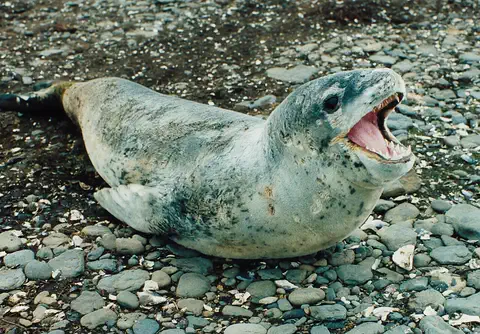
The leopard seal is a large, slender seal of the icy seas around Antarctica, named for the dark spots on its gray coat. It is a fast, powerful hunter with a big head and long teeth, and it eats everything from tiny krill to fish, penguins and young seals.
-
Watch
Country
Falkland Islands
The Falkland Islands lie in the South Atlantic, about 480 kilometers northeast of the tip of South America. They are a British Overseas Territory, and Argentina also claims them, calling them the Islas Malvinas. Several million penguins breed there. The 2021 census counted 3,662 people who usually live on the islands.
-
Watch
Country
Chile
Chile stretches about 4,300 kilometers along the west coast of South America, between the Andes and the Pacific Ocean, but it averages only about 180 kilometers wide. Its north holds one of the driest deserts on Earth, and its south is cold, wet and full of fjords and ice.
-
Watch
Country
New Zealand
New Zealand, also called Aotearoa, is an island country in the South Pacific. Its two main islands have snowy mountains, glaciers, volcanoes and deep fiords, and about 5.36 million people lived there in 2026.
-
 Watch
Animal
Adélie penguin
The Adélie penguin is a medium-sized penguin, about 70 centimeters tall, with a black back, a white front and a bright white ring around each eye. It breeds in summer on rocky, ice-free ground all around Antarctica, building nests of pebbles, and spends the winter far out at sea among the pack ice.
For parents & teachers
What children will learn
- Identify a rockhopper by its yellow plumes, red eyes and hopping gait.
- Locate sub-Antarctic islands in three oceans on a map.
- Explain how changes in ocean temperature can affect a seabird's food.
- Understand why scientists sometimes disagree about whether two forms are one species or two.
Recommended ages: 3 to 17 · About 15 minutes
Talk about it
- Why might a penguin that lives on steep, rocky islands hop instead of waddle?
- Why might only one of two chicks usually survive?
- What could scientists learn by counting the same colonies every year?
Try at home or in class
- Have a 'rockhopper race': jump with both feet together along a safe, soft path and count how many hops it takes.
- On a globe, find the Falkland Islands, Kerguelen, Macquarie Island and Campbell Island, and measure how far apart they are.
Key vocabulary: crest, plumes, colony, crèche, moult, countershading
Where these facts come from
- GBIF Backbone Taxonomy and GBIF Occurrence Search , Global Biodiversity Information Facility (CC0 1.0 (backbone); occurrence counts are facts derived from records under CC0, CC BY and CC BY-NC)
- Wikidata , Wikimedia Foundation (CC0 1.0)
- The IUCN Red List of Threatened Species , International Union for Conservation of Nature (IUCN terms of use (no redistribution of Red List data or range maps))
- Eudyptes chrysocome (BirdLife International, assessed 24 August 2020, published 2020) , IUCN Red List of Threatened Species
- Eudyptes chrysocome: taxonomy, range, population, habitat, threats and conservation text , IUCN Red List of Threatened Species
- Eudyptes chrysocome: IUCN Red List global assessment record (BirdLife International 2020), IUCN checklist on GBIF , GBIF
- Southern rockhopper penguin , Australian Antarctic Division
- Rockhopper penguins (scientific consultation: Heather Lynch, Stony Brook University, 2024) , Antarctic and Southern Ocean Coalition
- Western rockhopper penguin , New Zealand Birds Online
- Eastern rockhopper penguin , New Zealand Birds Online
- File:Rockhopper Penguin (5566888870).jpg (Saunders Island, Falkland Islands, 12 January 2011, Liam Quinn) , Wikimedia Commons
- Wikimedia Commons , Wikimedia Foundation (Per file: Public domain, CC0, CC BY or CC BY-SA only (credited on each page))
Checked, not yet human-reviewed. Last updated November 1, 2026. Spotted a mistake? Tell us.