
Animal
Gentoo penguin
The gentoo penguin has a bright orange bill and a white patch over each eye. It builds a nest of stones and is a super-fast swimmer.
The gentoo penguin is the penguin with the red-orange bill, orange feet and a white band across the top of its head. It lives on the Antarctic Peninsula and on islands around Antarctica, builds nests of stones, and usually lays two eggs. National Geographic says no other diving bird swims faster.
Pygoscelis papua, the third-largest living penguin, breeds on the Antarctic Peninsula and many subantarctic islands, and most birds stay near their islands all year. A close relative of the Adélie and chinstrap penguins, it is a flexible, near-shore hunter of crustaceans, fish and squid. The IUCN lists it as Least Concern with a stable population of about 774,000 mature individuals (2019).
Photo: W. Bulach, CC BY-SA 4.0, via Wikimedia Commons
Meet the gentoo penguin
The gentoo penguin has a black back and a white tummy.
It has a bright orange bill and orange feet. A white patch sits above each eye. It cannot fly, but it is a very fast swimmer.
Gentoo penguins are easy to spot. Look for the bright red-orange bill, the orange feet and the white patches above the eyes, joined by a thin white band across the top of the head.
A grown gentoo stands about 76 centimeters tall, about as tall as a kitchen table, and weighs 5 to 8 kilograms. That makes it the third-largest kind of penguin. Its close relatives are the Adélie and chinstrap penguins.
Pygoscelis papua is the third-largest living penguin, standing about 76 centimeters and weighing 5 to 8 kilograms, according to National Geographic and the Australian Antarctic Division. Males tend to be larger than females, though the difference is hard to see. It is closely related to the Adélie and chinstrap penguins, and Animal Diversity Web places it among the brush-tailed penguins.
Animal Diversity Web describes two white wedges around the eyes linked by a band over the crown, long tail feathers, and stout orange feet with long claws. National Geographic gives an average wild life span of 15 to 20 years, while Animal Diversity Web gives an average of 13 years.
Quick facts
- Group
- Bird
- Height
- 0.76 m
- Weight
- 5 to 8 kg
- Top speed
- up to 35 km/h
- Lifespan in the wild
- 15 to 20 years
Where it lives
Gentoo penguins live near Antarctica.
They live on rocky beaches by the cold sea. Many live on islands. They swim in the sea to find food.
Gentoo penguins live in the far south of the world. They breed on the Antarctic Peninsula, the part of Antarctica that reaches up toward South America, and on many islands in the Southern Ocean, from the Falkland Islands and South Georgia to islands south of Africa and Australia.
Unlike many penguins, most gentoos stay near their home islands all year. They like places free of ice, such as beaches, flat ground by the coast and sheltered valleys.
The IUCN global assessment lists breeding populations in Antarctica, the Falkland Islands, South Georgia, the French Crozet and Kerguelen Islands, Heard Island, Australia's Macquarie Island and South Africa's Prince Edward Islands; birds are also resident in Argentina and occur outside the breeding season in Chile. The Australian Antarctic Division notes that gentoos generally occupy their islands all year round.
Animal Diversity Web places the range between about 45 and 65 degrees south and estimates that around 40 percent of all gentoos live in the Falkland Islands. Colonies sit on ice-free ground: coastal plains, sheltered valleys and cliffs.
Continent
Its habitat

Where can you find this animal?
- Lives here naturally · Countries and seas named by a scientific source
- Sightings recorded · Records of wild sightings (GBIF)
- Visits for part of the year · Countries and seas named by a scientific source
Lives here naturally · Countries and seas named by a scientific source
Breeds on the Antarctic Peninsula and on subantarctic islands: the Falklands, South Georgia, the French Crozet and Kerguelen Islands, Heard Island, Macquarie Island (Australia) and the Prince Edward Islands (South Africa). South Georgia and Heard Island have no separate map shape; for Australia and South Africa only their far-southern islands are meant. Also resident in Argentina.
Places: Antarctica, Falkland Is., Fr. Southern Lands, Australia, South Africa, Argentina, Southern Ocean and Atlantic Ocean.
Source: iucn-red-list · checked October 2026
Sightings recorded · Records of wild sightings (GBIF)
Counts of GBIF records of wild observations (human and machine) and preserved specimens. Records include introduced populations, vagrants, escaped or released animals and misidentifications, so a country with records is not necessarily part of the native range.
Wild sightings have been recorded in Antarctica, Falkland Is., Argentina, Australia, Fr. Southern Lands, Chile, UK, South Africa and 13 more places.
Source: gbif · checked October 2026
Visits for part of the year · Countries and seas named by a scientific source
Outside the breeding season gentoos also occur in Chilean waters.
Places: Chile.
Source: iucn-red-list · checked October 2026
Range maps show where scientists say an animal lives, often country by country. An animal may live in only part of a country shown, and sightings records can include animals that wandered far from home.
What it eats
Gentoo penguins eat food from the sea.
They catch krill, small fish and squid. They swim and dive to catch them. They hunt all day long.
Gentoos eat a mix of crustaceans such as krill, small fish and squid. What they catch changes with the season and the place, so scientists call them opportunistic hunters: they take whatever good food is around.
Adults spend the whole day hunting, usually close to shore, but they sometimes swim as far as about 26 kilometers out to sea. Most dives are quite shallow, yet some gentoos dive as deep as about 200 meters.
The Australian Antarctic Division describes gentoos as opportunistic hunters with a diverse diet that varies by season and location, usually a mix of crustaceans, small fish and squid. National Geographic adds that adults hunt all day, mostly near shore but occasionally up to 16 miles (about 26 kilometers) out.
Dive depths reported by sources differ. Animal Diversity Web gives typical dives of only about 3 to 20 meters, with occasional dives to 70 meters, while National Geographic reports dives as deep as 655 feet (about 200 meters).
Did you know?
Gentoo penguins build their nests out of stones.
Gentoo nests are made of small pebbles, plus grass, moss and feathers, built on flat ground where the snow melts early.
Pebbles under about 5 centimeters across are the main nest material, and nests are spaced about a meter apart in the colony.
Built for speed
On land, gentoo penguins waddle and hop.
In the water, they zoom! Their bodies are smooth, and their flippers work like strong paddles.
On land a gentoo looks clumsy, but underwater it is graceful. Its smooth, streamlined body slips through the water, and its stiff, paddle-shaped flippers push it along at up to 35 kilometers an hour. National Geographic says that is faster than any other diving bird.
Gentoos keep their feathers waterproof by spreading oil on them with their bills. The oil comes from a gland near the base of the tail.
Gentoos are streamlined pursuit divers whose paddle-shaped flippers drive them at up to 22 miles an hour (about 35 kilometers an hour), which National Geographic describes as faster than any other diving bird.
Animal Diversity Web reports very fine feathers, up to 70 per square inch, kept waterproof with oil from the uropygial (preen) gland at the base of the tail. Like other penguins they are countershaded, dark above and white below. The tail of 14 to 18 long feathers, about 15 centimeters long, is a feature of the brush-tailed penguins.
Two eggs in a nest of stones
Gentoo parents build a round nest out of little stones.
The mother lays two eggs. Mom and dad take turns keeping the eggs warm. Then they both feed the chicks.
Gentoo parents build a round nest of stones, grass, moss and feathers, on a beach or among tall tufts of grass. The mother lays two white eggs, and both parents take turns keeping them warm for 34 to 37 days.
The chicks stay in the nest for up to a month while one parent hunts and the other guards them. At about 26 days old, chicks gather in groups called crèches. They are ready to go to sea at 80 to 90 days old.
Gentoos start breeding at 2 to 4 years old, and the Australian Antarctic Division notes that their breeding cycle is more variable than that of other penguins. Pairs build nests on beaches or among tussock grass and keenly defend them; the colony's exact position shifts slightly from year to year.
Two eggs are incubated for 34 to 37 days by both parents in turn. Chicks start forming crèches at about 26 days and fledge at 80 to 90 days. National Geographic notes that pairs often form long-lasting bonds, and Animal Diversity Web reports that a pair that loses its eggs can sometimes lay again in the same season.

Life in the colony
Gentoo penguins live together in big groups called colonies.
Each pair guards its own nest. A dad penguin points his bill to the sky and calls to find a partner.
Gentoos breed in colonies, which can hold anything from a few dozen pairs to many thousands. Each pair keeps its own small patch of ground around the nest and defends it from neighbors.
Stones matter a lot: small pebbles are the main building blocks of a nest. Gentoos pick flat spots where the snow melts early. To find a mate, a male chooses a nest site, points his bill to the sky and calls loudly.
Colonies range from a few dozen to many thousands of breeding pairs, and the Australian Antarctic Division notes that gentoos keenly defend their nest sites. Animal Diversity Web reports that pebbles under about 5 centimeters across are the main nest material and that nests are spaced roughly a meter apart.
Courtship begins with the male: he chooses a flat, snow-free site, points his bill vertically and calls to attract a female, and the pair then trumpet or bow to each other. Pairs are faithful within a season and some stay together for life, though 'divorces' between seasons do occur.
Did you know?
Lots of gentoo penguins live in the Falkland Islands.
Animal Diversity Web estimates that about 40 percent of all gentoo penguins live in the Falkland Islands.
Roughly 40 percent of the world's gentoos breed in the Falkland Islands, according to Animal Diversity Web.
Gentoos today
There are lots of gentoo penguins.
Their numbers are staying about the same overall. In some places there are more, and in some places fewer.
The gentoo penguin is listed as Least Concern, which means it is not in danger right now. Scientists estimate there are about 774,000 adult gentoos, and the total number is staying about the same.
That total hides changes in different places. Gentoos may be increasing around the Antarctic Peninsula but decreasing on some islands in the southern Indian Ocean. Long ago, people collected their eggs, especially in the Falkland Islands.
The IUCN's 2019 global assessment lists the gentoo penguin as Least Concern, with about 774,000 mature individuals and a stable overall trend. The Australian Antarctic Division notes that populations may be increasing around the Antarctic Peninsula and decreasing in the southern Indian Ocean.
Threats named by the IUCN include hunting, fishing, human disturbance from recreational activities, disease and pollution. In the past people collected gentoo eggs, particularly in the Falkland Islands, where sheep and cattle grazing in colonies can also trample nests.
IUCN Red List
How is the gentoo penguin doing in the wild?
- Least Concern (this animal)
- Near Threatened
- Vulnerable
- Endangered
- Critically Endangered
- Extinct in the Wild
- Extinct
Least Concern
Not at risk of disappearing from the wild right now.
See the IUCN Red List assessment · The IUCN Red List of Threatened Species 2021.3
Amazing facts
-
Gentoo penguins build their nests out of stones.
Gentoo nests are made of small pebbles, plus grass, moss and feathers, built on flat ground where the snow melts early.
Pebbles under about 5 centimeters across are the main nest material, and nests are spaced about a meter apart in the colony.
-
Gentoo penguins are very fast swimmers.
A gentoo can swim at up to 35 kilometers an hour. National Geographic says that is faster than any other diving bird.
National Geographic gives a top swimming speed of 22 miles an hour (about 35 km/h), faster than any other diving bird.
-
Gentoo mothers lay two eggs.
Gentoo penguins usually lay two eggs, and both parents take turns keeping them warm for 34 to 37 days.
Gentoos lay a two-egg clutch incubated for 34 to 37 days; pairs that lose their eggs can sometimes lay a replacement clutch in the same season.
-
Lots of gentoo penguins live in the Falkland Islands.
Animal Diversity Web estimates that about 40 percent of all gentoo penguins live in the Falkland Islands.
Roughly 40 percent of the world's gentoos breed in the Falkland Islands, according to Animal Diversity Web.
Words to know
- colony
- a large group of animals that live and breed together
- crèche
- a group of young penguins that gather together while their parents hunt
- streamlined
- smoothly shaped so it moves easily through water or air
- opportunistic
- eating whatever good food is easy to find
- subantarctic
- the cold islands and seas just north of Antarctica
- fledge
- when a young bird is ready to leave the nest
Discovery challenge
-
What does a gentoo penguin use to build its nest?
What is the main building material of a gentoo penguin's nest?
Which material do gentoo penguins mainly use to build their nests?
- Snow
- Small stones
- Mud
Show the answer
Small stones
Gentoos build round nests out of small stones.
Small pebbles, plus grass, moss and feathers, make the nest.
Pebbles under about 5 centimeters across are the main nest material.
-
What color are a gentoo penguin's bill and feet?
What color are a gentoo penguin's bill and feet?
Which colors help identify a gentoo penguin's bill and feet?
- Orange
- Blue
- Green
Show the answer
Orange
Gentoos have bright orange bills and orange feet.
The bill is red-orange and the feet are orange.
Sources describe a red-orange bill and bright orange (National Geographic: peach-colored) feet; the white band over the crown is the other key mark.
-
How many eggs does a gentoo mother lay?
How many eggs does a gentoo penguin usually lay?
What is the usual clutch size of a gentoo penguin?
- One
- Two
- Ten
Show the answer
Two
A gentoo mother lays two eggs.
Gentoos usually lay two eggs, and both parents take turns keeping them warm.
The usual clutch is two eggs, incubated for 34 to 37 days.
-
Where do gentoo penguins live?
Where do gentoo penguins live in the wild?
Which describes where gentoo penguins breed?
- In hot deserts
- On islands near Antarctica
- In jungles
Show the answer
On islands near Antarctica
They live on cold islands near Antarctica.
They live on the Antarctic Peninsula and on islands in the Southern Ocean.
On ice-free ground on the Antarctic Peninsula and many subantarctic islands.
Explore next
-
 Watch
Animal
Chinstrap penguin
The chinstrap penguin is named for the thin black band that runs under its chin from ear to ear, like a helmet strap. It breeds in huge colonies on the Antarctic Peninsula and nearby islands, raises two chicks each summer and dives for krill close to shore.
-
 Watch
Animal
Adélie penguin
The Adélie penguin is a medium-sized penguin, about 70 centimeters tall, with a black back, a white front and a bright white ring around each eye. It breeds in summer on rocky, ice-free ground all around Antarctica, building nests of pebbles, and spends the winter far out at sea among the pack ice.
-
 Watch
3D
Animal
King penguin
The king penguin is the second-largest penguin in the world. It lives in huge, noisy colonies on windy islands in the Southern Ocean and dives deep to catch lantern fish. Its babies grow a thick coat of brown fluff and take more than a year to raise.
-
 Watch
3D
Animal
Antarctic krill
Antarctic krill are small, shrimp-like crustaceans about 6 centimeters long that live in the icy Southern Ocean around Antarctica. They gather in enormous swarms, and almost all the bigger animals of the Antarctic, from penguins to blue whales, depend on them for food.
-
 Watch
Animal
Leopard seal
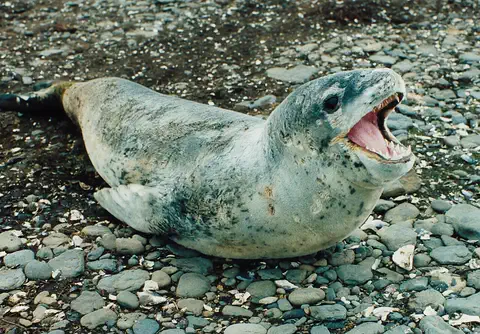
The leopard seal is a large, slender seal of the icy seas around Antarctica, named for the dark spots on its gray coat. It is a fast, powerful hunter with a big head and long teeth, and it eats everything from tiny krill to fish, penguins and young seals.
-
 Watch
3D
Animal
Little penguin
The little penguin is the smallest penguin in the world, only about 33 centimeters long and about 1 kilogram. It lives along the coasts of southern Australia and New Zealand, where it is also called the fairy penguin, the blue penguin or kororā. It fishes at sea by day and comes ashore after dark to its burrow.
-
 Watch
Animal
African penguin
The African penguin is a penguin of warm, sunny coasts. It lives only in South Africa and Namibia, nests in burrows and under bushes, and hunts sardines and anchovies in the cold sea. Its numbers have fallen so far that it is now Critically Endangered, and people are working hard to protect it.
-
 Watch
Animal
African fish eagle
The African fish eagle is a big eagle of Africa's lakes, rivers and coasts, with a white head, chest and tail and a chestnut-brown body. It snatches fish from the surface of the water, and its loud, ringing call is one of the best-known sounds of Africa.
For parents & teachers
What children will learn
- Identify a gentoo penguin by its orange bill and feet and white head band.
- Describe how gentoos build stone nests and raise two chicks.
- Explain how a streamlined body and flippers help a penguin swim fast.
- Understand that a species can be stable overall while some populations change.
Recommended ages: 3 to 17 · About 15 minutes
Talk about it
- Why might a gentoo pick a flat spot where the snow melts early for its nest?
- Gentoo numbers may be rising in one place and falling in another. How might scientists find out why?
- How is a penguin's flipper like a bird's wing, and how is it different?
Try at home or in class
- Build a small 'nest' of pebbles on a tray, pour a little water around it, and see whether an egg-sized ball stays dry on top.
- Push a flat hand and then a pointed hand through water in a sink to feel how a streamlined shape moves more easily.
Key vocabulary: colony, crèche, streamlined, opportunistic, subantarctic, fledge
Where these facts come from
- The IUCN Red List of Threatened Species , International Union for Conservation of Nature (IUCN terms of use (no redistribution of Red List data or range maps))
- GBIF Backbone Taxonomy and GBIF Occurrence Search , Global Biodiversity Information Facility (CC0 1.0 (backbone); occurrence counts are facts derived from records under CC0, CC BY and CC BY-NC)
- Wikidata , Wikimedia Foundation (CC0 1.0)
- Pygoscelis papua (Gentoo Penguin), Red List global assessment 2019 , IUCN Red List of Threatened Species
- Gentoo penguin , Australian Antarctic Division
- Gentoo penguin , National Geographic
- Pygoscelis papua (gentoo penguin) , Animal Diversity Web, University of Michigan Museum of Zoology
- Wikimedia Commons , Wikimedia Foundation (Per file: Public domain, CC0, CC BY or CC BY-SA only (credited on each page))
Checked, not yet human-reviewed. Last updated October 24, 2026. Spotted a mistake? Tell us.