
Animal
Mugger crocodile
The mugger is a crocodile with a wide snout. It lives in rivers, lakes and ponds in India and nearby countries.
The mugger crocodile is a big, broad-snouted crocodile of South Asia. It lives in rivers, lakes, marshes, village ponds and reservoirs in India, Sri Lanka, Pakistan, Nepal and Iran. Muggers dig burrows to escape heat and cold, and they sometimes walk long distances over land.
Crocodylus palustris (family Crocodylidae) is a freshwater crocodile of the Indian subcontinent and eastern Iran. Choudhury and de Silva assessed it as Vulnerable (A2cd) for the IUCN Red List (assessed 30 June 2009, published 2013, flagged as needing updating): past declines from habitat loss and poaching are thought to have stopped, but the population of about 5,700 to 8,700 non-hatchlings is split into isolated groups, and viable populations survive only in protected areas.
Photo: Charles J. Sharp, CC BY-SA 4.0, via Wikimedia Commons
Meet the mugger
The mugger is a big crocodile.
It has a wide, strong snout.
It likes to lie in the sun by the water.
The mugger crocodile, also called the marsh crocodile, is one of the crocodiles of South Asia. The Animal Diversity Web says it has the widest snout of any crocodile. Its body is covered in rough, thick scales and is a muddy brown color.
Muggers are big: the largest reach 4 to 5 meters long, and females are grown up once they are about 1.8 to 2 meters long. Females are smaller than males.
Crocodylus palustris belongs to the family Crocodylidae, genus Crocodylus. The Animal Diversity Web describes a crocodile with rough, thick scales over the whole body, a muddy brown color and the broadest snout of any Crocodylus species, with a maximum length of 4 to 5 meters and males larger than females; a hatchling measures about 0.27 meters.
The IUCN notes that females reach sexual maturity at about 1.8 to 2 meters (Whitaker and Whitaker 1989), and the Animal Diversity Web gives ages of about 8 to 10 years for females and 12 to 15 years for males.
Quick facts
- Group
- Reptile
- Length
- 4 to 5 m
- Lifespan in the wild
- 31.5 years
Rivers, ponds and village tanks
Muggers live in rivers, lakes and ponds.
Some live in big ponds that people built.
Muggers live in India, Sri Lanka, Pakistan, Nepal and eastern Iran. India and Sri Lanka have the most. They live in fresh water: rivers, lakes, hill streams, village ponds and reservoirs. In Sri Lanka many live in man-made reservoirs called tanks. Some may even be found in salty lagoons near the coast.
Muggers once lived in Bangladesh, Bhutan and Myanmar too, but they have disappeared from the wild there.
The IUCN lists the mugger as resident in India, Iran, Nepal, Pakistan and Sri Lanka, from sea level to 420 meters. It has disappeared from large parts of its range, and viable populations occur only in protected areas, leaving it severely fragmented; India (15 states, including the Chambal River and Gujarat) and Sri Lanka (about half in protected areas such as Wilpattu and Yala) hold the main populations. In Iran it lives in rivers, small dams and ponds of Sistan and Baluchestan near the Pakistan border.
It was last recorded in Myanmar in 1867 to 1868 and in Bhutan in the 1960s, and is considered extinct in the wild in Bangladesh, where it survives in small captive groups. Habitats include rivers, lakes, reservoirs, hill streams, village ponds, man-made tanks and coastal saltwater lagoons.
Continent
Its habitat

Where can you find this animal?
- Used to live here · Countries and seas named by a scientific source
- Lives here naturally · Countries and seas named by a scientific source
- Sightings recorded · Records of wild sightings (GBIF)
Used to live here · Countries and seas named by a scientific source
Countries where the IUCN lists the mugger as extinct: Bhutan (last seen in the 1960s) and Myanmar (last recorded in 1867 to 1868).
Places: Bhutan and Myanmar.
Source: iucn-red-list · checked October 2026
Lives here naturally · Countries and seas named by a scientific source
Countries where the IUCN lists the mugger as resident. It lives in scattered places, mostly protected areas, and in only part of most countries shaded; in Iran only in the southeast near Pakistan. The IUCN lists it as possibly extinct in Bangladesh, where its text records it only in small captive groups, so Bangladesh is not shaded.
Places: India, Sri Lanka, Pakistan, Nepal and Iran.
Source: iucn-red-list · checked October 2026
Sightings recorded · Records of wild sightings (GBIF)
Counts of GBIF records of wild observations (human and machine) and preserved specimens. Records include introduced populations, vagrants, escaped or released animals and misidentifications, so a country with records is not necessarily part of the native range.
Wild sightings have been recorded in India, Sri Lanka, Nepal, Iran, Japan, Pakistan, Cambodia, Bangladesh and 10 more places.
Source: gbif · checked October 2026
Range maps show where scientists say an animal lives, often country by country. An animal may live in only part of a country shown, and sightings records can include animals that wandered far from home.
A patient hunter
Muggers wait very still for food to come close.
Babies eat bugs.
Bigger muggers catch bigger animals.
Muggers are meat eaters that will eat almost any animal smaller than themselves. They are sit-and-wait hunters: they lie still in the water, often with just their eyes and nose showing, until prey comes close. They can even catch birds and bats that swoop down to the water's surface.
Baby muggers eat insects and other small creatures such as crustaceans. As they grow, they eat bigger prey.
The Animal Diversity Web describes the mugger as an opportunistic carnivore and sit-and-wait predator that takes almost any animal smaller than itself, including fish, birds, mammals, amphibians, reptiles and eggs, and even birds and bats feeding at the water's surface. Hatchlings eat insects and other small invertebrates, including crustaceans, and prey size rises as they grow. A meal can be 10 to 25% of body weight: more than 2 meters long, a mugger can eat about 3 kilograms at once, while one under 0.5 meters eats about 150 grams.
Did you know?
A mugger's skin can feel tiny ripples.
Under water, a mugger feels tiny vibrations through special sense organs in its skin.
Integumentary sense organs detect water vibrations, compared with a fish's lateral line (ADW).
Built for water and land
Its eyes and nose can poke out of the water.
Its skin is rough and bumpy.
It can feel ripples in the water.
A mugger often floats with only its nostrils or eyes above the water. Above the surface it uses its eyes, nose and ears. Under water it relies on its skin, which can feel tiny ripples and vibrations.
Its thick, rough scales cover its whole body, and its long tail is about 1.8 meters long in an adult.
The Animal Diversity Web notes that muggers usually float with just the nostrils or eyes above the surface and rely on sight, smell and hearing in air, while submerged they rely on sensory organs in the skin that detect vibrations in the water, a system it compares with a fish's lateral line. The adult tail is about 1.8 meters long, and the scales are rough and thick over the whole body.
The Animal Diversity Web notes that muggers must bask to raise their body temperature and dig burrows for shelter. The IUCN notes that burrows let them avoid long exposure to temperatures below 5°C or above 38°C, which can be lethal (Lang 1987).
Eggs in a hole
The mother lays her eggs in a hole.
She lays them in the dry season.
The babies stay near the nest for about a year.
Muggers are hole nesters: in the dry season a female lays about 25 to 30 eggs in a hole in the ground. Some females even nest at the entrance of their burrow or inside it.
The eggs hatch after about 55 to 75 days. The temperature of the nest decides whether the babies are male or female. The mother guards the nest, and the young stay near it until they are about a year old and big enough to look after themselves.
The IUCN describes a hole-nesting species that lays in the annual dry season: females mature at about 1.8 to 2 meters and lay 25 to 30 eggs (Whitaker and Whitaker 1989), sometimes at the mouth of or inside their burrow; captive females can lay two clutches a year, which has not been seen in the wild, and incubation is short, typically 55 to 75 days (Whitaker 1987).
The Animal Diversity Web summarizes temperature-dependent sex determination (Lang et al. 1998): only females at 28 to 31°C, only males at 32.5°C and above, and both at 31.5, 32.0 and 33.0°C. The female guards the nest; the young stay near it until they are yearlings, and males give no care.
Burrows and long walks
Muggers dig burrows to hide from the heat.
Sometimes they walk a long way over land.
Muggers of every age, from yearlings to big adults, dig burrows. The burrows help them stay safe from very hot or very cold weather. In Iran, muggers sometimes dig two burrows close together, used by one or more crocodiles.
Muggers were thought to stay in one place, but in India, Sri Lanka and Iran they have been seen making long treks over land. They also bask in the sun to warm up.
Whitaker and Whitaker (1984) recorded burrows in Sri Lanka and India dug by yearlings, sub-adults and adults; in Iran muggers sometimes dig two burrows close together, used by one or more animals (Mobaraki 2002). The IUCN presumes these burrows are refuges from hot daytime temperatures and notes they are critical for crocodiles in harsh environments (Whitaker et al. 2007).
Long-distance overland treks are reported from Gir in India, from Sri Lanka and from Iran (IUCN). The Animal Diversity Web adds that muggers do not migrate seasonally, that they stroke and rub each other's heads during courtship, and that females defend their burrows.
Did you know?
A big mugger can eat a lot in one meal.
A mugger can eat 10 to 25% of its body weight in one meal.
Single meals of 10 to 25% of body mass; about 3 kg for muggers over 2 m (ADW).
Protected, but in pieces
Muggers are in danger in the wild.
People have taken over many of their homes.
Parks help keep them safe.
The mugger is listed as vulnerable. Farms and factories have taken over much of its home, and people have poached muggers for their skins and meat and taken their eggs. Some have also been caught in fishing nets.
Today healthy mugger populations are found only in protected areas, and in India and Sri Lanka their numbers are stable or growing. Between 1978 and 1992, India released more than 1,000 captive-bred muggers into protected areas. Muggers can be dangerous, so people should keep well away from them.
Choudhury and de Silva assessed Crocodylus palustris as Vulnerable under A2cd (Global; assessed 30 June 2009, published 2013; 'needs updating'), inferring a 30% decline over three generations (75 years) from habitat destruction and illegal poaching that is now thought to have stopped. A 2013 workshop in Colombo estimated 5,700 to 8,700 non-hatchlings in the wild, including 3,021 to 4,287 in India and 2,400 to 3,500 in Sri Lanka; numbers in the National Chambal Sanctuary rose from 105 to 226 over 16 years, but declines continue in Pakistan, Iran and Nepal.
Threats have included agricultural and industrial expansion, entanglement in fishing gear, egg collection, poaching for skin and meat, and persecution by fishers who saw muggers as pests; conflicts with people are rising as settlements spread into mugger habitat. The species is on CITES Appendix I. Between 1978 and 1992 India released 1,193 captive-bred muggers into 28 protected areas, and protection is moderately effective in protected areas of India, Sri Lanka and Iran.
IUCN Red List
How is the mugger crocodile doing in the wild?
- Least Concern
- Near Threatened
- Vulnerable (this animal)
- Endangered
- Critically Endangered
- Extinct in the Wild
- Extinct
Vulnerable
At high risk of disappearing from the wild.
Amazing facts
-
Muggers can catch birds and bats near the water.
Muggers can catch birds and bats that swoop down to feed at the water's surface.
Sit-and-wait muggers take birds and bats feeding at the water surface (ADW).
-
Muggers sometimes go on long walks over land!
Muggers have been seen making long journeys over land in India, Sri Lanka and Iran.
Long-distance overland treks are reported from Gir (India), Sri Lanka and Iran (IUCN).
-
A mugger's skin can feel tiny ripples.
Under water, a mugger feels tiny vibrations through special sense organs in its skin.
Integumentary sense organs detect water vibrations, compared with a fish's lateral line (ADW).
-
A big mugger can eat a lot in one meal.
A mugger can eat 10 to 25% of its body weight in one meal.
Single meals of 10 to 25% of body mass; about 3 kg for muggers over 2 m (ADW).
Words to know
- crocodilian
- a member of the reptile group that includes alligators, caimans, crocodiles and gharials
- burrow
- a tunnel or hole that an animal digs to live or rest in
- tank
- in South Asia, a pond or lake made by people to store water
- ectotherm
- an animal whose body warmth comes mostly from its surroundings
- poaching
- hunting or taking animals when it is against the law
- vulnerable
- at high risk of dying out in the wild
Discovery challenge
-
What is special about the mugger's snout?
What is special about the mugger crocodile's snout?
How does the mugger's snout compare with other Crocodylus species?
- It is very wide
- It is very thin, like a needle
- It is shaped like a beak
Show the answer
It is very wide
Very wide!
The mugger has the widest snout of any crocodile.
The broadest snout among Crocodylus species (ADW).
-
Where does a mother mugger lay her eggs?
What kind of nest does a mugger make?
Which nesting type characterizes Crocodylus palustris?
- A hole in the ground
- A nest high in a tree
- A floating raft of leaves
Show the answer
A hole in the ground
A hole!
Muggers dig holes for their eggs, sometimes at or inside a burrow.
A hole-nester laying in the dry season (IUCN).
-
Why do muggers dig burrows?
How do burrows help muggers?
What role do burrows play for Crocodylus palustris?
- To shelter from very hot or very cold weather
- To store food for winter
- To keep their eggs cold
Show the answer
To shelter from very hot or very cold weather
To stay safe from heat and cold!
Burrows let muggers escape temperatures that are too hot or too cold.
Refuges from temperatures below 5°C or above 38°C (IUCN).
-
Which country has many muggers?
Which country holds one of the two largest mugger populations?
Which two countries hold the main populations of Crocodylus palustris?
- India
- Canada
- Egypt
Show the answer
India
India!
India and Sri Lanka have the most muggers.
India and Sri Lanka retain the major populations (IUCN).
Places where you might see it
-
 Watch
 Country
India
India is a huge country in South Asia, shaped like a big triangle pointing into the Indian Ocean. The Himalayas rise along its north, heavy monsoon rains arrive every summer, and about 1.46 billion people (2025) live there, speaking hundreds of languages.
-
 Watch
 Country
Sri Lanka
Sri Lanka is an island country in the Indian Ocean, just south of India. Green highlands rise in the middle, surrounded by plains and sandy beaches. About 22 million people live there, and the island is famous for its tea, its ancient cities and its wild elephants.
Explore next
-
 Watch
Animal
Gharial
The gharial is a crocodile relative with a long, skinny snout full of sharp teeth, perfect for snapping up fish. It lives in a few big rivers of northern India and Nepal, and it is one of the most threatened crocodilians on Earth.
-
 Watch
Animal
Saltwater crocodile
The saltwater crocodile is the largest reptile alive today. It lives in rivers, swamps and estuaries from India to northern Australia, can cope with fresh water and seawater, and sometimes swims far out across the open ocean to reach distant islands.
-
 Watch
Animal
Nile crocodile
The Nile crocodile is Africa's largest crocodile. It lives in rivers, lakes and swamps across much of eastern, central and southern Africa and Madagascar. It eats mostly fish, basks on sunny banks and is a surprisingly caring parent.
-
Watch
Country
India
India is a huge country in South Asia, shaped like a big triangle pointing into the Indian Ocean. The Himalayas rise along its north, heavy monsoon rains arrive every summer, and about 1.46 billion people (2025) live there, speaking hundreds of languages.
-
Watch
Country
Sri Lanka
Sri Lanka is an island country in the Indian Ocean, just south of India. Green highlands rise in the middle, surrounded by plains and sandy beaches. About 22 million people live there, and the island is famous for its tea, its ancient cities and its wild elephants.
-
 Watch
Animal
Aldabra giant tortoise
The Aldabra giant tortoise is one of the largest land tortoises on Earth. Wild ones live on Aldabra Atoll, a ring of coral islands in the Indian Ocean, where about 180,000 of them graze, browse and shape the land like elephants do in Africa. They can live for more than 100 years.
-
 Watch
Animal
Alligator snapping turtle
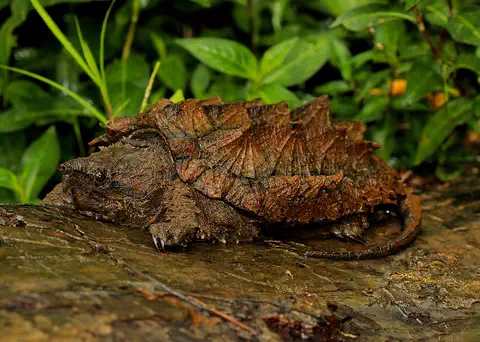
The alligator snapping turtle is the largest freshwater turtle in the United States. It lies still on the bottom of rivers and lakes with its mouth open, wiggling a worm-like lure on its tongue to trick fish into swimming close. Its numbers have fallen, and it is now endangered.
-
 Watch
3D
Animal
American alligator
The American alligator is a large, armored reptile of the swamps, marshes and lakes of the southeastern United States. Alligator mothers guard their nests and carry their babies to the water, and the holes alligators dig help many other animals survive dry seasons.
For parents & teachers
What children will learn
- Describe where mugger crocodiles live and why many live in protected areas.
- Explain how burrows help a cold-blooded animal survive heat and cold.
- Explain how nest temperature decides the sex of baby crocodiles.
- Describe how protected areas and captive-bred releases can help a vulnerable species.
Recommended ages: 3 to 17 · About 15 minutes
Talk about it
- Why might a reservoir built by people become a home for wild animals?
- What happens to a species when its populations are split into small, separate groups?
- Why is it important to watch crocodiles only from a safe distance?
Try at home or in class
- Burrow test: put one thermometer on a sunny surface and push another a few centimeters into damp soil or sand. Compare after 20 minutes and talk about why muggers dig burrows.
- Snout shapes: draw the outline of a wide snout and a narrow snout, and talk about how a broad snout differs from a gharial's thin one.
Key vocabulary: crocodilian, burrow, tank, ectotherm, poaching, vulnerable
Where these facts come from
- GBIF Backbone Taxonomy and GBIF Occurrence Search , Global Biodiversity Information Facility (CC0 1.0 (backbone); occurrence counts are facts derived from records under CC0, CC BY and CC BY-NC)
- Wikidata , Wikimedia Foundation (CC0 1.0)
- The IUCN Red List of Threatened Species , International Union for Conservation of Nature (IUCN terms of use (no redistribution of Red List data or range maps))
- Crocodylus palustris (Choudhury and de Silva, assessed 30 June 2009, published 2013) , IUCN Red List of Threatened Species
- Crocodylus palustris: justification, range, population, habitat, threats, use and trade, and conservation text , IUCN Red List of Threatened Species
- Crocodylus palustris: IUCN Red List global assessment record (Choudhury and de Silva 2013), IUCN checklist on GBIF , GBIF
- Crocodylus palustris (mugger crocodile) , Animal Diversity Web, University of Michigan Museum of Zoology
- File:Mugger crocodile (Crocodylus palustris) Gal Oya.jpg (1 March 2022, Charles J. Sharp) , Wikimedia Commons
- Wikimedia Commons , Wikimedia Foundation (Per file: Public domain, CC0, CC BY or CC BY-SA only (credited on each page))
Checked, not yet human-reviewed. Last updated November 1, 2026. Spotted a mistake? Tell us.