
Animal
Ochre sea star
The ochre sea star is a big, bumpy sea star. It can be purple or orange. It lives on rocky shores and eats mussels.
The ochre sea star lives on wave-washed rocky shores along the Pacific coast of North America. It can be purple, orange or brown, and it pries open mussels to eat them with a stomach it pushes out of its body. It is so important to its shore that scientists call it a keystone species.
Pisaster ochraceus is a large intertidal sea star of the northeastern Pacific, from Alaska to California, and the species on which the keystone species concept was based. A mussel predator that shapes rocky-shore communities, it suffered a massive die-off from sea star wasting disease beginning in 2013.
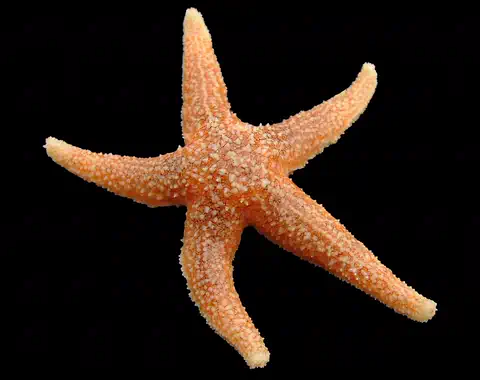
Photo: D. Gordon E. Robertson, CC BY-SA 3.0, via Wikimedia Commons
Meet the ochre sea star
The ochre sea star has five thick arms.
It can be purple, orange or brown. Its back is covered in tiny white bumps that make a pretty net pattern. It holds on tight to rocks by the sea.
The ochre sea star is one of the biggest and most common sea stars on the rocky shores of North America's Pacific coast. It usually has five stout arms, though some have four, six or rarely seven.
Despite its name, it is not always ochre, a yellow-orange color. It can be pale orange, brown or deep purple. Its upper side is covered in small white spines arranged in a net-like pattern, which helps tell it apart from other sea stars on the same shore.
Pisaster ochraceus (Brandt, 1835) is a forcipulatid sea star in the family Asteriidae. Walla Walla University's invertebrate guide gives a radius of up to about 25 centimeters, usually five stout, tapering rays (occasionally four, rarely up to seven), and colors from pale orange to dark brown or deep purple.
The aboral (upper) surface bears many small spines (ossicles) arranged in a net-like pattern, forming a pentagonal or star-shaped pattern on the central disc. That pattern, the large disc and rays thickest at the base distinguish it from the similar Evasterias troschelii.
Quick facts
- Group
- Invertebrate
- Length
- up to 25 cm
- Lifespan in the wild
- up to 20 years
Where it lives
Ochre sea stars live by the sea in western North America.
When the tide goes out, you can find them holding on to rocks. They can stay out of the water for hours!
Ochre sea stars live along the Pacific coast of North America, from Alaska down to California. They cling to rocky shores where waves crash, in the middle and lower parts of the shore that are covered and uncovered by the tides. Young ones hide in cracks and under rocks.
They are tough. At low tide they can stay out of the water for up to 8 hours, and they can lose almost a third of their body fluids and survive. But they cannot handle very warm water or water low in oxygen, so they avoid shallow bays and high tide pools.
Walla Walla University's guide gives the range as Prince William Sound, Alaska, to Point Sal, Santa Barbara County, California; Animal Diversity Web extends it to Baja California. The map shades the United States and Canada, where both agree; it lives only along their Pacific coasts.
It occurs in the low and middle intertidal and sometimes subtidally, to 88 meters, on wave-washed rocky shores. It regularly withstands 8 hours of air exposure at low tide and survived up to 50 hours in the laboratory, and ADW reports it can tolerate losing 30 percent of its body weight in fluids. Its intolerance of high temperature and low oxygen keeps it out of shallow bays and high tidepools.
Continent
Did you know?
The idea of a keystone species came from this sea star.
Scientists first came up with the idea of a keystone species by studying the ochre sea star.
Pisaster ochraceus was the basis of the keystone species concept (MARINe).
Where can you find this animal?
- Lives here naturally · Countries and seas named by a scientific source
- Sightings recorded · Records of wild sightings (GBIF)
Lives here naturally · Countries and seas named by a scientific source
Wave-washed rocky shores of the Pacific coast from Prince William Sound, Alaska, to Point Sal, California (Animal Diversity Web extends it to Baja California). It lives only along the Pacific coasts of the countries shown.
Places: United States and Canada.
Source: https://inverts.wallawalla.edu/Echinodermata/Class%20Asteroidea/Pisaster_ochrace · checked October 2026
Sightings recorded · Records of wild sightings (GBIF)
Counts of GBIF records of wild observations (human and machine) and preserved specimens. Records include introduced populations, vagrants, escaped or released animals and misidentifications, so a country with records is not necessarily part of the native range.
Wild sightings have been recorded in United States, Canada, Mexico, South Korea, Chile, Croatia, Panama, Pacific Ocean and 4 more places.
Source: gbif · checked October 2026
Range maps show where scientists say an animal lives, often country by country. An animal may live in only part of a country shown, and sightings records can include animals that wandered far from home.
A mussel eater
Ochre sea stars love to eat mussels.
They pull the mussel's shells open a tiny bit. Then they push their tummy inside and eat the mussel!
The ochre sea star mainly eats mussels. When mussels are scarce, it eats barnacles, snails, limpets and chitons instead.
It has a clever way to eat a closed mussel. It holds the mussel with its many tube feet and slowly pries the shells apart. Then it slides its stomach out of its body and into a gap as narrow as a tenth of a millimeter, about as thin as a hair, and digests the mussel right inside its own shell. Many snails and other molluscs try to move away when an ochre star comes near.
Walla Walla University's guide lists mussels, especially Mytilus californianus and M. trossulus, as the main prey, with barnacles, snails, limpets and chitons when mussels are absent. The sea star can insert its everted stomach into snail shells or slits as narrow as 0.1 millimeter between bivalve shells, and many molluscs show avoidance responses to it.
ADW notes that it handles prey with its tube feet and everts its stomach over prey too large to swallow, digesting it before swallowing. Its larvae are plankton feeders.
Did you know?
Ochre sea stars can stay out of the water for hours.
At low tide, ochre sea stars can stay out of the water for up to 8 hours.
It regularly withstands 8 hours of air exposure and survived 50 hours in the laboratory.
Tube feet and a body without a brain
Under each arm are hundreds of tiny feet.
The ochre sea star has no brain. But it can still sense light and touch, and its arms work together.
Like all sea stars, the ochre sea star walks on tube feet, tiny soft tubes under each arm that also grip prey. Its skin is covered in short white spines for protection.
It has no brain. Instead, a ring of nerves around its mouth connects to a nerve in each arm, so one arm can lead and the others follow. At the tip of each arm is a cluster of light-sensitive spots, a bit like simple eyes. It can also pull in its soft tube feet and cover them with spines when it is attacked.
ADW describes a simple nervous system with no brain or ganglia: a nerve ring around the mouth connects five radial nerves, relaying impulses so one arm can lead and the others follow. Light-sensitive cells form an optic cushion with several ocelli at the base of each terminal tentacle at the arm tips.
It can retract its podia (tube feet) and skin papillae, close the ambulacral grooves and spread spines over them for protection. Walla Walla University's guide adds that it takes in water through its madreporite to help maintain internal fluid balance, yet remains sensitive to salinity changes.
From drifting larva to sea star
Ochre sea stars let out eggs and sperm into the sea.
The babies drift and eat tiny food in the water. Then they settle on a rock and turn into tiny sea stars.
Ochre sea stars reproduce in late spring and early summer; in Puget Sound they spawn from about May to July. When they are ready, their eggs or sperm can make up as much as 40 percent of their body weight.
Eggs and sperm meet in the sea, and the young become free-swimming larvae that eat plankton. Each larva later settles on a rock, attaching with sticky tips on its arms, and changes into a tiny five-armed sea star. Scientists still know little about the young sea stars' life after they settle.
Spawning occurs in late spring or early summer (around May to July in Puget Sound), when mature gonads may account for up to 40 percent of body weight (Walla Walla University). Fertilization is external, producing planktotrophic larvae; ADW describes several larval stages, including the brachiolaria, which uses ciliated arms to feed and swim and attaches by glandular arm tips at settlement before metamorphosing into the five-armed form.
Little is known of juvenile life after settlement. ADW reports that this species could reach about 20 years of age, with growth depending on the food supply.
The original keystone species
Ochre sea stars are very important to their rocky shore.
When scientists took them away from a shore, fewer kinds of plants and animals lived there.
A keystone is the stone at the top of an arch that holds the whole arch together. Scientists call some animals keystone species because they hold their whole community together. The ochre sea star was the animal that gave scientists this idea.
Ochre sea stars eat lots of mussels, and they can change the whole community of living things on a rocky shore. In Washington State, when ochre sea stars were removed from a shore, the number of kinds of living things there went down.
MARINe (the Multi-Agency Rocky Intertidal Network) notes that Pisaster ochraceus was the basis of the keystone species concept because of its potential to dramatically alter the rocky intertidal community. ADW reports that when it was removed from intertidal areas of Washington, species diversity decreased.
Adults have few predators; sea otters and gulls eat them. After wasting disease reduced ochre stars, Walla Walla University's guide reports that in Burrard Inlet, British Columbia, the mottled star Evasterias troschelii, which appears less susceptible, increased in relative abundance.
Did you know?
An ochre sea star can squeeze its tummy into a tiny crack.
An ochre sea star can slip its stomach into a gap between mussel shells only a tenth of a millimeter wide.
The everted stomach can enter slits as narrow as 0.1 mm between bivalve shells (Walla Walla University).
Sea star wasting disease
In 2013, many ochre sea stars got sick and died.
Scientists are studying the sickness to help sea stars. In some places, lots of baby ochre sea stars arrived afterward.
In 2013, sea stars along much of North America's Pacific coast began to die from a sickness called sea star wasting disease. It was first noticed in ochre sea stars in Washington State in June 2013. Sick stars look deflated, then their bodies break down. More than 20 kinds of sea stars were affected, and huge numbers of ochre sea stars died.
There is some hopeful news. In Oregon, many young ochre sea stars settled on the shore after the die-off. In 2025, scientists identified a bacterium that causes the disease in sunflower sea stars, and they are now studying whether it affects ochre stars too.
Ochre sea stars have not been evaluated for the IUCN Red List (GBIF's Red List copy: Not Evaluated). MARINe reports that the current sea star wasting disease outbreak was first noted in ochre stars in June 2013 on the Washington coast; die-offs were most severe in 2013 to 2014 and the disease persists at low levels, with regional flare-ups. Similar die-offs occurred in the 1970s, 1980s and 1990s, but never at this magnitude or scale.
In Oregon the die-off peaked in summers 2014 and 2015 and was followed by recruitment of young sea stars up to 300 times higher than usual (Menge and colleagues, 2016, cited by Walla Walla University). In 2025 Prentice and colleagues identified a strain of Vibrio pectenicida as a causative agent of wasting in sunflower stars; MARINe says more research is needed on its role in other species.
Did you know?
Sea stars have tiny eye spots on the ends of their arms.
At the tip of each arm, an ochre sea star has a cluster of light-sensitive spots.
An optic cushion with several ocelli sits at the base of each terminal tentacle (ADW).
Amazing facts
-
An ochre sea star can squeeze its tummy into a tiny crack.
An ochre sea star can slip its stomach into a gap between mussel shells only a tenth of a millimeter wide.
The everted stomach can enter slits as narrow as 0.1 mm between bivalve shells (Walla Walla University).
-
Ochre sea stars can stay out of the water for hours.
At low tide, ochre sea stars can stay out of the water for up to 8 hours.
It regularly withstands 8 hours of air exposure and survived 50 hours in the laboratory.
-
Sea stars have tiny eye spots on the ends of their arms.
At the tip of each arm, an ochre sea star has a cluster of light-sensitive spots.
An optic cushion with several ocelli sits at the base of each terminal tentacle (ADW).
-
The idea of a keystone species came from this sea star.
Scientists first came up with the idea of a keystone species by studying the ochre sea star.
Pisaster ochraceus was the basis of the keystone species concept (MARINe).
Words to know
- sea star
- a sea animal with arms around a central body, also called a starfish
- tube feet
- tiny soft tubes under a sea star's arms used for walking and gripping
- keystone species
- an animal or plant that holds its whole community together
- intertidal
- the part of the shore covered at high tide and uncovered at low tide
- larva
- a young stage that looks very different from the adult
- wasting disease
- an illness that makes sea stars' bodies break down
Discovery challenge
-
What is the ochre sea star's favorite food?
What does the ochre sea star mainly eat?
What is the main prey of Pisaster ochraceus?
- Mussels
- Seaweed
- Sand
Show the answer
Mussels
It loves to eat mussels.
Mainly mussels; it also eats barnacles, snails, limpets and chitons.
Mussels, especially Mytilus californianus and M. trossulus.
-
How does it eat a mussel?
How does an ochre sea star eat a mussel inside its shell?
How does Pisaster ochraceus digest bivalve prey?
- It pushes its stomach into the shell
- It cracks the shell with teeth
- It swallows the rock too
Show the answer
It pushes its stomach into the shell
It pushes its tummy inside the shell!
It pulls the shells a little apart and slides its stomach into the gap to digest the mussel.
It everts its stomach into gaps as narrow as 0.1 mm and digests the prey externally.
-
Why is the ochre sea star so important to its shore?
Why do scientists call the ochre sea star a keystone species?
What happened when Pisaster ochraceus was removed from Washington intertidal sites?
- It shapes which plants and animals live on the shore
- It builds sand castles
- It makes the tide go out
Show the answer
It shapes which plants and animals live on the shore
It changes which plants and animals can live on its shore.
When it was taken away, fewer kinds of living things were found on the shore.
Species diversity decreased after its removal (ADW).
-
What happened to many ochre sea stars in 2013?
What began killing many ochre sea stars in 2013?
Which event, first noted in ochre stars in June 2013, caused a massive die-off?
- Sea star wasting disease
- A snowstorm
- A volcano
Show the answer
Sea star wasting disease
Many got sick with a disease. Scientists are studying it to help.
Sea star wasting disease spread along the Pacific coast, starting in 2013.
Sea star wasting disease, most severe in 2013 to 2014 (MARINe).
Places where you might see it
Explore next
-
 Watch
Animal
Common starfish
The common starfish is the most familiar starfish of the north-east Atlantic coasts. It has five arms, an eye spot at the tip of each one, and many tube feet. It can pull open a mussel shell and push its own stomach inside to eat.
-
 Watch
Animal
Blue sea star
The blue sea star is easy to spot on Indian and Pacific Ocean reefs: bright blue, with five smooth, tube-shaped arms. It cleans up the reef by eating dead animals, tiny creatures and the thin film that grows on rocks, and it can grow back an arm it loses.
-
 Watch
Animal
Sea otter
The sea otter is a marine mammal of the North Pacific coast that spends almost its whole life in the water. It has the thickest fur of any animal, floats on its back to eat, and even uses rocks as tools. By eating sea urchins, sea otters help kelp forests stay healthy.
-
 Watch
Animal
Purple sea urchin
The purple sea urchin is a spiny, ball-shaped animal of North America's Pacific coast, up to about 10 centimeters across. It scrapes algae with a mouth of five teeth, walks on tiny tube feet, and can even carve a hollow in solid rock. Since 2014 its numbers have exploded in parts of California, and hungry urchins have eaten away large areas of kelp forest.
-
 Watch
 Country
Canada
Canada is the second-largest country in the world, stretching across the north of North America from the Atlantic to the Pacific and up into the Arctic. It has the Rocky Mountains, thousands of islands and about 42 million people, who speak English, French and many other languages.
-
 Watch
Animal
American lobster
The American lobster is a big crustacean that lives on the rocky sea floor of the northwest Atlantic Ocean. It has two very different claws, one for crushing and one for tearing, and it must climb out of its hard shell again and again to grow.
-
 Watch
3D
Animal
Antarctic krill
Antarctic krill are small, shrimp-like crustaceans about 6 centimeters long that live in the icy Southern Ocean around Antarctica. They gather in enormous swarms, and almost all the bigger animals of the Antarctic, from penguins to blue whales, depend on them for food.
-
 Watch
Animal
Army ant
Army ants hunt together in giant swarms and never build a permanent nest. This page is about the best-studied kind, Eciton burchellii, of Central and South American forests. Each night of its traveling phase the colony moves, and the workers link their legs to build a living camp around their queen and young.
For parents & teachers
What children will learn
- Describe the ochre sea star's arms, spines and tube feet.
- Explain how it eats mussels by pushing its stomach out.
- Explain what a keystone species is and why the ochre sea star is one.
- Describe sea star wasting disease and how scientists are studying it.
Recommended ages: 3 to 17 · About 15 minutes
Talk about it
- What might happen to a rocky shore if all the ochre sea stars disappeared?
- How can an animal without a brain move all its arms together?
- Why is it helpful for scientists to monitor the same shores year after year?
Try at home or in class
- Build an arch from blocks with a keystone at the top, then remove the keystone to see why the term is used for important species.
- Visit a tide pool with a grown-up at low tide: look closely, touch nothing, and leave every animal where it is.
Key vocabulary: sea star, tube feet, keystone species, intertidal, larva, wasting disease
Where these facts come from
- GBIF Backbone Taxonomy and GBIF Occurrence Search , Global Biodiversity Information Facility (CC0 1.0 (backbone); occurrence counts are facts derived from records under CC0, CC BY and CC BY-NC)
- Pisaster ochraceus , Invertebrates of the Salish Sea, Walla Walla University (Rosario Beach Marine Laboratory)
- Sea Star Wasting Syndrome , MARINe (Multi-Agency Rocky Intertidal Network), University of California, Santa Cruz
- Pisaster ochraceus (ochre sea star) , Animal Diversity Web, University of Michigan Museum of Zoology
- Wikidata , Wikimedia Foundation (CC0 1.0)
- Wikimedia Commons , Wikimedia Foundation (Per file: Public domain, CC0, CC BY or CC BY-SA only (credited on each page))
Checked, not yet human-reviewed. Last updated October 27, 2026. Spotted a mistake? Tell us.