
Animal
Purple sea urchin
The purple sea urchin is a round sea animal covered in purple spines, like a pincushion. It lives by rocky shores and eats seaweed called kelp.
The purple sea urchin is a spiny, ball-shaped animal of North America's Pacific coast, up to about 10 centimeters across. It scrapes algae with a mouth of five teeth, walks on tiny tube feet, and can even carve a hollow in solid rock. Since 2014 its numbers have exploded in parts of California, and hungry urchins have eaten away large areas of kelp forest.
Strongylocentrotus purpuratus is an intertidal and shallow subtidal sea urchin of the northeastern Pacific, from Alaska to Baja California. A key kelp grazer with an Aristotle's lantern, tube feet and pedicellariae, it can live at least 20 years. The loss of predators such as sunflower sea stars and sea otters has let populations boom, with knock-on effects on kelp forests.
Photo: Kirt L. Onthank, CC BY 3.0, via Wikimedia Commons
Meet the purple sea urchin
The purple sea urchin is round and spiky. Its spines are bright purple.
It does not have a head or a face. Its mouth is on the bottom! It moves very slowly over the rocks.
The purple sea urchin is an echinoderm, a relative of sea stars. Its body is a round shell called a test, up to about 10 centimeters across, covered in bright purple spines. Young urchins have spines that are mostly pale green with a purple tinge.
The spines protect it, help it move and even trap bits of floating seaweed for it to eat. Its mouth is on the underside, facing the rock, and the top side faces up toward the light.
Strongylocentrotus purpuratus (Stimpson, 1857) is a regular sea urchin (class Echinoidea, family Strongylocentrotidae). Animal Diversity Web gives a test diameter of 50 millimeters to an occasional 100 millimeters, and the Aquarium of the Pacific says it can grow up to 10 centimeters. Adults have bright purple spines; juveniles have mostly pale green spines tinged with purple.
The Aquarium of the Pacific notes that the spines provide protection, help with movement and trap drifting algae. The oral side, with the mouth, usually faces the substrate and the aboral side faces up; males and females look alike.
Quick facts
- Group
- Invertebrate
- Length
- 5 to 10 cm
- Lifespan in the wild
- from 20 years
Where it lives
Purple sea urchins live by rocky shores on the Pacific coast of North America.
Some live in tide pools. Others live underwater in forests of tall seaweed called kelp.
Purple sea urchins live along the Pacific coast of North America, from Alaska to Baja California in Mexico. They are found from the lowest part of the shore, uncovered only at the lowest tides, down to about 100 meters deep, but they are most common in shallow water.
They like places with strong waves and churning water, and many live near the holdfasts that anchor giant kelp to the sea floor. Some even scrape out a hollow in the rock, which helps protect them from waves and predators.
ADW gives the range as Alaska to Cedros Island, Mexico, and the Aquarium of the Pacific as Alaska to Baja California, in the low intertidal and shallow subtidal to about 100 meters, most abundant in shallow water. ADW describes it as thriving amid strong wave action and aerated water, often near giant kelp holdfasts.
Using its Aristotle's lantern and spines, it can wear depressions into intertidal rock, giving it a firm hold and some protection from predators and environmental stress. The map shades the United States, Canada and Mexico; it lives only along their Pacific coasts.
Continent
Did you know?
Purple sea urchins can dig a little home in solid rock.
Using their teeth and spines, purple sea urchins can slowly wear a hollow into rock to sit in.
The lantern and spines can wear depressions into intertidal rock, offering protection from predators and stress.
Where can you find this animal?
- Lives here naturally · Countries and seas named by a scientific source
- Sightings recorded · Records of wild sightings (GBIF)
Lives here naturally · Countries and seas named by a scientific source
Pacific coast of North America from Alaska to Baja California (Cedros Island), low intertidal to about 100 m, most common in shallow water. It lives only along the Pacific coasts of the countries shown.
Places: United States, Canada and Mexico.
Source: https://aquariumofpacific.org/reportcard/info/purple_sea_urchin · checked October 2026
Sightings recorded · Records of wild sightings (GBIF)
Counts of GBIF records of wild observations (human and machine) and preserved specimens. Records include introduced populations, vagrants, escaped or released animals and misidentifications, so a country with records is not necessarily part of the native range.
Wild sightings have been recorded in United States, Canada, Mexico, South Korea, Antarctica, UK, Indonesia, Japan and 6 more places.
Source: gbif · checked October 2026
Range maps show where scientists say an animal lives, often country by country. An animal may live in only part of a country shown, and sightings records can include animals that wandered far from home.
A kelp grazer
Purple sea urchins eat seaweed, especially kelp.
They scrape it with five little teeth. They also catch bits of seaweed floating by.
Purple sea urchins are grazers that eat kelp and other algae, and their favorite is giant kelp. They catch pieces of drifting seaweed with their spines and tube feet, and they scrape algae off rocks with a remarkable mouth called Aristotle's lantern, which has five strong teeth.
When urchins are in balance with their predators, they eat drift kelp, pieces that break off and float down, and help control algae. They can also survive for a long time without food.
The Aquarium of the Pacific describes purple urchins as grazers feeding primarily on kelp and other algae; when populations are balanced they consume drift kelp and help control algal growth, and they can survive prolonged starvation. ADW notes a preference for giant kelp, Macrocystis pyrifera.
Food is captured with tube feet, spines and pedicellariae and passed to the mouth, and the Aristotle's lantern, a jaw apparatus with five teeth, scrapes algae from rock. In urchin barrens, where kelp has been eaten away, the Aquarium of the Pacific notes that the urchins' gonads can be almost empty because there is so little food.
Did you know?
Baby purple urchins have green spines.
Young purple sea urchins have spines that are mostly pale green with a purple tinge.
Juvenile spines are mostly pale green tinged with purple, becoming bright purple in adults (ADW).
Spines, tube feet and a lantern
Under all those spines are hundreds of tiny tube feet with suckers.
The urchin uses them to walk and hold on. Tiny pinchers keep its shell clean.
Between its spines, a purple sea urchin has hundreds of tube feet, thin, stretchy tubes tipped with suction cups. It uses them to walk slowly, hold onto rocks and grab food, and they also help it breathe and sense its surroundings.
Tiny pinching parts called pedicellariae can nip at predators and stop barnacles and sponges from growing on its shell. At low tide, purple urchins often cover themselves with shells, pebbles and bits of seaweed, which may protect them from predators and from the sun's ultraviolet rays.
The Aquarium of the Pacific describes tube feet with suction cups on the underside that function in locomotion, respiration and sensory perception, and the Aristotle's lantern as a mouth of five bony plates or teeth. ADW adds that tube feet and pedicellariae cover the test; pedicellariae can grab or pinch predators and keep barnacles, sponges and other organisms off the aboral surface.
At low tide, purple urchins often cover themselves with shells, rocks and algae, which the Aquarium of the Pacific links to protection from predators and UV rays. They are usually solitary but may cluster for protection.
Millions of eggs
A mother urchin lets out millions of tiny eggs into the sea.
The babies drift and eat in the open water. Then they settle on the rocks and grow spines.
Purple sea urchins are either male or female, but you cannot tell them apart by looking. They release eggs and sperm into the sea, mostly from January to March, though some are ready to spawn as late as July. A female can release several million eggs at once, but only 10 to 40 percent of them get fertilized.
The larvae feed and grow in the open water on their own, then settle on the bottom and grow into small urchins. They can reproduce at 1 to 2 years old, when they are about 2.5 centimeters across, and they can live for at least 20 years.
Sexes are separate and alike in appearance (occasional hermaphrodites are recorded, ADW). ADW gives January to March as the primary reproductive months, with ripe individuals into July. The Aquarium of the Pacific reports that a female releases several million eggs per spawning, of which only 10 to 40 percent are fertilized; there is no parental care, and the larvae feed and develop in the plankton before settling.
Maturity comes at 1 to 2 years (ADW: about 2 years and 25 millimeters or more in diameter), and the species can live at least 20 years. The Aquarium of the Pacific attributes its resilience to high fecundity, external fertilization, long life and annual reproduction.
Urchins, otters and sea stars
Sea otters and big sea stars eat purple sea urchins.
When there are not enough of them, there can be too many urchins. Then the urchins eat lots of kelp.
Purple sea urchins have predators, including sea otters and several kinds of sea stars, such as the sunflower sea star. These predators help keep urchin numbers in balance.
When the predators disappear, urchins can multiply. Large numbers of hungry urchins can overgraze kelp forests, and places where urchins have eaten away the kelp are called urchin barrens.
ADW lists predatory sea stars (Solaster stimpsoni, Pycnopodia helianthoides and Astrometis sertulifera) and sea otters as primary predators. The Aquarium of the Pacific attributes the recent urchin explosion partly to the decline of sea otters, reduced historically by fur trapping, and of sunflower sea stars, devastated by sea star wasting disease.
It describes severe overgrazing of kelp forests along the Pacific coast as the result, and notes that marine heatwaves have also contributed to kelp declines, making purple urchins both a threat to and a victim of changing ocean conditions; whether heatwaves affect the urchins directly is not yet clear.
Did you know?
A sea urchin's mouth has five teeth.
A sea urchin's mouth, called Aristotle's lantern, has five strong teeth for scraping algae.
The Aristotle's lantern is a jaw apparatus of five bony plates or teeth (Aquarium of the Pacific).
Too many urchins
Purple sea urchins are not rare. In some places there are too many!
Too many urchins can eat up a kelp forest. Sea otters and sea stars help keep urchins in balance.
The purple sea urchin has not been assessed for the IUCN Red List, and it is not rare. In fact, the problem is the opposite: in some parts of California, purple urchin numbers have risen by up to 1,000 percent. The jump began in 2014, right after sunflower sea stars collapsed from disease in 2013 and 2014.
People have eaten purple urchins for hundreds of years, and today some are harvested for food. The Aquarium of the Pacific says that balancing conservation with careful harvesting will be important for keeping kelp forests, and the animals that live in them, healthy.
Strongylocentrotus purpuratus has not been evaluated for the IUCN Red List (GBIF's Red List copy: Not Evaluated). The Aquarium of the Pacific's report card (January 2025) describes a strong increasing trend, with some areas seeing increases of up to 1,000 percent; California monitoring shows the rise beginning in 2014, coinciding with the 2013 to 2014 sunflower sea star collapse, greatest in the Central Coast region and essentially stable on the North Coast.
Indigenous peoples of the Northwest Coast and California have eaten purple urchins for hundreds of years, and a limited commercial harvest, by permit in California, may help reduce their impact. Recent studies cited by the Aquarium of the Pacific suggest purple urchins have ample genetic variation to cope with ocean acidification.
Did you know?
Urchins sometimes wear little hats made of shells and seaweed.
At low tide, purple urchins often cover themselves with shells, pebbles and seaweed.
Covering behavior at low tide is linked to protection from predators and UV rays (Aquarium of the Pacific).
Amazing facts
-
A sea urchin's mouth has five teeth.
A sea urchin's mouth, called Aristotle's lantern, has five strong teeth for scraping algae.
The Aristotle's lantern is a jaw apparatus of five bony plates or teeth (Aquarium of the Pacific).
-
Purple sea urchins can dig a little home in solid rock.
Using their teeth and spines, purple sea urchins can slowly wear a hollow into rock to sit in.
The lantern and spines can wear depressions into intertidal rock, offering protection from predators and stress.
-
Urchins sometimes wear little hats made of shells and seaweed.
At low tide, purple urchins often cover themselves with shells, pebbles and seaweed.
Covering behavior at low tide is linked to protection from predators and UV rays (Aquarium of the Pacific).
-
Baby purple urchins have green spines.
Young purple sea urchins have spines that are mostly pale green with a purple tinge.
Juvenile spines are mostly pale green tinged with purple, becoming bright purple in adults (ADW).
Words to know
- sea urchin
- a round sea animal covered in spines, related to sea stars
- test
- the hard, round shell of a sea urchin
- tube feet
- tiny soft tubes with suckers used for walking and gripping
- kelp
- a very large brown seaweed that can form underwater forests
- grazer
- an animal that feeds by nibbling plants or algae
- urchin barren
- a sea floor where urchins have eaten away the kelp
Discovery challenge
-
What do purple sea urchins love to eat?
What is the main food of purple sea urchins?
Which food does ADW say purple urchins prefer?
- Kelp and other seaweed
- Fish
- Sand
Show the answer
Kelp and other seaweed
They love kelp and other seaweed.
They graze kelp and other algae, especially giant kelp.
Giant kelp, Macrocystis pyrifera, though any algae will do.
-
Where is a sea urchin's mouth?
Where is the purple sea urchin's mouth?
Which side of the urchin bears the Aristotle's lantern?
- On the bottom
- On the very top
- At the end of a spine
Show the answer
On the bottom
Its mouth is on the bottom, next to the rock.
The mouth, with five teeth, is on the underside facing the rock.
The oral side, which usually faces the substrate.
-
Which animals eat purple sea urchins?
Which of these animals is a predator of the purple sea urchin?
Which predator's decline is linked to the recent purple urchin population boom?
- Sunflower sea stars
- Butterflies
- Owls
Show the answer
Sunflower sea stars
Big sunflower sea stars eat urchins. Sea otters do too!
Sunflower sea stars and sea otters eat purple urchins.
The 2013 to 2014 collapse of sunflower sea stars from wasting disease.
-
What does a sea urchin use to walk?
What does a purple sea urchin use to walk and hold onto rocks?
Which structures function in urchin locomotion, respiration and sensing?
- Tube feet with suckers
- Legs with claws
- Fins
Show the answer
Tube feet with suckers
It walks on tiny tube feet with suckers.
Tube feet with suction cups, helped by its spines.
Tube feet with suction cups (Aquarium of the Pacific).
Places where you might see it
Explore next
-
 Watch
Animal
Sea otter
The sea otter is a marine mammal of the North Pacific coast that spends almost its whole life in the water. It has the thickest fur of any animal, floats on its back to eat, and even uses rocks as tools. By eating sea urchins, sea otters help kelp forests stay healthy.
-
 Watch
Animal
Ochre sea star
The ochre sea star lives on wave-washed rocky shores along the Pacific coast of North America. It can be purple, orange or brown, and it pries open mussels to eat them with a stomach it pushes out of its body. It is so important to its shore that scientists call it a keystone species.
-
 Watch
Animal
Blue sea star
The blue sea star is easy to spot on Indian and Pacific Ocean reefs: bright blue, with five smooth, tube-shaped arms. It cleans up the reef by eating dead animals, tiny creatures and the thin film that grows on rocks, and it can grow back an arm it loses.
-
 Watch
 Country
United States
The United States is a large country in North America made of 50 states, from icy Alaska to the warm islands of Hawaii. It has the Grand Canyon, the Mississippi River and Yellowstone, and about 342 million people live there.
-
 Watch
Animal
Common starfish
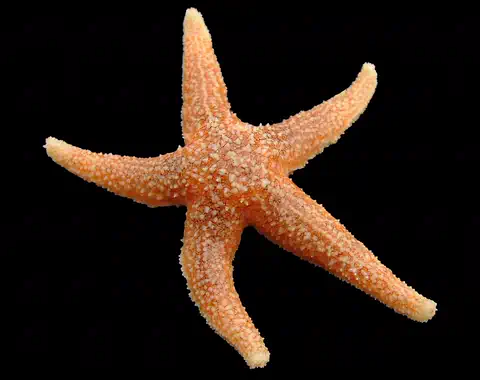
The common starfish is the most familiar starfish of the north-east Atlantic coasts. It has five arms, an eye spot at the tip of each one, and many tube feet. It can pull open a mussel shell and push its own stomach inside to eat.
-
 Watch
Animal
American lobster
The American lobster is a big crustacean that lives on the rocky sea floor of the northwest Atlantic Ocean. It has two very different claws, one for crushing and one for tearing, and it must climb out of its hard shell again and again to grow.
-
 Watch
3D
Animal
Antarctic krill
Antarctic krill are small, shrimp-like crustaceans about 6 centimeters long that live in the icy Southern Ocean around Antarctica. They gather in enormous swarms, and almost all the bigger animals of the Antarctic, from penguins to blue whales, depend on them for food.
-
 Watch
Animal
Army ant
Army ants hunt together in giant swarms and never build a permanent nest. This page is about the best-studied kind, Eciton burchellii, of Central and South American forests. Each night of its traveling phase the colony moves, and the workers link their legs to build a living camp around their queen and young.
For parents & teachers
What children will learn
- Describe the purple sea urchin's test, spines, tube feet and five-toothed mouth.
- Explain how urchins graze kelp and what an urchin barren is.
- Describe how losing predators can let a population boom.
- Understand the urchin life cycle and how long urchins can live.
Recommended ages: 3 to 17 · About 15 minutes
Talk about it
- How can losing one predator, like the sunflower sea star, change a whole kelp forest?
- Why might eating purple urchins help kelp forests?
- Why do you think urchins cover themselves with shells at low tide?
Try at home or in class
- Push toothpicks into a ball of clay to make an urchin, then add short pieces of yarn with tape tips as tube feet.
- Draw a kelp forest food chain: kelp, urchin, sea otter and sunflower sea star.
Key vocabulary: sea urchin, test, tube feet, kelp, grazer, urchin barren
Where these facts come from
- GBIF Backbone Taxonomy and GBIF Occurrence Search , Global Biodiversity Information Facility (CC0 1.0 (backbone); occurrence counts are facts derived from records under CC0, CC BY and CC BY-NC)
- Purple Sea Urchin (Marine Species Report Card) , Aquarium of the Pacific
- Strongylocentrotus purpuratus (purple sea urchin) , Animal Diversity Web, University of Michigan Museum of Zoology
- Wikidata , Wikimedia Foundation (CC0 1.0)
- Wikimedia Commons , Wikimedia Foundation (Per file: Public domain, CC0, CC BY or CC BY-SA only (credited on each page))
Checked, not yet human-reviewed. Last updated October 27, 2026. Spotted a mistake? Tell us.