
Animal
Axolotl
The axolotl is a salamander that lives in water all its life. It has feathery gills on its head, and it can grow back a lost leg.
The axolotl is a salamander from the canals and lakes of Mexico City. Unlike most amphibians, it keeps its baby features, such as feathery gills and a fin, its whole life. It can regrow lost legs and even parts of its heart, but in the wild it is critically endangered.
Ambystoma mexicanum is a paedomorphic mole salamander: it reaches adulthood while keeping larval traits such as external gills and a tail fin. Its remarkable ability to regenerate limbs and organs makes it a key research animal, yet the IUCN lists it as Critically Endangered, with an estimated 50 to 1,000 mature individuals left in the wild.
Photo: Scazon, CC BY 2.0, via Wikimedia Commons
Meet the axolotl
The axolotl is a kind of salamander.
It lives in water all its life. It has feathery gills on its head, a long tail and little legs. Its mouth looks like a smile.
The axolotl (say AX-oh-lot-ul) is a salamander, an amphibian with a long body, a tail and four short legs. Unlike most salamanders, the axolotl stays a water animal all its life. It keeps its feathery gills, its tail fin and its life in the water even when it is grown up.
Keeping baby features as an adult is called neoteny. Axolotls grow to about 23 centimeters long on average, and some reach 30 centimeters. It is sometimes called the Mexican walking fish, but it is not a fish at all.
Ambystoma mexicanum belongs to the mole salamanders, family Ambystomatidae, and its closest relative is the tiger salamander. It is paedomorphic, or neotenic: it becomes sexually mature while keeping larval traits, including external gills, a tail with a fin running from the back of the head to the tip, and no movable eyelids.
Britannica gives adult length as about 25 centimeters; San Diego Zoo Wildlife Alliance says axolotls can reach 30 centimeters but average about 23. National Geographic suggests one explanation for its neoteny: its home lakes did not dry up, so it never needed to trade aquatic features for land ones.
Quick facts
- Group
- Amphibian
- Length
- up to 30 cm
- Lifespan in the wild
- 5 to 6 years
Where it lives
Wild axolotls live in Mexico.
They live in canals and lakes in Mexico City, one of the biggest cities in the world. They hide in mud and water plants.
Wild axolotls live in just one small area: the canals and lakes of Xochimilco and Chalco on the southern edge of Mexico City. Long ago they lived in a whole series of lakes and marshes in the Valley of Mexico.
Most of that water was drained to make room for the growing city. Today the remaining axolotls live in still, fresh water, where they hide among water plants and in the muddy bottom during the day.
The IUCN records the species only in Mexico City, at three locations, and describes the population as severely fragmented. San Diego Zoo Wildlife Alliance explains that it is native to lakes Xochimilco and Chalco in the southern Basin of Mexico, where marshes, swamps and lagoons once covered about 200 square kilometers before drainage projects shrank them.
Axolotls are lentic animals, living in still water. National Geographic notes that they now survive mainly in a few canals in the area. Britannica describes the species as found only in Lake Xochimilco; sources differ on whether a population persists at Chalco.
Continent
Its habitat

Where can you find this animal?
- Lives here naturally · Countries and seas named by a scientific source
- Sightings recorded · Records of wild sightings (GBIF)
Lives here naturally · Countries and seas named by a scientific source
Only a few canals and lake remnants of Xochimilco (and possibly Chalco) on the southern edge of Mexico City. The species once lived in a larger system of lakes in the Valley of Mexico. It lives in a tiny part of the country shown.
Places: Mexico.
Source: iucn-red-list · checked October 2026
Sightings recorded · Records of wild sightings (GBIF)
Counts of GBIF records of wild observations (human and machine) and preserved specimens. Records include introduced populations, vagrants, escaped or released animals and misidentifications, so a country with records is not necessarily part of the native range.
Wild sightings have been recorded in Mexico, UK, Canada, Germany, United States, Brazil, New Zealand, Austria and 2 more places.
Source: gbif · checked October 2026
Range maps show where scientists say an animal lives, often country by country. An animal may live in only part of a country shown, and sightings records can include animals that wandered far from home.
What it eats
Axolotls hunt at night.
They suck up worms, snails, bugs and tiny fish. Whoosh! Dinner goes in like a vacuum cleaner.
Axolotls may look gentle, but they are good hunters. They come out at night and eat worms, snails and other mollusks, crustaceans, insect larvae and small fish.
They feed by suction: they open their mouths quickly and suck their prey in, like a vacuum cleaner. Sometimes they swallow bits of gravel too. The gravel can help grind up food in their stomachs, a bit like the grit birds swallow.
Axolotls are nocturnal predators of small aquatic animals. Sources list worms, mollusks, crustaceans, insect larvae and eggs, tadpoles and small fish, and Britannica notes that they also eat other axolotls. Their teeth are undeveloped, and they capture prey by suction feeding, sucking it in with a rush of water.
Gravel swallowed with prey may help break food down in the stomach, which San Diego Zoo compares to the grit used by birds. During the day they bury themselves in mud and vegetation, avoiding predators such as herons, storks and large fish.
Did you know?
The axolotl is called a walking fish, but it is not a fish.
Axolotls are sometimes called Mexican walking fish, but they are amphibians, not fish.
Despite the popular name Mexican walking fish, the axolotl is a salamander, an amphibian in the order Caudata.
Gills, fins and superpowers
Look at the axolotl's head. Those feathery parts are gills for breathing in water.
If an axolotl loses a leg, it can grow a new one!
The feathery stalks on each side of an axolotl's head are gills. They take oxygen from the water. Axolotls also have lungs and sometimes swim up to gulp air, and they can breathe through their skin too.
Their most famous trick is regeneration, growing back lost body parts. An axolotl can regrow a lost leg in a few weeks, with new bone, muscle and skin and no scar. It can also repair parts of its heart, spine and even brain.
External gill stalks on each side of the head, fringed with fine filaments, extract oxygen from water; adults also have functional lungs and exchange gases through the skin. In the wild axolotls are dark, grayish brown with black speckles, and they can shift a few shades lighter or darker. Albino, white and other color forms are common, and pale axolotls are usually bred in captivity.
Regeneration is why biologists study them. San Diego Zoo reports that an axolotl can regrow a limb perfectly five times over, in a few weeks and without a scar, replacing skin, bone, cartilage and muscle, and National Geographic lists hearts, spinal cords and parts of the brain. A 2025 study reported by National Geographic linked an enzyme and a gene working with retinoic acid to growing the right part in the right place.
A life without changing shape
A mother axolotl lays her eggs one by one on plants.
The babies hatch and swim away. They grow bigger but keep their gills, even as grown-ups.
Axolotls court with a kind of dance, swaying and shaking their tails. Then the female lays her eggs one at a time on water plants or rocks, where they are safer from predators. She can lay up to 1,000 eggs, though about 300 is more usual.
About two weeks later the young hatch and swim off on their own. Their parents do not look after them. A frog tadpole changes shape completely, but a young axolotl just grows bigger, keeping its gills and fin.
Courtship involves a tail-waving display, after which the male deposits a spermatophore, a sperm packet, that the female takes up with her cloaca. She lays her eggs individually on plants or rocks: National Geographic gives up to 1,000 with an average of about 300, and San Diego Zoo 300 to 1,000. Eggs hatch after about two weeks, and there is no parental care.
Larvae grow directly into gilled adults without metamorphosis. Sources differ on timing: San Diego Zoo gives maturity at about six months and a breeding season from March to June, while National Geographic gives maturity at a year and wild spawning in February. Lifespan figures differ too: Britannica gives about five or six years in the wild and up to 15 in captivity, while National Geographic gives 10 to 15 years in the wild.

Quiet life on the lake bottom
Axolotls like to be alone.
In the day, they hide in mud and plants. At night, they come out to look for food.
Axolotls are solitary, which means they mostly live alone. During the day they stay hidden in mud or among water plants, safe from herons and big fish. At night they wake up and go hunting.
Their short legs carry them along the lake bottom. But if they need to, they can dash away surprisingly fast, as fast as about 15 kilometers per hour for a moment.
Little is known about the behavior of wild axolotls, because the remaining populations are small and hard to study; much of what is known comes from captive animals, San Diego Zoo notes. They are solitary and largely nocturnal, sheltering by day in mud and vegetation.
Axolotls walk along the lake bottom on lizard-like limbs, and San Diego Zoo reports short bursts of about 15 kilometers per hour. Their dark coloring matches the murky lake bed and can lighten or darken for camouflage. National Geographic notes that males may find females using chemical signals called pheromones.
Did you know?
Axolotls first came to Paris more than 150 years ago.
Axolotls were brought from Mexico to Paris in 1864. People in Europe began breeding them, and now they are kept all around the world.
The first axolotls brought to Paris in 1864 founded a long tradition of captive breeding, and the species breeds readily in captivity.
Saving the wild axolotl
There are very few wild axolotls left.
Their water got dirty, and new fish came that eat their food and babies. People are cleaning the canals to help them.
Many axolotls live in aquariums and labs around the world, but the wild ones are critically endangered. Only about 50 to 1,000 grown-up axolotls may be left in the wild.
Their lakes have been drained and polluted as Mexico City grew, and fish brought in from elsewhere, such as tilapia and carp, compete with them and eat them. People are making refuges in the canals by putting in water filters and keeping the non-native fish out, and farmers are using traditional methods without chemicals to keep the water clean.
The IUCN assessed the axolotl in 2019 as Critically Endangered, with 50 to 1,000 mature individuals, a decreasing and severely fragmented population, and continuing loss of habitat. Listed threats include urban and tourism development, harvesting, invasive species, and pollution from household, industrial and agricultural waste water and garbage.
San Diego Zoo Wildlife Alliance describes conservation refuges in Xochimilco's canals, where water filters are installed and non-native fish such as tilapia are excluded, and farmers returning to traditional methods without pesticides or fertilizers. International trade is controlled, and National Geographic notes it is restricted in most countries partly because of poaching concerns.
IUCN Red List
How is the axolotl doing in the wild?
- Least Concern
- Near Threatened
- Vulnerable
- Endangered
- Critically Endangered (this animal)
- Extinct in the Wild
- Extinct
Critically Endangered
At extremely high risk of disappearing from the wild.
See the IUCN Red List assessment · The IUCN Red List of Threatened Species 2022.2
Amazing facts
-
An axolotl can grow back a lost leg.
An axolotl can regrow a lost leg in a few weeks, with new skin, bone and muscle, and no scar.
Limb regeneration replaces every tissue, including skin, bone, cartilage and muscle; San Diego Zoo reports that a limb can be regrown perfectly five times, with no scar.
-
Axolotls sometimes swallow little stones.
Axolotls sometimes suck up gravel with their food. The gravel helps grind up food in their stomachs.
Ingested gravel may aid digestion by grinding food, comparable to the grit used by birds.
-
The axolotl is called a walking fish, but it is not a fish.
Axolotls are sometimes called Mexican walking fish, but they are amphibians, not fish.
Despite the popular name Mexican walking fish, the axolotl is a salamander, an amphibian in the order Caudata.
-
Axolotls first came to Paris more than 150 years ago.
Axolotls were brought from Mexico to Paris in 1864. People in Europe began breeding them, and now they are kept all around the world.
The first axolotls brought to Paris in 1864 founded a long tradition of captive breeding, and the species breeds readily in captivity.
Words to know
- salamander
- an amphibian with a long body, a tail and four legs
- gills
- body parts that take oxygen from water
- neoteny
- keeping young features, like gills, as an adult
- regeneration
- growing back a body part that was lost or hurt
- critically endangered
- at very high risk of disappearing from the wild
- non-native
- a plant or animal brought by people to a place where it did not live before
Discovery challenge
-
What are the feathery parts on an axolotl's head?
What are the feathery stalks on the sides of an axolotl's head?
What are the axolotl's feathery head structures, kept from its larval stage?
- Ears
- Gills for breathing in water
- Horns
Show the answer
Gills for breathing in water
They are gills. They help the axolotl breathe under water.
They are gills, which take oxygen from the water. Axolotls keep them all their lives.
External gills, a larval trait retained in this paedomorphic salamander; adults also have functional lungs.
-
If an axolotl loses a leg, what can it do?
What can an axolotl do if it loses a leg?
What can an axolotl do after losing a limb?
- Grow a new one
- Nothing at all
- Turn into a frog
Show the answer
Grow a new one
It can grow a brand new leg!
It can regrow the leg in a few weeks, with new bone, muscle and skin, and no scar.
It regenerates the limb completely, replacing every tissue type without scarring.
-
Where do wild axolotls live?
Where do axolotls live in the wild?
Which describes the axolotl's wild range today?
- The Amazon River
- The Arctic Ocean
- Canals and lakes in Mexico City
Show the answer
Canals and lakes in Mexico City
Wild axolotls live in Mexico City, in Mexico.
They live only in a few canals and lakes at the southern edge of Mexico City.
The IUCN records only three locations, all in Mexico City, chiefly the canals of Xochimilco.
-
What color are most wild axolotls?
What color are most axolotls in the wild?
What is the usual coloring of wild axolotls?
- Grayish brown
- Bright pink
- White with blue spots
Show the answer
Grayish brown
Wild ones are brown and gray. Pale ones are usually pets.
Wild axolotls are mostly grayish brown with dark speckles. White and pink ones are usually bred as pets.
Wild axolotls are dark brown or grayish brown with black speckling; pale forms are common in captivity.
Places where you might see it
-
 Watch
 Country
Mexico
Mexico is a large country in southern North America, between the Pacific Ocean and the Gulf of Mexico. It has smoking volcanoes, ancient cities built by the Maya and other peoples, and about 132 million people, many of them in and around Mexico City.
-
 Watch
Life around the world
Floating gardens of Xochimilco, Mexico City
Xochimilco, in the south of Mexico City, still has chinampas: long garden islands built up from lake mud, branches and plants, edged with willow trees and surrounded by canals. Farmers have worked them since Aztec times. UNESCO lists Xochimilco as World Heritage, and FAO named the chinampa system an agricultural heritage site in 2017.
Experiments to try
- Watch What If? Lab What if you could regrow a hand? Axolotls, salamanders from Mexico, can regrow whole legs, and even parts of their hearts and brains. Our bodies can heal too: skin grows back over a scrape and broken bones knit together. But we can't regrow a hand. Discover how axolotls do it, what our own bodies can regrow, and what scientists are learning.
- Watch What If? Lab What if you had gills? Fish don't breathe water itself: their gills take tiny amounts of oxygen gas out of the water. Air is about one fifth oxygen, but water holds only a few oxygen molecules in every million. Imagine growing gills, and find out how fish, and the smiling axolotl, get enough oxygen.
Explore next
-
 Watch
Animal
Eastern tiger salamander
The eastern tiger salamander is one of North America's biggest land salamanders: dark and shiny, with yellow or olive blotches. It spends most of its life in burrows, then walks to fishless ponds on rainy nights to lay its eggs. Its babies live in water and breathe with feathery gills.
-
 Watch
Animal
Olm
The olm is a long, pale salamander that spends its whole life in underground rivers and lakes in the caves of southeastern Europe. Its eyes are covered by skin, it keeps pink feathery gills all its life, and it finds food by smell and by feeling vibrations. Olms can live for many decades and survive years without eating.
-
 Watch
Animal
Common frog
The common frog is a familiar frog of ponds and gardens across Europe. It spends most of the year in damp grass, gardens and woods, and every spring it returns to ponds to lay clumps of frogspawn that grow into tadpoles and then little froglets.
-
Watch
Country
Mexico
Mexico is a large country in southern North America, between the Pacific Ocean and the Gulf of Mexico. It has smoking volcanoes, ancient cities built by the Maya and other peoples, and about 132 million people, many of them in and around Mexico City.
-
 Watch
Animal
Panamanian golden frog
The Panamanian golden frog is a small, bright yellow toad with black patches from the forest streams of Panama. Males wave their arms to talk to each other. A disease caused by the chytrid fungus wiped out the wild frogs, and none has been seen in the wild since 2009, so zoos and scientists are caring for golden frogs and working to return them to nature one day.
-
 Watch
Animal
Japanese giant salamander
The Japanese giant salamander is one of the biggest salamanders in the world, growing up to 1.5 meters long. It lives its whole life in cool, clear rivers in Japan, breathes mostly through its wrinkly skin, and the fathers guard the eggs and babies for months.
-
 Watch
3D
Animal
West Indian Ocean coelacanth
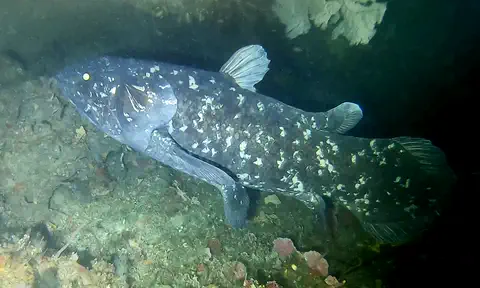
The West Indian Ocean coelacanth is a large, blue, spotted fish that lives in deep, rocky waters off eastern Africa. Its group was known only from fossils and thought to have died out about 66 million years ago, until a living one was found in South Africa in 1938.
-
Watch
Life around the world
Floating gardens of Xochimilco, Mexico City
Xochimilco, in the south of Mexico City, still has chinampas: long garden islands built up from lake mud, branches and plants, edged with willow trees and surrounded by canals. Farmers have worked them since Aztec times. UNESCO lists Xochimilco as World Heritage, and FAO named the chinampa system an agricultural heritage site in 2017.
For parents & teachers
What children will learn
- Explain neoteny: why an adult axolotl still has gills and a fin.
- Describe regeneration and why scientists study axolotls.
- Compare the axolotl's life cycle with a frog's metamorphosis.
- Understand why the wild axolotl is critically endangered and how people are helping.
Recommended ages: 3 to 17 · About 15 minutes
Talk about it
- How is an axolotl's life cycle different from a frog's?
- Why might a city be a hard place for a wild animal to live?
- Many axolotls live in aquariums. Why does it still matter to save the wild ones?
Try at home or in class
- Draw an axolotl and a frog side by side, and label what each keeps or loses as it grows up.
- Measure 23 centimeters on a ruler and compare it with your hand to see how long an axolotl is.
Key vocabulary: salamander, gills, neoteny, regeneration, critically endangered, non-native
Where these facts come from
- The IUCN Red List of Threatened Species , International Union for Conservation of Nature (IUCN terms of use (no redistribution of Red List data or range maps))
- GBIF Backbone Taxonomy and GBIF Occurrence Search , Global Biodiversity Information Facility (CC0 1.0 (backbone); occurrence counts are facts derived from records under CC0, CC BY and CC BY-NC)
- Ambystoma mexicanum (Axolotl), 2019 global assessment , IUCN Red List of Threatened Species
- Axolotl , San Diego Zoo Wildlife Alliance
- Axolotl , Encyclopaedia Britannica
- Axolotl , National Geographic
- Wikidata , Wikimedia Foundation (CC0 1.0)
- Wikimedia Commons , Wikimedia Foundation (Per file: Public domain, CC0, CC BY or CC BY-SA only (credited on each page))
Checked, not yet human-reviewed. Last updated October 24, 2026. Spotted a mistake? Tell us.