
Animal
Philippine tarsier
The Philippine tarsier is a tiny animal with giant eyes. It can jump very far. It hunts bugs at night.
The Philippine tarsier is a tiny primate that lives only on islands in the southeastern Philippines. For its size, it has the biggest eyes of any mammal: each eye is heavier than its brain. At night it clings to thin stems, then leaps out to grab insects and other small animals.
Carlito syrichta is a nocturnal, wholly carnivorous haplorhine primate endemic to the Mindanao faunal region of the Philippines (Bohol, Samar, Leyte, Mindanao and nearby islands). Its enormous eyes, elongated tarsal bones and adhesive finger pads suit a life of vertical clinging and leaping. It is listed as Near Threatened (IUCN, 2020).
Photo: Charles J. Sharp, CC BY-SA 4.0, via Wikimedia Commons
Meet the tarsier
The tarsier is a very small animal.
It has huge round eyes and big ears. Its fingers are long and thin.
The Philippine tarsier is one of the smallest primates on Earth. Its body is only about 11 to 13 centimeters long, its thin tail is about twice that, and it weighs around 110 to 130 grams.
What you notice first are its eyes. For its size, a tarsier has the biggest eyes of any mammal; each eye is heavier than its brain. Its big ears stick straight out, its soft fur is gray to yellowish-brown, and its long, thin fingers end in round pads.
Carlito syrichta measures about 8.5 to 16 centimeters head-and-body with a roughly 25-centimeter tail and weighs about 80 to 165 grams (Animal Diversity Web); the New England Primate Conservancy gives typical figures of 11 to 13 centimeters and 110 to 130 grams. The sexes look alike.
Relative to body size its eyes are the largest of any mammal, each heavier than the brain. Tarsiers are haplorhines, grouped with monkeys and apes rather than lemurs, but placed in their own infraorder, Tarsiiformes. Whether the Philippine tarsier deserves its own genus, Carlito, and how many subspecies exist are still debated.
Quick facts
- Group
- Mammal
- Length
- 8.5 to 16 cm
- Weight
- 80 to 165 g
- Lifespan in the wild
- up to 13 years
Where it lives
Tarsiers live only in the Philippines.
They live on a few islands, in forests with lots of small trees and bushes.
Philippine tarsiers live only in the southeastern Philippines, on islands such as Bohol, Samar, Leyte and Mindanao. Long ago, when the sea was lower, these islands were joined, and they still share many of the same animals.
Tarsiers live in rainforest up to about 750 meters above sea level. They like thick, low plants: small trees, tall grasses, bushes and bamboo. They can live in forest edges and regrowing forest, but fewer tarsiers live there.
The species is endemic to the Mindanao faunal region, chiefly Samar, Leyte, Bohol and Mindanao (Animal Diversity Web). About 20,000 years ago lower sea levels joined these islands into larger landmasses, which is why they share a fauna (New England Primate Conservancy). Three subspecies are often named: C. s. syrichta (Leyte and Samar), C. s. fraterculus (Bohol) and C. s. carbonarius (Mindanao).
Tarsiers occur in rainforest to about 750 meters and tolerate edge and secondary forest, though at lower densities. They favor dense, low vegetation, small trees, grasses and bamboo, and usually stay within about one to two meters of the ground. Fossil tarsiers once lived in Europe, Africa, Asia and North America.
Continent
Its habitat

Where can you find this animal?
- Lives here naturally · Countries and seas named by a scientific source
- Sightings recorded · Records of wild sightings (GBIF)
Lives here naturally · Countries and seas named by a scientific source
Rainforest and dense, low secondary growth on Bohol, Samar, Leyte, Mindanao and nearby islands in the southeastern Philippines. It does not live on the northern and western Philippine islands.
Places: Philippines.
Source: iucn-red-list · checked October 2026
Sightings recorded · Records of wild sightings (GBIF)
Counts of GBIF records of wild observations (human and machine) and preserved specimens. Records include introduced populations, vagrants, escaped or released animals and misidentifications, so a country with records is not necessarily part of the native range.
Wild sightings have been recorded in Philippines, Indonesia, United States, Japan and Sweden.
Source: gbif · checked October 2026
Range maps show where scientists say an animal lives, often country by country. An animal may live in only part of a country shown, and sightings records can include animals that wandered far from home.
A meat-eating primate
Tarsiers only eat animals.
They catch bugs, spiders and sometimes little lizards. They never eat fruit or leaves.
Most primates eat at least some fruit or leaves, but tarsiers eat no plants at all. They are the only primates that eat only animals.
A tarsier waits quietly on a stem, watching and listening. When it spots an insect or spider, it leaps and grabs it with its hands. It also catches frogs, lizards and even small birds. In the dry season, when food is harder to find, it probably spends more time hunting.
Tarsiers are the only fully carnivorous primates, eating no plant material (New England Primate Conservancy). The Philippine tarsier takes mainly insects, plus spiders, frogs, lizards and small birds (Animal Diversity Web).
In spectral tarsiers of Sulawesi, foraging takes about 55 percent of waking time, travel 23 percent, rest 16 and social activity 6; Philippine tarsiers likely spend their nights similarly, foraging and traveling more in the dry season. Hunting relies on acute vision and hearing and a sudden leap to seize prey by hand.
Did you know?
Long ago, tarsiers lived in many parts of the world.
Fossils show that tarsiers once lived in Europe, Africa, Asia and North America; now they live only on islands in Southeast Asia.
Fossil tarsiers are known from Europe, northern Africa, Asia and North America; living species are restricted to island Southeast Asia.
Giant eyes, jumping legs
Tarsiers cannot move their big eyes.
So they turn their whole head to look around. Their strong back legs help them jump far.
A tarsier's eyes are so big that they cannot move in their sockets. Instead, a tarsier can turn its head almost halfway around, like an owl. Most night animals have a shiny layer in their eyes to collect light, but tarsiers do not, so their huge eyes do the job.
Two bones in each foot, called tarsals, are very long. That is where the tarsier gets its name. With these long legs it can leap about 6 meters, and sticky pads on its fingers and toes help it land and hold on.
The eyes are fixed in their sockets, so a specialized neck lets the head rotate nearly 180 degrees. Tarsiers lack a tapetum lucidum, the reflective layer most nocturnal mammals use, and instead rely on sheer eye size (New England Primate Conservancy).
Two greatly elongated tarsal bones in each foot give the group its name; the hind legs, with their muscles, make up about a quarter of body mass and power leaps of up to about 6 meters. Long fingers and toes end in swollen adhesive pads, each foot bears grooming claws, and the thin tail is almost hairless, used as a prop while clinging vertically.
A quick start
A mother tarsier has one baby.
The baby is born with fur and open eyes. It can climb when it is two days old!
A mother tarsier has a single baby after about six months. The baby is born with fur and with its eyes open, and it grows up fast.
At two days old it can climb, and two days later it can jump, though it stays close to its mother. She carries it in her mouth or on her belly. At about 19 days old it moves almost as well as an adult, and at about 45 days it catches its own food and stops drinking milk.
Philippine tarsiers are probably monogamous and breed year-round, perhaps more when insects are plentiful. A single infant is born after about six months (about 179 days); it is fully furred with open eyes (New England Primate Conservancy; Animal Diversity Web).
Infants climb at two days and leap at four, are carried in the mother's mouth or on her belly, move almost like adults at about 19 days, and catch prey and are weaned at about 45 days. Females have several pairs of nipples but nurse with one. Infant mortality is high in the wild and in captivity. The oldest known tarsier lived about 13 years in captivity.
Night life
Tarsiers sleep in the day, hidden in thick plants.
At night they wake up to hunt. They squeak when they are scared.
Tarsiers are nocturnal. In the day they sleep hidden in thick plants close to the ground, and at night they come out to hunt. They spend most of their time clinging upright to thin stems.
They usually live in pairs, a male and a female, sometimes with young. Each pair has a small home range of about one or two hectares, about the size of two or three soccer fields. Tarsiers are quieter than most primates, but they squeak when in danger and use smell marks to say "this is my place".
Fully arboreal and nocturnal, tarsiers sleep in dense vegetation near the ground, usually near the edge of the home range, using three or four regular sleeping sites. They cling vertically, leap rather than walk, and move almost silently (New England Primate Conservancy).
They are most often seen in male-female pairs, sometimes in groups of about four, in home ranges of 1 to 2 hectares that overlap with the opposite sex but little with the same sex. Females travel about 1,100 meters a night and males about 1,600. Males are strongly territorial. Calls maintain territory and pair contact, a high squeak signals danger, and urine and gland scent marks are used extensively.
Did you know?
The tarsier is named after the long bones in its feet.
The name tarsier comes from the tarsal bones in its feet, which are extra long for jumping.
"Tarsier" refers to the greatly elongated tarsal bones of the foot.
Protecting tarsiers
Tarsiers need their forests.
They need quiet places to sleep in the daytime. The best way to see one is quietly, in a safe place.
The Philippine tarsier is listed as Near Threatened. Little untouched forest is left where it lives, and fewer tarsiers live in damaged forest. Some are caught and sold as pets, even though that is against the law, and they rarely live long as pets.
Tourism can help, because visitors make local people proud of tarsiers. But some places catch wild tarsiers to show visitors in the daytime, when they should be asleep. Tarsiers are protected by law in the Philippines.
The IUCN lists Carlito syrichta as Near Threatened (Shekelle, 2020). Very little primary habitat remains, densities are lower in disturbed forest, the range is small, and high infant mortality slows recovery. Declining insect abundance may also reduce food (New England Primate Conservancy).
Illegal capture for the pet trade continues; captive tarsiers need large amounts of live insects and often do poorly. Tourism has raised local support but also drives wild capture for daytime displays. The species is protected under Philippine law and listed in CITES Appendix II; captive breeding has mostly failed, so protecting wild habitat matters most.
IUCN Red List
How is the philippine tarsier doing in the wild?
- Least Concern
- Near Threatened (this animal)
- Vulnerable
- Endangered
- Critically Endangered
- Extinct in the Wild
- Extinct
Near Threatened
Not at risk yet, but it could be soon.
See the IUCN Red List assessment · The IUCN Red List of Threatened Species 2022.2
Amazing facts
-
If your eyes were as big as a tarsier's, they would be as big as grapefruits!
If a person's eyes were as big for their body as a tarsier's, each would be about the size of a grapefruit.
Scaled to human body size, tarsier eyes would be roughly grapefruit-sized.
-
The tarsier is named after the long bones in its feet.
The name tarsier comes from the tarsal bones in its feet, which are extra long for jumping.
"Tarsier" refers to the greatly elongated tarsal bones of the foot.
-
Tarsiers never eat fruit or leaves.
Tarsiers are the only primates that eat no plants at all.
Tarsiers are the only fully carnivorous primates.
-
Long ago, tarsiers lived in many parts of the world.
Fossils show that tarsiers once lived in Europe, Africa, Asia and North America; now they live only on islands in Southeast Asia.
Fossil tarsiers are known from Europe, northern Africa, Asia and North America; living species are restricted to island Southeast Asia.
Words to know
- nocturnal
- active at night and asleep during the day
- carnivore
- an animal that eats other animals
- endemic
- found naturally in only one place in the world
- tarsal bones
- bones in the ankle and foot
- primate
- the group of mammals that includes tarsiers, lemurs, monkeys, apes and people
Discovery challenge
-
How does a tarsier look behind itself?
Tarsiers cannot move their eyes. How do they look around?
How do tarsiers compensate for eyes fixed in their sockets?
- It turns its head almost all the way around
- It closes one eye
- It walks backward
Show the answer
It turns its head almost all the way around
It turns its head, like an owl.
It turns its head almost 180 degrees, like an owl.
Neck rotation of nearly 180 degrees replaces eye movement.
-
What does a tarsier eat?
What kind of food does a Philippine tarsier eat?
What is unusual about the tarsier's diet among primates?
- Only animals, like bugs and lizards
- Only fruit
- Only leaves
Show the answer
Only animals, like bugs and lizards
It eats bugs, spiders and small animals.
Only animals: insects, spiders, frogs, lizards and small birds.
It is fully carnivorous, the only primate group that eats no plants.
-
Where do Philippine tarsiers live?
Where in the world do Philippine tarsiers live?
Where is Carlito syrichta endemic?
- Islands in the Philippines
- The Amazon rainforest
- Deserts in Africa
Show the answer
Islands in the Philippines
On a few islands in the Philippines.
Only on islands in the southeastern Philippines, such as Bohol and Mindanao.
The Mindanao faunal region: Samar, Leyte, Bohol, Mindanao and nearby islands.
-
How old is a baby tarsier when it starts to climb?
How soon after birth can a baby tarsier climb?
At what age do infant tarsiers begin climbing?
- About 2 days
- About 2 years
- About 2 months
Show the answer
About 2 days
Just two days old!
About two days: it is born with fur and open eyes, ready to go.
About two days; infants are precocial and leap by four days.
Places where you might see it
Explore next
-
 Watch
Animal
Sunda slow loris
The Sunda slow loris is a small primate from the rainforests of Southeast Asia. It comes out at night, creeping slowly through the branches with a super-strong grip, and licks sap, nectar and gum from trees. It is one of very few venomous mammals, and it is Endangered because so many are caught for the pet trade.
-
 Watch
3D
Animal
Ring-tailed lemur
The ring-tailed lemur is a primate that lives only on Madagascar, a big island off the coast of Africa. It has a striped tail with 13 black and white rings, sunbathes with its arms spread wide, and lives in groups where the females are in charge.
-
 Watch
 Country
Philippines
The Philippines is an island country in Southeast Asia, in the western Pacific Ocean. It has more than 7,000 islands, about 50 volcanoes and rich coral reefs, and about 112.7 million people were counted there in 2024.
-
 Watch
Animal
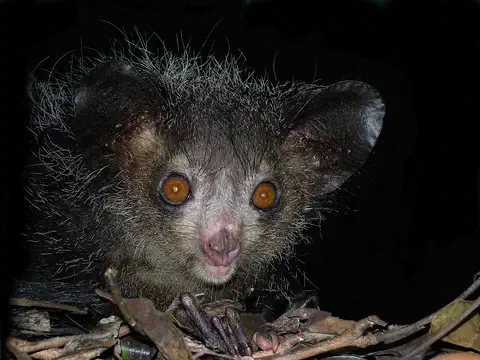
Aye-aye
The aye-aye is a lemur from Madagascar, and the largest primate that is active at night. It taps on branches with its long, skinny middle finger, listens with its enormous ears for hidden grubs, then bites into the wood and hooks them out.
-
 Watch
Animal
Aardvark
The aardvark is a shy night digger of African savannas. It sniffs out ant and termite nests, rips them open with its spade-like claws and laps up the insects with a sticky tongue about 30 centimeters long. Its name means 'earth pig' in Afrikaans.
-
 Watch
Animal
African buffalo
The African buffalo is a huge, cow-like grazer with heavy, curving horns. It lives in herds that can number in the thousands, and a herd will rush to protect a calf in danger. It lives across much of Africa south of the Sahara, from open savannas to rainforests.
-
 Watch
Animal
African forest elephant
The African forest elephant is a separate species from the bigger bush elephant. It lives in the rainforests of central and western Africa, eats lots of fruit and spreads the seeds of forest trees in its dung. It is Critically Endangered.
-
 Watch
3D
Animal
African wild dog
The African wild dog, or painted dog, has a patchy coat unlike any other dog's, big round ears and only four toes on its front feet. It lives in close packs that hunt together, share food and care for the pups. It is endangered: the IUCN estimated in 2025 that only about 1,676 adults are left in the wild.
For parents & teachers
What children will learn
- Explain how big eyes and ears help a nocturnal hunter.
- Describe how the tarsier's legs and feet are built for leaping.
- Understand what endemic means, using the Philippine islands as an example.
- Discuss how tourism can both help and harm wild animals.
Recommended ages: 3 to 17 · About 15 minutes
Talk about it
- Why do you think tarsiers have such big eyes instead of a shiny layer like a cat's?
- How could visitors watch tarsiers without disturbing them?
- Why might an animal that lives on only a few islands be at extra risk?
Try at home or in class
- Keep your eyes still and look around the room by turning only your head, like a tarsier: how far can you turn?
- Measure 6 meters with a tape measure and mark it: that is how far a tarsier about the size of your hand can leap.
Key vocabulary: nocturnal, carnivore, endemic, tarsal bones, primate
Where these facts come from
- GBIF Backbone Taxonomy and GBIF Occurrence Search , Global Biodiversity Information Facility (CC0 1.0 (backbone); occurrence counts are facts derived from records under CC0, CC BY and CC BY-NC)
- The IUCN Red List of Threatened Species , International Union for Conservation of Nature (IUCN terms of use (no redistribution of Red List data or range maps))
- Philippine tarsier, Carlito syrichta , New England Primate Conservancy
- Tarsius syrichta (Philippine tarsier) , Animal Diversity Web, University of Michigan
- Carlito syrichta: IUCN Red List global assessment record (Shekelle 2020), IUCN checklist on GBIF , GBIF
- Carlito syrichta (Philippine Tarsier), Shekelle 2020, global assessment , IUCN Red List of Threatened Species
- Wikidata , Wikimedia Foundation (CC0 1.0)
- Wikimedia Commons , Wikimedia Foundation (Per file: Public domain, CC0, CC BY or CC BY-SA only (credited on each page))
Checked, not yet human-reviewed. Last updated November 1, 2026. Spotted a mistake? Tell us.