
Animal
Sunda slow loris
The Sunda slow loris is a small, furry animal with huge round eyes. It wakes up at night. It climbs slowly and quietly through the trees.
The Sunda slow loris is a small primate from the rainforests of Southeast Asia. It comes out at night, creeping slowly through the branches with a super-strong grip, and licks sap, nectar and gum from trees. It is one of very few venomous mammals, and it is Endangered because so many are caught for the pet trade.
Nycticebus coucang is a nocturnal strepsirrhine of the Malay Peninsula, southern Thailand, Singapore and Sumatra. A slow-climbing gum and nectar feeder with a venomous bite produced by glands on its arms, it is listed as Endangered (IUCN, 2020); deforestation, the illegal pet trade and hybridization with released lorises are the main threats.
Photo: Lucie Čižmářová, The Kukang Rescue Program, CC BY-SA 4.0, via Wikimedia Commons
Meet the slow loris
The slow loris is small and furry.
It has very big, round eyes with dark rings. A white stripe runs down its nose.
The Sunda slow loris is about as heavy as a big bottle of water, around 600 to 700 grams, and its head and body are 27 to 38 centimeters long. It has almost no tail.
Its thick, short fur is brown, with a darker stripe down its back that splits in two on top of its head. Dark rings circle its huge eyes, and a white stripe runs from its nose up between them. Its little round ears are almost hidden in its fur.
Nycticebus coucang weighs about 599 to 685 grams, with no size difference between the sexes, and measures 27 to 38 centimeters head-and-body (Animal Diversity Web). The tail is vestigial, a short furry stub.
The dense brown pelage has a darker dorsal stripe that forks over the crown toward the eyes. Large eyes sit in dark rings, separated by a pale stripe from the nose to the forehead; the muzzle is short with a moist rhinarium. Lorises are strepsirrhine primates, related to lemurs and galagos, not to sloths, although an early description in 1770 called this animal a kind of sloth (New England Primate Conservancy).
Quick facts
- Group
- Mammal
- Length
- 27 to 38 cm
- Weight
- 599 to 685 g
- Lifespan in the wild
- up to 20 years
Where it lives
Slow lorises live in Southeast Asia.
They live in warm rainforests. Some live in parks and gardens too.
Sunda slow lorises live in Southeast Asia: on the Malay Peninsula in Malaysia and southern Thailand, in Singapore, and on the Indonesian island of Sumatra and some small islands nearby.
They like tall rainforest best, but they can also live in logged forest, swamp forest, plantations, parks and even gardens. In the day they sleep curled up in trees, hidden in leaves and vines, from about 2 to 35 meters above the ground.
The range covers Peninsular Malaysia and Pulau Tioman, southern Thailand south of the Isthmus of Kra, Singapore, and in Indonesia Sumatra, the Riau Archipelago and North Natuna islands, from sea level to about 1,300 meters (Animal Diversity Web; New England Primate Conservancy). Lorises on Borneo belong to other species.
It uses primary and secondary lowland rainforest, swamp forest and logged forest, and also persists in plantations, scrub and gardens. Home ranges of about 2 to 15 hectares are smaller in primary forest. Some southern Thai animals may be hybrids with the Bengal slow loris, and Natuna lorises may need reclassifying.
Continent
Its habitat

Where can you find this animal?
- Lives here naturally · Countries and seas named by a scientific source
- Sightings recorded · Records of wild sightings (GBIF)
Lives here naturally · Countries and seas named by a scientific source
Rainforest and forest edges of Peninsular Malaysia (not Malaysian Borneo), southern Thailand south of the Isthmus of Kra, and Sumatra and nearby Riau and North Natuna islands in Indonesia. It also lives in Singapore, which is too small to show on this map.
Places: Malaysia, Thailand and Indonesia.
Source: iucn-red-list · checked October 2026
Sightings recorded · Records of wild sightings (GBIF)
Counts of GBIF records of wild observations (human and machine) and preserved specimens. Records include introduced populations, vagrants, escaped or released animals and misidentifications, so a country with records is not necessarily part of the native range.
Wild sightings have been recorded in Malaysia, Indonesia, Thailand, United States, Myanmar, Philippines, India, Japan and 10 more places.
Source: gbif · checked October 2026
Range maps show where scientists say an animal lives, often country by country. An animal may live in only part of a country shown, and sightings records can include animals that wandered far from home.
Sap, nectar and bugs
Slow lorises lick sweet sap and nectar.
They also eat fruit and catch bugs with their hands.
Slow lorises have a sweet tooth. About a third of what they eat is sap and gum from trees, and about another third is nectar from flowers. Fruit makes up about a quarter.
To get sap, a loris bites through the bark with its sharp teeth and licks what oozes out. It grabs insects, spiders and flowers with its hands, and sometimes eats snails and bird eggs. It often sniffs its food before eating it.
The diet is dominated by exudates and nectar: sap and gum about 35 percent, nectar about 31 percent and fruit about 22 percent, with arthropods, snails, bird eggs and occasionally small vertebrates (New England Primate Conservancy; Animal Diversity Web). In Thailand lorises have eaten the giant African land snail.
Lorises gouge bark with their canines to start exudate flow, catch insects by hand, and pull food toward the mouth with one hand. Feeding peaks just after waking, between about 6 and 7 in the evening. Infants feed mostly on floral nectar.
Did you know?
Long ago, people thought slow lorises were sloths.
When the Sunda slow loris was first described in 1770, it was called a kind of sloth. It is really a primate.
Vosmaer's 1770 description treated it as a sloth; Boddaert placed it with the lorises in 1785.
A super grip
A slow loris holds on very tightly.
Its hands and feet grip branches like strong clips. Its big eyes see well at night.
Slow lorises cannot jump. Instead, they creep along branches on all four short legs, holding on so tightly that they hardly ever slip.
Their thumbs and big toes can open very wide, and their pointer fingers are tiny, so each hand and foot works like a strong clamp. To cross to another tree, a loris stretches its body between the branches like a bridge. Its huge eyes help it see in the dark.
Short limbs suit slow, deliberate quadrupedal climbing and suspension. The thumb and big toe can rotate nearly 180 degrees and the index finger is greatly reduced, giving a powerful pincer grip (New England Primate Conservancy).
Unable to leap, lorises bridge gaps by stretching between branches, yet may travel up to about 8 kilometers a night. Grooming uses a toothcomb of forward-pointing lower teeth. An extra vertebra lets a threatened loris sway its body in a snake-like defensive posture.
A venomous primate
Slow lorises have a special oil on their arms.
They use it to keep enemies away. Never touch a wild loris.
Slow lorises are among the very few venomous mammals. A gland on the inside of each elbow makes a strong-smelling oil. When a loris licks the gland, the oil mixes with its spit and becomes venom.
If a predator attacks, the loris tries to bite, and the bite can make even people very sick. Lorises also spread the oil on their fur, and mothers put it on their babies, to keep predators away. They use the oil's smell to leave messages, too.
Lorises are the only venomous primates. A brachial gland inside each elbow secretes an oily toxin; mixed with saliva, it produces a venomous bite that can kill small animals and cause festering wounds or anaphylactic shock in larger ones, including humans (New England Primate Conservancy). Animal Diversity Web notes it can be dangerous to people if untreated.
Grooming spreads the oil over the fur, and mothers coat infants before leaving them. The same secretion, often mixed with urine, is used for scent marking. Lorises do not give alarm calls to warn one another.
Did you know?
A slow loris can walk a long way in one night.
Even though it moves slowly, a slow loris may travel up to about 8 kilometers in one night.
Despite slow locomotion, nightly travel distances can reach about 8 kilometers, depending on habitat.
Growing up
A mother loris has one baby.
The baby holds on to her belly. Sometimes she leaves it on a branch while she finds food.
A mother slow loris has a single baby after about six months; twins are very rare. The baby is born with its eyes open and covered in fur, and it clings to its mother's belly as she climbs.
When the baby is about a week old, the mother sometimes "parks" it on a branch while she looks for food. The father does not help. The baby drinks milk until about four months old. Lorises are grown up at about one and a half to two years.
Females show no visible estrus and can conceive several times a year. Gestation averages about 188 to 192 days and usually produces one infant, born furred with eyes open (Animal Diversity Web; New England Primate Conservancy).
Infants cling ventrally; from about a week old they may be parked while the mother forages, and they are weaned at three to six months, on average four. Males give no care, though another adult may sleep beside mother and infant. Females mature at 18 to 24 months and males at about 17 to 20. Wild lifespan averages about 20 years.
Quiet nights
Slow lorises sleep all day.
At night they wake up and climb slowly to find food. They click to say hello.
Slow lorises are nocturnal: they are busy from sunset to sunrise. Before setting off, they clean their fur, then click as they climb to their feeding trees. They are less active on bright, moonlit nights.
They spend a lot of time alone, but a male, a female and their young share an area and may sleep near each other. In Thailand people call the slow loris "wind monkey", because it moves so quietly through the trees.
Activity runs from sunset to sunrise, with roughly 30 percent of time traveling, 25 percent feeding, about 25 percent foraging and 13 percent grooming; moonlight reduces activity. Lorises are largely solitary but form spatial groups of one adult female, one adult male and young; they scent mark but are not aggressively territorial, and they rarely reuse a sleeping site more than two nights running (New England Primate Conservancy).
Calls include whistles and short keckers in friendly contexts, alternating click calls, and snarls, grunts and screams in conflict; infants also make ultrasonic calls. Local names include kukang and, in Thailand, ling lom (wind monkey).
Did you know?
Slow lorises cannot jump. They make a bridge with their body!
Slow lorises cannot jump, so they stretch their bodies between branches like a bridge.
Unable to leap, lorises cross gaps by bridging between supports.
Not a pet
Slow lorises are in danger.
Forests are cut down, and people catch lorises to sell as pets. Lorises are wild animals, not toys.
The Sunda slow loris is Endangered. Forests are cleared for timber and palm oil plantations, and lorises are caught and sold as pets or used for photos with tourists. Videos of people tickling or holding lorises make the problem worse, because they make lorises look like pets.
Rescue centers care for lorises taken from traders, and teams like the Little Fireface Project study wild lorises and teach children about them. The best way to help is never to share or like videos of pet lorises.
The IUCN lists Nycticebus coucang as Endangered, with a decreasing and severely fragmented population (Nekaris, Poindexter and Streicher, assessed 2015, published 2020). Deforestation for timber and oil palm has fragmented habitat, and the population is reported to have halved over about 25 years (New England Primate Conservancy). Lorises are also shot as crop pests and hit by vehicles.
The illegal pet trade is a major threat: traders often pull lorises' teeth, causing infection and death, and toothless lorises cannot be released. Releases of other loris species into this species' range cause hybridization. It has been in CITES Appendix I since 2007; viral videos of handled lorises drive demand.
IUCN Red List
How is the sunda slow loris doing in the wild?
- Least Concern
- Near Threatened
- Vulnerable
- Endangered (this animal)
- Critically Endangered
- Extinct in the Wild
- Extinct
Endangered
At very high risk of disappearing from the wild.
See the IUCN Red List assessment · The IUCN Red List of Threatened Species 2022.2
Amazing facts
-
In Thailand, the slow loris is called the wind monkey.
In Thailand, people call the slow loris ling lom, which means wind monkey, because it moves so quietly.
The Thai name ling lom, "wind monkey", refers to the loris's silent movement through the trees.
-
A slow loris can walk a long way in one night.
Even though it moves slowly, a slow loris may travel up to about 8 kilometers in one night.
Despite slow locomotion, nightly travel distances can reach about 8 kilometers, depending on habitat.
-
Slow lorises cannot jump. They make a bridge with their body!
Slow lorises cannot jump, so they stretch their bodies between branches like a bridge.
Unable to leap, lorises cross gaps by bridging between supports.
-
Long ago, people thought slow lorises were sloths.
When the Sunda slow loris was first described in 1770, it was called a kind of sloth. It is really a primate.
Vosmaer's 1770 description treated it as a sloth; Boddaert placed it with the lorises in 1785.
Words to know
- nocturnal
- active at night and asleep during the day
- venomous
- able to put a harmful substance into another animal, for example by biting
- nectar
- a sweet liquid made by flowers
- primate
- the group of mammals that includes lorises, lemurs, monkeys, apes and people
- hybrid
- the young of parents from two different species
Discovery challenge
-
When is a slow loris awake?
When is the Sunda slow loris active?
What is the Sunda slow loris's activity pattern?
- At night
- Only at noon
- Only in winter
Show the answer
At night
It is awake at night and sleeps in the day.
At night: it is nocturnal, busy from sunset to sunrise.
Nocturnal, active from sunset to sunrise, and less active in bright moonlight.
-
Where does a slow loris make its special oil?
Where is the gland that makes a slow loris's venom oil?
Where are the slow loris's toxin-producing glands?
- On the inside of its elbows
- In its tail
- Behind its ears
Show the answer
On the inside of its elbows
On the inside of its elbows.
Inside each elbow; licked and mixed with spit, the oil becomes venom.
Brachial glands inside the elbows; the secretion mixed with saliva is venomous.
-
What sweet food do slow lorises lick from trees?
Which food makes up the biggest part of a Sunda slow loris's diet?
Which food category is largest in the Sunda slow loris's diet?
- Sap and gum
- Grass
- Fish
Show the answer
Sap and gum
They lick sweet sap and gum from trees.
Sap and gum, about a third of the diet, then nectar and fruit.
Exudates (about 35 percent), ahead of nectar (31) and fruit (22).
-
How does a slow loris cross from one tree to another?
How does a slow loris get across a gap between trees?
How do slow lorises cross gaps in the canopy?
- It stretches across like a bridge
- It jumps far
- It flies
Show the answer
It stretches across like a bridge
It cannot jump, so it stretches across.
It stretches its body between branches like a bridge, because it cannot jump.
By bridging between supports; lorises do not leap.
Places where you might see it
-
 Watch
 Country
Malaysia
Malaysia is a country in Southeast Asia, just north of the Equator. One part is on the Malay Peninsula and the other is on the island of Borneo. It has rainforests, huge caves, Mount Kinabalu and the city of Kuala Lumpur, with about 34.4 million people (2026).
-
 Watch
 Country
Indonesia
Indonesia is a country of about 17,500 islands in Southeast Asia, spread across the Equator between the Indian and Pacific oceans. It has more than 100 active volcanoes, rainforests full of wildlife, and about 286 million people (2025).
-
 Watch
 Country
Thailand
Thailand is a tropical country in the middle of mainland Southeast Asia, with forested mountains in the north, rice fields on its central plains and a long, narrow peninsula in the south. Its capital is Bangkok, and about 65.8 million people were on its civil register at the end of 2025.
Explore next
-
 Watch
Animal
Philippine tarsier
The Philippine tarsier is a tiny primate that lives only on islands in the southeastern Philippines. For its size, it has the biggest eyes of any mammal: each eye is heavier than its brain. At night it clings to thin stems, then leaps out to grab insects and other small animals.
-
 Watch
3D
Animal
Ring-tailed lemur
The ring-tailed lemur is a primate that lives only on Madagascar, a big island off the coast of Africa. It has a striped tail with 13 black and white rings, sunbathes with its arms spread wide, and lives in groups where the females are in charge.
-
 Watch
Animal
Proboscis monkey
The proboscis monkey is named for the grown-up male's huge, drooping nose. It lives only on Borneo, in forests along rivers, swamps and coasts. It eats mostly leaves and fruit, sleeps by the river every night and is a strong swimmer.
-
Watch
Country
Malaysia
Malaysia is a country in Southeast Asia, just north of the Equator. One part is on the Malay Peninsula and the other is on the island of Borneo. It has rainforests, huge caves, Mount Kinabalu and the city of Kuala Lumpur, with about 34.4 million people (2026).
-
Watch
Country
Indonesia
Indonesia is a country of about 17,500 islands in Southeast Asia, spread across the Equator between the Indian and Pacific oceans. It has more than 100 active volcanoes, rainforests full of wildlife, and about 286 million people (2025).
-
Watch
Country
Thailand
Thailand is a tropical country in the middle of mainland Southeast Asia, with forested mountains in the north, rice fields on its central plains and a long, narrow peninsula in the south. Its capital is Bangkok, and about 65.8 million people were on its civil register at the end of 2025.
-
 Watch
Animal
Aye-aye
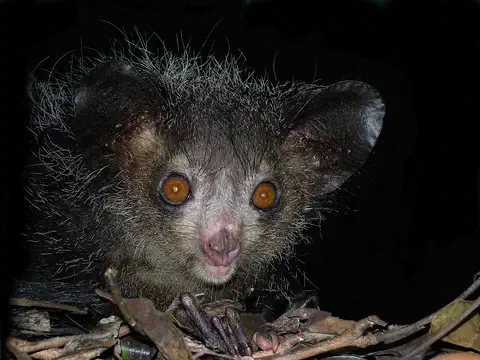
The aye-aye is a lemur from Madagascar, and the largest primate that is active at night. It taps on branches with its long, skinny middle finger, listens with its enormous ears for hidden grubs, then bites into the wood and hooks them out.
-
 Watch
Animal
Sumatran orangutan
The Sumatran orangutan is a shaggy red great ape that lives almost all its life in the treetops of northern Sumatra, in Indonesia. Its hair is longer and lighter than its Bornean cousin's, and a mother has a baby only every eight or nine years.
For parents & teachers
What children will learn
- Explain what nocturnal means and how big eyes help at night.
- Describe how a slow loris feeds on sap, nectar and insects.
- Understand why slow lorises are among the few venomous mammals.
- Discuss how videos of wild animals as pets can harm them.
Recommended ages: 3 to 17 · About 15 minutes
Talk about it
- Why might moving slowly and quietly help an animal stay safe?
- Why do you think videos of slow lorises being tickled are harmful?
- What could people in Southeast Asia and around the world do to protect slow lorises?
Try at home or in class
- Try picking up a pencil using only your thumb and middle finger, then with your thumb and pointer finger: which grip is stronger?
- Go outside at dusk with a grown-up and list the animals you can hear or see once it gets dark.
Key vocabulary: nocturnal, venomous, nectar, primate, hybrid
Where these facts come from
- GBIF Backbone Taxonomy and GBIF Occurrence Search , Global Biodiversity Information Facility (CC0 1.0 (backbone); occurrence counts are facts derived from records under CC0, CC BY and CC BY-NC)
- The IUCN Red List of Threatened Species , International Union for Conservation of Nature (IUCN terms of use (no redistribution of Red List data or range maps))
- Sunda slow loris, Nycticebus coucang , New England Primate Conservancy
- Nycticebus coucang (Sunda slow loris) , Animal Diversity Web, University of Michigan
- Nycticebus coucang: IUCN Red List global assessment record (Nekaris et al. 2020), IUCN checklist on GBIF , GBIF
- Nycticebus coucang (Greater Slow Loris), Nekaris et al. 2020, global assessment , IUCN Red List of Threatened Species
- Wikidata , Wikimedia Foundation (CC0 1.0)
- Wikimedia Commons , Wikimedia Foundation (Per file: Public domain, CC0, CC BY or CC BY-SA only (credited on each page))
Checked, not yet human-reviewed. Last updated November 1, 2026. Spotted a mistake? Tell us.