
Animal
Plains zebra
The plains zebra is a wild horse with black and white stripes. It lives in big herds on the grassy plains of Africa.
Plains zebras are striped members of the horse family that graze on the grasslands of eastern and southern Africa. They live in close family groups, travel long distances to find fresh grass and water, and every zebra's stripes are different.
Equus quagga, the plains zebra, is the most abundant and widespread of the three zebra species: a grazing equid of eastern and southern African savannas whose seasonal movements form some of Africa's great migrations. Its stripes are still debated, and it is listed as Near Threatened.
Photo: Giles Laurent, CC BY-SA 4.0, via Wikimedia Commons
Meet the plains zebra
A zebra looks like a horse in striped pajamas.
It has black and white stripes all over. It has a short mane that sticks straight up. Zebras live together in families.
Plains zebras are wild members of the horse family, cousins of horses and donkeys. An adult stands about as tall at the shoulder as a ten-year-old child and weighs 250 to 300 kilograms, about as much as four grown-ups.
There are three kinds of zebra. The plains zebra is the most common. Its stripes are wide, and many plains zebras have pale brown 'shadow stripes' between the black ones. No two zebras have exactly the same pattern.
The plains zebra (Equus quagga) is one of three living zebra species, alongside Grevy's zebra and the mountain zebra, and belongs to the genus Equus with horses and asses. Adults measure about 2.2 to 2.5 meters in head-and-body length and 1.1 to 1.45 meters at the shoulder; males are only slightly larger than females.
Britannica recognizes six subspecies, among them Grant's, Chapman's, Crawshay's and Burchell's zebras. One subspecies, the quagga of South Africa, was striped mainly on the head and neck, with the stripes fading away behind the shoulder. It once lived in vast herds, but it died out in the 1800s: the last known quagga died at London Zoo in 1872.
Quick facts
- Group
- Mammal
- Length
- 2.17 to 2.46 m
- Height
- 1.1 to 1.45 m
- Weight
- 250 to 300 kg
- Top speed
- up to 64 km/h
Where plains zebras live
Plains zebras live in Africa.
They live where there is lots of grass to eat. They never go too far from water.
Plains zebras live in eastern and southern Africa, from Ethiopia and South Sudan down to South Africa. They like grasslands, savannas and open woodlands, and they stay away from deserts, thick rainforests and swamps.
They are one of Africa's most adaptable grazing animals, so they live in more countries than any other zebra. Some of the largest herds are on the Serengeti plains of Tanzania and Kenya. Zebras have disappeared from Burundi and Lesotho.
The IUCN lists the plains zebra as native and resident in 16 countries, from South Sudan and Ethiopia south to South Africa and west to Angola and Namibia. It is possibly extinct in Somalia and extinct in Burundi and Lesotho. Its best-known migration crosses the Serengeti-Mara plains of Tanzania and Kenya.
The species tolerates a range of grasslands, woodlands and scrub, even hilly country up to about 4,400 meters according to Animal Diversity Web, but it must stay within reach of drinking water. Many populations move with the seasons as rain renews the grass. Habitat loss is most severe in the south of the range and hunting pressure in the north. The country shading on the map shows where zebras occur, not that they live everywhere inside each country.
Continent
Its habitats


Where can you find this animal?
- Used to live here · Countries and seas named by a scientific source
- Lives here naturally · Countries and seas named by a scientific source
- Sightings recorded · Records of wild sightings (GBIF)
Used to live here · Countries and seas named by a scientific source
Burundi and Lesotho, where the IUCN lists the plains zebra as extinct.
Places: Burundi and Lesotho.
Source: iucn-red-list · checked October 2026
Lives here naturally · Countries and seas named by a scientific source
Grasslands, savannas and open woodlands of eastern and southern Africa, from South Sudan and Ethiopia to South Africa. Zebras live in only part of each country shown.
Places: Angola, Botswana, DR Congo, Eswatini, Ethiopia, Kenya, Malawi, Mozambique and 8 more places.
Source: iucn-red-list · checked October 2026
Sightings recorded · Records of wild sightings (GBIF)
Counts of GBIF records of wild observations (human and machine) and preserved specimens. Records include introduced populations, vagrants, escaped or released animals and misidentifications, so a country with records is not necessarily part of the native range.
Wild sightings have been recorded in South Africa, Kenya, Tanzania, Namibia, Zambia, Botswana, Zimbabwe, Uganda and 26 more places.
Source: gbif · checked October 2026
Range maps show where scientists say an animal lives, often country by country. An animal may live in only part of a country shown, and sightings records can include animals that wandered far from home.
Grass, grass and more grass
Zebras eat grass.
They nibble grass with their strong front teeth. They eat for many hours every day. They also need to drink water.
Zebras are grazers: they eat mostly grass, with a few leaves and stems when grass is scarce. Their strong front teeth clip the grass, and big flat back teeth grind it down.
Unlike many grazers, zebras can eat tall, tough grass. They often move into an area first and munch the long tops. That opens up the shorter, leafier grass below for wildebeest and gazelles that come after them. Zebras must drink often, so herds stay near rivers and water holes.
Plains zebras are bulk grazers with strong upper and lower incisors for cropping and high-crowned cheek teeth that resist wear from silica-rich grasses. Like horses they are hindgut fermenters: symbiotic bacteria in the cecum, a pouch of the gut beyond the stomach, break down cellulose. This lets them process large amounts of lower-quality forage quickly, a trade-off that requires long hours of feeding.
The African Wildlife Foundation describes them as 'pioneer grazers': by removing coarse, tall growth they prepare pastures for more selective grazers such as wildebeest. Because they depend on surface water, their movements in the dry season track water holes and rivers, and herds walk long distances between grazing grounds and water.
Did you know?
A zebra is on a country's coat of arms.
The plains zebra appears on the coat of arms of Botswana.
Botswana's coat of arms features plains zebras, a mark of the species' place in southern African landscapes.
Stripes and speed
Under its stripes, a zebra has dark skin.
Zebras can hear and see very well. They have strong legs and hard hooves. They can run very fast.
Here is a surprise: a zebra's skin is dark. Special cells in the skin decide which hairs get dark color and which stay white, and that makes the stripes. A zebra foal's stripes start out brown and white.
Zebras have excellent hearing and eyesight. They can gallop at more than 60 km/h, and a zebra's kick is strong enough to make a lion think twice. Each foot ends in one hard hoof, just like a horse's.
Zebras have dark skin; pigment cells (melanocytes) add melanin to some growing hairs and not others, producing the stripes. Why stripes evolved is still debated. Ideas include confusing predators when a herd moves, cooling, social recognition and protection from biting flies. A 2019 study comparing zebras and horses in Britain found that horse flies landed on striped coats less often, which supports the fly hypothesis.
As equids, zebras are single-hoofed (perissodactyl) runners with long legs and keen senses. San Diego Zoo gives top speeds above 64 km/h. Each stripe pattern is unique, so researchers identify individual zebras from photographs.
A foal's first hour
A baby zebra is called a foal.
It can walk soon after it is born. Its stripes are brown at first. The foal learns its mom's stripes so it can always find her.
A mother zebra carries her foal for about a year. Then she steps a little way from the herd to give birth. A newborn foal has long legs and fuzzy brown and white stripes. It can stand and walk within about 20 minutes and run within an hour, which matters because the herd must keep moving.
For the first few days the mother keeps others away while the foal learns her stripes, her smell and her voice. Foals nibble grass at about one week old and drink milk for most of their first year.
Gestation lasts a little over a year, and a single foal of about 32 kilograms is born, often in the rainy season. Foals are precocial: standing within minutes and running within an hour. The mare isolates her foal briefly so that it imprints on her stripe pattern, scent and voice; mares rarely nurse foals other than their own.
Foals begin grazing within about a week but are weaned at 7 to 11 months. Young females usually leave their birth group when they first come into season, at around one to two years, and are courted by stallions from other families. Young males leave by about two years to join bachelor groups. Animal Diversity Web gives an average wild life span of about 9 years, though zebras can live for decades in zoos.

Family groups and herds
Zebras live in families.
A family has a dad, some moms and their foals. Zebras groom each other with gentle nibbles. When danger comes, they run away together.
A plains zebra family, called a harem, has one stallion, a few mares and their foals. The family stays together for years, even while thousands of zebras gather in big herds around them.
Zebras talk with barks, brays, snorts and their faces. Ears pinned back mean 'watch out'. Friends groom each other by standing side by side and nibbling each other's necks and backs. When a lion is spotted, the stallion often stays at the back, between the danger and his family.
Plains zebras live in stable harems of one stallion, usually one to six mares and their young. The bonds among the mares are the core of the group, and the harem stays together even if the stallion is replaced. Bachelor males form separate groups. In some seasons many harems gather into herds of hundreds or thousands, yet each family stays together within the crowd.
Communication combines calls, including an alarm call, with ear, eye and mouth postures. Mutual grooming strengthens bonds. Zebras often mix with wildebeest and other grazers, and these mixed herds may gain from more eyes watching for predators. At night most of the group rests while at least one animal stays standing and alert.
Did you know?
No two zebras have the same stripes.
Every zebra's stripes are different, like your fingerprints, so scientists can tell zebras apart from photos.
Stripe patterns are individually unique, which allows photographic identification and long-term studies of known animals.
Keeping the herds moving
There are still many plains zebras.
But their homes are getting smaller. People are making safe paths so zebras can travel between parks.
Plains zebras are still common, but there are fewer of them than before. Farms and settlements take over their grasslands, livestock eats the same grass, and some zebras are hunted for meat and skins.
The IUCN lists the plains zebra as Near Threatened. Conservation groups protect wildlife corridors, wide strips of land that let zebras travel from one park to another and follow the rains. Protecting these journeys is just as important as protecting the zebras themselves.
The IUCN's 2016 assessment lists the plains zebra as Near Threatened, with an estimated 150,000 to 250,000 mature individuals and a decreasing trend. Threats are habitat loss from settlement and agriculture, worst in the south of the range, competition with livestock for grass and water, and hunting for meat and skins, worst in the north.
Britannica points out that the species' large-scale migrations are themselves an endangered behavior: the routes can be lost long before the animals become rare. Wildlife corridors that link protected areas, and agreements that help herders and wildlife share rangelands, are therefore central to conservation. The fate of the quagga is a reminder of how quickly a common animal can be lost.
IUCN Red List
How is the plains zebra doing in the wild?
- Least Concern
- Near Threatened (this animal)
- Vulnerable
- Endangered
- Critically Endangered
- Extinct in the Wild
- Extinct
Near Threatened
Not at risk yet, but it could be soon.
See the IUCN Red List assessment · The IUCN Red List of Threatened Species 2022.2
Amazing facts
-
Zebras have dark skin under their striped fur.
Under the stripes, a zebra's skin is dark. Skin cells decide which hairs grow dark and which stay white.
Zebra skin is dark; melanocytes transfer melanin into some growing hairs and not others, producing the striped coat.
-
No two zebras have the same stripes.
Every zebra's stripes are different, like your fingerprints, so scientists can tell zebras apart from photos.
Stripe patterns are individually unique, which allows photographic identification and long-term studies of known animals.
-
Zebra foals can walk soon after they are born.
A zebra foal can walk about 20 minutes after it is born and run within an hour.
Plains zebra foals are precocial, standing within minutes and able to keep pace with the herd within about an hour.
-
A zebra is on a country's coat of arms.
The plains zebra appears on the coat of arms of Botswana.
Botswana's coat of arms features plains zebras, a mark of the species' place in southern African landscapes.
Words to know
- grazer
- an animal that eats mostly grass
- harem
- a zebra family of one stallion, a few mares and their young
- foal
- a baby zebra, horse or donkey
- migration
- a long journey animals make, often with the seasons
- corridor
- a strip of land that lets wild animals travel safely between areas
- near threatened
- close to becoming at risk of disappearing from the wild
Discovery challenge
-
What color is a zebra's skin?
What color is a zebra's skin under its fur?
What produces a zebra's stripes?
- Dark
- Bright green
- Pink with spots
Show the answer
Dark
A zebra has dark skin under its stripes.
Zebra skin is dark. Skin cells make some hairs dark and leave others white.
Melanocytes in the dark skin add melanin to some hairs and not others, creating the stripe pattern.
-
What do zebras eat?
What is a plains zebra's main food?
Which describes the plains zebra's feeding?
- Fish
- Grass
- Insects
Show the answer
Grass
Zebras eat grass, lots of it.
Zebras are grazers. They eat mostly grass, even tall, tough grass that other animals leave.
They are bulk grazers and hindgut fermenters, often the first to crop tall grass, opening pastures for more selective grazers.
-
Who is in a zebra family?
What is a plains zebra family group called?
Which statement about plains zebra harems is true?
- A harem
- A school
- A flock
Show the answer
A harem
A zebra family is called a harem: a dad, some moms and their foals.
A harem is one stallion, a few mares and their foals, and it stays together for years.
Harems are stable for years and are held together by bonds among the mares, even if the stallion is replaced.
-
Which idea about stripes has good evidence?
Scientists have found good evidence that stripes help zebras with what?
Which stripe hypothesis was supported by the 2019 study of zebras and horses?
- Keeping biting flies away
- Flying
- Swimming faster
Show the answer
Keeping biting flies away
Biting flies do not like to land on stripes.
Studies found that biting horse flies land on striped coats less often than on plain ones.
Horse flies landed on and bit zebras less often than horses, supporting the biting-fly hypothesis.
Places where you might see it
-
 Watch
Natural wonder
Serengeti National Park
Serengeti National Park in northern Tanzania protects 14,763 square kilometers of grassy plains and woodlands. Each year more than a million wildebeest, with zebras and gazelles, travel a great loop across the Serengeti and into Kenya in search of grass and water, followed by lions and other predators.
-
 Watch
Natural wonder
Kalahari Desert
The Kalahari is a giant sandy plain in southern Africa, covering almost all of Botswana and parts of Namibia and South Africa. It stretches about 1,600 kilometers from north to south. Its southwest is a true desert, with long red dunes, while its north is green with woodlands and even has a huge swamp, the Okavango Delta.
-
 Watch
 Country
Rwanda
Rwanda is a small, landlocked country in east-central Africa, just south of the equator. It is often called the land of a thousand hills. Mountain gorillas live among its volcanoes in the northwest, Lake Kivu lies on its western edge, and about 14.6 million people lived there in 2025.
Experiments to try
Explore next
-
 Watch
Animal
Grévy's zebra
Grévy's zebra is the largest zebra, with narrow stripes, a white belly and big, round ears. It lives only in the dry grasslands and scrub of northern Kenya and Ethiopia, and it is endangered: only a few thousand are left in the wild.
-
 Watch
3D
Animal
Horse
Horses are grazing animals built for running, with long legs that end in a single hard hoof. People tamed wild horses about 6,000 years ago on the grasslands of Europe and Asia, and horses changed history: they pulled plows, carried riders and connected faraway places.
-
 Watch
3D
Animal
Donkey
Donkeys are domesticated members of the horse family, bred from the African wild ass more than 6,000 years ago. With their long ears, sure feet and great strength, they have carried loads for people on rough, dry land ever since, and in many countries they still do that work today.
-
 Watch
Animal
Blue wildebeest
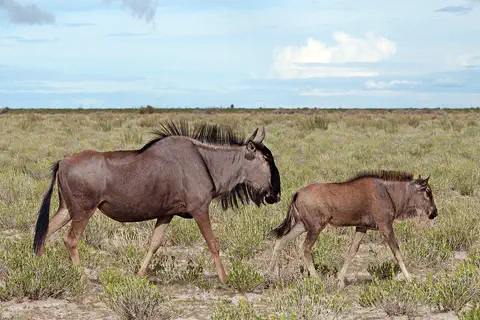
The blue wildebeest, or gnu, is a big antelope with a box-like head, curved horns, a mane and a beard. It grazes the savannas of eastern and southern Africa, and in the Serengeti huge herds travel in a giant circle every year following the rains.
-
 Watch
3D
Animal
Giraffe
Giraffes are the tallest animals on Earth. A long neck and a long dark tongue let them eat leaves from treetops that other animals cannot reach, and their patchy coats help them blend into the shade of the trees.
- Watch What If? Lab What if elephants stopped shaping the savanna? African elephants change the land around them. They feed on and push over trees, dig wells in dry riverbeds that other animals drink from, and carry seeds farther than almost any other land animal. Imagine elephants stopped doing all that: how might the savanna change?
-
 Watch
3D
Animal
Common ostrich
The common ostrich is the tallest and heaviest bird alive. It cannot fly, but it is the fastest runner on two legs, sprinting at about 70 kilometers an hour across the savannas and deserts of Africa. It also lays the biggest egg of any living animal.
-
Watch
Natural wonder
Serengeti National Park
Serengeti National Park in northern Tanzania protects 14,763 square kilometers of grassy plains and woodlands. Each year more than a million wildebeest, with zebras and gazelles, travel a great loop across the Serengeti and into Kenya in search of grass and water, followed by lions and other predators.
For parents & teachers
What children will learn
- Describe the plains zebra's body, including its dark skin, stripes, teeth and hooves.
- Explain what a grazer is and how zebras help other grazing animals.
- Describe zebra family life and how foals learn to recognize their mothers.
- Explain why migration corridors matter for conservation.
Recommended ages: 3 to 17 · About 15 minutes
Talk about it
- Scientists have several ideas about why zebras have stripes. Which do you think is most likely, and how could you test it?
- Why might it help a foal to walk and run within an hour of being born?
- What could happen to zebras if fences cut across the paths they travel each year?
Try at home or in class
- Draw a zebra outline and give it your own stripe pattern, then compare with a family member's: no two will match.
- Lay a striped cloth and a plain cloth outside on a warm day and watch which one flies land on more often.
Key vocabulary: grazer, harem, foal, migration, corridor, near threatened
Where these facts come from
- The IUCN Red List of Threatened Species , International Union for Conservation of Nature (IUCN terms of use (no redistribution of Red List data or range maps))
- GBIF Backbone Taxonomy and GBIF Occurrence Search , Global Biodiversity Information Facility (CC0 1.0 (backbone); occurrence counts are facts derived from records under CC0, CC BY and CC BY-NC)
- Zebra , San Diego Zoo Wildlife Alliance
- Zebra , Encyclopaedia Britannica
- Zebra , African Wildlife Foundation
- Equus burchellii (Burchell's zebra) , Animal Diversity Web, University of Michigan
- Equus quagga (Plains zebra), 2016 assessment , IUCN Red List
- Quagga , Encyclopaedia Britannica
- Wikidata , Wikimedia Foundation (CC0 1.0)
- Wikimedia Commons , Wikimedia Foundation (Per file: Public domain, CC0, CC BY or CC BY-SA only (credited on each page))
Checked, not yet human-reviewed. Last updated October 24, 2026. Spotted a mistake? Tell us.