
Animal
Horse
The horse is a big, strong animal with a long face, a flowing mane and hard hooves. People ride horses, and horses can run very fast.
Horses are grazing animals built for running, with long legs that end in a single hard hoof. People tamed wild horses about 6,000 years ago on the grasslands of Europe and Asia, and horses changed history: they pulled plows, carried riders and connected faraway places.
Equus caballus, the domestic horse, is a single-hoofed grazing mammal domesticated about 6,000 years ago on the western Eurasian steppe. Its wild ancestors are gone; the Przewalski's horse of Mongolia is a distant wild cousin. Hundreds of breeds, from ponies to heavy draft horses, now live on every inhabited continent.
Photo: Mikel Ortega from Errenteria, Basque Country, Spain, with a retouche by Richard Bartz. See the original file here., CC BY-SA 2.0, via Wikimedia Commons
Meet the horse
A horse has a long face, long legs and a long tail.
It has a mane of hair on its neck. Each foot has one hard hoof. A baby horse is called a foal.
Horses are big, strong mammals that eat plants. Each leg ends in a single hard hoof, made of keratin like your fingernails. Horses come in many sizes: a small pony may stand under a meter at the shoulder, while a big draft horse can be 1.7 meters tall and weigh 900 kilograms.
There are hundreds of breeds. Heavy horses, like Clydesdales, pull loads. Light horses, like Arabians and Thoroughbreds, are for riding and racing. Ponies are the smallest. A male is a stallion, a female a mare, and a young horse a foal.
All domestic horses belong to one species, Equus caballus, in the family Equidae with zebras and asses. Size varies enormously by breed: about 0.9 to 1.7 meters at the withers and 227 to 900 kilograms. Britannica groups breeds into heavy (draft) horses, light horses and ponies; the Arabian is often called the oldest recognized breed.
The horse's evolutionary history is unusually well documented by fossils, from Eocene ancestors such as Hyracotherium, the 'dawn horse', more than 50 million years ago, to modern Equus. Over that time the family shifted from many-toed browsers to long-legged, single-toed grazers that run on the tips of a single digit.
Quick facts
- Group
- Mammal
- Length
- 2.2 to 2.8 m
- Height
- 0.9 to 1.7 m
- Weight
- 227 to 900 kg
- Lifespan in the wild
- 25 to 30 years
From wild steppe to the whole world
Long ago, wild horses ran on big grassy plains.
People tamed them. Now horses live with people in almost every part of the world.
Wild horses once roamed grasslands across Europe, Asia and North America. North America's wild horses died out about 8,000 to 10,000 years ago. In Europe and Asia, people tamed wild horses about 6,000 years ago, probably on the steppes north of the Black and Caspian seas.
Today horses live with people on every continent except Antarctica. The 'wild' horses of the American West and Australia are really feral horses: their ancestors escaped or were let go from farms and ranches.
Wild horses once ranged across Eurasia, North Africa and North America; Animal Diversity Web notes that North American populations died out 8,000 to 10,000 years ago, and horses returned with European colonists. Britannica dates domestication to about 6,000 years ago, probably by people living on the steppes north of the Black and Caspian seas.
The wild ancestor of domestic horses no longer exists in the wild. Free-roaming horses in western North America, on East Coast barrier islands and in Australia are feral descendants of domestic horses. The Przewalski's horse, reintroduced in Mongolia, China and Kazakhstan, is a separate wild lineage. The map shows where domestic horses are kept, by continent, with feral populations as a separate layer.
Continents
Its habitat

Where can you find this animal?
- Kept by people · Countries and seas named by a scientific source
- Brought here by people · Countries and seas named by a scientific source
- Sightings recorded · Records of wild sightings (GBIF)
Kept by people · Countries and seas named by a scientific source
Horses are domesticated and kept by people on every continent except Antarctica. The map shows where they are raised, not a wild range; their wild ancestor no longer exists.
Places: Africa, Asia, Europe, North America, South America and Australia and Oceania.
Source: Encyclopaedia Britannica · checked October 2026
Brought here by people · Countries and seas named by a scientific source
Examples of feral horses, descended from domestic animals, living free in the western United States, on East Coast barrier islands and in Australia.
Places: United States and Australia.
Source: Smithsonian's National Zoo · checked October 2026
Sightings recorded · Records of wild sightings (GBIF)
Counts of GBIF records of wild observations (human and machine) and preserved specimens. Records include introduced populations, vagrants, escaped or released animals and misidentifications, so a country with records is not necessarily part of the native range.
Wild sightings have been recorded in Chile, Colombia, Australia, United States, Netherlands, Portugal, Germany, Belgium and 96 more places.
Source: gbif · checked October 2026
Range maps show where scientists say an animal lives, often country by country. An animal may live in only part of a country shown, and sightings records can include animals that wandered far from home.
Grazing all day
Horses eat grass and hay.
They nibble grass for many hours every day. Their big flat teeth grind the grass.
Horses are grazers. They eat mostly grass, and on farms they also eat hay and grain. They graze for many hours, a little at a time, because grass does not have much energy in each mouthful.
Horses have strong front teeth to snip grass and big, tall back teeth to grind it. Unlike cows, horses do not chew cud. Instead, like zebras, they digest the tough plant fibers in the cecum, a big pouch of the gut beyond the stomach, where helpful bacteria break them down.
Horses are grazers with strong, high-crowned (hypsodont) cheek teeth adapted to grinding abrasive grasses, and a long digestive tract suited to plant food. Like zebras, asses and Przewalski's horses, they are hindgut fermenters: symbiotic bacteria in the cecum, beyond the stomach and small intestine, break down cellulose.
This strategy differs from that of ruminants such as cattle. Hindgut fermenters process large volumes of lower-quality forage quickly and need plenty of water, but extract less from each mouthful, so horses spend much of the day feeding. On farms, diets of pasture and hay are often supplemented with grain for working animals.

Built to run
Horses have big eyes on the sides of their heads.
They can see almost all the way around. Their long legs and hard hooves help them run fast.
A horse's large eyes sit on the sides of its head, so it can see a very wide area. Its eyes are set high, so it can watch for danger even while its head is down, grazing.
Horses are built to run. They stand on the very tips of their toes: each leg ends in one big toe covered by a hoof. Horses see well, and their long, upright ears help them hear; smell matters to them too.
Laterally placed, high-set eyes give horses a very wide field of view, letting them watch for predators while grazing. Their limbs are long, with weight carried on the tip of a single digit capped by a keratin hoof, an adaptation for fast running.
Vision is the main sense; long, upright ears aid hearing, and smell and touch through the whiskers also matter. Britannica notes that horses' powers of observation and memory let them learn and remember signals, which is part of why they could be trained for work and riding. Breeds differ in build: heavy draft horses are bred to pull loads, while light horses such as the Thoroughbred are bred for riding and racing.
A foal on its feet
A baby horse is called a foal.
It can stand up about an hour after it is born. Soon it can follow its mother. It grows very fast.
A mother horse, or mare, is pregnant for about 11 months. Foals are usually born at night in a quiet place. A newborn foal can stand within about an hour and walk within four or five hours to follow its mother.
Foals grow quickly: their weight doubles every week for the first four weeks. Many farm foals stop drinking milk at four to six months. Horses are fully grown at about four to seven years old and often live 25 to 30 years.
Average gestation is about 335 days, but it ranges widely, from about 287 to 419 days. Births usually happen at night. Foals are precocial, standing within about an hour and walking within four to five hours; domestic foals average about 40 kilograms at birth, wild-type foals 25 to 30.
Foal weight doubles every week for the first four weeks. Domestic foals are often weaned at four to six months, while weaning can take up to two years in wild horses. Females mature at four to five years and males at six to seven. Domestic horses typically live 25 to 30 years; the maximum recorded is about 61 years.
Herd life and horse talk
Horses like to be with other horses.
They neigh, whinny and snort. They move their ears and tails to show how they feel.
Horses are herd animals. In feral and wild herds, one or a few stallions live with several mares and their young. Being in a herd helps horses stay safe and learn from each other.
Horses 'talk' with their bodies. The position of the ears, head and tail and the expression on the face all send messages. They also whinny, neigh and snort, from friendly greetings to warnings. Horses remember well and can learn many signals.
Free-living herds, or bands, typically hold 5 to 11 mares, 1 to 4 stallions and their young, with a dominant male; hierarchy depends on age and reproductive status and is set through kicking, biting, sounds and facial gestures. Studies of feral horses show young animals eventually disperse from their natal herd.
Communication is largely visual, through postures and movements of the ears, head and tail and facial expressions, supported by vocalizations such as whinnies, neighs and snorts, and by smell. These social skills, together with a good memory, underlie horses' long partnership with people.
Did you know?
The first horses were tiny.
The earliest horse ancestor, the 'dawn horse', lived more than 50 million years ago and had several toes on each foot.
Hyracotherium (Eohippus), from the early Eocene, began a lineage that over 50 million years produced the single-toed modern horse.
Horses and people
Horses have helped people for a very long time.
They pulled wagons and plows. People ride horses for fun and sport. Small ponies give children their first rides.
Before cars and tractors, horses did a huge amount of work. They plowed fields, brought in harvests, pulled wagons and carriages and carried riders across countries. Horses changed how far people could travel and how they farmed.
Today many horses are kept for riding and sport, such as show jumping, racing and dressage. Horsehair is used for violin bows, and horses' blood has even been used to make medicines that protect people from tetanus.
Since domestication, horses have plowed fields, hauled goods, carried passengers and riders, tracked cattle and opened routes for exploration and trade. Many early cultures centered on possession of the horse, and horses appear in art from Stone Age cave paintings, such as those at Lascaux, to Chinese Tang dynasty sculpture.
Horses also supply materials and medicines: high-quality horsehair for violin bows, horsehide for leather, and tetanus antitoxin from the blood serum of immunized horses. Riding and sports such as dressage, show jumping and racing are major uses today.
Did you know?
Violin bows are made with horsehair.
High-quality horsehair, usually white, is used to string violin bows.
Fine white horsehair is the traditional material for the ribbon of violin bows.
The last wild horses
Farm horses are not in danger.
But the horse has a wild cousin, the Przewalski's horse. It almost disappeared. People helped it come back.
Domestic horses are not endangered. Their wild cousin is another story. The Przewalski's horse, a short, stocky wild horse with a stiff mane, disappeared from the wild in the 1960s. Zoos kept a few alive and bred them carefully.
Today about 1,900 Przewalski's horses live in zoos and in reintroduction sites in Mongolia, China and Kazakhstan, all descended from just 14 horses caught long ago.
As a domestic species, the horse is not assessed on the IUCN Red List. Its closest surviving wild relative, Przewalski's horse, diverged from the lineage of domestic horses roughly 500,000 years ago according to mitochondrial DNA. It was last seen in the wild in the Gobi in the 1960s, and the roughly 1,900 alive today descend from 14 founders caught between 1910 and 1960.
Zoo breeding, an international studbook started in 1959 and reintroductions in Mongolia, China and Kazakhstan brought it back, though low genetic diversity, hybridization, disease and habitat degradation remain threats. Recent genetic work has debated whether the species was ever tamed, but the Smithsonian concludes there is no strong evidence that it descends from domestic horses.
Did you know?
Horses walk on the tips of their toes.
Each horse leg ends in one big toe covered by a hoof, so a horse really stands on its tiptoes.
Horses bear weight on the tip of a single digit per limb, capped by a keratin hoof.
Amazing facts
-
A foal can stand up about an hour after it is born.
Newborn foals can usually stand within an hour and walk within four or five hours.
Foals are precocial, standing within about an hour and following the mare within four to five hours.
-
Horses walk on the tips of their toes.
Each horse leg ends in one big toe covered by a hoof, so a horse really stands on its tiptoes.
Horses bear weight on the tip of a single digit per limb, capped by a keratin hoof.
-
Violin bows are made with horsehair.
High-quality horsehair, usually white, is used to string violin bows.
Fine white horsehair is the traditional material for the ribbon of violin bows.
-
The first horses were tiny.
The earliest horse ancestor, the 'dawn horse', lived more than 50 million years ago and had several toes on each foot.
Hyracotherium (Eohippus), from the early Eocene, began a lineage that over 50 million years produced the single-toed modern horse.
Words to know
- hoof
- the hard covering on the end of a horse's toe
- mane
- the long hair growing along the top of a horse's neck
- foal
- a baby horse
- domesticated
- tamed and raised by people over many generations
- feral
- living wild, but descended from tame animals
- breed
- a type of domestic animal with its own look and traits
Discovery challenge
-
What is a baby horse called?
How soon can a newborn foal stand?
What does 'precocial' mean for a foal?
- A foal
- A cub
- A chick
Show the answer
A foal
A baby horse is a foal.
A foal can usually stand within about an hour of birth.
Born well developed: standing within an hour and walking with the mare within hours.
-
How many hooves does a horse have on each foot?
What is a horse's hoof made of?
On what part of the foot does a horse stand?
- One
- Five
- None
Show the answer
One
One hard hoof on each foot.
Keratin, the same material as your fingernails.
The tip of a single digit, capped by a keratin hoof.
-
When did people tame horses?
About how long ago were horses domesticated?
Where were horses probably first domesticated?
- About 6,000 years ago
- Last year
- Before dinosaurs
Show the answer
About 6,000 years ago
A very long time ago, about 6,000 years ago.
About 6,000 years ago.
Probably on the steppes north of the Black and Caspian seas, about 6,000 years ago.
-
Are the 'wild' horses of America really wild?
What are the free-roaming horses of the American West?
Which horse is considered the last truly wild horse?
- They came from farm horses (feral)
- They are a kind of zebra
- They are deer
Show the answer
They came from farm horses (feral)
Their great-great-grandparents lived on farms. They are called feral.
They are feral horses, descended from domestic horses that escaped or were let go.
Przewalski's horse; the free-roaming horses of the American West and Australia are feral domestic horses.
Places where you might see it
Explore next
-
 Watch
3D
Animal
Donkey
Donkeys are domesticated members of the horse family, bred from the African wild ass more than 6,000 years ago. With their long ears, sure feet and great strength, they have carried loads for people on rough, dry land ever since, and in many countries they still do that work today.
-
 Watch
Animal
Plains zebra
Plains zebras are striped members of the horse family that graze on the grasslands of eastern and southern Africa. They live in close family groups, travel long distances to find fresh grass and water, and every zebra's stripes are different.
-
 Watch
3D
Animal
Cattle
Cattle are large farm animals that people tamed from wild oxen long ago. They eat grass and digest it with a stomach that has four parts. Farmers around the world keep cattle for milk, meat and leather, and in some places oxen still pull plows and carts.
-
 Watch
3D
Animal
Dromedary camel
The dromedary, or Arabian camel, is the one-humped camel of the deserts of North Africa, the Middle East and India. Its hump stores fat, not water, and its body is full of tricks for saving water. People tamed dromedaries thousands of years ago, and today none live truly wild, except a large feral population in Australia.
-
 Watch
3D
Animal
Domestic pig
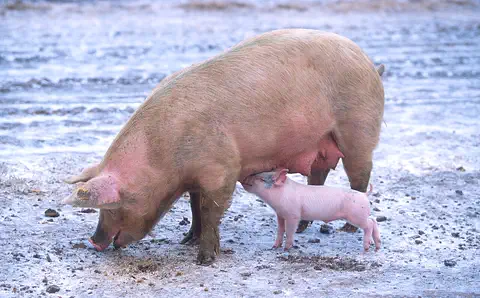
Domestic pigs live with people on every continent except Antarctica. Their ancestor is the wild boar, which people began taming about 9,000 years ago. Pigs are among the smartest farm animals, with a super-sensitive snout for digging up food.
- Watch Natural wonder Cave of Altamira The Cave of Altamira, in northern Spain, holds some of the most famous prehistoric paintings in the world. People who hunted and gathered their food used the cave between about 36,000 and 13,000 years ago, and painted and engraved bison, horses, deer, hands and signs on its walls and ceiling. It was the first cave where prehistoric cave art was ever recognized.
-
 Watch
Animal
Grévy's zebra
Grévy's zebra is the largest zebra, with narrow stripes, a white belly and big, round ears. It lives only in the dry grasslands and scrub of northern Kenya and Ethiopia, and it is endangered: only a few thousand are left in the wild.
-
 Watch
Animal
Aardvark
The aardvark is a shy night digger of African savannas. It sniffs out ant and termite nests, rips them open with its spade-like claws and laps up the insects with a sticky tongue about 30 centimeters long. Its name means 'earth pig' in Afrikaans.
For parents & teachers
What children will learn
- Describe how the horse's eyes, legs, hooves and teeth suit a grazing, running animal.
- Explain the difference between domestic, feral and wild horses.
- Describe the horse life cycle and herd behavior.
- Understand how horses changed farming, travel and history.
Recommended ages: 3 to 17 · About 15 minutes
Talk about it
- How might life have been different before horses were tamed, and after?
- Why might eyes on the sides of the head be useful for an animal that is hunted?
- Feral horses live free in places where horses are not native. What would you want to know before deciding how to look after them?
Try at home or in class
- Stand on your tiptoes and walk a few steps: horses stand on the tip of one toe on each leg all the time.
- Cover one eye, then the other, and notice how much you see from each side; then imagine eyes on the sides of your head like a horse.
Key vocabulary: hoof, mane, foal, domesticated, feral, breed
Where these facts come from
- GBIF Backbone Taxonomy and GBIF Occurrence Search , Global Biodiversity Information Facility (CC0 1.0 (backbone); occurrence counts are facts derived from records under CC0, CC BY and CC BY-NC)
- Horse , Encyclopaedia Britannica
- Equus caballus (horse) , Animal Diversity Web, University of Michigan
- Przewalski's horse , Smithsonian's National Zoo and Conservation Biology Institute
- 6 domestic animals and their wild ancestors , Encyclopaedia Britannica
- Horse: Evolution of the horse , Encyclopaedia Britannica
- Zebra , Encyclopaedia Britannica
- Wikidata , Wikimedia Foundation (CC0 1.0)
- Wikimedia Commons , Wikimedia Foundation (Per file: Public domain, CC0, CC BY or CC BY-SA only (credited on each page))
Checked, not yet human-reviewed. Last updated October 28, 2026. Spotted a mistake? Tell us.
Picture and 3D model credits
- Photo: Mikel Ortega from Errenteria, Basque Country, Spain, with a retouche by Richard Bartz. See the original file here., CC BY-SA 2.0, via Wikimedia Commons · source · license
- Photo: Photo: Myrabella, CC BY-SA 3.0, via Wikimedia Commons · source · license
- Photo: IAEA Imagebank, CC BY-SA 2.0, via Wikimedia Commons · source · license
- 3D model: iRahulRajput, CC BY 4.0, via Sketchfab · source · license