
Animal
Santa Cruz giant tortoise
The Santa Cruz giant tortoise is a huge, slow tortoise with a round shell. It lives on one island in the Galápagos. It can live for more than 100 years.
The Santa Cruz giant tortoise lives only on the western side of Santa Cruz Island in the Galápagos. It has a big, dome-shaped shell, eats grass, leaves and cactus, walks between the dry lowlands and the misty highlands, and can live for well over a century.
Chelonoidis porteri, the western Santa Cruz giant tortoise, is a domed Galápagos tortoise found only on the southwestern slopes of Santa Cruz Island. Genetic work in 2015 split the island's tortoises into two species. Its population, estimated at 2,000 to 4,000 tortoises in the 2015 study, is assessed by the IUCN as Critically Endangered.
Photo: Don Johnston, CC0 1.0, via Wikimedia Commons
Meet the Santa Cruz giant tortoise
This giant tortoise is big, heavy and very slow.
It has a round shell shaped like a dome. It has a long neck, wrinkly gray skin and thick, scaly legs. It lives on an island in the sea.
The Santa Cruz giant tortoise is one of the giant tortoises of the Galápagos Islands, which lie in the Pacific Ocean about 1,000 kilometers off South America. Its shell is shaped like a high, round dome and can be more than a meter long. A big adult can weigh about 250 kilograms, as much as three grown-ups.
Each big Galápagos island once had its own kind of giant tortoise. This one lives only on the western side of Santa Cruz Island.
Chelonoidis porteri is one of the 15 species of Galápagos giant tortoise recognized by Galápagos Conservancy, which belong to particular islands or to the major volcanoes of Isabela; Santa Cruz is home to two of them. It has the domed carapace typical of tortoises from large, high islands with humid highlands, and Max Planck researchers report Santa Cruz adults of up to about 250 kilograms.
Its name has changed with the science. All tortoises on Santa Cruz used to be called C. porteri. In 2015 a genetic study published in PLOS One showed that the small eastern population at Cerro Fatal is a separate species, C. donfaustoi, named for the park ranger Fausto Llerena. C. porteri now refers to the large western population.
Quick facts
- Group
- Reptile
- Length
- from 1 m
- Weight
- 113 to 250 kg
- Lifespan in the wild
- 100 to 150 years
Where it lives
This tortoise lives on Santa Cruz Island.
The island is in the Galápagos, far out in the Pacific Ocean. Part of the island is dry and warm. The high part is green, cool and misty.
The Santa Cruz giant tortoise lives on the southwestern slopes of Santa Cruz Island, part of Ecuador's Galápagos Islands. That is its only home in the wild.
The island rises from dry lowlands near the sea to green highlands, which are often wrapped in fog during the cool season. The fog keeps plants growing there even when it does not rain. Tortoises use both zones, moving up and down the slopes as the seasons change.
The species occupies about 156 square kilometers of the island's mesic southwestern slopes, an area known as the Reserva (PLOS One, 2015). Its range is roughly 20 kilometers from that of the eastern species, C. donfaustoi.
Santa Cruz has strong vegetation zones. Arid lowlands near the coast are rich in succulent plants in the wet season, while the highlands, often in fog during the cool season (about June to November), stay green through the dry months. Over the last century, part of the tortoises' range has been turned into farmland: an agricultural band now crosses the island's southern slope, and many tortoises move through farms and pastures. The map shades all of Ecuador, but the tortoise lives only on this one island.
Continent
Its habitat

Where can you find this animal?
- Lives here naturally · Countries and seas named by a scientific source
- Sightings recorded · Records of wild sightings (GBIF)
Lives here naturally · Countries and seas named by a scientific source
Only the western and southwestern slopes of Santa Cruz Island in the Galápagos Islands, Ecuador, about 156 square kilometers. The shading covers all of Ecuador, but the tortoise lives on this one island.
Places: Ecuador.
Source: iucn-red-list · checked October 2026
Sightings recorded · Records of wild sightings (GBIF)
Counts of GBIF records of wild observations (human and machine) and preserved specimens. Records include introduced populations, vagrants, escaped or released animals and misidentifications, so a country with records is not necessarily part of the native range.
Wild sightings have been recorded in Ecuador, United States, Chile, Spain, Peru, Pacific Ocean, Southern Ocean, Arctic Ocean and 2 more places.
Source: gbif · checked October 2026
Range maps show where scientists say an animal lives, often country by country. An animal may live in only part of a country shown, and sightings records can include animals that wandered far from home.
What it eats
Giant tortoises eat only plants.
They munch grass, leaves, flowers, fruit and cactus. They love red flowers and fruit. They drink lots of water when they find puddles.
Galápagos tortoises are herbivores. They eat grass, leaves, flowers, fruit and the pads and fruit of prickly pear cactus. They have no teeth, so they bite with the hard, bony edges of their mouths and swallow quickly.
Tortoises find food mostly by looking, not smelling, and bright red things catch their eye. When water is around they drink a lot and store it in their bodies. They can survive for up to a year without eating or drinking.
Galápagos tortoises are generalist herbivores, eating grasses, leaves, flowers, native fruits and cactus pads. They are toothless; the San Diego Zoo describes them biting off and mashing food with the bony outer edges of the mouth, and relying on sight more than smell, with red objects drawing particular attention.
Their ability to store water in the bladder and survive up to a year without food or water is a key adaptation to drought. It also nearly destroyed them: sailors stored live tortoises in ships' holds as fresh meat for long voyages. On Santa Cruz, movement between lowland and highland feeding areas is driven by the seasonal availability and quality of plants.

An amazing body
The shell is the tortoise's house. It cannot take it off.
Thick, scaly legs hold up the heavy body. A long neck stretches out to reach food. The tortoise pulls its head in when it is scared.
A tortoise's shell is part of its skeleton: its ribs and backbone are joined to it, so it can never crawl out. The shell is not solid, though. Inside it has a honeycomb of small air spaces, which makes it lighter to carry.
The Santa Cruz tortoise has a domed shell. Tortoises on drier islands have saddle-shaped shells that lift at the front so they can stretch up to cactus. Thick, scaly legs work like pillars to hold up all that weight.
The carapace is fused to the ribs and vertebrae, but it is far from solid bone: the San Diego Zoo describes a honeycomb structure enclosing small air chambers, which reduces its weight. The lungs lie along the top of the body beneath the dome, and the dark shell absorbs solar heat; like all reptiles, tortoises are ectotherms.
Shell shape varies with habitat across the archipelago. Domed shells, ancestral in form, occur on large islands with lush highlands such as Santa Cruz; saddlebacked shells, with a raised front opening, evolved on arid islands where reaching high vegetation matters. Galápagos Conservancy notes that the islands were named for these shells: the old Spanish word galápago meant saddle.
Growing up
A mother tortoise digs a hole in dry ground with her back feet.
She lays round eggs as big as tennis balls. Months later, tiny tortoises hatch. They dig their way up and look after themselves.
Females walk to dry, lower nesting areas and dig a hole with their back feet. Domed tortoises can lay 20 or more eggs about the size of tennis balls. The eggs take about four to six months to hatch, and warmer nests make more females.
The hatchlings stay underground for a few weeks, then dig out. Nobody looks after them. Young tortoises grow very slowly and are not ready to breed until they are about 20 to 25 years old.
Mating peaks in the hot season (January to May). In the cool season females migrate to drier nesting zones and lay one to four clutches between June and December. Galápagos Conservancy reports clutches of sometimes more than 20 to 25 eggs for domed tortoises, against 2 to 7 for saddlebacks, and incubation of 110 to 175 days depending on when the nest was laid.
Sex is set by incubation temperature, with females at slightly hotter temperatures. Hatchlings remain in the nest for a few weeks before emerging, then face their riskiest years, when introduced rats, pigs and ants take eggs and young. Maturity comes at about 20 to 25 years (San Diego Zoo), and individuals can live well over a century.
A slow and steady life
Giant tortoises rest for most of the day.
They warm up in the sun and cool off in muddy pools. Each year big tortoises walk slowly up the hill and back down again.
Giant tortoises spend about 16 hours a day resting. They bask in the sun to warm up and lie in mud or puddles to keep cool.
They are also travelers. Scientists put small GPS trackers on Santa Cruz tortoises and found that big adults walk up to 10 kilometers into the highlands in the dry season, then back down when the rains come. Small finches sometimes hop on them to eat ticks, and the tortoise stretches up its neck to help.
Activity tracks temperature and food: Galápagos Conservancy reports an average of about 16 hours of rest a day, with midday activity in the cool season and early-morning and late-afternoon activity in the hot season.
GPS and accelerometer tracking of 17 adults on Santa Cruz by Stephen Blake and Washington Tapia (a study that also followed tortoises of the Cerro Fatal population, now C. donfaustoi) revealed partial migration: large adults, especially dominant males, walk up to 10 kilometers into the foggy highlands around June and return to the lowlands when the rains begin, while small tortoises stay low all year. Why only big tortoises migrate is still unknown. Socially, rival males stretch their necks as high as possible with mouths open, and the higher head usually wins without a fight.
Did you know?
Little birds sometimes ride on giant tortoises.
Darwin's finches hop in front of a tortoise to show they want to clean it. The tortoise stands tall and stretches its neck so the birds can eat its ticks.
Some Darwin's finches have a mutualistic relationship with tortoises: the birds signal, the tortoise rises and extends its neck, and the finches remove ticks.
Helping giant tortoises
Long ago, many tortoises were taken away on ships.
Now the island is a national park. Park rangers and scientists look after the tortoises and raise babies until they are big and strong.
Between the 1600s and 1800s, sailors took huge numbers of Galápagos tortoises for food. Animals people brought to the islands, like rats, pigs and goats, still eat tortoise eggs or their food.
In 1959 Ecuador created Galápagos National Park. Rangers and scientists now raise young tortoises at breeding centers until they are about five years old and strong enough to return to the wild. The Santa Cruz giant tortoise is still listed as critically endangered.
The IUCN Red List assessed C. porteri as Critically Endangered in 2016. Across the archipelago, buccaneers and whalers removed an estimated 100,000 to 200,000 tortoises, and introduced rats, pigs, dogs, cats and ants take eggs and hatchlings, while goats, cattle and invasive plants such as guava and blackberry compete with tortoises or change their habitat. On Santa Cruz, farmland now covers part of the range.
The Galápagos National Park (1959) and the Charles Darwin Research Station began tortoise rearing in 1965. Young are raised to about five years old before release; Galápagos Conservancy reports that over 7,000 juveniles had been returned to their islands, including Santa Cruz, by the end of 2017. The 2015 species split also means the eastern tortoises now need their own protection.
IUCN Red List
How is the santa cruz giant tortoise doing in the wild?
- Least Concern
- Near Threatened
- Vulnerable
- Endangered
- Critically Endangered (this animal)
- Extinct in the Wild
- Extinct
Critically Endangered
At extremely high risk of disappearing from the wild.
See the IUCN Red List assessment · The IUCN Red List of Threatened Species 2022.2
Amazing facts
-
The Galápagos Islands are named after giant tortoises.
The Galápagos Islands are named after their tortoises: galápago was an old Spanish word for saddle, because of the shape of some tortoise shells.
Early Spanish visitors used galápago, an old word for saddle, for the tortoises' shells, and the archipelago took its name from them.
-
A giant tortoise can go a whole year without food.
Galápagos tortoises can survive for up to a year without eating or drinking, because they store food and water so well.
Storing water in the bladder lets giant tortoises survive up to a year without food or water, which, sadly, made them ideal live food for sailors.
-
Little birds sometimes ride on giant tortoises.
Darwin's finches hop in front of a tortoise to show they want to clean it. The tortoise stands tall and stretches its neck so the birds can eat its ticks.
Some Darwin's finches have a mutualistic relationship with tortoises: the birds signal, the tortoise rises and extends its neck, and the finches remove ticks.
-
Big tortoises sleep and rest for most of the day.
Galápagos tortoises rest for about 16 hours a day, and in a drought they may rest for weeks at a time.
Average rest is about 16 hours a day; activity windows shift with season and temperature, and in droughts tortoises can stay inactive for weeks.
Words to know
- carapace
- the top part of a tortoise's shell
- herbivore
- an animal that eats only plants
- island
- land with water all around it
- migration
- a journey animals make between places as the seasons change
- species
- one kind of living thing; members can have young together
- critically endangered
- at extremely high risk of disappearing from the wild
Discovery challenge
-
What does the giant tortoise eat?
What does the Santa Cruz giant tortoise eat?
Which best describes the giant tortoise's diet and feeding?
- Plants such as grass and cactus
- Fish from the sea
- Insects only
Show the answer
Plants such as grass and cactus
It eats plants: grass, leaves, fruit and cactus.
It is a herbivore that eats grass, leaves, flowers, fruit and cactus.
A toothless generalist herbivore that crops grasses, leaves, fruit and cactus with the bony edges of its mouth.
-
Can a tortoise take off its shell?
Can a tortoise crawl out of its shell?
Can a giant tortoise ever leave its carapace?
- Yes, every night
- No, it is joined to its skeleton
- Only when it swims
Show the answer
No, it is joined to its skeleton
No! The shell is part of the tortoise's body.
No. The shell is joined to the ribs and backbone, so it is part of the skeleton.
No: the carapace is fused to the skeleton and built as a light honeycomb of air chambers rather than solid bone.
-
Where does this tortoise live?
Where in the wild does the Santa Cruz giant tortoise live?
Which describes the range of Chelonoidis porteri since the 2015 split?
- In a desert in Africa
- On one island in the Galápagos
- On every continent
Show the answer
On one island in the Galápagos
It lives on Santa Cruz Island in the Galápagos.
Only on the western side of Santa Cruz Island, in Ecuador's Galápagos Islands.
About 156 square kilometers of the southwestern slopes of Santa Cruz; the eastern tortoises are now C. donfaustoi.
-
Which tortoises walk up the hills each year?
Which Santa Cruz tortoises did GPS trackers show walking up into the highlands each year?
Which tortoises did tracking studies show migrating seasonally on Santa Cruz?
- The big grown-ups
- Only the babies
- None of them
Show the answer
The big grown-ups
The big grown-up tortoises walk up to the misty hills.
Big adults walk up to 10 kilometers into the highlands in the dry season and back down when it rains.
Partial migration: large adults, especially dominant males, migrate seasonally; small tortoises stay in the lowlands.
Places where you might see it
-
 Watch
 Country
Ecuador
Ecuador is a country in northwestern South America, named after the equator, which crosses it. In a small space it holds Pacific beaches, high snowy volcanoes of the Andes, part of the Amazon rainforest and the Galápagos Islands, whose wildlife helped Charles Darwin develop his ideas.
-
Watch
Natural wonder
Galápagos Islands
The Galápagos Islands are a group of volcanic islands in the Pacific Ocean, about 1,000 kilometers off the coast of Ecuador. Many of their animals live nowhere else on Earth, and they helped inspire Charles Darwin's theory of evolution by natural selection.
Explore next
-
 Watch
Animal
Aldabra giant tortoise
The Aldabra giant tortoise is one of the largest land tortoises on Earth. Wild ones live on Aldabra Atoll, a ring of coral islands in the Indian Ocean, where more than 100,000 of them graze, browse and shape the land like elephants do in Africa. They can live for more than 100 years.
-
 Watch
Animal
Desert tortoise
The desert tortoise, also called the Mojave desert tortoise, lives in the deserts of the south-western United States. It spends most of its life in underground burrows, stores water in its body, and can live for 50 years or more. Sadly, it is now critically endangered.
-
 Watch
Animal
Marine iguana
The marine iguana is the only lizard in the world that finds its food in the sea. It lives only on the rocky shores of the Galápagos Islands, where it grazes on seaweed, warms up on black lava rocks and sneezes out extra salt.
-
Watch
Country
Ecuador
Ecuador is a country in northwestern South America, named after the equator, which crosses it. In a small space it holds Pacific beaches, high snowy volcanoes of the Andes, part of the Amazon rainforest and the Galápagos Islands, whose wildlife helped Charles Darwin develop his ideas.
-
Watch
Natural wonder
Galápagos Islands
The Galápagos Islands are a group of volcanic islands in the Pacific Ocean, about 1,000 kilometers off the coast of Ecuador. Many of their animals live nowhere else on Earth, and they helped inspire Charles Darwin's theory of evolution by natural selection.
-
 Watch
Animal
Alligator snapping turtle
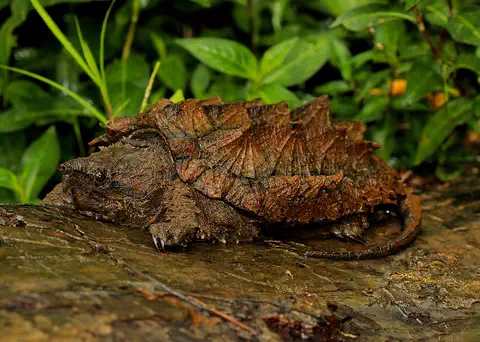
The alligator snapping turtle is the largest freshwater turtle in the United States. It lies still on the bottom of rivers and lakes with its mouth open, wiggling a worm-like lure on its tongue to trick fish into swimming close. Its numbers have fallen, and it is now endangered.
-
 Watch
3D
Animal
American alligator
The American alligator is a large, armored reptile of the swamps, marshes and lakes of the southeastern United States. Alligator mothers guard their nests and carry their babies to the water, and the holes alligators dig help many other animals survive dry seasons.
-
 Watch
Animal
American crocodile
The American crocodile is a large reptile of warm coasts and mangrove swamps, from the southern tip of Florida through Mexico, Central America, the Caribbean and northern South America. It is shy, it basks in the sun to warm up, and mother crocodiles carry their babies to the water.
For parents & teachers
What children will learn
- Describe the giant tortoise's body (domed shell joined to its skeleton, toothless mouth, scaly legs).
- Explain how shell shape links to the habitat on different Galápagos islands.
- Describe seasonal migration between dry lowlands and misty highlands.
- Explain why the species is Critically Endangered and how captive rearing helps.
Recommended ages: 3 to 17 · About 15 minutes
Talk about it
- Why might tortoises on different islands have different shell shapes?
- Why do you think only the big tortoises walk up into the highlands?
- How can animals people bring to an island cause problems for the animals already there?
Try at home or in class
- Look at a honeycomb picture or a cardboard egg box: talk about why a shell full of small spaces can be strong but light.
- Walk very slowly across a room, a step every few seconds, to feel how a giant tortoise travels.
Key vocabulary: carapace, herbivore, island, migration, species, critically endangered
Where these facts come from
- The IUCN Red List of Threatened Species , International Union for Conservation of Nature (IUCN terms of use (no redistribution of Red List data or range maps))
- GBIF Backbone Taxonomy and GBIF Occurrence Search , Global Biodiversity Information Facility (CC0 1.0 (backbone); occurrence counts are facts derived from records under CC0, CC BY and CC BY-NC)
- Wikidata , Wikimedia Foundation (CC0 1.0)
- Chelonoidis porteri (Western Santa Cruz Giant Tortoise), Red List assessment 2016 , IUCN Red List of Threatened Species
- Description of a New Galapagos Giant Tortoise Species (Chelonoidis; Testudines: Testudinidae) from Cerro Fatal on Santa Cruz Island , PLOS One (Poulakakis et al., 2015)
- Galápagos biodiversity , Galápagos Conservancy
- Giant tortoise restoration in the Galápagos Islands , Galápagos Conservancy
- Galápagos giant tortoise , San Diego Zoo Wildlife Alliance
- Galapagos tortoises are a migrating species , Max Planck Society
- Galapagos tortoise , Encyclopaedia Britannica
- Wikimedia Commons , Wikimedia Foundation (Per file: Public domain, CC0, CC BY or CC BY-SA only (credited on each page))
Checked, not yet human-reviewed. Last updated October 27, 2026. Spotted a mistake? Tell us.