
Animal
Marine iguana
The marine iguana is a dark lizard that swims in the sea. It lives only on the Galápagos Islands and eats seaweed.
The marine iguana is the only lizard in the world that finds its food in the sea. It lives only on the rocky shores of the Galápagos Islands, where it grazes on seaweed, warms up on black lava rocks and sneezes out extra salt.
Amblyrhynchus cristatus, endemic to the Galápagos Islands of Ecuador, is the only lizard that forages in the ocean, grazing on marine algae between the tides and, in the largest animals, on the seabed. Its numbers rise and crash with El Niño and La Niña, and the IUCN lists it as Vulnerable with a decreasing trend.
Photo: E bailey, CC BY-SA 4.0, via Wikimedia Commons
Meet the marine iguana
The marine iguana is a lizard that swims in the sea.
It is dark gray or black, with spikes along its back. It lives on rocky islands in the ocean and eats seaweed.
The marine iguana is a lizard that lives on land but finds almost all its food in the sea. No other lizard in the world does this. It goes into the cold ocean to nibble seaweed, then climbs back onto the rocks to warm up.
Marine iguanas have short, blunt faces, spiky crests along the back and long, sharp claws. Most are dark gray or black, but in some places grown-ups turn red, green or gray, and males become extra colorful in the breeding season.
Amblyrhynchus cristatus is a single species divided into 11 subspecies on different islands, according to the IUCN. It is the only lizard that forages in the ocean, and it varies a great deal from island to island in size, shape and color. Males are larger than females, with differently shaped heads and bigger spines along the head and back.
Its ancestors are thought to have reached the islands from South America by floating on rafts of vegetation; the Galápagos Conservancy reports that marine and land iguanas split about 10.5 million years ago. Young marine iguanas are black, and adults range from black to red, green and gray depending on the island.
Quick facts
- Group
- Reptile
- Length
- up to 1.5 m
- Weight
- 1.5 kg
Where it lives
Marine iguanas live only on the Galápagos Islands.
These islands are far out in the Pacific Ocean. The iguanas live on rocky shores right next to the sea.
Marine iguanas live only on the Galápagos Islands, which belong to Ecuador and lie far out in the Pacific Ocean. They live on almost every rocky shore there, on big islands and tiny islets alike.
They stay close to the sea, usually within about 2 kilometers of the coast. Females travel a little way inland to dig their nests in sandy ground, and big males dive into the sea to feed.
The species is endemic to the Galápagos Archipelago. The IUCN's 2020 assessment lists it on the large islands of Española, Fernandina, Floreana, Genovesa, Isabela, Marchena, Pinta, San Cristóbal, Santa Cruz, Santa Fé and Santiago, on mid-sized islands such as Baltra and the Plazas, on Darwin, Wolf and Roca Redonda, and on many islets.
It lives within about 2 kilometers of the shore, on rocky coasts and in the intertidal zone, from near sea level (below 200 meters) down into the sea, with nesting females up to 2 kilometers inland and large males foraging at depths of up to 30 meters. The whole range lies inside the Galápagos National Park and Marine Reserve.
Continent
Did you know?
Underwater, a marine iguana's heart beats slowly.
When a marine iguana swims into the sea, its heartbeat slows to about half its normal speed.
On entering the water the heart rate falls to about half its normal rate, which the Galapagos Conservation Trust links to saving energy so the iguana can feed longer.
Where can you find this animal?
- Lives here naturally · Countries and seas named by a scientific source
- Sightings recorded · Records of wild sightings (GBIF)
Lives here naturally · Countries and seas named by a scientific source
Rocky coasts of the Galápagos Islands, Ecuador, within about 2 kilometers of the sea. The shading covers all of Ecuador, but marine iguanas live only on the Galápagos Islands, not on the mainland.
Places: Ecuador.
Source: iucn-red-list · checked October 2026
Sightings recorded · Records of wild sightings (GBIF)
Counts of GBIF records of wild observations (human and machine) and preserved specimens. Records include introduced populations, vagrants, escaped or released animals and misidentifications, so a country with records is not necessarily part of the native range.
Wild sightings have been recorded in Ecuador, Pacific Ocean, Southern Ocean, Arctic Ocean, Atlantic Ocean and Indian Ocean.
Source: gbif · checked October 2026
Range maps show where scientists say an animal lives, often country by country. An animal may live in only part of a country shown, and sightings records can include animals that wandered far from home.
What it eats
Marine iguanas eat seaweed.
Most of them nibble seaweed on the rocks when the tide goes out. The biggest ones dive under the water to find more.
Marine iguanas are herbivores that eat algae, the plant-like living things we often call seaweed. Most of them graze on rocks by the shore when the tide goes out and the seaweed is uncovered.
The biggest iguanas swim farther out and dive under the water to feed on seaweed beds on the seabed. Their short, blunt snouts and small, sharp teeth help them scrape seaweed off the rocks.
The diet is almost entirely marine algae, mainly red algae of the genera Centroceras, Gelidium and Pterocladia and green Ulva, grazed when exposed at low tide (IUCN). Most iguanas feed in the intertidal zone, but the largest animals in each colony dive to offshore algal beds about 2 to 30 meters deep. Some populations add salty coastal plants such as saltwort.
The short, blunt snout and small, sharp teeth suit scraping algae from rock (National Geographic). The diet swings with the ocean: in El Niño years warm water replaces the algae they can digest with brown algae they cannot, and many iguanas starve.
Did you know?
Some marine iguanas turn red and green.
Marine iguanas on Española Island are the most colorful of all, with bright red and green patches.
Coloration varies by island: young iguanas are black, adults range from black to red, green and gray, and Española's marine iguanas are the most colorful (Galápagos Conservancy).
Built for sea and sun
A marine iguana has a flat tail for swimming.
Its sharp claws hold on to wet rocks. Its dark skin soaks up the sun. It sneezes to get rid of extra salt.
Look at the photo: this iguana is dark, which helps it soak up the sun's warmth after a swim in the cold sea. Its long, sharp claws grip slippery rocks, even in strong currents.
In the water, it swims by pushing with its flattened tail while its legs rest against its body. Seaweed is salty, so marine iguanas have a special gland connected to the nose that cleans extra salt out of the blood. They sneeze the salt out, and it often dries into white crusts on their heads.
The marine iguana is ectothermic, and the Galápagos waters are cold, so it cannot stay in the sea for long. Dark skin absorbs sunlight while it basks, and the Galapagos Conservation Trust reports that its heartbeat slows to about half its normal rate once it enters the water.
A flattened tail drives it through the water, with the legs held at its sides, and long, sharp claws anchor it to rocks in strong currents. Salt swallowed with algae is removed from the blood by a gland connected to the nostrils and sneezed out, often leaving a white crust of salt on the head (National Geographic; Galapagos Conservation Trust).
Growing up
A mother marine iguana digs a hole in the sand.
She lays two or three eggs inside. The babies hatch a few months later. Baby marine iguanas are black.
Marine iguanas have one breeding season a year, at the time when their seaweed is best. During this season males become more colorful. About four weeks after mating, each female digs a burrow in sandy ground and lays her eggs, usually two or three.
The eggs stay in the burrow for about three months. The hatchlings are small and black. Young iguanas on land have to watch out for hawks, herons and other birds that try to catch them.
Breeding happens once a year in a month-long season timed to the richest, most nutritious algae, so it falls at different times on different islands (IUCN). Around four weeks after mating, females dig and defend burrows in sandy areas and lay 1 to 6 eggs, most often 2 or 3, depending on their condition and food supply. Incubation takes about three months, and hatchlings weigh about 50 grams.
Most females lay eggs only every two years, but yearly when food is plentiful. Young iguanas on land are taken by hawks, herons and other birds (Galápagos Conservancy), and on islands with introduced cats, hatchling survival can collapse: the IUCN cites 1 percent survival at a cat-affected colony on Santa Cruz compared with 53 percent on Santa Fé.
Warming up together
On cold nights, marine iguanas cuddle up in groups.
In the morning they lie on the rocks in the sun. When they are warm, they swim out to eat.
Marine iguanas often pile together in big groups, especially on cold nights, which helps them keep warm. In the morning they bask in the sun until they are warm enough to swim out and feed.
In the breeding season, a few strong males guard tiny patches of ground and bob their heads to impress females. When food runs short in an El Niño year, adults do something amazing: they actually get shorter, and grow back again when food returns.
Not truly social but highly gregarious, marine iguanas cluster on cold nights and bask in the morning before foraging (Galapagos Conservation Trust). The IUCN describes them as the only lizard known to use a lek mating system: dominant males defend small territories with no resources but themselves, head-bob to court females, and a single territorial male may account for 35 percent of matings on a lek.
During El Niño food shortages adults can shrink in body length within a few months, apparently by absorbing some of their own bone, and regrow when food returns. The Galápagos Conservancy describes this as the first known case of a shrinking adult vertebrate, reported in the journal Nature.
Did you know?
Marine iguanas sneeze out salt.
Marine iguanas swallow lots of salt with their seaweed. They sneeze it out, and it can dry into a white crust on their heads.
A salt gland connected to the nostrils removes excess salt from the blood; the iguana sneezes it out, often leaving white salt crystals on its head (Galapagos Conservation Trust).
Protecting marine iguanas
Marine iguanas need help.
Cats and rats brought by people catch baby iguanas. Oil and plastic in the sea are a problem too. All the places they live are protected.
Marine iguanas are listed as vulnerable. Their numbers go up and down a lot: in El Niño years, when the sea warms and their seaweed changes, many of them starve.
People have brought cats, rats, dogs and pigs to the islands, and these catch young iguanas. Oil spills and plastic in the sea are dangers too. All the islands where marine iguanas live are protected, and people are working to remove the animals that hunt them.
The IUCN assessment (made in 2019, published in 2020) lists the species as Vulnerable (A2abce+4abce) with a decreasing trend. Total numbers are known only roughly, from about 33,000 after a strong El Niño to 350,000 after good La Niña years, and El Niño mortality ranges from 10 to 90 percent.
Introduced cats, rats, dogs and pigs prey on young iguanas on several large islands. Growing tourism and settlement bring pollution and the risk of new species and diseases: after a tanker spill in 2001, 62 percent of the Santa Fé population died. The whole range lies in protected areas, and cats have been removed from Baltra and Venecia and rats from Seymour Norte; scientists recommend more control of introduced predators and better monitoring.
IUCN Red List
How is the marine iguana doing in the wild?
- Least Concern
- Near Threatened
- Vulnerable (this animal)
- Endangered
- Critically Endangered
- Extinct in the Wild
- Extinct
Vulnerable
At high risk of disappearing from the wild.
See the IUCN Red List assessment · The IUCN Red List of Threatened Species 2022.2
Amazing facts
-
Marine iguanas sneeze out salt.
Marine iguanas swallow lots of salt with their seaweed. They sneeze it out, and it can dry into a white crust on their heads.
A salt gland connected to the nostrils removes excess salt from the blood; the iguana sneezes it out, often leaving white salt crystals on its head (Galapagos Conservation Trust).
-
When food is hard to find, marine iguanas get shorter.
In hungry El Niño years, grown-up marine iguanas can actually shrink in length, then grow back when there is food again.
Shrinking in body length during El Niño famine, apparently by absorbing bone, was described as the first known case in an adult vertebrate (Galápagos Conservancy).
-
Underwater, a marine iguana's heart beats slowly.
When a marine iguana swims into the sea, its heartbeat slows to about half its normal speed.
On entering the water the heart rate falls to about half its normal rate, which the Galapagos Conservation Trust links to saving energy so the iguana can feed longer.
-
Some marine iguanas turn red and green.
Marine iguanas on Española Island are the most colorful of all, with bright red and green patches.
Coloration varies by island: young iguanas are black, adults range from black to red, green and gray, and Española's marine iguanas are the most colorful (Galápagos Conservancy).
Words to know
- algae
- simple plant-like living things, such as seaweed
- endemic
- found in only one place in the world
- bask
- to lie in the sun to warm up
- gland
- a body part that makes or removes a special substance
- El Niño
- a change in ocean currents that makes the eastern Pacific warmer for a while
- vulnerable
- at risk of becoming endangered
Discovery challenge
-
What does a marine iguana eat?
What is a marine iguana's main food?
What makes up almost all of a marine iguana's diet?
- Fish
- Seaweed
- Insects
Show the answer
Seaweed
Marine iguanas eat seaweed from the rocks and the sea.
They graze on seaweed (algae) on rocks at low tide, and big ones dive for it.
Almost entirely marine algae, mainly red algae and green Ulva.
-
How does a marine iguana get rid of extra salt?
How do marine iguanas get rid of the salt from their food?
How does the marine iguana excrete excess salt?
- It sneezes it out
- It sweats it out
- It keeps it in its tail
Show the answer
It sneezes it out
It sneezes the salt out of its nose.
A gland connected to the nose cleans salt out of the blood, and the iguana sneezes it out.
A salt gland connected to the nostrils removes salt from the blood; it is expelled by sneezing.
-
Where do marine iguanas live?
Where in the world do marine iguanas live?
What is the marine iguana's range?
- All over South America
- Only on the Galápagos Islands
- In the Arctic
Show the answer
Only on the Galápagos Islands
They live only on the Galápagos Islands.
They live only on the Galápagos Islands, which belong to Ecuador.
Endemic to the Galápagos Archipelago, within about 2 kilometers of the coast.
-
Why do marine iguanas lie in the sun?
Why do marine iguanas bask on the rocks?
Why must marine iguanas bask after foraging?
- To dry their eggs
- To warm up after the cold sea
- To hide from fish
Show the answer
To warm up after the cold sea
The sea is cold. The sun warms them up again.
The sea around the Galápagos is cold, so iguanas warm up in the sun before and after they feed.
As ectotherms foraging in cold water, they cannot stay in the sea long and must bask to regain body heat.
Places where you might see it
-
 Watch
Natural wonder
Galápagos Islands
The Galápagos Islands are a group of volcanic islands in the Pacific Ocean, about 1,000 kilometers off the coast of Ecuador. Many of their animals live nowhere else on Earth, and they helped inspire Charles Darwin's theory of evolution by natural selection.
-
Watch
 Country
Ecuador
Ecuador is a country in northwestern South America, named after the equator, which crosses it. In a small space it holds Pacific beaches, high snowy volcanoes of the Andes, part of the Amazon rainforest and the Galápagos Islands, whose wildlife helped Charles Darwin develop his ideas.
Explore next
-
 Watch
3D
Animal
Green iguana
The green iguana is a large lizard from the forests of Central and South America. It climbs high into trees to bask in the sun, eats leaves, flowers and fruit, and dives into rivers to get away from danger. It can grow to about 2 meters long, tail included.
-
Watch
Natural wonder
Galápagos Islands
The Galápagos Islands are a group of volcanic islands in the Pacific Ocean, about 1,000 kilometers off the coast of Ecuador. Many of their animals live nowhere else on Earth, and they helped inspire Charles Darwin's theory of evolution by natural selection.
-
Watch
Country
Ecuador
Ecuador is a country in northwestern South America, named after the equator, which crosses it. In a small space it holds Pacific beaches, high snowy volcanoes of the Andes, part of the Amazon rainforest and the Galápagos Islands, whose wildlife helped Charles Darwin develop his ideas.
-
 Watch
Animal
Santa Cruz giant tortoise
The Santa Cruz giant tortoise lives only on the western side of Santa Cruz Island in the Galápagos. It has a big, dome-shaped shell, eats grass, leaves and cactus, walks between the dry lowlands and the misty highlands, and can live for well over a century.
-
 Watch
Animal
Blue-footed booby
The blue-footed booby is a seabird of the tropical eastern Pacific, from Mexico to Peru and the Galápagos Islands. Its bright blue feet star in its courtship dance: birds with bluer feet are more likely to find a mate. It catches fish by diving into the sea from high in the air.
-
 Watch
Animal
Aldabra giant tortoise
The Aldabra giant tortoise is one of the largest land tortoises on Earth. Wild ones live on Aldabra Atoll, a ring of coral islands in the Indian Ocean, where more than 100,000 of them graze, browse and shape the land like elephants do in Africa. They can live for more than 100 years.
-
 Watch
Animal
Alligator snapping turtle
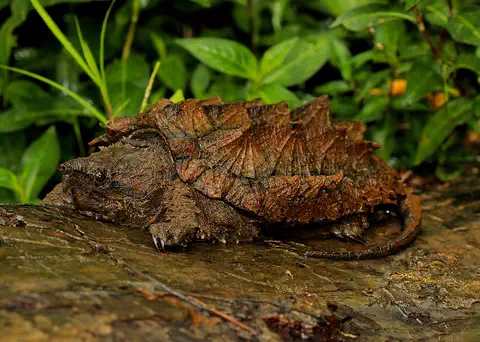
The alligator snapping turtle is the largest freshwater turtle in the United States. It lies still on the bottom of rivers and lakes with its mouth open, wiggling a worm-like lure on its tongue to trick fish into swimming close. Its numbers have fallen, and it is now endangered.
-
 Watch
3D
Animal
American alligator
The American alligator is a large, armored reptile of the swamps, marshes and lakes of the southeastern United States. Alligator mothers guard their nests and carry their babies to the water, and the holes alligators dig help many other animals survive dry seasons.
For parents & teachers
What children will learn
- Explain what makes the marine iguana the only sea-feeding lizard and how its body suits that life.
- Describe how a cold-blooded animal uses the sun to warm up.
- Describe the marine iguana's life cycle and how El Niño affects its numbers.
- Understand why introduced animals and pollution threaten island wildlife.
Recommended ages: 3 to 17 · About 15 minutes
Talk about it
- Why might an island animal be in trouble when people bring cats and rats to its island?
- How do you warm up after a swim in cold water? How is that like a marine iguana?
- Why do you think marine iguanas on different islands look different?
Try at home or in class
- On a sunny day, put a black sheet of paper and a white sheet side by side in the sun for ten minutes, then feel which is warmer.
- Make a salt crust: dissolve a spoonful of salt in a little warm water, paint it on dark paper and let it dry to see white crystals form.
Key vocabulary: algae, endemic, bask, gland, El Niño, vulnerable
Where these facts come from
- The IUCN Red List of Threatened Species , International Union for Conservation of Nature (IUCN terms of use (no redistribution of Red List data or range maps))
- GBIF Backbone Taxonomy and GBIF Occurrence Search , Global Biodiversity Information Facility (CC0 1.0 (backbone); occurrence counts are facts derived from records under CC0, CC BY and CC BY-NC)
- Amblyrhynchus cristatus (Marine Iguana), global Red List assessment 2020 , IUCN Red List of Threatened Species
- Marine iguana , Galapagos Conservation Trust
- Galápagos biodiversity , Galápagos Conservancy
- Marine iguana , National Geographic
- Wikidata , Wikimedia Foundation (CC0 1.0)
- Wikimedia Commons , Wikimedia Foundation (Per file: Public domain, CC0, CC BY or CC BY-SA only (credited on each page))
Checked, not yet human-reviewed. Last updated October 27, 2026. Spotted a mistake? Tell us.