
Animal
Spotted eagle ray
The spotted eagle ray is a flat fish. It flaps its wide fins like wings. It is dark with bright white spots and has a very long, thin tail.
The spotted eagle ray is a ray that 'flies' through warm Atlantic waters by flapping its wide, wing-like fins. Its dark back is covered in white spots, its tail is long and whip-like, and its snout looks a bit like a duck's bill, which it uses to dig for clams and other shellfish.
Aetobatus narinari, the whitespotted eagle ray, is a large coastal ray of the warm Atlantic, reaching about 2.3 meters across. A 2019 genetic study restricted the species to the Atlantic; related eagle rays elsewhere are now separate species. It crushes shellfish with plate-like teeth, has only a few pups a year, and has been assessed as Endangered by the IUCN because of heavy inshore fishing.
Photo: Keithmccall, public domain, via Wikimedia Commons
Meet the spotted eagle ray
The spotted eagle ray is a fish with a flat body and wide fins.
It flaps its fins like a bird flaps its wings. Its back is dark with lots of white spots. Its tail is long and thin, like a whip.
The spotted eagle ray is a ray, a fish related to sharks, with a flat, diamond-shaped body. Its wide side fins work like wings, and as it flaps them it seems to fly through the water.
Its back is dark gray, brown or black and covered with small white or pale spots or rings, and its belly is white. It has a rounded head with a snout shaped a little like a duck's bill, and a whip-like tail that can be two and a half to three times as long as its body is wide.
Aetobatus narinari is a cartilaginous fish (class Chondrichthyes, order Myliobatiformes) placed by the IUCN in the eagle ray family Aetobatidae; it reaches about 230 centimeters in disc width. The IUCN's preferred English name is Whitespotted Eagle Ray. A 2019 phylogeographic study (Sales and colleagues) restricted the name to the western Atlantic, and Fricke and colleagues (2020) added the eastern Atlantic, so rays in the Indo-Pacific and eastern Pacific that were once included now belong to other species, such as the ocellated eagle ray (Aetobatus ocellatus).
The Florida Museum describes an angular disc about twice as wide as long, a long, broad snout with a duckbill-shaped lobe below, large spiracles, pointed pectoral tips, no tail fin, and a whip-like tail 2.5 to 3 times the disc width, carrying two to six short spines.
Quick facts
- Group
- Fish
- Wingspan
- up to 2.3 m
Bays, lagoons and reefs of the Atlantic
Spotted eagle rays live in warm parts of the Atlantic Ocean.
They swim near coral reefs, in bays and near beaches. Sometimes they swim in big groups.
Spotted eagle rays live in warm coastal waters on both sides of the Atlantic Ocean: from North Carolina in the United States south to Brazil, including the Gulf of Mexico and the Caribbean, and along the coast of West Africa.
They swim over the shallow sea floor near land, from the surface down to about 60 meters. They often visit lagoons and river mouths and are often seen around coral reefs.
The IUCN (2021) maps the species from Cape Hatteras, North Carolina, to Rio de Janeiro, Brazil, including the Gulf of Mexico, the Bahamas and the Caribbean, and in the eastern Atlantic from Mauritania to Angola and possibly South Africa. It is benthopelagic over the continental shelf from the surface to 60 meters, frequently enters lagoons and estuaries, and is often associated with coral reefs.
The Florida Museum adds that these rays can swim long distances across open water, as shown by their presence in Bermuda, often in large schools near the surface, and that individuals show high site fidelity, staying in or returning to the same places.
Its habitat

Where can you find this animal?
- Lives here naturally · Countries and seas named by a scientific source
- Sightings recorded · Records of wild sightings (GBIF)
Lives here naturally · Countries and seas named by a scientific source
Warm coastal waters of the Atlantic: from North Carolina to southern Brazil, including the Gulf of Mexico and the Caribbean, and from Mauritania to Angola. Shading is by whole ocean, much wider than the coastal shelf the rays use. Eagle rays in the Indian and Pacific Oceans are now treated as other species.
Places: Atlantic Ocean.
Source: iucn-red-list · checked October 2026
Sightings recorded · Records of wild sightings (GBIF)
Counts of GBIF records of wild observations (human and machine) and preserved specimens. Records include introduced populations, vagrants, escaped or released animals and misidentifications, so a country with records is not necessarily part of the native range.
Wild sightings have been recorded in United States, Mexico, Belize, New Caledonia, Brazil, Honduras, Nigeria, Colombia and 67 more places.
Source: gbif · checked October 2026
Range maps show where scientists say an animal lives, often country by country. An animal may live in only part of a country shown, and sightings records can include animals that wandered far from home.
A shellfish cracker
Spotted eagle rays eat clams and other shellfish.
They dig in the sand with their snout. Their flat teeth crunch the shells.
Spotted eagle rays dig in mud and sand with their shovel-shaped snout to find buried animals such as clams, oysters and whelks. They also eat shrimp, octopus, squid, sea urchins and some fish.
Inside the mouth, flat teeth join together to make a hard plate that crushes shells like a nutcracker. Little bumps in the mouth then help separate the soft food from the broken shell, and the ray spits the shell out.
The Florida Museum lists clams, oysters, shrimp, octopus, squid, sea urchins and bony fishes as prey. The shovel-shaped snout and duckbill-like subrostral lobe are used to search mud for buried invertebrates.
Each jaw has a single row of broad, flat teeth fused into a plate; the upper plate spans about 80 percent of the mouth's width and the lower about 60 percent. Rows of papillae on the roof and floor of the mouth separate shell from flesh, and stomach contents examined contained prey without shell fragments.
Did you know?
Eagle rays like to come back to their favorite places.
Many spotted eagle rays stay in, or keep coming back to, the same places.
The species shows high site fidelity, with individuals staying in or returning to the same locations (Florida Museum).
Wings, spots and a whip
The ray's wide fins are its wings.
Its back is covered in white spots. Its tail is very long. It has a few little spines near the start of its tail.
A spotted eagle ray's 'wings' are really its pectoral fins, joined to its head and body to make one wide, flat disc. Flapping them up and down pushes the ray through the water.
The white spots on its dark back can be white, bluish, greenish or yellowish, and some rays have pale rings instead of spots. Its skin is smooth, without the tiny rough scales called denticles. Near the base of its long tail are a few short spines that it uses to defend itself.
The ray swims by undulating its broad, pointed pectoral fins. Spots may be white, bluish, greenish, pearly or yellow on black, dark gray or brown, sometimes replaced by pale rings with dark centers; the underside is white, and the disc margins and tail are dark (Florida Museum). The skin lacks denticles and thorns.
Two to six short spines with barbed tips sit just behind the small dorsal fin. The Florida Museum notes that the species is shy and wary of divers but considered potentially dangerous to people because these venomous spines can inflict serious wounds; they are used in defense.
A few pups at a time
Mother eagle rays have live babies called pups.
They have only a few pups at a time. The pups look like small copies of their parents.
Spotted eagle rays do not lay eggs. The babies grow inside their mother for about a year, and then she gives birth to between one and five pups, usually three. Each newborn pup is already 18 to 36 centimeters across, like a small copy of its parents.
They grow up slowly: a ray is about 1.3 meters across before it is ready to have pups of its own.
Reproduction is matrotrophic viviparity, in which the young develop inside the mother and receive nourishment from her (IUCN). The IUCN gives litters of one to five pups (average three) produced every year after a 12-month gestation, with a disc width at birth of about 18 to 36 centimeters. Males mature at 127 to 129 centimeters disc width and females at about 135 centimeters.
The IUCN infers a generation length of about 10 years, scaled from the larger ocellated eagle ray. The Florida Museum describes mating in which one or more males pursue a female; it notes that sharks such as great hammerheads prey on eagle rays and have been reported following them in the birthing season.
Flying through the sea
Spotted eagle rays glide through the water like birds in the sky.
Sometimes they jump right out of the water! They often swim together in groups.
Spotted eagle rays are graceful swimmers that seem to fly through the water. In open water they often swim in large schools close to the surface, and they can travel long distances.
They are shy and usually stay away from divers. When chased, an eagle ray can leap right out of the water. Many rays return again and again to the same favorite places.
The Florida Museum describes the species as spending much of its time schooling in open water near the surface, capable of long-distance travel, and showing high site fidelity and social interaction with others of its kind. When pursued it can leap completely out of the water, and when caught and taken from the water it produces loud sounds.
Its swimming behavior also exposes it to fishing gear throughout the water column, especially inshore gillnets (IUCN). It is a popular species in public aquariums.
Did you know?
Eagle rays crunch shells with flat teeth.
An eagle ray's teeth are joined into flat plates that work like nutcrackers on clams and oysters.
Each jaw bears a single row of broad, flat teeth forming a plate; papillae in the mouth separate shell from flesh.
Rays in trouble
There are fewer spotted eagle rays than before.
Many are caught in fishing nets near the coast. People are working on rules to protect them.
The spotted eagle ray is endangered. Because it swims near the coast where many people fish, it is often caught in nets, and in many places there are no rules to limit the catch.
In some places, such as Belize, the number of rays has stayed steady, but in other places they have become much rarer. In parts of West Africa, scientists have hardly seen any for years.
The IUCN assessed the whitespotted eagle ray as Endangered (A2bd) in 2020 (published 2021), suspecting a 50 to 79 percent decline over three generations (30 years). It is taken in gillnets, trawls and beach seines, as a target of small-scale fisheries and as retained bycatch of shrimp trawlers. Catch rates in the southern Gulf of Mexico fell from 30 to 40 rays per trip to 10 to 15, and landings in Pernambuco, Brazil, fell by about 80 percent since 1995.
In West Africa there have been very few recent records, suggesting the species may have largely disappeared there, while abundance in Belize was stable from 2009 to 2018 and populations may be stable in US and Caribbean island waters. Fisheries taking it are largely unmanaged, though some countries, such as Cuba, have national plans for sharks and rays.
IUCN Red List
How is the spotted eagle ray doing in the wild?
- Least Concern
- Near Threatened
- Vulnerable
- Endangered (this animal)
- Critically Endangered
- Extinct in the Wild
- Extinct
Endangered
At very high risk of disappearing from the wild.
See the IUCN Red List assessment · The IUCN Red List of Threatened Species 2022.2
Amazing facts
-
Eagle rays can jump out of the water!
When something chases it, a spotted eagle ray can leap right out of the water.
The species is capable of leaping completely clear of the water when pursued (Florida Museum).
-
An eagle ray's tail can be longer than its whole body is wide.
A spotted eagle ray's tail can be two and a half to three times as long as the ray is wide.
Undamaged tails reach 2.5 to 3 times the disc width; there is no caudal fin.
-
Eagle rays crunch shells with flat teeth.
An eagle ray's teeth are joined into flat plates that work like nutcrackers on clams and oysters.
Each jaw bears a single row of broad, flat teeth forming a plate; papillae in the mouth separate shell from flesh.
-
Eagle rays like to come back to their favorite places.
Many spotted eagle rays stay in, or keep coming back to, the same places.
The species shows high site fidelity, with individuals staying in or returning to the same locations (Florida Museum).
Words to know
- ray
- a flat fish related to sharks, with wide fins joined to its head
- pectoral fins
- the pair of fins on a fish's sides; in a ray they form its 'wings'
- disc
- the flat, wide body of a ray, including its wing-like fins
- lagoon
- a shallow area of sea water partly cut off from the ocean
- pup
- a baby ray or shark
- spine
- a sharp, pointed part that an animal can use to defend itself
Discovery challenge
-
How does an eagle ray swim?
How does a spotted eagle ray move through the water?
Which fins drive the eagle ray's swimming?
- It flaps its wide fins like wings
- It walks on its legs
- It rolls like a ball
Show the answer
It flaps its wide fins like wings
It flaps its wide fins, like a bird flapping its wings.
It flaps its wing-like pectoral fins and seems to fly through the water.
The broad pectoral fins, undulated to 'fly' through the water.
-
What do eagle rays eat?
Which food do spotted eagle rays dig up and crush?
What kind of prey are the eagle ray's tooth plates built to crush?
- Clams and oysters
- Leaves
- Bananas
Show the answer
Clams and oysters
They eat clams and oysters and crunch the shells.
They dig clams, oysters and whelks out of the mud and crush the shells with flat teeth.
Hard-shelled invertebrates such as clams, oysters and whelks, crushed by fused tooth plates.
-
What is on the eagle ray's back?
What pattern covers a spotted eagle ray's back?
Which dorsal pattern is typical of the species?
- Stripes like a zebra
- White spots on a dark back
- Bright red squares
Show the answer
White spots on a dark back
Lots of white spots on a dark back.
Its dark back is covered in small white or pale spots, and some rays have rings instead.
Small pale spots, or rings with dark centers, on a dark disc.
-
In which ocean do spotted eagle rays live?
Which ocean is home to the spotted eagle ray?
To which ocean is Aetobatus narinari now restricted?
- The Atlantic Ocean
- The Arctic Ocean
- The Southern Ocean
Show the answer
The Atlantic Ocean
They live in the warm Atlantic Ocean.
They live along warm Atlantic coasts of the Americas and Africa.
The Atlantic, following the 2019 phylogeographic revision; other oceans hold related species.
Places where you might see it
Explore next
-
 Watch
Animal
Giant oceanic manta ray
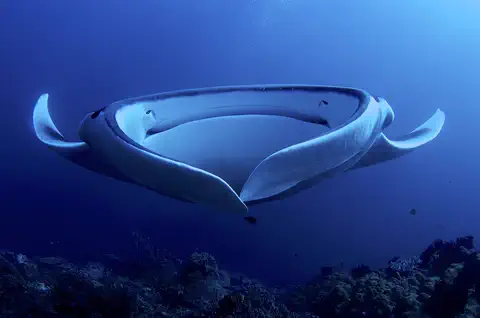
The giant oceanic manta ray is the largest ray in the world, with wing-like fins that can stretch more than 6 meters from tip to tip. This gentle filter feeder funnels plankton into its wide mouth, and it has a single pup only every two to three years.
-
 Watch
Animal
Southern stingray
The southern stingray is a flat, diamond-shaped ray of warm western Atlantic waters, from the eastern United States through the Gulf of Mexico and the Caribbean to South America. It spends much of its time on sandy bottoms, finding buried crabs, shrimp and fish by smell, touch and tiny electric signals.
-
 Watch
 Country
Mexico
Mexico is a large country in southern North America, between the Pacific Ocean and the Gulf of Mexico. It has smoking volcanoes, ancient cities built by the Maya and other peoples, and about 132 million people, many of them in and around Mexico City.
-
 Watch
3D
Animal
Scalloped hammerhead
The scalloped hammerhead is a large shark with a wide, flat head shaped like a hammer, with wavy notches along the front edge. It lives in warm coastal seas around the world, gathers in big schools, and hunts fish and squid. It is now critically endangered because so many are caught.
-
 Watch
Animal
Green sea turtle
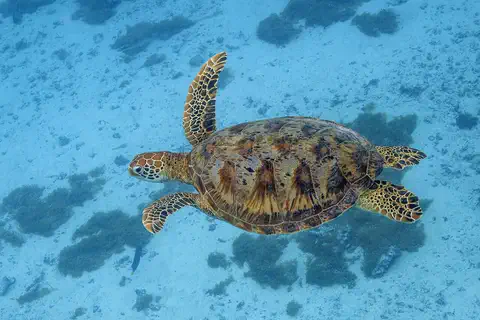
The green sea turtle is the largest sea turtle with a hard shell. It lives in warm seas around the world and, unlike other sea turtles, grown-ups eat mostly seagrass and algae. Females swim hundreds or even thousands of kilometers to lay their eggs on the beaches where they hatched long ago.
-
 Watch
Animal
Smalltooth sawfish
The smalltooth sawfish is a giant ray with a shark-like body and a long, flat snout edged with teeth, called a rostrum or saw. It swings the saw to stun fish and uses it to sense their tiny electric signals. Young sawfish grow up among mangroves. Once found on both sides of the Atlantic, it is now Critically Endangered.
-
 Watch
Animal
Great hammerhead
The great hammerhead is the biggest of the hammerhead sharks. Its wide, flat head, called a cephalofoil, holds its eyes far apart and is packed with senses that help it find stingrays hiding in the sand of warm, shallow seas.
-
 Watch
Animal
Alligator gar
The alligator gar is one of the largest freshwater fish in North America. It has a broad snout lined with teeth, armor-like scales, and a swim bladder that works like a lung, so it can gulp air in warm, still water. It lives in the big rivers, swamps and bayous of the southern United States, Mexico and Central America.
For parents & teachers
What children will learn
- Describe how the spotted eagle ray swims, feeds and defends itself.
- Explain how plate-like teeth help an animal eat shellfish.
- Understand that new genetic studies can split one species into several.
- Explain why animals with few young are hurt by heavy fishing.
Recommended ages: 3 to 17 · About 10 minutes
Talk about it
- How is an eagle ray's way of swimming like a bird's flying, and how is it different?
- Why might a ray that has only a few pups a year be at risk if many are caught?
- Why do you think scientists needed genetic tests to tell eagle rays from different oceans apart?
Try at home or in class
- Crack a walnut with a nutcracker and compare it with how an eagle ray's tooth plates crush shells.
- Cut a diamond-shaped ray from paper with a long string tail and move it up and down through the air to copy the flapping motion.
Key vocabulary: ray, pectoral fins, disc, lagoon, pup, spine
Where these facts come from
- The IUCN Red List of Threatened Species , International Union for Conservation of Nature (IUCN terms of use (no redistribution of Red List data or range maps))
- GBIF Backbone Taxonomy and GBIF Occurrence Search , Global Biodiversity Information Facility (CC0 1.0 (backbone); occurrence counts are facts derived from records under CC0, CC BY and CC BY-NC)
- Aetobatus narinari (Whitespotted Eagle Ray), 2021 global assessment , IUCN Red List of Threatened Species
- Spotted eagle ray species profile , Florida Museum of Natural History
- Wikidata , Wikimedia Foundation (CC0 1.0)
- Wikimedia Commons , Wikimedia Foundation (Per file: Public domain, CC0, CC BY or CC BY-SA only (credited on each page))
Checked, not yet human-reviewed. Last updated October 28, 2026. Spotted a mistake? Tell us.