Animal
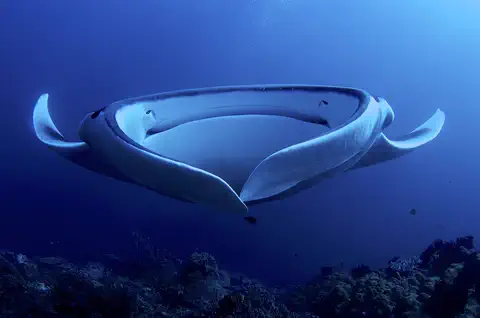
Giant oceanic manta ray
The giant manta ray is a huge, flat fish with wings like a kite. It glides through the sea and eats tiny plankton.
The giant oceanic manta ray is the largest ray in the world, with wing-like fins that can stretch more than 6 meters from tip to tip. This gentle filter feeder funnels plankton into its wide mouth, and it has a single pup only every two to three years.
Mobula birostris, the giant oceanic manta ray, is the largest ray: a migratory, plankton-eating relative of sharks with small, fragmented populations spread across tropical, subtropical and temperate seas. Fishing, driven partly by the trade in its gill plates, has reduced its numbers, and a very low reproductive rate makes recovery slow; the IUCN lists it globally as Endangered.
Photo: Arturo de Frias Marques, CC BY-SA 4.0, via Wikimedia Commons
Meet the giant manta ray
The giant manta ray is a very big, flat fish.
Its wide fins look like wings. It flaps them slowly, as if it is flying under the water. It has a big mouth at the front.
The giant oceanic manta ray is the largest ray in the world. Rays are flat relatives of sharks, and their skeletons are made of bendy cartilage instead of bone.
A manta's body is shaped like a diamond, with long, wing-like fins. Many giant mantas measure about 4 meters from wing tip to wing tip, and the biggest reliably measured was 6.7 meters. Its long, whip-like tail has no sting, so unlike a stingray it cannot sting.
Mobula birostris is the largest of the rays, an elasmobranch (the subclass of cartilaginous fishes that includes sharks and rays) in the family Mobulidae. Its disc, the flattened body and pectoral fins, is wider than it is long; widths of about 4 meters are relatively common, the largest reliably measured was 6.7 meters, and the Australian Museum reports that the species possibly reaches 9.1 meters. NOAA gives a disc width of up to 26 feet and a weight of up to 5,300 pounds.
Manta taxonomy is still changing. Long treated as one species, mantas were split in 2009 into the giant manta and the smaller reef manta (Mobula alfredi). In 2025 scientists formally described a third species, Mobula yarae, from western Atlantic specimens, after more than 15 years of suspecting an undescribed Atlantic manta. So far it is known only from the Atlantic, and which Atlantic mantas belong to which species is still being worked out.
Quick facts
- Group
- Fish
- Wingspan
- up to 6.7 m
- Weight
- up to 2,400 kg
- Lifespan in the wild
- from 45 years
Where it lives
Giant manta rays live in seas around the world.
They swim in the open ocean. They also visit coasts and islands where there is lots of tiny food.
Giant manta rays live in tropical, subtropical and temperate seas around the world. They are often found far offshore, but they also visit food-rich coasts, island groups and underwater mountains called seamounts, and they have even been seen in bays and river mouths.
They can live in water as cool as 19 °C. Off the coast of Ecuador lives the largest known group, thought to be more than 22,000 giant mantas.
The giant manta is found worldwide in tropical, subtropical and temperate waters: offshore in oceanic waters, in productive coastal areas, and occasionally in estuaries, oceanic inlets, bays and intracoastal waterways. It is a seasonal visitor to coastlines with regular upwelling, oceanic island groups, offshore pinnacles and seamounts; NOAA links the timing of visits to zooplankton, currents, tides, upwelling, water temperature and possibly mating.
Temperature preference varies by region: mantas off the U.S. East Coast are commonly found at 19 to 22 °C, while those off the Yucatán Peninsula and Indonesia are commonly found at 25 to 30 °C. Most regional populations appear small, about 600 to 2,000 animals, but Ecuador is thought to hold more than 22,000, with large aggregation sites in Machalilla National Park and the Galápagos Marine Reserve.
Its habitats


Where can you find this animal?
- Lives here naturally · Countries and seas named by a scientific source
- Sightings recorded · Records of wild sightings (GBIF)
Lives here naturally · Countries and seas named by a scientific source
Tropical, subtropical and temperate seas worldwide, offshore and along food-rich coasts, island groups and seamounts, in small, scattered populations. In 2025 a new manta species, Mobula yarae, was described from the western Atlantic, so some Atlantic mantas may belong to it rather than to the giant manta. Shading is by whole ocean, so it is much wider than where giant mantas actually live.
Places: Atlantic Ocean, Indian Ocean and Pacific Ocean.
Source: https://www.fisheries.noaa.gov/species/giant-manta-ray · checked October 2026
Sightings recorded · Records of wild sightings (GBIF)
Counts of GBIF records of wild observations (human and machine) and preserved specimens. Records include introduced populations, vagrants, escaped or released animals and misidentifications, so a country with records is not necessarily part of the native range.
Wild sightings have been recorded in Ecuador, United States, Mexico, Peru, Indonesia, New Zealand, New Caledonia, Brazil and 43 more places.
Source: gbif · checked October 2026
Range maps show where scientists say an animal lives, often country by country. An animal may live in only part of a country shown, and sightings records can include animals that wandered far from home.
What it eats
The giant manta ray eats tiny food called plankton.
It opens its big mouth wide and swims forward. The water rushes in, and tiny animals are caught inside.
Giant mantas are filter feeders. They eat zooplankton, tiny drifting animals such as krill, copepods, shrimp and their larvae, and sometimes small fish.
To feed, a manta unrolls two flaps beside its mouth, called cephalic lobes, and holds them in an O shape. With its mouth wide open, this makes a funnel that pushes water and food inside. Some mantas feed by turning somersaults, over and over, and some form feeding chains with other mantas.
Mantas feed mainly on planktonic organisms, including euphausiids (krill), copepods, mysids, decapod larvae and shrimp, and some studies record small and moderately sized fish. When feeding, a manta holds its cephalic fins in an O shape and opens its mouth wide, creating a funnel that pushes water and prey through the mouth and over the gill plates, which filter out the food.
Feeding strategies are varied, including barrel rolling, somersaulting over and over again, and feeding chains formed with other mantas. Depth use is flexible. Feeding aggregations often form in water less than 10 meters deep, but tagged mantas regularly dive to 200 to 450 meters and can go deeper than 1,000 meters, possibly following prey that shifts with the thermocline and the seasons.
Did you know?
Every manta has its own pattern of spots on its belly.
The spots on a giant manta's belly are different on every animal, so scientists can use them to recognize individuals.
Individual ventral spot patterns allow researchers to identify individual giant mantas.
A body built for gliding
The manta's fins are like giant wings.
Its eyes are on the sides of its head. Two flaps by its mouth help push food in. Its belly has spots, and every manta's spots are different.
A giant manta's body is a wide diamond with long, wing-like pectoral fins. Its eyes are on the sides of its head, its gill slits are underneath, and its wide mouth is right at the front.
Giant mantas come in two color types: chevron, mostly black on the back and white on the belly, and black, almost black on both sides. The spots on a manta's belly make a pattern scientists use to recognize individual animals.
NOAA describes the manta's large, diamond-shaped body with elongated, wing-like pectoral fins, gill slits on the underside, eyes on the sides of the head and a wide terminal mouth. The paired cephalic lobes in front of the mouth make mantas, in NOAA's words, the only vertebrates with three paired appendages.
Giant mantas occur in chevron and black color forms, and individual belly-spot patterns allow researchers to identify animals. Compared with the reef manta, the giant manta is generally larger, has rough skin and a caudal thorn (a lump at the base of the tail), no dark spots between the gill slits, and distinct, roughly triangular white shoulder patches. The whip-like tail lacks a sting, and the teeth are tiny. The Australian Museum notes that manta and devil rays have the largest brains of all sharks and rays.
Growing up
A mother manta has one baby at a time.
The baby grows inside her for about a year before it is born. Mantas can live for a very long time.
Giant mantas have very few babies. A mother usually gives birth to just one pup every two to three years, and scientists think each pregnancy lasts about a year.
Mantas can live for at least 45 years, but scientists still know very little about how they grow up. Because they have so few young, a population that loses many mantas takes a very long time to recover.
Manta rays have among the lowest fecundity of all elasmobranchs: females typically give birth to a single pup every two to three years, after a gestation thought to last about a year. Lifespan is reported to be at least 45 years, and the IUCN gives a generation length of 29 years, but NOAA notes that little is known about growth and development.
These life-history traits mean, in NOAA's assessment, that giant manta populations are inherently vulnerable to depletion and have a low likelihood of recovery once reduced.
Travelers and acrobats
Giant mantas travel far across the sea.
Most of the time a manta swims alone. Sometimes mantas leap right out of the water and land with a big splash!
Giant mantas are migratory: they travel and visit some coasts and islands only in certain seasons, when food is plentiful. They usually swim on their own, but they gather in groups to feed, to mate and at places called cleaning sites.
Most mantas are seen swimming slowly and gracefully, but they can also swim fast. Sometimes they leap out of the water and land on the surface with a loud slap.
The giant manta tends to be solitary but aggregates at cleaning sites, at feeding grounds and to mate. It is migratory, and visits to particular coasts and islands vary by region, apparently tracking zooplankton, current circulation and tidal patterns, upwelling, water temperature and possibly mating.
Divers usually see mantas cruising slowly, but the Australian Museum notes they can swim at rapid speed and are sometimes seen leaping clear of the water and landing back on the surface with a loud slap. Tagging studies reveal flexible depth use, from shallow feeding to dives beyond 1,000 meters, and the global population structure is still poorly understood.

Protecting giant mantas
There are fewer giant mantas than there used to be.
Some are caught by fishing boats. People are working to protect them, and visitors watch them gently.
The giant manta ray is endangered. The biggest threat is fishing: mantas are caught on purpose and by accident in nets and on long fishing lines. Their gill plates, the parts that filter their food, are sold in some markets.
Because a mother has so few pups, NOAA says manta populations recover slowly once they are reduced. In 2018 the United States listed the giant manta as threatened, and fishing for mantas is banned in much of their range, although some illegal fishing continues.
The global IUCN assessment (assessed 2019, published 2022) lists Mobula birostris as Endangered under criteria A2bcd+3d, with a decreasing population; the threat it names is fishing and harvesting of aquatic resources. NOAA identifies commercial overutilization as the most significant threat: giant mantas are targeted and taken as bycatch, especially in artisanal fisheries, purse seines, gill nets, longlines and trawls. Rising demand for gill plates in Asian markets has driven heavy harvests in parts of the Indo-Pacific and Eastern Pacific, with massive population declines and fishery collapse.
NOAA listed the species as threatened under the U.S. Endangered Species Act in 2018, but judges existing regulations inadequate, since targeted fishing and illegal retention continue despite prohibitions. It also lists entanglement, vessel strikes, marine debris, climate change, recreational fishing, tourism and the aquarium trade as threats to monitor.
IUCN Red List
How is the giant oceanic manta ray doing in the wild?
- Least Concern
- Near Threatened
- Vulnerable
- Endangered (this animal)
- Critically Endangered
- Extinct in the Wild
- Extinct
Endangered
At very high risk of disappearing from the wild.
See the IUCN Red List assessment · The IUCN Red List of Threatened Species 2022.2
Amazing facts
-
Every manta has its own pattern of spots on its belly.
The spots on a giant manta's belly are different on every animal, so scientists can use them to recognize individuals.
Individual ventral spot patterns allow researchers to identify individual giant mantas.
-
Mantas can do somersaults while they eat.
Giant mantas sometimes feed by doing somersaults, over and over again.
Barrel rolling, somersaulting over and over again, is one of several feeding strategies, alongside feeding chains formed with other mantas.
-
Manta rays have bigger brains than sharks do.
Manta and devil rays have the largest brains of all sharks and rays.
According to the Australian Museum, manta and devil rays have the largest brains of all elasmobranchs.
-
A manta's tail cannot sting.
Unlike a stingray, a giant manta's long, whip-like tail has no sting.
The whip-like tail of Mobula birostris lacks a sting; a lump at its base, a caudal thorn, helps separate it from the reef manta.
Words to know
- ray
- a flat fish related to sharks, with wide, wing-like fins
- cephalic lobes
- two flaps in front of a manta's mouth that help funnel food inside
- filter feeder
- an animal that strains small food out of the water
- plankton
- tiny living things that drift in the water
- cartilage
- a tough, bendy material that makes up the skeleton of sharks and rays
- seamount
- an underwater mountain that does not reach the surface
Discovery challenge
-
What does a giant manta ray eat?
What is a giant manta ray's main food?
What do giant manta rays mainly feed on?
- Seaweed
- Tiny plankton
- Seals and sea lions
Show the answer
Tiny plankton
Mantas eat tiny plankton floating in the water.
Mantas are filter feeders that eat zooplankton, such as krill and copepods, and sometimes small fish.
Planktonic organisms, including euphausiids, copepods, mysids, decapod larvae and shrimp, plus some small fish.
-
What helps a manta push food into its mouth?
Which body parts make a funnel when a manta feeds?
Which paired structures channel water into the manta's mouth during feeding?
- A sting on its tail
- Its teeth
- Its cephalic lobes
Show the answer
Its cephalic lobes
Two flaps by its mouth, called cephalic lobes, push food in.
The manta holds its two cephalic lobes in an O shape, making a funnel that pushes water and food into its mouth.
The cephalic lobes, held in an O shape; a manta's teeth are tiny and its tail has no sting.
-
How can people tell one manta from another?
How do scientists recognize individual giant mantas?
Which feature allows researchers to identify individual giant mantas?
- The spots on its belly
- The length of its tail
- The color of its eyes
Show the answer
The spots on its belly
Every manta has its own belly spots.
The pattern of spots on a manta's belly is different for each animal.
Distinct ventral spot patterns identify individuals.
-
How many babies does a mother manta usually have at a time?
How many pups does a giant manta usually have at a time?
What is the usual litter size of Mobula birostris?
- One
- About fifty
- Hundreds
Show the answer
One
A mother manta usually has just one baby at a time.
Usually just one pup, every two to three years, which is why manta numbers recover so slowly.
Typically a single pup every two to three years, among the lowest fecundity of any elasmobranch.
Places where you might see it
-
 Watch
 Country
Ecuador
Ecuador is a country in northwestern South America, named after the equator, which crosses it. In a small space it holds Pacific beaches, high snowy volcanoes of the Andes, part of the Amazon rainforest and the Galápagos Islands, whose wildlife helped Charles Darwin develop his ideas.
-
 Watch
 Country
Indonesia
Indonesia is a country of about 17,500 islands in Southeast Asia, spread across the Equator between the Indian and Pacific oceans. It has more than 100 active volcanoes, rainforests full of wildlife, and about 286 million people (2025).
-
 Watch
 Country
Mexico
Mexico is a large country in southern North America, between the Pacific Ocean and the Gulf of Mexico. It has smoking volcanoes, ancient cities built by the Maya and other peoples, and about 132 million people, many of them in and around Mexico City.
Explore next
-
 Watch
3D
Animal
Spotted eagle ray
The spotted eagle ray is a ray that 'flies' through warm Atlantic waters by flapping its wide, wing-like fins. Its dark back is covered in white spots, its tail is long and whip-like, and its snout looks a bit like a duck's bill, which it uses to dig for clams and other shellfish.
-
 Watch
3D
Animal
Whale shark
The whale shark is the largest fish in the world. This gentle giant swims through warm seas with its huge mouth open, filtering tiny plankton and small fish from the water, and every whale shark has its own pattern of pale spots.
-
 Watch
Animal
Great hammerhead
The great hammerhead is the biggest of the hammerhead sharks. Its wide, flat head, called a cephalofoil, holds its eyes far apart and is packed with senses that help it find stingrays hiding in the sand of warm, shallow seas.
-
Watch
Country
Ecuador
Ecuador is a country in northwestern South America, named after the equator, which crosses it. In a small space it holds Pacific beaches, high snowy volcanoes of the Andes, part of the Amazon rainforest and the Galápagos Islands, whose wildlife helped Charles Darwin develop his ideas.
-
Watch
Country
Indonesia
Indonesia is a country of about 17,500 islands in Southeast Asia, spread across the Equator between the Indian and Pacific oceans. It has more than 100 active volcanoes, rainforests full of wildlife, and about 286 million people (2025).
-
Watch
Country
Mexico
Mexico is a large country in southern North America, between the Pacific Ocean and the Gulf of Mexico. It has smoking volcanoes, ancient cities built by the Maya and other peoples, and about 132 million people, many of them in and around Mexico City.
-
 Watch
3D
Animal
Basking shark
The basking shark is the second-biggest fish in the world, after the whale shark. It swims slowly near the surface with its enormous mouth open, sieving tiny floating animals called zooplankton out of the water. It is gentle and lives mainly in cool seas.
-
 Watch
Animal
Southern stingray
The southern stingray is a flat, diamond-shaped ray of warm western Atlantic waters, from the eastern United States through the Gulf of Mexico and the Caribbean to South America. It spends much of its time on sandy bottoms, finding buried crabs, shrimp and fish by smell, touch and tiny electric signals.
For parents & teachers
What children will learn
- Explain that the giant manta is the largest ray, a filter-feeding relative of sharks.
- Describe how the cephalic lobes and gill plates work together when a manta feeds.
- Understand why having one pup every two to three years makes mantas slow to recover.
- Describe the main threats, including fishing for gill plates, and how people protect mantas.
Recommended ages: 3 to 17 · About 15 minutes
Talk about it
- Why might an animal that eats tiny plankton grow so large?
- If a manta has one pup every two or three years, how many might she have in 20 years?
- How could divers and boat trips help mantas, and how could they harm them?
Try at home or in class
- Measure 6.7 meters along a hallway or sidewalk to see how wide the biggest measured manta was from wing tip to wing tip.
- Fold a paper plate into a cone and push it slowly through a basin of water with a few grains of rice floating in it, to see how a funnel guides food toward a mouth.
Key vocabulary: ray, cephalic lobes, filter feeder, plankton, cartilage, seamount
Where these facts come from
- The IUCN Red List of Threatened Species , International Union for Conservation of Nature (IUCN terms of use (no redistribution of Red List data or range maps))
- GBIF Backbone Taxonomy and GBIF Occurrence Search , Global Biodiversity Information Facility (CC0 1.0 (backbone); occurrence counts are facts derived from records under CC0, CC BY and CC BY-NC)
- Mobula birostris (Oceanic Manta Ray), 2019 global assessment , IUCN Red List of Threatened Species
- Giant Manta Ray , NOAA Fisheries
- Giant Manta Ray, Mobula birostris , Australian Museum
- Great Hammerhead, Sphyrna mokarran , Australian Museum
- Manta Ray (Mobula yarae, described 2025) , Georgia Aquarium
- An integrative taxonomy investigation unravels a cryptic species of Mobula (Mobulidae, Myliobatiformes), from the Atlantic Ocean , Environmental Biology of Fishes (Springer Nature), 2025
- Wikidata , Wikimedia Foundation (CC0 1.0)
- Wikimedia Commons , Wikimedia Foundation (Per file: Public domain, CC0, CC BY or CC BY-SA only (credited on each page))
Checked, not yet human-reviewed. Last updated October 28, 2026. Spotted a mistake? Tell us.