
Animal
Great hammerhead
The great hammerhead is a big shark with a head shaped like a wide hammer. Its eyes are at the ends of its head.
The great hammerhead is the biggest of the hammerhead sharks. Its wide, flat head, called a cephalofoil, holds its eyes far apart and is packed with senses that help it find stingrays hiding in the sand of warm, shallow seas.
Sphyrna mokarran, the great hammerhead, is the largest of the nine recognized hammerhead species: a migratory predator of warm coastal seas whose cephalofoil carries widely spaced eyes and dense electroreceptors. Fishing, including for the fin trade, has led the IUCN to list it globally as Critically Endangered.
Photo: Jake Mohan from Minneapolis, USA, CC BY 2.0, via Wikimedia Commons
Meet the great hammerhead
The great hammerhead is a big shark.
Its head is wide and flat, like a hammer. It has a very tall fin on its back. It is gray or brown on top and white underneath.
The great hammerhead is the largest of the hammerhead sharks. Its name comes from its head, which stretches out sideways like the head of a hammer. Scientists call this wide, flat head a cephalofoil.
Adult females are usually about 4.9 to 5.5 meters long, longer than a car, and males are smaller. Great hammerheads also have a very tall, curved fin on their backs, which helps people tell them apart from other hammerheads.
Sphyrna mokarran is the largest of the nine hammerhead species currently recognized, which the Florida Museum separates by size and by the shape of the cephalofoil. In adult great hammerheads the front edge of the head is nearly straight, with a shallow notch in the middle; juveniles have a more curved head. The Australian Museum lists the very tall first dorsal fin, strongly curved (falcate) in shape, among its identifying features, and the curved rear edges of the pelvic fins are not seen in the scalloped hammerhead.
As in many sharks, females are larger than males: common adult length is about 4.9 to 5.5 meters for females and about 3.7 meters for males. The longest recorded was 6.1 meters, and the Florida Museum gives an average weight of over 230 kilograms.
Quick facts
- Group
- Fish
- Length
- 3.7 to 5.5 m
- Weight
- 230 to 450 kg
- Lifespan in the wild
- 20 to 30 years
Where it lives
Great hammerheads live in warm seas around the world.
They swim in shallow seas near coasts, near coral reefs and islands, and in calm lagoons. Most of the time they stay in fairly shallow water.
Great hammerheads live in warm temperate and tropical seas around the world, in the Atlantic, Indian and Pacific Oceans. They usually swim over the continental shelf, the shallow sea around a coast, and near islands, coral reefs and lagoons.
Most stay less than 100 meters deep, but they sometimes go down to 300 meters. They are great travelers, and in summer some move toward cooler water nearer the poles.
The great hammerhead is circumtropical, living in coastal warm temperate and tropical waters between about 40°N and 35°S. The Florida Museum traces its range from North Carolina to Uruguay (including the Gulf of Mexico and the Caribbean) in the western Atlantic, from Morocco to Senegal and into the Mediterranean in the eastern Atlantic, across the Indian Ocean and the Indo-Pacific from the Ryukyu Islands to New Caledonia and French Polynesia, and from southern Baja California to Peru in the eastern Pacific.
It is a coastal and semi-oceanic species, commonly found over continental shelves and in lagoons to about 80 to 100 meters deep, and recorded to 300 meters. It is listed as a highly migratory species under the 1982 United Nations Convention on the Law of the Sea, and some populations move poleward in summer.

Where can you find this animal?
- Lives here naturally · Countries and seas named by a scientific source
- Sightings recorded · Records of wild sightings (GBIF)
Lives here naturally · Countries and seas named by a scientific source
Coastal warm temperate and tropical seas worldwide, between about 40°N and 35°S, mostly over continental shelves, near islands and reefs and in lagoons. Shading is by whole ocean, so it is much wider than where great hammerheads actually live.
Places: Atlantic Ocean, Indian Ocean and Pacific Ocean.
Source: https://www.floridamuseum.ufl.edu/discover-fish/species-profiles/great-hammerhea · checked October 2026
Sightings recorded · Records of wild sightings (GBIF)
Counts of GBIF records of wild observations (human and machine) and preserved specimens. Records include introduced populations, vagrants, escaped or released animals and misidentifications, so a country with records is not necessarily part of the native range.
Wild sightings have been recorded in Australia, Brazil, United States, Mozambique, Mexico, Bahamas, UK, Colombia and 44 more places.
Source: gbif · checked October 2026
Range maps show where scientists say an animal lives, often country by country. An animal may live in only part of a country shown, and sightings records can include animals that wandered far from home.
What it eats
Great hammerheads eat other sea animals.
They love to eat stingrays! They also catch fish and squid. They can find food hiding in the sand.
Great hammerheads are active predators. Their favorite food is stingrays and other rays, when they can find them, but they also eat reef fish, groupers, catfish, squid, crustaceans that live on the seafloor and even other sharks.
One idea scientists have is that a hammerhead may use its wide head to pin its prey down while it feeds. The head is also full of senses for finding prey that is hidden under the sand.
Great hammerheads are active predators of a wide range of animals, from invertebrates to bony fishes and sharks, and are known to prefer stingrays and other batoids when available. Georgia Aquarium lists reef fishes, rays, skates, groupers, sea catfish, squid and bottom-dwelling crustaceans, and the Australian Museum reports cownose rays among their prey. The Florida Museum notes that they are thought to eat their own species when food is scarce.
One theory, described by Georgia Aquarium, is that hammerheads pin prey down with the cephalofoil while biting. The head's electrosensory organs let it locate rays buried in sand at close range.
Did you know?
Hammerheads have very big brains for sharks.
Hammerheads have the largest and most complex brains of all sharks.
The Australian Museum reports that hammerheads have the largest and most complex brains of any sharks, though manta and devil rays have the largest brains among all sharks and rays.
A hammer-shaped head
The great hammerhead's head is wide and flat.
Its eyes and nose holes are at the two ends. It has a very tall fin on its back and a big tail for swimming fast.
The hammer-shaped head, or cephalofoil, has the eyes and nostrils at its two ends. In grown-up great hammerheads, the front edge is almost straight, with a small notch in the middle.
The body is broad and streamlined, gray to brown on top and white below. The first fin on the back is very tall and curved, and the large tail has distinct upper and lower lobes, which help the shark build speed and lift as it swims.
The cephalofoil is greatly widened sideways into flattened lobes, with the eyes and nares (nostrils) at their ends; its width is less than 40 percent of the total length. The broad, streamlined body is dark gray to brown or olive above and white below, and adults lack conspicuous fin markings.
The teeth are triangular and strongly serrated, becoming more oblique toward the corners of the mouth. Closely spaced, overlapping dermal denticles cover the skin, each diamond-shaped with three to six ridges depending on the shark's size. The large, well-developed tail, with distinct lobes, helps it build speed and lift; the deeply notched anal fin and curved pelvic fins are among the features scientists use to tell great hammerheads from their relatives.
Super senses
The great hammerhead has amazing senses.
Its eyes are far apart, so it can see a lot around it. Its head can feel tiny signals from animals hiding in the sand.
With an eye at each end of its wide head, a hammerhead has excellent vision. By turning its eyes and sweeping its head from side to side, it can see almost all the way around itself.
Hammerheads also have a sense people do not have. Tiny jelly-filled pores on the head, called ampullae of Lorenzini, can feel the weak electric signals that living animals give off, even when they are hidden in the sand.
The widely spaced eyes give hammerheads excellent binocular vision, and the Australian Museum describes how rotating the eyes and sweeping the head allows almost 360-degree vision. Highly sensitive nostrils can detect traces of amino acids in the water.
All sharks sense electric fields through jelly-filled ampullae of Lorenzini, which can detect prey at close range, within about 50 centimeters, even when it is buried. Hammerheads have more ampullae than any other group of sharks, and one theory is that the wide lobes of the head give more surface area for them. The same sense may help sharks orient to Earth's magnetic field during long migrations. The Australian Museum adds that hammerheads have the largest and most complex brains of any sharks, which it links to processing this flood of sensory information.
Did you know?
The name Sphyrna means hammer.
The great hammerhead's scientific genus name, Sphyrna, comes from the Greek word for hammer.
The genus name Sphyrna is Greek for hammer, a reference to the cephalofoil shared by all nine hammerhead species.
Growing up
Baby great hammerheads grow inside their mother.
They are born alive, many babies at a time. A newborn is about as long as a grown-up's arm.
Great hammerheads are born alive. The babies grow inside their mother for about 11 months, fed through a link to her body, like a placenta. Births usually happen in late spring and summer.
A mother can have from 6 to 42 pups at a time, each about 50 to 70 centimeters long, and she has a new litter once every two years. Young hammerheads must watch out for larger sharks. Great hammerheads can live for about 20 to 30 years.
Like all hammerheads, the great hammerhead is viviparous, with a yolk-sac placenta nourishing the embryos. After a gestation of about 11 months, birth takes place in spring or summer in the Northern Hemisphere. Litters range from 6 to 42 pups (Florida Museum, citing Compagno; the Australian Museum gives 6 to 33), and each pup measures about 50 to 70 centimeters. Females breed once every two years.
Larger sharks prey on juveniles and sub-adults; the Florida Museum says adults have no major predators, and Georgia Aquarium names only people and larger sharks. The expected lifespan is about 20 to 30 years, and the IUCN gives a generation length of about 24 years.
A traveling hunter
Great hammerheads swim long distances.
Some swim to cooler water in summer. They can sweep their heads from side to side to look all around.
Great hammerheads are strong swimmers that travel long distances, and some move to cooler waters in the summer. They can find prey buried in sand, and they can sweep their wide heads from side to side to see almost all the way around.
Hammerheads very rarely bite people. By 2018, scientists who keep records of shark bites had counted only 17 unprovoked bites by all kinds of hammerhead together, and none was fatal.
The great hammerhead is highly migratory, and some populations move poleward into cooler waters during summer. Hammerheads can sweep the head from side to side to widen their field of view, and their ampullae let them locate prey buried in sand; Georgia Aquarium reports the theory that great hammerheads then pin prey down with the head.
Encounters with people are uncommon. According to the International Shark Attack File, cited by the Florida Museum, by 2018 there had been 17 unprovoked bites with no fatalities for all species of the genus Sphyrna combined, and few can be attributed to the great hammerhead itself because hammerhead species are hard to tell apart. Because of its size and varied diet, the museum advises treating it with respect and caution.
Did you know?
Baby great hammerheads have rounder heads than grown-ups.
Young great hammerheads have a more curved front edge to their heads; it becomes almost straight as they grow up.
The front margin of the cephalofoil is strongly curved in juveniles and becomes nearly straight, with a shallow notch, in adults.
Saving the great hammerhead
Great hammerheads are in big trouble.
Too many are caught by fishing boats. People are making new rules to protect them, so more can grow up.
The IUCN lists the great hammerhead as critically endangered, at extremely high risk of disappearing from the wild. The main threat is fishing. Many are caught by accident in nets and on long fishing lines, and their large fins are wanted for shark fin soup.
Some countries, including the United States and Australia, and the European Union have banned shark finning, the practice of cutting off a shark's fins and throwing the body back into the sea.
The 2018 global IUCN assessment (published 2019) lists Sphyrna mokarran as Critically Endangered under criteria A2bd, with a decreasing population; the threat it names is fishing and harvesting of aquatic resources. The Florida Museum reports that great hammerheads are taken in gillnets and on longlines and as bycatch in driftnet fisheries, that more than 90 percent of those caught die, and that their large fins are highly sought for the fin trade, sometimes removed illegally at sea without the catch being reported. Georgia Aquarium adds that the species is also taken for meat, liver oil, hides and fishmeal, and for sport.
Because hammerhead species are hard to tell apart in high-seas catches, bycatch data are seldom recorded by species, which makes the true impact hard to measure. The United States, Australia and the European Union have adopted shark-finning bans.
IUCN Red List
How is the great hammerhead doing in the wild?
- Least Concern
- Near Threatened
- Vulnerable
- Endangered
- Critically Endangered (this animal)
- Extinct in the Wild
- Extinct
Critically Endangered
At extremely high risk of disappearing from the wild.
See the IUCN Red List assessment · The IUCN Red List of Threatened Species 2022.2
Amazing facts
-
The name Sphyrna means hammer.
The great hammerhead's scientific genus name, Sphyrna, comes from the Greek word for hammer.
The genus name Sphyrna is Greek for hammer, a reference to the cephalofoil shared by all nine hammerhead species.
-
A hammerhead can see almost all the way around itself.
By turning its eyes and sweeping its head from side to side, a hammerhead can see almost all the way around.
Eye rotation combined with side-to-side head sweeps gives hammerheads almost 360-degree vision.
-
Baby great hammerheads have rounder heads than grown-ups.
Young great hammerheads have a more curved front edge to their heads; it becomes almost straight as they grow up.
The front margin of the cephalofoil is strongly curved in juveniles and becomes nearly straight, with a shallow notch, in adults.
-
Hammerheads have very big brains for sharks.
Hammerheads have the largest and most complex brains of all sharks.
The Australian Museum reports that hammerheads have the largest and most complex brains of any sharks, though manta and devil rays have the largest brains among all sharks and rays.
Words to know
- cephalofoil
- the wide, flat, hammer-shaped head of a hammerhead shark
- ampullae of Lorenzini
- jelly-filled pores on a shark's head that sense tiny electric signals
- binocular vision
- seeing the same thing with both eyes at once, which helps judge distance
- batoid
- a ray or skate, a flat relative of sharks
- critically endangered
- at extremely high risk of disappearing from the wild
- shark finning
- cutting off a shark's fins and throwing the body back into the sea
Discovery challenge
-
What shape is a great hammerhead's head?
What makes a great hammerhead's head special?
Which describes the great hammerhead's cephalofoil?
- Wide and flat, like a hammer
- Long and pointed, like a sword
- Round, like a ball
Show the answer
Wide and flat, like a hammer
Its head is wide and flat, like a hammer.
The wide, flat head, called a cephalofoil, stretches out sideways like a hammer.
A laterally expanded, flattened head; in adults its front margin is nearly straight with a shallow central notch.
-
Where are a hammerhead's eyes?
Where are a great hammerhead's eyes?
Where on the body are the great hammerhead's eyes and nostrils?
- On top of its back
- At the two ends of its head
- Under its belly
Show the answer
At the two ends of its head
There is an eye at each end of its wide head.
The eyes are at the ends of the hammer, far apart, which gives it excellent vision.
Eyes and nares sit at the tips of the cephalofoil's lobes, giving binocular vision and near-360-degree coverage with head sweeps.
-
What food does a great hammerhead love?
Which food do great hammerheads prefer when they can find it?
Which prey are great hammerheads known to prefer when available?
- Seaweed
- Seals on the ice
- Stingrays and other rays
Show the answer
Stingrays and other rays
Great hammerheads love to eat stingrays.
They prefer stingrays and other rays, and find them hidden in the sand with their electric sense.
Stingrays and other batoids, located even when buried by the ampullae of Lorenzini across the cephalofoil.
-
How are great hammerheads doing in the wild?
How does the IUCN list the great hammerhead?
What is the great hammerhead's global IUCN Red List category?
- Critically endangered
- Not at risk at all
- Extinct
Show the answer
Critically endangered
They are in big trouble, because too many are caught by fishing boats.
Great hammerheads are critically endangered, mainly because of fishing and the trade in their fins.
Critically Endangered under criteria A2bd (2018 assessment), with a decreasing population; the threat named is fishing.
Places where you might see it
-
 Watch
 Country
Australia
Australia is a country and the smallest continent, surrounded by ocean in the Southern Hemisphere. Much of its middle is dry and flat, most people live near the coast, and its animals include kangaroos, koalas and the platypus, a mammal that lays eggs.
-
 Watch
 Country
United States
The United States is a large country in North America made of 50 states, from icy Alaska to the warm islands of Hawaii. It has the Grand Canyon, the Mississippi River and Yellowstone, and about 342 million people live there.
Explore next
-
 Watch
3D
Animal
Scalloped hammerhead
The scalloped hammerhead is a large shark with a wide, flat head shaped like a hammer, with wavy notches along the front edge. It lives in warm coastal seas around the world, gathers in big schools, and hunts fish and squid. It is now critically endangered because so many are caught.
-
 Watch
3D
Animal
Great white shark
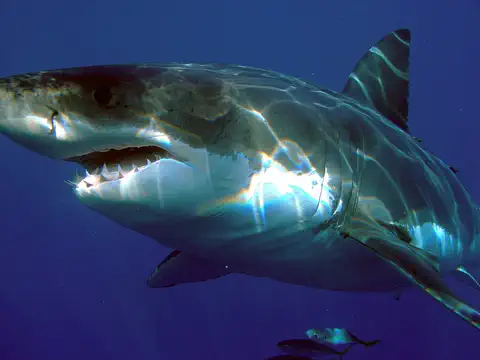
The great white shark is the largest of the mackerel sharks: a strong, torpedo-shaped fish with a gray back and a white belly. It hunts fish, seals and sea lions, and it is partly warm-blooded, which helps it stay active in cool water.
-
 Watch
Animal
Southern stingray
The southern stingray is a flat, diamond-shaped ray of warm western Atlantic waters, from the eastern United States through the Gulf of Mexico and the Caribbean to South America. It spends much of its time on sandy bottoms, finding buried crabs, shrimp and fish by smell, touch and tiny electric signals.
-
 Watch
3D
Animal
Spotted eagle ray
The spotted eagle ray is a ray that 'flies' through warm Atlantic waters by flapping its wide, wing-like fins. Its dark back is covered in white spots, its tail is long and whip-like, and its snout looks a bit like a duck's bill, which it uses to dig for clams and other shellfish.
-
 Watch
Animal
Giant oceanic manta ray
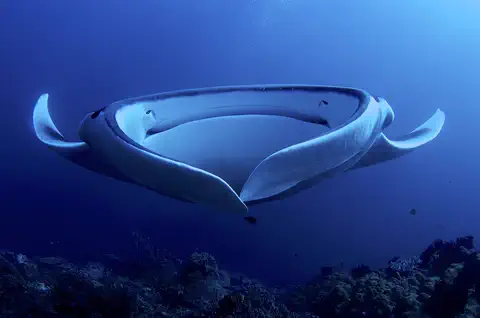
The giant oceanic manta ray is the largest ray in the world, with wing-like fins that can stretch more than 6 meters from tip to tip. This gentle filter feeder funnels plankton into its wide mouth, and it has a single pup only every two to three years.
-
Watch
Country
Australia
Australia is a country and the smallest continent, surrounded by ocean in the Southern Hemisphere. Much of its middle is dry and flat, most people live near the coast, and its animals include kangaroos, koalas and the platypus, a mammal that lays eggs.
-
Watch
Country
United States
The United States is a large country in North America made of 50 states, from icy Alaska to the warm islands of Hawaii. It has the Grand Canyon, the Mississippi River and Yellowstone, and about 342 million people live there.
-
 Watch
Animal
Blacktip reef shark
The blacktip reef shark is a medium-sized shark of warm, shallow coral reefs in the Indian and Pacific Oceans. You can spot it by the black tips on all its fins. It hunts fish, squid and crabs, stays close to its home reef, and gives birth to just a few live pups at a time.
For parents & teachers
What children will learn
- Describe the great hammerhead's cephalofoil and how it carries the eyes and electric sense organs.
- Explain how the shark finds prey hidden in the sand.
- Describe its life cycle: live birth after about 11 months, with litters every two years.
- Understand why the species is Critically Endangered and what finning bans do.
Recommended ages: 3 to 17 · About 15 minutes
Talk about it
- What might be good about having eyes very far apart? What might be hard?
- Why would a sense for tiny electric signals help an animal that hunts things hidden in sand?
- Why is it hard to protect a shark when fishers cannot easily tell which hammerhead species they caught?
Try at home or in class
- Look at a pencil held at arm's length, closing one eye and then the other, and notice how each eye sees a slightly different view; then imagine eyes at the ends of a hammer.
- Hide a coin under a thin layer of sand in a tray and try to find it by gently sweeping your hand from side to side, like a hammerhead sweeping its head.
Key vocabulary: cephalofoil, ampullae of Lorenzini, binocular vision, batoid, critically endangered, shark finning
Where these facts come from
- The IUCN Red List of Threatened Species , International Union for Conservation of Nature (IUCN terms of use (no redistribution of Red List data or range maps))
- GBIF Backbone Taxonomy and GBIF Occurrence Search , Global Biodiversity Information Facility (CC0 1.0 (backbone); occurrence counts are facts derived from records under CC0, CC BY and CC BY-NC)
- Sphyrna mokarran (Great Hammerhead), 2018 global assessment , IUCN Red List of Threatened Species
- Great Hammerhead (Sphyrna mokarran) species profile , Florida Museum of Natural History
- Great Hammerhead Shark , Georgia Aquarium
- Great Hammerhead, Sphyrna mokarran , Australian Museum
- Wikidata , Wikimedia Foundation (CC0 1.0)
- Wikimedia Commons , Wikimedia Foundation (Per file: Public domain, CC0, CC BY or CC BY-SA only (credited on each page))
Checked, not yet human-reviewed. Last updated October 28, 2026. Spotted a mistake? Tell us.