
Animal
Sumatran orangutan
The Sumatran orangutan is a red-haired ape. It lives high in the trees on an island called Sumatra.
The Sumatran orangutan is a shaggy red great ape that lives almost all its life in the treetops of northern Sumatra, in Indonesia. Its hair is longer and lighter than its Bornean cousin's, and a mother has a baby only every eight or nine years.
Pongo abelii, endemic to northern Sumatra, is almost exclusively arboreal and has the longest interbirth interval recorded for any mammal, 8.2 to 9.3 years. About 13,846 remain (2016 estimate), 95 percent of them in the Leuser Ecosystem, and the IUCN lists the species as Critically Endangered because of forest conversion and illegal killing.
Photo: Andrew Regan, CC BY 3.0, via Wikimedia Commons
Meet the Sumatran orangutan
The Sumatran orangutan is a big ape with long red hair.
It has very long arms for climbing. It lives in the treetops and hardly ever comes down to the ground.
Orangutans are the only great apes that live in Asia. There are three species: the Bornean orangutan, the Sumatran orangutan and the rare Tapanuli orangutan.
Compared with Bornean orangutans, Sumatran orangutans have longer, lighter-colored hair and a less heavy build. Grown-up males have cheek pads that form stiff half circles on the sides of the face, and both males and females usually grow beards as they get older. Bornean males have bigger cheek pads and a larger throat pouch.
Sumatran and Bornean orangutans were long treated as subspecies of Pongo pygmaeus; taxonomic reviews from 2001 onward support Pongo abelii as a distinct species, and in 2017 the Batang Toru population of Sumatra was described as a third species, the Tapanuli orangutan.
San Diego Zoo Wildlife Alliance notes that Sumatran orangutans have longer, lighter hair and a less heavy-set build than Bornean ones; the flanges of adult males form rigid half circles, and both sexes usually develop beards with age, whereas Bornean females rarely have one and Bornean males have larger flanges and throat pouches. WWF gives adults 1.2 to 1.5 meters and about 30 to 90 kilograms.
Quick facts
- Group
- Mammal
- Height
- 1.2 to 1.5 m
- Weight
- 30 to 90 kg
- Lifespan in the wild
- 53 to 58 years
Where it lives
Sumatran orangutans live on the island of Sumatra.
Sumatra is part of Indonesia, in Asia. The orangutans live in the north of the island, in thick, green forests.
Sumatran orangutans live only in the north of Sumatra, a big island in Indonesia. Long ago they lived all over Sumatra and even on the island of Java, but now most live in Aceh Province at the island's northern tip.
About 95 out of every 100 live in a huge area of forest called the Leuser Ecosystem. They live in lowland rainforest, mountain forest and swampy peat forest, and few, if any, breeding populations live higher than about 1,500 meters.
Pongo abelii is endemic to northern Sumatra. Its southern limit is the Simpang Kanan River on the west coast and the Asahan River on the east; its northern limit is roughly the northern boundary of the Leuser Ecosystem. WWF notes that it once ranged over the whole island and into Java.
Today 82.5 percent live in Aceh Province and 95 percent within the Leuser Ecosystem, with smaller populations at Sidiangkat and Pakpak Barat. Habitats are moist lowland forest, montane forest and peat swamp; density falls with altitude and few, if any, reproducing populations live above 1,500 meters. Key forest below 500 meters shrank by 60 percent between 1985 and 2007.
Continent
Its habitat

Where can you find this animal?
- Lives here naturally · Countries and seas named by a scientific source
- Sightings recorded · Records of wild sightings (GBIF)
Lives here naturally · Countries and seas named by a scientific source
Northern Sumatra only, mostly in Aceh Province and the Leuser Ecosystem. Reintroduced populations are being built around Bukit Tigapuluh National Park and the Jantho reserve.
Places: Indonesia.
Source: iucn-red-list · checked October 2026
Sightings recorded · Records of wild sightings (GBIF)
Counts of GBIF records of wild observations (human and machine) and preserved specimens. Records include introduced populations, vagrants, escaped or released animals and misidentifications, so a country with records is not necessarily part of the native range.
Wild sightings have been recorded in Indonesia, United States, Malaysia and Japan.
Source: gbif · checked October 2026
Range maps show where scientists say an animal lives, often country by country. An animal may live in only part of a country shown, and sightings records can include animals that wandered far from home.
What it eats
Orangutans love ripe fruit, like figs.
They also eat leaves, flowers and bark. Sometimes they eat ants and termites too.
Sumatran orangutans eat mainly fruit. Orangutans can eat up to 100 kinds of ripe fruit, and figs and durian fruit are the most common. They also eat leaves, seeds, shoots, flowers, bark and insects such as termites and ants.
When a big fig tree is full of fruit, several Sumatran orangutans may gather to feed together. As they eat fruit and travel, orangutans spread seeds over a huge area, so many trees, especially ones with large seeds, depend on them.
The IUCN describes the species as primarily frugivorous, also eating young and mature leaves, seeds, shoots, pith, flowers, termites, ants, bark and, occasionally, the meat of slow lorises. San Diego Zoo Wildlife Alliance lists up to 100 kinds of ripe fruit for orangutans, with figs and durian the most common.
WWF links the Sumatran orangutan's closer social ties to mass fruiting of fig trees, where groups can feed together, and stresses its role in seed dispersal: if orangutans disappeared, several tree species, especially large-seeded ones, would be lost too. Orangutans also strip leaves from twigs to probe holes for termites.
Did you know?
An orangutan can use leaves like an umbrella.
When it rains, orangutans hold leafy branches over themselves, and sometimes drape big leaves on like a poncho.
Unlike the African apes, orangutans frequently use vegetation to shelter from rain.
Made for the treetops
An orangutan's arms are longer than its body.
Its hands and feet can both grab branches. It swings from tree to tree.
Orangutans have the longest arms, for their size, of all the great apes, and their legs are short. Their hands are shaped like hooks, with long fingers and short thumbs, and their feet can grab like hands. Bendy hips let them move their legs almost like arms.
On the ground orangutans are slow and walk on their fists or flat palms, not on their knuckles like African apes. Sumatran orangutans spend even more time in the trees than Bornean ones: females almost never come down at all.
Britannica describes the proportionately longest arms of any great ape, short legs, hook-like hands with long fingers and short thumbs, feet with opposable big toes, and flexible hip joints. Orangutans usually clamber using all four limbs and only occasionally brachiate; on the ground they move slowly on closed fists or extended palms rather than knuckle-walking.
The IUCN notes that Sumatran orangutans are almost exclusively arboreal: females virtually never travel on the ground and adult males rarely do, in contrast to Bornean orangutans, especially adult males. San Diego Zoo Wildlife Alliance links this to Sumatra's tigers, clouded leopards, large pythons and crocodiles, predators absent from Borneo.
Growing up
A baby orangutan stays with its mother for a long time.
She teaches it how to find fruit and build a bed in the trees. It drinks her milk until it is about seven.
A Sumatran orangutan mother is pregnant for about 254 days, a little over eight months. Her baby weighs less than 1.5 kilograms and has white patches around its eyes and mouth.
The baby drinks milk until it is about 7 years old. Its mother teaches it where fruit grows and how to build nests. A female has her first baby at about 15 and then a new one only every 8 to 9 years, so she raises just 4 or 5 young in her whole life.
Gestation lasts about 254 days; Britannica notes newborn orangutans weigh under 1.5 kilograms and have white patches around the eyes and mouth. Infants are weaned at about 7 years. Females first give birth at about 15, and interbirth intervals of 8.2 to 9.3 years are the longest of any mammal, against 6.1 to 7.7 years in Bornean orangutans. A female bears 4 to 5 offspring in her life.
Males mature at about 14 and show bimaturism: fully flanged males and smaller unflanged males both reproduce, using different mating strategies. Estimated wild longevity is 53 years for females and 58 for males, with a generation length of at least 25 years.

Life in the canopy
Grown-up male orangutans like to be alone.
Mothers and babies stay together. Every night, each orangutan makes a new leafy bed high in a tree.
Orangutans spend much of their time alone, but Sumatran orangutans are more social than their Bornean cousins. Mothers and young may feed together at a fruit tree, and young orangutans sometimes travel in small groups for a few days.
Grown-up males with cheek pads stay alone and keep away from other males. They make a loud long call that can carry about 2 kilometers. Every evening an orangutan bends branches into a new nest, and in the rain it may hold leafy branches over itself like an umbrella.
Orangutans have a semisolitary social organization, but WWF reports closer social ties in Sumatran orangutans than in Bornean ones, and San Diego Zoo Wildlife Alliance describes Sumatran adolescents, females or unflanged males traveling together for days. Flanged males remain solitary and intolerant of each other.
Female home ranges are 0.8 to 1.5 square kilometers; male ranges are not fully known but are inferred to exceed 30 square kilometers. Flanged males give the long call, amplified by the throat sac, which Britannica says can carry 2 kilometers. Orangutans build a new nest almost every night and use leafy branches to shelter from rain and sun.
Did you know?
Orangutan moms have a baby only every eight or nine years.
Sumatran orangutan mothers have a baby only every 8 to 9 years, the longest gap of any mammal.
Interbirth intervals of 8.2 to 9.3 years in Pongo abelii are the longest recorded for any mammal.
Saving the Sumatran orangutan
There are not many Sumatran orangutans left.
People are protecting their forests. Some orangutans that were kept as pets are going back to live in the wild.
The Sumatran orangutan is critically endangered. Its forests are being cut down for oil-palm plantations, logging and new roads. Some orangutans are killed illegally, and their babies are sold as pets.
Scientists estimated in 2016 that about 13,846 are left. That is more than an older count, only because surveys got better; the real number is still falling. Rescuers are returning orangutans taken from the pet trade to the wild, and more than 260 have been released to start new populations.
The IUCN lists Pongo abelii as Critically Endangered (assessed 2017, amended 2024), projecting a decline of more than 80 percent over three generations from 1985 to 2060. Threats are oil-palm plantations, legal and illegal logging, roads that open forest to settlers and poachers, deliberate killing, the pet trade and conflict over crops. The IUCN names Aceh's 2013 spatial plan, which ignores the Leuser Ecosystem's protected status, as the largest single threat.
The 2016 estimate of 13,846 in 16,775 square kilometers of forest is higher than the 2008 figure of about 6,600 only because surveys improved; numbers continue to fall. More than 260 confiscated orangutans have been reintroduced around Bukit Tigapuluh National Park and the Jantho reserve to build new wild populations.
IUCN Red List
How is the sumatran orangutan doing in the wild?
- Least Concern
- Near Threatened
- Vulnerable
- Endangered
- Critically Endangered (this animal)
- Extinct in the Wild
- Extinct
Critically Endangered
At extremely high risk of disappearing from the wild.
See the IUCN Red List assessment · The IUCN Red List of Threatened Species 2022.2
Amazing facts
-
Orangutan moms have a baby only every eight or nine years.
Sumatran orangutan mothers have a baby only every 8 to 9 years, the longest gap of any mammal.
Interbirth intervals of 8.2 to 9.3 years in Pongo abelii are the longest recorded for any mammal.
-
Orangutans make a new bed in the trees almost every night.
Almost every evening, an orangutan bends branches into a fresh nest high in a tree.
Orangutans construct a sleeping platform almost every night, occasionally reusing an old one.
-
An orangutan can use leaves like an umbrella.
When it rains, orangutans hold leafy branches over themselves, and sometimes drape big leaves on like a poncho.
Unlike the African apes, orangutans frequently use vegetation to shelter from rain.
-
Lots of forest trees need orangutans to spread their seeds.
Orangutans spread seeds across huge areas. Without them, some trees with big seeds would disappear.
WWF warns that several tree species, especially large-seeded ones, would vanish if orangutans disappeared.
Words to know
- great ape
- a large ape with no tail, such as an orangutan, gorilla, chimpanzee or bonobo
- arboreal
- living in trees
- cheek pads
- wide, flat pads on the sides of a grown-up male orangutan's face, also called flanges
- frugivore
- an animal that eats mostly fruit
- endemic
- found naturally in only one place
- critically endangered
- at very high risk of disappearing from the wild
Discovery challenge
-
Where does a Sumatran orangutan spend most of its time?
Where do Sumatran orangutans spend almost all their lives?
Which describes how Sumatran orangutans use the forest?
- High up in the trees
- In underground burrows
- Swimming in rivers
Show the answer
High up in the trees
Orangutans live high in the trees.
They live almost entirely in the trees; females almost never come down to the ground.
Almost exclusively arboreal: females virtually never travel on the ground and adult males rarely do.
-
How is a Sumatran orangutan different from a Bornean one?
Which feature helps you tell a Sumatran orangutan from a Bornean orangutan?
Which trait distinguishes Pongo abelii from Pongo pygmaeus?
- Longer, lighter-colored hair
- Black and white stripes
- A long, curly tail
Show the answer
Longer, lighter-colored hair
Sumatran orangutans have longer, lighter hair.
Sumatran orangutans have longer, lighter hair, and both males and females often grow beards.
Longer, lighter hair, beards in both sexes and smaller, rigid flanges in males.
-
What do orangutans like to eat most?
What do Sumatran orangutans mostly eat?
Which best describes the Sumatran orangutan's diet?
- Fruit
- Fish
- Grass
Show the answer
Fruit
Orangutans love fruit, like figs.
They eat mostly fruit, plus leaves, flowers, bark and insects.
Primarily frugivorous, with leaves, seeds, pith, flowers, bark, termites and ants, and occasional meat.
-
On which island do Sumatran orangutans live?
On which island do Sumatran orangutans live?
To which island is Pongo abelii endemic?
- Sumatra
- Borneo
- Madagascar
Show the answer
Sumatra
They live on Sumatra, an island in Indonesia.
They live only in the north of Sumatra, in Indonesia. Bornean orangutans live on Borneo.
Endemic to northern Sumatra; Borneo holds the Bornean orangutan.
Places where you might see it
Explore next
-
 Watch
3D
Animal
Bornean orangutan
The Bornean orangutan is a shaggy red great ape that spends almost all its life in the treetops of Borneo's rainforests. It eats mostly ripe fruit, builds a new leafy bed every night, and lives a quieter, more solitary life than other great apes.
-
 Watch
Animal
Eastern gorilla
The eastern gorilla is the gorilla of the misty mountains and forests of east-central Africa. It has two kinds: the shaggy mountain gorilla, whose numbers are slowly growing, and the big Grauer's gorilla, which has become much rarer.
-
 Watch
Animal
Bonobo
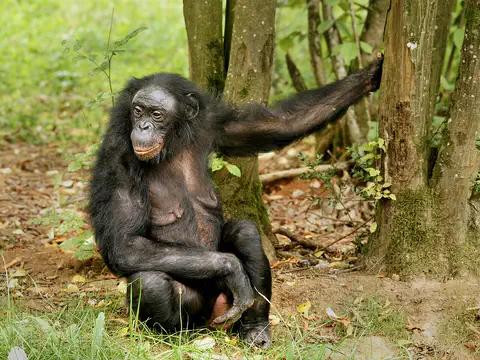
The bonobo is a great ape that looks a lot like a chimpanzee but is more slender, with a rounder head. It lives only in the rainforests south of the Congo River, in groups where females take the lead and squabbles rarely turn into fights.
-
 Watch
 Country
Indonesia
Indonesia is a country of about 17,500 islands in Southeast Asia, spread across the Equator between the Indian and Pacific oceans. It has more than 100 active volcanoes, rainforests full of wildlife, and about 286 million people (2025).
-
 Watch
Animal
Aardvark
The aardvark is a shy night digger of African savannas. It sniffs out ant and termite nests, rips them open with its spade-like claws and laps up the insects with a sticky tongue about 30 centimeters long. Its name means 'earth pig' in Afrikaans.
-
 Watch
Animal
African buffalo
The African buffalo is a huge, cow-like grazer with heavy, curving horns. It lives in herds that can number in the thousands, and a herd will rush to protect a calf in danger. It lives across much of Africa south of the Sahara, from open savannas to rainforests.
-
 Watch
Animal
African forest elephant
The African forest elephant is a separate species from the bigger bush elephant. It lives in the rainforests of central and western Africa, eats lots of fruit and spreads the seeds of forest trees in its dung. It is Critically Endangered.
-
 Watch
3D
Animal
African wild dog
The African wild dog, or painted dog, has a patchy coat unlike any other dog's, big round ears and only four toes on its front feet. It lives in close packs that hunt together, share food and care for the pups. It is endangered: the IUCN estimated in 2025 that only about 1,676 adults are left in the wild.
For parents & teachers
What children will learn
- Tell Sumatran orangutans apart from Bornean orangutans.
- Explain how an orangutan's body suits life in the treetops.
- Explain why very slow breeding makes orangutans vulnerable.
- Describe the threats to Sumatran orangutan forests and how people are responding.
Recommended ages: 3 to 17 · About 15 minutes
Talk about it
- Why might animals on an island with tigers spend more time in the trees?
- A mother orangutan teaches her baby for about seven years. What do you think she needs to teach?
- How can shoppers far away make a difference to orangutan forests?
Try at home or in class
- Measure your arm span and your height. Orangutans' arms are long for their size; are yours about the same as your height?
- Try picking up a small toy with your toes, then imagine feet that grab as well as hands.
Key vocabulary: great ape, arboreal, cheek pads, frugivore, endemic, critically endangered
Where these facts come from
- The IUCN Red List of Threatened Species , International Union for Conservation of Nature (IUCN terms of use (no redistribution of Red List data or range maps))
- GBIF Backbone Taxonomy and GBIF Occurrence Search , Global Biodiversity Information Facility (CC0 1.0 (backbone); occurrence counts are facts derived from records under CC0, CC BY and CC BY-NC)
- Pongo abelii (Sumatran Orangutan), global assessment , IUCN Red List of Threatened Species
- Sumatran Orangutan , World Wildlife Fund
- Orangutan , San Diego Zoo Wildlife Alliance
- Orangutan , Encyclopaedia Britannica
- Wikidata , Wikimedia Foundation (CC0 1.0)
- Wikimedia Commons , Wikimedia Foundation (Per file: Public domain, CC0, CC BY or CC BY-SA only (credited on each page))
Checked, not yet human-reviewed. Last updated October 24, 2026. Spotted a mistake? Tell us.