
Animal
Eastern gorilla
The eastern gorilla is a big, gentle ape. It lives in green mountain forests in the middle of Africa.
The eastern gorilla is the gorilla of the misty mountains and forests of east-central Africa. It has two kinds: the shaggy mountain gorilla, whose numbers are slowly growing, and the big Grauer's gorilla, which has become much rarer.
Gorilla beringei, recognized as a species separate from the western gorilla since 2001, lives only in eastern Democratic Republic of the Congo, northwest Rwanda and southwest Uganda. The IUCN lists it as Critically Endangered: mountain gorillas have recovered to 1,063 (counts of 2015 to 2016 and 2018), but Grauer's gorillas fell by an estimated 77 percent between 1994 and 2015.
Photo: Diego Delso, CC BY-SA 4.0, via Wikimedia Commons
Meet the eastern gorilla
The eastern gorilla is a very big ape.
It has thick black hair and long, strong arms. It lives with its family in the forest. Some eastern gorillas live high up on mountains.
Gorillas are the largest primates, and scientists split them into two species: the western gorilla and the eastern gorilla. The eastern gorilla has two kinds, called subspecies. Mountain gorillas live high on forested mountains. Grauer's gorillas, also called eastern lowland gorillas, live from lowland forest up into the hills.
Grauer's gorilla is the biggest of all four gorilla subspecies, with a stocky body, large hands and a short muzzle. Standing on two feet, an eastern gorilla can be about 1.7 meters tall.
Gorilla beringei appeared in the 1996 Red List as a subspecies of Gorilla gorilla; since 2001 it has been treated as a separate species with two subspecies, the mountain gorilla (G. b. beringei) and Grauer's gorilla (G. b. graueri). Grauer's gorilla, formerly called the eastern lowland gorilla, is the largest of the four gorilla subspecies, with a stocky body, large hands and a short muzzle.
The Animal Diversity Web describes mountain gorillas as having longer hair, larger jaws and teeth, a smaller nose and shorter arms than other gorillas. Adult females weigh about 70 to 114 kilograms and males average about 160, with large males reaching about 200.
Quick facts
- Group
- Mammal
- Height
- 1.2 to 1.7 m
- Weight
- 70 to 200 kg
- Lifespan in the wild
- 40 to 50 years
Where it lives
Eastern gorillas live in Africa.
They live in three countries: Uganda, Rwanda and the Democratic Republic of the Congo. Some climb high on old volcanoes. It can be cold and misty there.
Eastern gorillas live only in eastern Democratic Republic of the Congo, northwest Rwanda and southwest Uganda. Mountain gorillas live in two places just 25 kilometers apart: the Virunga volcanoes, where the three countries meet, and Bwindi Impenetrable National Park in Uganda.
Grauer's gorillas live only in eastern Democratic Republic of the Congo, from lowland rainforest up to about 2,900 meters. Mountain gorillas live as high as about 3,800 meters.
The IUCN assessment places the species in eastern DRC, northwest Rwanda and southwest Uganda. Mountain gorillas form two populations about 25 kilometers apart, separated by densely settled farmland: the Virunga Volcanoes (Virunga National Park in DRC, Volcanoes National Park in Rwanda, Mgahinga Gorilla National Park in Uganda) and Bwindi Impenetrable National Park, with a small contiguous part in DRC's Sarambwe Nature Reserve.
Grauer's gorilla is endemic to the Albertine Rift forests of eastern DRC and spans the widest altitudinal range of any gorilla, about 600 to 2,900 meters, overlapping the mountain gorilla's 1,400 to 3,800 meters. Human settlement keeps Virunga gorillas above about 1,850 meters. Group home ranges of 6 to 40 square kilometers overlap widely.
Continent
Its habitat

Where can you find this animal?
- Lives here naturally · Countries and seas named by a scientific source
- Sightings recorded · Records of wild sightings (GBIF)
Lives here naturally · Countries and seas named by a scientific source
Mountain forests of the Virunga volcanoes and Bwindi (mountain gorilla) and the Albertine Rift forests of eastern Democratic Republic of the Congo (Grauer's gorilla). Gorillas live in only a small part of each country shown.
Places: DR Congo, Rwanda and Uganda.
Source: iucn-red-list · checked October 2026
Sightings recorded · Records of wild sightings (GBIF)
Counts of GBIF records of wild observations (human and machine) and preserved specimens. Records include introduced populations, vagrants, escaped or released animals and misidentifications, so a country with records is not necessarily part of the native range.
Wild sightings have been recorded in Uganda, Rwanda, DR Congo, Congo and Tanzania.
Source: gbif · checked October 2026
Range maps show where scientists say an animal lives, often country by country. An animal may live in only part of a country shown, and sightings records can include animals that wandered far from home.
What it eats
Gorillas eat plants all day long.
They munch leaves, stems and roots. Twice a year, new bamboo shoots pop up. Then the gorillas eat almost nothing else!
Mountain gorillas eat mostly plants: stems, pith, leaves, bark, wood and roots, with an occasional snack of ants. Their favorite foods include wild celery, thistles, nettles and a plant called bedstraw.
Twice a year, when young bamboo shoots appear, both kinds of eastern gorilla eat almost nothing else. Lower down the mountains there is more fruit, so Grauer's gorillas in lowland forest and the mountain gorillas of Bwindi eat much more of it. A big male can eat up to about 18 kilograms of food a day.
Diet varies with elevation and food availability. Mountain gorillas are largely folivorous, eating stems, pith, leaves, bark and occasionally ants; the IUCN lists wild celery, thistles, nettles, bedstraw, wood and roots among favored foods. Both subspecies feed almost exclusively on young bamboo shoots during the two seasons a year when they appear.
At lower elevations the diet is more diverse and seasonal, and both lowland Grauer's gorillas and Bwindi's mountain gorillas are frugivorous. The Animal Diversity Web adds small amounts of fungi, galls, invertebrates and dung. San Diego Zoo Wildlife Alliance notes that gorilla dung fertilizes the forest, with seedlings sprouting from it.

A body for the mountains
Mountain gorillas have very thick, long hair.
It keeps them warm on cold mountain nights. Gorillas walk on their feet and the knuckles of their hands.
Mountain gorillas have thicker fur, and more of it, than other great apes. That coat helps them live where the temperature often drops below freezing. Their hair can be blue-black to brownish-gray.
Like all gorillas, they have arms longer than their legs and walk on the backs of their folded fingers, which is called knuckle-walking. Their big toes can grab like thumbs, which helps them hold food and climb. Grown-up males get a patch of silver hair on the back and are called silverbacks.
WWF notes that mountain gorillas have thicker and more abundant fur than other great apes, an advantage in habitat where temperatures often fall below freezing. The Animal Diversity Web describes their coats as silky and long, blue-black to brownish-gray, and lists longer hair, larger jaws and teeth, a smaller nose and shorter arms as differences from other gorillas.
Gorillas knuckle-walk on forelimbs longer than their hindlimbs and have opposable big toes. Mature males develop the silver saddle of the silverback, and they have apocrine glands in the armpits that release a strong odor under stress, which appears to serve as chemical communication.
Growing up
A baby gorilla is small and needs its mother.
It rides on her back through the forest. When it is about three or four, it stops riding on her back.
A gorilla mother is pregnant for about eight and a half months, and her baby weighs only about 2 kilograms. She holds it against her chest at first; later it rides on her back. Babies start walking at about 5 or 6 months.
At 3 to 4 years, young eastern gorillas stop drinking milk and stop riding on their mothers. Females have their first baby at about 10, then a new baby every 3 to 4 years. Males become silverbacks at about 12.
A single infant is born after about 8.5 months' gestation; San Diego Zoo Wildlife Alliance gives gorilla birth weights of 1.8 to 2.3 kilograms and first walking at 5 to 6 months. According to the life history summarized in the IUCN assessment, eastern gorillas are weaned at 3 to 4 years, when they stop traveling on their mothers' backs.
Females reach menarche at 6 to 7, followed by adolescent sterility, and first give birth at an average age of 9.9 years; they give birth every 3 to 4 years and usually raise 3 to 4 surviving offspring. Males can breed as blackbacks at 8 to 12, count as silverbacks at 12 and reach full size at 15. Generation time is about 18.2 years for females and 20.4 for males.
Family life
Eastern gorillas live in family groups.
They eat, rest and travel together. Every night each gorilla makes a bed, usually on the ground.
Eastern gorilla groups have one or more grown males, several females and their young. A typical group has about 10 members, and the biggest ever seen had 65. Groups do not defend a territory, and the areas they use often overlap.
Gorillas are active by day, spending about 30 percent of it feeding, 30 percent traveling and 40 percent resting. At night each one builds a nest, usually on the ground. Young females leave to join another group at about 8 years old.
Groups may contain one or several adult males with several females, offspring and immature relatives; the IUCN gives a median of 10 weaned individuals and a maximum observed size of 65. Groups are not territorial and annual home ranges overlap extensively. Eastern gorillas are diurnal and semi-terrestrial, feeding intensively after waking and then alternating rest, travel and feeding; most night nests are on the ground.
The Animal Diversity Web estimates a day of about 30 percent feeding, 30 percent travel and 40 percent rest. Females transfer from their natal group at around 8, often to a lone male; males leave at about 11 and usually live alone until they attract females and form a group, at 15 or older.
Did you know?
There are more mountain gorillas now than long ago.
Mountain gorillas are the only great apes whose numbers are going up. The latest counts add up to 1,063.
Virunga's mountain gorillas fell to 254 in 1981; with 604 counted there in 2015 to 2016 and 459 in Bwindi-Sarambwe in 2018, the subspecies totals 1,063.
Helping eastern gorillas
Eastern gorillas need help.
Rangers guard their forests. Animal doctors care for sick gorillas. There are now more mountain gorillas than there were years ago.
The eastern gorilla is critically endangered. Grauer's gorillas have been hunted for meat near mining camps, and years of unrest have made them hard to protect. Their numbers fell from about 16,900 in the mid-1990s to about 3,800 in 2015.
Mountain gorillas show what care can do. Rangers, vets and carefully run gorilla tourism have helped their numbers grow. Counts finished in 2018 found 1,063, more than twice as many as in the late 1950s.
The IUCN listed Gorilla beringei as Critically Endangered in its 2018 assessment. Grauer's gorillas fell from about 16,900 in 1994 to 1995 to an estimated 3,800 in 2015, a 77 percent loss in one generation, driven mainly by bushmeat hunting around artisanal mining camps, easier access to firearms amid insecurity, habitat loss and civil unrest. Decline continues at about 5 percent a year at many sites, and the IUCN Green Status assessment of 2026 gives about 2,600 mature individuals for the species.
Mountain gorillas are the only great ape recorded as increasing: 604 in the Virunga Massif (2015 to 2016) and 459 in Bwindi-Sarambwe (2018) make 1,063. Habituated groups, which WWF says survive better than unvisited ones, benefit from monitoring and veterinary care, though tourism also carries a risk of human disease.
IUCN Red List
How is the eastern gorilla doing in the wild?
- Least Concern
- Near Threatened
- Vulnerable
- Endangered
- Critically Endangered (this animal)
- Extinct in the Wild
- Extinct
Critically Endangered
At extremely high risk of disappearing from the wild.
See the IUCN Red List assessment · The IUCN Red List of Threatened Species 2022.2
Amazing facts
-
Gorillas eat almost only bamboo shoots when they come up.
Twice a year, when young bamboo shoots appear, eastern gorillas eat almost nothing else.
Both subspecies feed almost exclusively on young bamboo shoots during the two short seasons a year when they are available.
-
One gorilla group had 65 gorillas in it!
Most eastern gorilla groups have about 10 members, but one group of 65 has been seen.
Median group size is 10 weaned individuals; the largest group observed contained 65.
-
There are more mountain gorillas now than long ago.
Mountain gorillas are the only great apes whose numbers are going up. The latest counts add up to 1,063.
Virunga's mountain gorillas fell to 254 in 1981; with 604 counted there in 2015 to 2016 and 459 in Bwindi-Sarambwe in 2018, the subspecies totals 1,063.
-
Mountain gorillas live where it can be freezing cold at night.
Mountain gorillas live as high as about 3,800 meters, where temperatures often drop below freezing.
Human settlement at lower elevations keeps Virunga mountain gorillas above about 1,850 meters, up to about 3,800 meters.
Words to know
- great ape
- a large ape with no tail, such as a gorilla, chimpanzee, bonobo or orangutan
- subspecies
- a group within a species that lives in its own area and looks a little different
- silverback
- a grown-up male gorilla with silver hair on his back
- habituated
- used to people being nearby, so the animals stay calm
- bushmeat
- meat from wild animals hunted in the forest
- critically endangered
- at very high risk of disappearing from the wild
Discovery challenge
-
Which gorillas have extra-thick hair for cold mountains?
Which kind of eastern gorilla has extra-thick fur for freezing mountain nights?
Which gorillas have thicker, more abundant fur than other great apes?
- Mountain gorillas
- Western lowland gorillas
- Only baby gorillas
Show the answer
Mountain gorillas
Mountain gorillas have thick, warm hair for the cold.
Mountain gorillas live where it often gets colder than freezing, and their thick coat keeps them warm.
WWF notes mountain gorillas' thicker and more abundant fur, suited to habitat where temperatures often fall below freezing.
-
What do eastern gorillas eat?
What do eastern gorillas mostly eat?
Which best describes the eastern gorilla's diet?
- Plants, such as leaves, stems and bamboo shoots
- Mostly fish
- Mostly meat
Show the answer
Plants, such as leaves, stems and bamboo shoots
Gorillas eat plants: leaves, stems and bamboo shoots.
They eat mostly plants, feast on bamboo shoots in season, and eat more fruit lower down the mountains.
Largely herbivorous: stems, pith, leaves and bark, near-exclusive bamboo shoots in season, more fruit at lower elevations and occasional ants.
-
On which continent do eastern gorillas live?
On which continent do eastern gorillas live in the wild?
On which continent are the Albertine Rift forests where eastern gorillas live?
- Africa
- South America
- Australia
Show the answer
Africa
Eastern gorillas live in Africa.
They live in Africa, in the Democratic Republic of the Congo, Rwanda and Uganda.
Eastern DRC, northwest Rwanda and southwest Uganda, along the Albertine Rift.
-
Which gorillas are there more of now than before?
Which kind of eastern gorilla has been growing in number?
Which eastern gorilla subspecies is the only great ape recorded as increasing?
- Mountain gorillas
- Grauer's gorillas
- Neither kind
Show the answer
Mountain gorillas
There are more mountain gorillas now, because people protect them.
Mountain gorillas have grown to 1,063, while Grauer's gorillas have become much rarer.
Mountain gorillas reached 1,063 after recovering from a low in 1981; Grauer's gorillas declined by about 77 percent between 1994 and 2015.
Places where you might see it
-
 Watch
 Country
Uganda
Uganda is a landlocked country in East Africa, on the shores of Lake Victoria, Africa's largest freshwater lake. The Victoria Nile flows out of the lake here, snowy mountains rise in the west, and its forests are home to mountain gorillas and chimpanzees. About 51.4 million people lived there in 2025.
-
 Watch
 Country
Rwanda
Rwanda is a small, landlocked country in east-central Africa, just south of the equator. It is often called the land of a thousand hills. Mountain gorillas live among its volcanoes in the northwest, Lake Kivu lies on its western edge, and about 14.6 million people lived there in 2025.
-
 Watch
 Country
Democratic Republic of the Congo
The Democratic Republic of the Congo, or DR Congo, is the second-largest country in Africa. The mighty Congo River curves through its rainforests, volcanoes rise in the east, and its capital, Kinshasa, is a center of music, fashion and popular culture.
-
Watch
Natural wonder
Virunga National Park
Virunga National Park, in the east of the Democratic Republic of the Congo, was founded in 1925; the park describes itself as Africa's first national park. It stretches from active volcanoes in the south to the snowy Rwenzori Mountains in the north. About one third of the world's mountain gorillas live in its forests, along with elephants, hippos, chimpanzees and hundreds of kinds of birds.
Explore next
-
 Watch
Animal
Western gorilla
The western gorilla is a great ape, one of our closest animal relatives. It lives in family groups led by a big silverback male, eats leaves and fruit in the rainforests of central Africa, and is quiet and peaceful unless it feels threatened.
-
 Watch
Animal
Bonobo
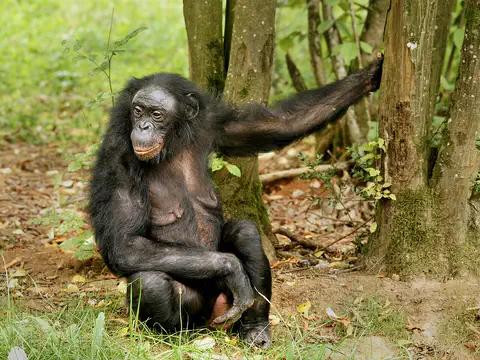
The bonobo is a great ape that looks a lot like a chimpanzee but is more slender, with a rounder head. It lives only in the rainforests south of the Congo River, in groups where females take the lead and squabbles rarely turn into fights.
-
Watch
Country
Uganda
Uganda is a landlocked country in East Africa, on the shores of Lake Victoria, Africa's largest freshwater lake. The Victoria Nile flows out of the lake here, snowy mountains rise in the west, and its forests are home to mountain gorillas and chimpanzees. About 51.4 million people lived there in 2025.
-
Watch
Country
Rwanda
Rwanda is a small, landlocked country in east-central Africa, just south of the equator. It is often called the land of a thousand hills. Mountain gorillas live among its volcanoes in the northwest, Lake Kivu lies on its western edge, and about 14.6 million people lived there in 2025.
-
Watch
Country
Democratic Republic of the Congo
The Democratic Republic of the Congo, or DR Congo, is the second-largest country in Africa. The mighty Congo River curves through its rainforests, volcanoes rise in the east, and its capital, Kinshasa, is a center of music, fashion and popular culture.
-
Watch
Natural wonder
Virunga National Park
Virunga National Park, in the east of the Democratic Republic of the Congo, was founded in 1925; the park describes itself as Africa's first national park. It stretches from active volcanoes in the south to the snowy Rwenzori Mountains in the north. About one third of the world's mountain gorillas live in its forests, along with elephants, hippos, chimpanzees and hundreds of kinds of birds.
-
 Watch
Animal
Sumatran orangutan
The Sumatran orangutan is a shaggy red great ape that lives almost all its life in the treetops of northern Sumatra, in Indonesia. Its hair is longer and lighter than its Bornean cousin's, and a mother has a baby only every eight or nine years.
-
 Watch
Animal
Okapi
The okapi has a velvety reddish-brown coat and zebra-like stripes on its legs, but its closest living relative is the giraffe. It lives only in the rainforests of the Democratic Republic of the Congo, where it browses leaves with a long, dark tongue. It is endangered.
For parents & teachers
What children will learn
- Name the two eastern gorilla subspecies and how they differ from western gorillas.
- Explain how mountain gorillas' bodies and diets suit high, cold forests.
- Describe eastern gorilla group life and the slow pace of gorilla growing up.
- Compare the recovery of mountain gorillas with the decline of Grauer's gorillas, and what made the difference.
Recommended ages: 3 to 17 · About 15 minutes
Talk about it
- Why do you think mountain gorillas have increased while Grauer's gorillas have declined?
- Gorilla tourism helps pay for protection but can spread human illnesses. What rules would you make for visitors?
- How could buying certified wood or recycling old phones connect to gorillas far away?
Try at home or in class
- Mark 1.7 meters on a wall with tape and stand beside it to compare yourself with a standing gorilla.
- Feel the difference a thick coat makes: on a cool day, hold one hand in a wool mitten and leave the other bare for a minute.
Key vocabulary: great ape, subspecies, silverback, habituated, bushmeat, critically endangered
Where these facts come from
- The IUCN Red List of Threatened Species , International Union for Conservation of Nature (IUCN terms of use (no redistribution of Red List data or range maps))
- GBIF Backbone Taxonomy and GBIF Occurrence Search , Global Biodiversity Information Facility (CC0 1.0 (backbone); occurrence counts are facts derived from records under CC0, CC BY and CC BY-NC)
- Gorilla beringei (Eastern Gorilla), global assessment , IUCN Red List of Threatened Species
- Eastern Lowland Gorilla , World Wildlife Fund
- Mountain Gorilla , World Wildlife Fund
- Gorilla beringei , Animal Diversity Web, University of Michigan Museum of Zoology
- Gorilla , San Diego Zoo Wildlife Alliance
- 2019 Ends With Good News For Great Apes: Mountain Gorillas Increasing in Numbers , Wildlife Conservation Society
- Wikidata , Wikimedia Foundation (CC0 1.0)
- Wikimedia Commons , Wikimedia Foundation (Per file: Public domain, CC0, CC BY or CC BY-SA only (credited on each page))
Checked, not yet human-reviewed. Last updated October 24, 2026. Spotted a mistake? Tell us.