Animal
Bonobo
The bonobo is a clever ape. It lives in the rainforest in Africa, and its family is led by the moms.
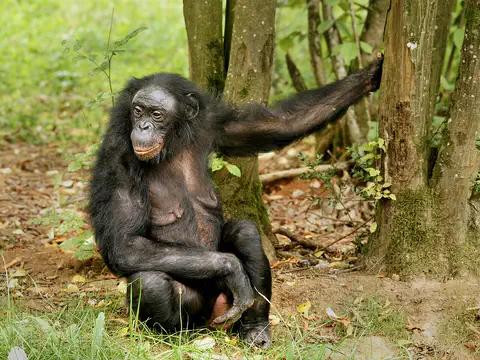
The bonobo is a great ape that looks a lot like a chimpanzee but is more slender, with a rounder head. It lives only in the rainforests south of the Congo River, in groups where females take the lead and squabbles rarely turn into fights.
Pan paniscus, classified separately from the chimpanzee since 1933, lives only south of the Congo River in the Democratic Republic of the Congo. Its female-centered, fission-fusion communities are known for social tolerance, and the IUCN lists it as Endangered, chiefly because of commercial bushmeat hunting and forest loss.
Photo: © Hans Hillewaert, CC BY-SA 4.0, via Wikimedia Commons
Meet the bonobo
The bonobo is an ape, like a chimpanzee.
It has black hair, a dark face and long arms. Bonobos live in big groups. They play, share food and help each other.
The bonobo is one of the great apes, with gorillas, orangutans and chimpanzees. It was once called the pygmy chimpanzee, but scientists have treated it as its own species since 1933.
Bonobos are not much smaller than chimpanzees. Standing up, male and female bonobos are both about 1.15 meters tall. But bonobos are more slender, with longer limbs, a narrower chest, a rounder head and smaller ears. They keep a white patch of hair on the rump all their lives, and their head hair often looks neatly parted down the middle.
Pan paniscus was regarded as a subspecies of the chimpanzee until 1933. Genetic studies suggest the two Pan species diverged about 1.7 million years ago, and that their lineage split from the one leading to humans between about 6.5 and 9.3 million years ago.
Britannica gives males about 39 kilograms and females about 31, both standing about 115 centimeters when upright. Compared with chimpanzees, bonobos are more slender, with longer limbs, a narrower chest and a rounder head with a less protruding face. San Diego Zoo Wildlife Alliance adds smaller ears, a white rump patch kept for life (it darkens with age in chimpanzees) and a greater ease walking upright.
Quick facts
- Group
- Mammal
- Length
- 0.7 to 0.83 m
- Height
- up to 1.15 m
- Weight
- 31 to 39 kg
Where it lives
Bonobos live in just one country in Africa.
It is called the Democratic Republic of the Congo. They live in warm, wet forests near a huge river.
Bonobos live in only one country: the Democratic Republic of the Congo, in the middle of Africa. They are found south of the great Congo River, in low, hilly land between about 300 and 700 meters above sea level.
Their home is damp rainforest, swampy forest and patches of forest mixed with grassland. Bonobos often wade into small streams and ponds to find food, but they do not swim. Wide rivers act like walls that keep bonobo groups apart.
The range is discontinuous, in the low-lying central basin south of the Congo River: east to the Lualaba River, south to the Kasai and Sankuru rivers, and west to the Congo River about 300 kilometers north of Kinshasa and around Lake Tumba and Lake Mai-Ndombe. Of a potential range of about 563,330 square kilometers, only 28 percent is suitable.
Bonobos use moist mature and secondary forest, swamp forest and forest-savanna mosaics at 300 to 700 meters, preferring primary forest where it exists. They enter water but do not swim, so large rivers limit gene flow between populations. The IUCN identifies four strongholds; the 36,000-square-kilometer Salonga National Park was the first protected area created that harbors bonobos.
Continent
Did you know?
Grown-up bonobos sometimes share a bed.
Adult bonobos sometimes share a nest, something not seen in the other great apes.
San Diego Zoo Wildlife Alliance describes nest-sharing between adults as unique among the great apes.
Where can you find this animal?
- Lives here naturally · Countries and seas named by a scientific source
- Sightings recorded · Records of wild sightings (GBIF)
Lives here naturally · Countries and seas named by a scientific source
Lowland rainforest, swamp forest and forest-savanna mosaic south of the Congo River, in the central Congo Basin of the Democratic Republic of the Congo. Bonobos live in only part of the country.
Places: DR Congo.
Source: iucn-red-list · checked October 2026
Sightings recorded · Records of wild sightings (GBIF)
Counts of GBIF records of wild observations (human and machine) and preserved specimens. Records include introduced populations, vagrants, escaped or released animals and misidentifications, so a country with records is not necessarily part of the native range.
Wild sightings have been recorded in DR Congo, Congo, Zimbabwe, Cameroon, Germany and United States.
Source: gbif · checked October 2026
Range maps show where scientists say an animal lives, often country by country. An animal may live in only part of a country shown, and sightings records can include animals that wandered far from home.
What it eats
Bonobos love fruit.
They also eat leaves, stems and flowers. They dig for earthworms too. Bonobos often share their food with each other.
More than half of a bonobo's food is fruit and seeds. Bonobos also eat leaves, stems, shoots, bark, flowers, mushrooms and honey, plus plants that grow in water. They spend hours hunting for earthworms, and they have even been seen catching shrimp with their hands.
Bonobos usually get most of the water they need from fruit. Working in small groups, they often share the food they find. Bonobos are important seed spreaders, which helps the forest grow back.
Bonobos are omnivorous: over 50 percent of the diet is fruit and seeds, supplemented by leaves, stems, shoots, pith, bark, flowers, truffles and other fungi, and honey. The IUCN notes that they depend more than chimpanzees on terrestrial herbaceous vegetation, including aquatic plants, foraging in small streams and breast-deep ponds; invertebrates such as termites and caterpillars, and occasionally vertebrates such as duikers, are also eaten.
San Diego Zoo Wildlife Alliance describes long searches for earthworms, fishing for shrimp by hand and food-sharing within foraging groups, and notes that fruit supplies most of their water. Their seed dispersal is considered critical for forest regeneration.
Did you know?
Bonobos laugh when they tickle each other.
Bonobos laugh when they tickle each other or play, and youngsters play chasing games with their hands over their eyes.
Play includes tickling with laughter and games resembling King of the Mountain and a chasing game played with eyes covered.
An ape body
Bonobos have long arms and strong hands.
They climb trees and swing from branch to branch. On the ground, they walk on their feet and knuckles.
Bonobos are made for both trees and ground. They swing hand to hand through branches, climb trunks and leap from tree to tree. On the ground they usually walk on all fours, leaning on their knuckles, and they are more comfortable walking upright than chimpanzees are.
Their hands are clever too. Bonobos have been seen sponging water out of tree trunks with moss, making a rain hat out of leaves and shaping a twig into a toothpick.
Bonobos move on all fours by knuckle-walking and are agile in the canopy, swinging, climbing and leaping between trees. Their slender build and long limbs distinguish them from chimpanzees, and San Diego Zoo Wildlife Alliance notes that they walk upright more readily.
Tool use in the wild is modest. Britannica describes it as mostly limited to leaf umbrellas and dragging branches during intimidation displays, while San Diego Zoo Wildlife Alliance reports moss sponges for water, leaf rain hats and twig toothpicks. Hand and foot gestures and facial expressions are part of their communication.
Growing up
A baby bonobo is small and needs lots of care.
Its mother carries it everywhere for two years. Sons stay close to their moms all their lives.
A bonobo mother is pregnant for about eight months and usually has one baby, weighing about 1.3 kilograms. Babies are born almost helpless, so their mothers carry them everywhere for the first two years.
Young bonobos grow up slowly, playing chasing games and learning from the group. Daughters leave to join a new community when they are between about 6 and 13 years old, and usually have their first baby at about 13. Sons stay with their mothers for life, and a mother has a new baby only about every five years.
There is no birth season. After about eight months' gestation a single infant of about 1.3 kilograms is born, nearly helpless, and is carried by its mother for its first two years. At Wamba (1976 to 1996) the interbirth interval averaged 4.8 years, with infants weaned shortly before the next birth; 73 percent of offspring survived to age six.
Females migrate between the ages of 6 and 13, settle in a new community when they begin cycling at 9 to 12, and first give birth at 13 to 14. Males remain in their birth community and keep a close bond with their mothers, whose status they inherit. Generation length is estimated at 23 to 25 years, so populations cannot withstand much hunting.

A peaceful society
In a bonobo group, the moms are in charge.
Bonobos hug and touch to comfort each other. They laugh when they play. Every night they build leafy beds in the trees.
Bonobos live in communities of about 30 to 80 or more. During the day they split into small parties that forage together, then gather to build sleeping nests in the trees each evening.
Females and their young are at the center of bonobo life. Females form strong friendships, and males tend to follow the lead of older females. Bonobos use touch to reassure each other, call to share news of good food, and laugh when they tickle and play. Scientists have never seen bonobos raid a neighboring group and kill its members, as chimpanzees sometimes do.
Communities of 30 to more than 100 individuals occupy home ranges of about 20 to 60 square kilometers that overlap widely with neighbors'. Membership of the foraging parties of 6 to 15 changes constantly (a fission-fusion society). Females and their offspring form the core; females unite against adult males, and mothers support their adult sons' rank, so males, though larger, cannot be said to dominate females.
Bonobos are diurnal and build new nests each night, usually in the forks of trees, though ground nests have also been reported. Communication includes food calls, rapid vocal exchanges under stress, gestures and touch. Britannica notes that the infanticide, cannibalism and lethal raids on neighbors seen in chimpanzees have never been observed in bonobos, and members of neighboring communities often intermingle.
Did you know?
Bonobos get most of their water from juicy fruit.
Bonobos usually get most of the water they need from the fruit they eat.
San Diego Zoo Wildlife Alliance says bonobos can usually get most of their hydration from fruit, which with seeds makes up over half their diet.
Protecting bonobos
There are not many bonobos left.
Kind people are working to protect them. Rangers guard their forests, and villages help keep them safe.
The bonobo is endangered. The biggest danger is illegal hunting for meat, which is sold in cities. Forests are also being cleared for farms, and years of unrest have made bonobos harder to protect. Because mothers have a baby only about every five years, bonobo numbers recover slowly.
Counts in protected strongholds suggested at least 15,000 to 20,000 bonobos in 2016. Parks such as Salonga National Park, guards called ecoguards and community-run reserves protect them, and in some places local traditions forbid eating bonobos.
The IUCN assessed the bonobo as Endangered in 2016. Poaching for the commercial bushmeat trade is by far the greatest threat: an estimated nine tons of bushmeat leave one 50,000-square-kilometer conservation landscape in its range each day, with demand from cities, armed groups and poorly paid soldiers. Slash-and-burn agriculture is the second threat, and industrial agriculture is likely to become serious.
Only about 30 percent of the historic range has been surveyed; estimates from the four strongholds give a minimum of 15,000 to 20,000 (2016). Britannica reports fewer than 40,000 at the end of the 20th century and slightly more than 20,000 by 2016. Well-guarded sites, such as Salonga's Lokofa Sector, have fared best, and community reserves such as Kokolopori add local protection.
IUCN Red List
How is the bonobo doing in the wild?
- Least Concern
- Near Threatened
- Vulnerable
- Endangered (this animal)
- Critically Endangered
- Extinct in the Wild
- Extinct
Endangered
At very high risk of disappearing from the wild.
See the IUCN Red List assessment · The IUCN Red List of Threatened Species 2022.2
Amazing facts
-
Bonobos laugh when they tickle each other.
Bonobos laugh when they tickle each other or play, and youngsters play chasing games with their hands over their eyes.
Play includes tickling with laughter and games resembling King of the Mountain and a chasing game played with eyes covered.
-
Bonobos can wade in water, but they do not swim.
Bonobos wade into streams and ponds to find food, but they do not swim. Big rivers keep bonobo groups apart.
Because bonobos do not swim, large rivers constrain gene flow between populations.
-
Grown-up bonobos sometimes share a bed.
Adult bonobos sometimes share a nest, something not seen in the other great apes.
San Diego Zoo Wildlife Alliance describes nest-sharing between adults as unique among the great apes.
-
Bonobos get most of their water from juicy fruit.
Bonobos usually get most of the water they need from the fruit they eat.
San Diego Zoo Wildlife Alliance says bonobos can usually get most of their hydration from fruit, which with seeds makes up over half their diet.
Words to know
- great ape
- a large ape with no tail, such as a gorilla, chimpanzee, bonobo or orangutan
- community
- a big group of bonobos that share a home range
- party
- a small group that splits off from the community to look for food together
- seed disperser
- an animal that carries seeds to new places, helping plants grow
- bushmeat
- meat from wild animals hunted in the forest
- endangered
- at risk of disappearing from the wild
Discovery challenge
-
Who is in charge in a bonobo group?
Who is at the center of bonobo group life and takes the lead?
Which sex forms the influential core of bonobo groups?
- The females
- One big male
- The smallest baby
Show the answer
The females
In bonobo groups, the moms are in charge.
Females and their young are at the center, and males tend to follow the lead of older females.
Females and their offspring form the core; female coalitions mean larger males do not dominate females.
-
What do bonobos eat most?
What makes up more than half of a bonobo's food?
Which food category makes up over 50 percent of the bonobo diet?
- Fruit and seeds
- Fish
- Grass
Show the answer
Fruit and seeds
Bonobos love fruit!
More than half of their food is fruit and seeds, plus leaves, stems, mushrooms, honey and earthworms.
Fruit and seeds exceed 50 percent, supplemented by herbaceous and aquatic plants, fungi, honey and invertebrates.
-
Where do bonobos live?
In which country do all wild bonobos live?
Which country holds the bonobo's entire native range?
- Democratic Republic of the Congo
- Australia
- Brazil
Show the answer
Democratic Republic of the Congo
Bonobos live in the Democratic Republic of the Congo, in Africa.
All wild bonobos live in the Democratic Republic of the Congo, south of the Congo River.
The whole range lies south of the Congo River in the DRC, between the Lualaba and the Kasai and Sankuru rivers.
-
How is a bonobo different from a chimpanzee?
Which feature helps you tell a bonobo from a chimpanzee?
Which trait distinguishes bonobos from chimpanzees?
- A rounder head and a more slender body
- A long, striped tail
- Wings for gliding
Show the answer
A rounder head and a more slender body
Bonobos have rounder heads and thinner bodies.
Bonobos are more slender, with longer limbs, a narrower chest, a rounder head and smaller ears.
A slenderer build, longer limbs, a narrower chest and a rounder head with a less protruding face.
Places where you might see it
-
 Watch
 Country
Democratic Republic of the Congo
The Democratic Republic of the Congo, or DR Congo, is the second-largest country in Africa. The mighty Congo River curves through its rainforests, volcanoes rise in the east, and its capital, Kinshasa, is a center of music, fashion and popular culture.
-
 Watch
Natural wonder
River Congo
The Congo is Africa's second-longest river, about 4,700 kilometers long. It curves in a giant arc through the rainforests of central Africa and empties into the Atlantic Ocean. Rain falls in its basin all year, so it carries a huge amount of water, and its wild lower rapids are home to about 320 kinds of fish, about 90 of them found nowhere else.
Explore next
-
 Watch
Animal
Eastern gorilla
The eastern gorilla is the gorilla of the misty mountains and forests of east-central Africa. It has two kinds: the shaggy mountain gorilla, whose numbers are slowly growing, and the big Grauer's gorilla, which has become much rarer.
-
 Watch
Animal
Western gorilla
The western gorilla is a great ape, one of our closest animal relatives. It lives in family groups led by a big silverback male, eats leaves and fruit in the rainforests of central Africa, and is quiet and peaceful unless it feels threatened.
-
 Watch
3D
Animal
Bornean orangutan
The Bornean orangutan is a shaggy red great ape that spends almost all its life in the treetops of Borneo's rainforests. It eats mostly ripe fruit, builds a new leafy bed every night, and lives a quieter, more solitary life than other great apes.
-
Watch
Country
Democratic Republic of the Congo
The Democratic Republic of the Congo, or DR Congo, is the second-largest country in Africa. The mighty Congo River curves through its rainforests, volcanoes rise in the east, and its capital, Kinshasa, is a center of music, fashion and popular culture.
-
Watch
Natural wonder
River Congo
The Congo is Africa's second-longest river, about 4,700 kilometers long. It curves in a giant arc through the rainforests of central Africa and empties into the Atlantic Ocean. Rain falls in its basin all year, so it carries a huge amount of water, and its wild lower rapids are home to about 320 kinds of fish, about 90 of them found nowhere else.
-
 Watch
Animal
Sumatran orangutan
The Sumatran orangutan is a shaggy red great ape that lives almost all its life in the treetops of northern Sumatra, in Indonesia. Its hair is longer and lighter than its Bornean cousin's, and a mother has a baby only every eight or nine years.
-
 Watch
Animal
Aardvark
The aardvark is a shy night digger of African savannas. It sniffs out ant and termite nests, rips them open with its spade-like claws and laps up the insects with a sticky tongue about 30 centimeters long. Its name means 'earth pig' in Afrikaans.
-
 Watch
Animal
African buffalo
The African buffalo is a huge, cow-like grazer with heavy, curving horns. It lives in herds that can number in the thousands, and a herd will rush to protect a calf in danger. It lives across much of Africa south of the Sahara, from open savannas to rainforests.
For parents & teachers
What children will learn
- Tell bonobos apart from chimpanzees by body features, range and behavior.
- Describe the bonobo's fruit-rich diet and its role in spreading seeds.
- Describe a female-centered, fission-fusion society.
- Explain why slow breeding and a one-country range make bonobos vulnerable.
Recommended ages: 3 to 17 · About 15 minutes
Talk about it
- Bonobos settle squabbles without fighting much. What are some ways people calm each other down?
- Why might a big river keep two kinds of ape apart for so long?
- Why is it risky for an animal to live in only one country?
Try at home or in class
- Measure 1.15 meters on a wall and compare your height with a standing bonobo's.
- Soak up water from a bowl with a small sponge or a wad of moss-like cotton wool, the way bonobos use moss to sponge water out of tree trunks.
Key vocabulary: great ape, community, party, seed disperser, bushmeat, endangered
Where these facts come from
- The IUCN Red List of Threatened Species , International Union for Conservation of Nature (IUCN terms of use (no redistribution of Red List data or range maps))
- GBIF Backbone Taxonomy and GBIF Occurrence Search , Global Biodiversity Information Facility (CC0 1.0 (backbone); occurrence counts are facts derived from records under CC0, CC BY and CC BY-NC)
- Pan paniscus (Bonobo), global assessment , IUCN Red List of Threatened Species
- Bonobo , Encyclopaedia Britannica
- Bonobo , San Diego Zoo Wildlife Alliance
- Wikidata , Wikimedia Foundation (CC0 1.0)
- Wikimedia Commons , Wikimedia Foundation (Per file: Public domain, CC0, CC BY or CC BY-SA only (credited on each page))
Checked, not yet human-reviewed. Last updated October 24, 2026. Spotted a mistake? Tell us.