
Animal
Turkey vulture
The turkey vulture is a big dark bird with a bare red head. It soars high in the sky. It finds dead animals to eat by smelling them.
The turkey vulture is a large, dark bird with a bare red head, named because its head looks like a wild turkey's. It spends much of its time soaring with its wings held in a shallow V and rarely flaps. Unlike most birds, it has a keen sense of smell, which helps it find dead animals to eat. It lives from southern Canada to the tip of South America.
Cathartes aura is a New World vulture (family Cathartidae) that ranges from southern Canada to Tierra del Fuego. It feeds almost entirely on carrion, which it finds by smell as well as sight, an unusual ability among birds. BirdLife International assessed it as Least Concern for the IUCN Red List (assessed 2018, published 2018), with a stable population trend.
Photo: © Frank Schulenburg, CC BY-SA 4.0, via Wikimedia Commons
Meet the turkey vulture
The turkey vulture is a big, dark bird.
Its head has no feathers. The skin on its head is red, like a wild turkey's.
The turkey vulture is a very large bird, 63 to 81 centimeters long, with wings that stretch 1.6 to 2 meters from tip to tip. Yet it weighs only 0.9 to 2 kilograms.
It is dark blackish-brown, with silvery-gray undersides to its long flight feathers. Adults have a bare red head and a pale, bone-colored beak. The bird got its name because its red, featherless head looks like a wild turkey's. Young birds have gray heads and dark beaks.
The Peregrine Fund gives a body length of 63 to 81 centimeters, a wingspan of 1.6 to 2 meters and a mass of 0.9 to 2 kilograms; the Animal Diversity Web account (2008) notes that the sexes look alike and that mass varies with subspecies, of which it lists six, three in North America and three in Central and South America.
Hawk Mountain Sanctuary describes the plumage as blackish-brown with silver-gray undersides to the flight feathers, giving a two-toned underwing. Adults have a red, featherless head and a bone-colored bill; recently fledged juveniles have gray heads and dark bills. The species belongs to the Cathartidae, the seven species of New World vultures, and Hawk Mountain notes that some experts think these may be more closely related to storks than to other raptors.
Quick facts
- Group
- Bird
- Length
- 0.63 to 0.81 m
- Wingspan
- 1.6 to 2 m
- Weight
- 0.9 to 2 kg
- Lifespan in the wild
- up to 16.8 years
From Canada to Tierra del Fuego
Turkey vultures live in North, Central and South America.
They fly over fields, woods, deserts and hills.
Turkey vultures live from southern Canada all the way to Tierra del Fuego, at the southern tip of South America. They fly over open country, woods, deserts and foothills, and are most common over open land near rocky or wooded places where they can nest safely. They generally stay away from thick forest.
In the last few decades they have spread farther north. Birds in warm places stay all year, but northern birds fly south for the winter, some all the way to South America.
The IUCN assessment lists the species as resident across most of Central and South America and the Caribbean, as breeding in the United States, Jamaica and Uruguay, and as present outside the breeding season in Costa Rica, with an upper elevation limit of 4,300 meters. The Animal Diversity Web account (2008) gives the range as the southern border of Canada to Tierra del Fuego and notes a northward expansion over recent decades, which it suggests may follow legal protection from hunting.
Audubon describes open country, woods, deserts and foothills, most commonly within a few miles of rocky or wooded nesting areas, and notes that the species generally avoids dense forest. Hawk Mountain calls it a partial migrant: northern populations are highly migratory and 'leap-frog' southern ones, while southern populations stay put.
Continents
Its habitats


Where can you find this animal?
- Lives here naturally · Countries and seas named by a scientific source
- Sightings recorded · Records of wild sightings (GBIF)
Lives here naturally · Countries and seas named by a scientific source
Open country, woodland, desert and foothills from southern Canada to Tierra del Fuego, up to about 4,300 meters; northern birds migrate south for the winter, some as far as South America. Some small islands and territories, such as Aruba, the Cayman Islands, French Guiana and the Turks and Caicos Islands, have no separate shape on this map.
Places: Argentina, Bahamas, Bolivia, Brazil, Belize, Canada, Chile, Colombia and 22 more places.
Source: iucn-red-list · checked October 2026
Sightings recorded · Records of wild sightings (GBIF)
Counts of GBIF records of wild observations (human and machine) and preserved specimens. Records include introduced populations, vagrants, escaped or released animals and misidentifications, so a country with records is not necessarily part of the native range.
Wild sightings have been recorded in United States, Canada, Mexico, Costa Rica, Colombia, Panama, Chile, Brazil and 34 more places.
Source: gbif · checked October 2026
Range maps show where scientists say an animal lives, often country by country. An animal may live in only part of a country shown, and sightings records can include animals that wandered far from home.
Cleaning up dead animals
Turkey vultures eat dead animals.
They find them by smell and by sight. This helps keep places clean.
Turkey vultures are scavengers: they eat mostly animals that have already died, called carrion. They like fresh carrion best. Most of it comes from dead mammals, but they also eat dead birds, reptiles and other animals, and sometimes plant foods such as pumpkins, coconuts and grapes.
Their feet are not strong enough to carry food, so they usually eat where they find it. Black vultures, which cannot smell well, often follow turkey vultures to a meal and then push them away.
Hawk Mountain describes a diet almost entirely of carrion and human garbage, mostly from mammals, with dead birds, reptiles, amphibians and invertebrates, plus plant material such as pumpkins, coconuts, juniper berries and grapes. Fresh carrion is preferred. Live prey is taken only rarely, and some reports of it involve misidentified black vultures. Lacking powerful feet, the bird eats most carrion where it lies.
The Animal Diversity Web account (2008) adds that birds near farms feed mainly on dead livestock and, near people, on roadkill, and that they cannot open the thick skin of large carcasses until some decay has set in. Black vultures, which lack a keen sense of smell, follow turkey vultures to carcasses and displace them.
Did you know?
Turkey vultures cannot sing. They only hiss and grunt.
Turkey vultures have no voice box, so their only sounds are hisses and grunts.
Lacking a voice box, the species is limited to hisses, grunts and barking sounds.
A nose for food
Most birds cannot smell well.
The turkey vulture can. It sniffs the air to find food.
Most birds are thought to have a poor sense of smell, but the turkey vulture is one of the few birds that uses smell to find food. It soars over the land, watching the ground and other scavengers, and sniffing the air.
Because it can smell as well as see, a turkey vulture can find a dead animal lying on the forest floor, even under thick trees.
Audubon notes that most birds are believed to have a very poor sense of smell, while the turkey vulture can apparently find carrion by odor, and The Peregrine Fund calls it one of the few birds able to use smell to locate food. According to Hawk Mountain, it is the only vulture in North America with a highly developed sense of smell, and it can locate carcasses beneath dense forest canopy.
It searches by soaring over open or partly wooded country, watching the ground and the actions of other scavengers (Audubon), combining smell and sight.
Did you know?
Black vultures follow turkey vultures to find food.
Black vultures cannot smell well, so they follow turkey vultures to dead animals.
Black vultures follow turkey vultures to carcasses and then displace them.
Master of soaring
Turkey vultures hardly ever flap their wings.
They glide on warm air, rocking from side to side.
Turkey vultures are masters of soaring. They hold their wings up in a shallow V and often rock from side to side as they glide. Once they are up in the sky, they rarely flap.
They ride rising columns of warm air called thermals, and winds that blow up mountain slopes. On the ground they look clumsy and have to work hard to take off, but in the air they are graceful.
The Animal Diversity Web account (2008) notes light wing loading for the bird's size, making it buoyant and able to use thermals with little energy. It holds its wings in a dihedral, a V above the back that Hawk Mountain says stabilizes flight in turbulence, and often rocks from side to side; once above the canopy it rarely flaps.
On take-off its wingbeats are deep and heavy (Audubon), and The Peregrine Fund notes that it looks ungainly on the ground but is graceful in the air. Migrants soar and glide on thermals and mountain updrafts, avoid long crossings of open water, and seldom migrate on rainy or overcast days, when thermals do not form (Hawk Mountain).
Hisses and grunts
Listen to the sound at the start of this page.
Turkey vultures cannot sing. They hiss and grunt.
Turkey vultures are usually silent. They have no voice box, so they cannot sing or call like other birds; they can only hiss and grunt, mostly when feeding or at the nest.
At the start of this page you can play a recording of a turkey vulture made in Gainesville, Florida, in 1996.
The Peregrine Fund notes that the species has no voice box and that its sounds are limited to hisses and grunts; Audubon says it is usually silent and hisses or grunts when feeding or at the nest. The Animal Diversity Web account (2008) adds barking sounds and says vocalizations are used mainly to deter predators.
The recording on this page is described on Wikimedia Commons as a turkey vulture in Gainesville, Florida, recorded by G. McGrane in 1996 and released into the public domain.
Did you know?
Turkey vultures can find food by smelling it.
The turkey vulture is one of the few birds that uses its sense of smell to find food.
Olfaction lets it find carcasses even under dense forest canopy.
Eggs in a hidden place
Turkey vultures do not build nests.
They lay eggs in caves, logs and hollow trees. Both parents feed the chicks.
Turkey vultures do not build a nest. They lay their eggs in dark, sheltered places: hollow trees and logs, cracks in cliffs, caves, thickets and old buildings. The female usually lays 2 eggs, whitish with brown and lavender blotches.
Both parents take turns keeping the eggs warm for about five weeks. Then they feed the chicks by bringing up food from their own stomachs. The young first fly when they are about 60 to 80 days old.
Little or no nest is built: eggs are laid on debris or the bare floor of a sheltered site such as a hollow tree or log, cliff crevice, cave, dense thicket or old building (Audubon), and Hawk Mountain adds abandoned stick nests, mammal burrows and the ground. Pairs reuse sites year after year and, Hawk Mountain says, evidence suggests they stay together until one dies.
Clutches are usually 2 (1 to 3); both parents incubate for about five weeks (Audubon gives 34 to 41 days), brood the young continuously for the first five days, and feed them by regurgitation. Hawk Mountain gives fledging at 60 to 80 days; fledglings are fed at the nest site for one to three weeks more and disperse by about 12 weeks. Disturbed nestlings defend themselves by hissing and regurgitating.
Flocks, roosts and kettles
Turkey vultures sleep together in big groups.
In the daytime, each one flies off to look for food.
Turkey vultures often fly together in flocks called kettles, both when migrating and when looking for food. Outside the breeding season, hundreds may sleep together at a shared roost, sometimes with black vultures.
Migrating flocks can be huge. In Mexico and Central America, a single flock often has more than 10,000 vultures. They do not defend territories, and they travel as far as they need to find food.
Hawk Mountain describes the species as social: individuals often travel in flocks, or 'kettles', and outside the breeding season they roost communally with black vultures, sometimes by the hundreds. The Animal Diversity Web account (2008) notes that birds roost together but search for food independently, that home ranges depend on food supply, and that the species does not defend territories.
Migrating flocks range from a few birds to several thousand and grow in the tropics, often exceeding 10,000 birds in Mexico and Central America, sometimes mixed with broad-winged and Swainson's hawks (Hawk Mountain). In courtship, several birds hop around a circle on the ground with wings half open, and in the air one bird closely follows another (Audubon).
A helpful neighbor
There are millions of turkey vultures.
They help by eating dead animals.
The turkey vulture is listed as Least Concern, and its numbers seem stable. Hawk Mountain Sanctuary says there are almost certainly more than five million in the world.
People once shot turkey vultures, wrongly believing that they spread disease to farm animals. Today their job as clean-up crews is better understood. Dangers include poisoned bait meant for other animals, lead and other poisons, traps, and cars when they feed on roadkill.
BirdLife International assessed Cathartes aura as Least Concern for the IUCN Red List (assessed 9 August 2018, published 2018), with a stable trend and an extremely large range and population. Audubon notes the species is thought to have declined during the 20th century in parts of North America, with populations now apparently stable, and Hawk Mountain says the world population almost certainly exceeds five million.
Hawk Mountain reports past shooting by ranchers and farmers who wrongly believed the birds spread disease, and current threats from poisoned bait, leg-hold traps, lead, mercury and insecticides, collisions with vehicles while feeding on roadkill, and collisions with aircraft. Numbers stayed stable through the DDT era, although eggshell thinning occurred in some areas.
IUCN Red List
How is the turkey vulture doing in the wild?
- Least Concern (this animal)
- Near Threatened
- Vulnerable
- Endangered
- Critically Endangered
- Extinct in the Wild
- Extinct
Least Concern
Not at risk of disappearing from the wild right now.
See the IUCN Red List assessment · The IUCN Red List of Threatened Species 2021.3
Amazing facts
-
Turkey vultures can find food by smelling it.
The turkey vulture is one of the few birds that uses its sense of smell to find food.
Olfaction lets it find carcasses even under dense forest canopy.
-
Turkey vultures cannot sing. They only hiss and grunt.
Turkey vultures have no voice box, so their only sounds are hisses and grunts.
Lacking a voice box, the species is limited to hisses, grunts and barking sounds.
-
Some flocks have more than ten thousand vultures!
In Mexico and Central America, a migrating flock often has more than 10,000 turkey vultures.
Migrating flocks in Mexico and Central America often exceed 10,000 birds.
-
Black vultures follow turkey vultures to find food.
Black vultures cannot smell well, so they follow turkey vultures to dead animals.
Black vultures follow turkey vultures to carcasses and then displace them.
Words to know
- vulture
- a large bird that feeds mostly on dead animals
- carrion
- the body of an animal that has died
- scavenger
- an animal that eats dead animals or waste
- thermal
- a rising column of warm air that birds can glide on
- roost
- a place where birds rest or sleep together
- kettle
- a group of birds circling together in the sky
Discovery challenge
-
How does a turkey vulture find food?
Which sense helps a turkey vulture find food that most birds can't use well?
Which sense, unusual among birds, does the turkey vulture use to find carrion?
- Smell
- Hearing
- Taste
Show the answer
Smell
It smells the food.
Smell. It is one of the few birds that uses smell to find food.
Smell, combined with sight; it can find carcasses under forest canopy.
-
Why is it called a turkey vulture?
Where does the turkey vulture's name come from?
What feature gave Cathartes aura its English name?
- Its red head looks like a turkey's
- It eats turkeys
- It gobbles like a turkey
Show the answer
Its red head looks like a turkey's
Its red head looks like a wild turkey's head.
Its red, featherless head looks like a wild turkey's.
The bare red head resembles that of the wild turkey.
-
Where does a turkey vulture lay its eggs?
Where does a turkey vulture lay its eggs?
What kind of nest site does the turkey vulture use?
- In a hidden place like a cave or hollow log
- In a woven nest on a branch
- Floating on a pond
Show the answer
In a hidden place like a cave or hollow log
In a hidden place, like a cave or a hollow log.
It builds no nest; the eggs go in a sheltered spot such as a cave, cliff crack or hollow log.
Little or no nest; eggs laid on debris in sheltered cavities, crevices, caves or buildings.
-
How do turkey vultures fly?
How do turkey vultures usually fly?
Which flight style is typical of the turkey vulture?
- They soar with wings in a V and rarely flap
- They hover in one spot
- They flap very fast like a hummingbird
Show the answer
They soar with wings in a V and rarely flap
They glide with their wings in a V.
They soar on warm air with their wings in a shallow V, rocking side to side.
Dihedral soaring on thermals and updrafts, with frequent side-to-side rocking.
Places where you might see it
-
 Watch
 Country
United States
The United States is a large country in North America made of 50 states, from icy Alaska to the warm islands of Hawaii. It has the Grand Canyon, the Mississippi River and Yellowstone, and about 342 million people live there.
-
 Watch
 Country
Canada
Canada is the second-largest country in the world, stretching across the north of North America from the Atlantic to the Pacific and up into the Arctic. It has the Rocky Mountains, thousands of islands and about 42 million people, who speak English, French and many other languages.
-
 Watch
 Country
Brazil
Brazil covers about half of South America and is the fifth-largest country in the world. It holds most of the Amazon River basin and much of the world's largest rainforest, and about 214 million people lived there in 2026, most of them near the Atlantic coast.
Explore next
-
 Watch
Animal
Andean condor
The Andean condor is one of the largest flying birds in the world. With wings up to 3.2 meters across, it soars over the Andes Mountains of South America, barely flapping, as it searches for dead animals to eat. It is a vulture, nature's clean-up crew.
-
 Watch
Animal
California condor
The California condor is the largest wild bird in North America, a giant vulture with wings about 2.8 meters wide. In the 1980s only 22 were left. Thanks to a huge rescue effort, the US Fish and Wildlife Service counted 607 condors at the end of 2025, 392 of them flying free.
-
 Watch
Animal
Harris's hawk
The Harris's hawk is a dark brown hawk with reddish shoulders and thighs, long yellow legs and white at both ends of its tail. It lives from the southwestern United States to Chile and Argentina. It is more sociable than most birds of prey: two males and one female often nest together, and two or three hawks may hunt as a team.
-
 Watch
Animal
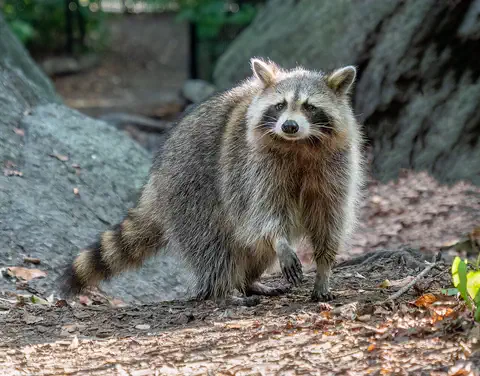
Common raccoon
The common raccoon is a clever night-time animal from North and Central America, famous for its black mask, ringed tail and nimble, hand-like front paws. It eats almost anything and lives in forests, wetlands, farms and even big cities. People have also brought raccoons to Europe and Japan, where they now live wild.
-
Watch
Country
United States
The United States is a large country in North America made of 50 states, from icy Alaska to the warm islands of Hawaii. It has the Grand Canyon, the Mississippi River and Yellowstone, and about 342 million people live there.
-
Watch
Country
Canada
Canada is the second-largest country in the world, stretching across the north of North America from the Atlantic to the Pacific and up into the Arctic. It has the Rocky Mountains, thousands of islands and about 42 million people, who speak English, French and many other languages.
-
Watch
Country
Brazil
Brazil covers about half of South America and is the fifth-largest country in the world. It holds most of the Amazon River basin and much of the world's largest rainforest, and about 214 million people lived there in 2026, most of them near the Atlantic coast.
-
 Watch
Animal
Rüppell's vulture
Rüppell's vulture is a huge African vulture with wings up to 2.6 meters wide. It soars for hours over the savanna, searching by sight for dead animals to eat, and nests in colonies on cliffs. One Rüppell's vulture holds the record for the highest-flying bird. Its numbers have fallen so fast that it is now Critically Endangered.
For parents & teachers
What children will learn
- Explain how a turkey vulture finds food by smell and sight.
- Describe why scavengers are useful in nature.
- Explain how soaring birds use rising warm air.
- Recognize how mistaken beliefs once harmed a bird.
Recommended ages: 3 to 17 · About 15 minutes
Talk about it
- Why might a good sense of smell help a bird that eats dead animals?
- What would happen to dead animals if there were no scavengers?
- Why do you think people once wrongly blamed vultures for spreading disease?
Try at home or in class
- Hide a few cotton balls dabbed with vanilla or lemon around a room and find them by smell alone, like a turkey vulture.
- Fold two paper gliders, one with its wings bent up in a shallow V and one flat, fly them in front of a gently blowing fan and compare how steady they are.
Key vocabulary: vulture, carrion, scavenger, thermal, roost, kettle
Where these facts come from
- GBIF Backbone Taxonomy and GBIF Occurrence Search , Global Biodiversity Information Facility (CC0 1.0 (backbone); occurrence counts are facts derived from records under CC0, CC BY and CC BY-NC)
- Wikidata , Wikimedia Foundation (CC0 1.0)
- The IUCN Red List of Threatened Species , International Union for Conservation of Nature (IUCN terms of use (no redistribution of Red List data or range maps))
- Cathartes aura (BirdLife International, assessed 9 August 2018, published 2018) , IUCN Red List of Threatened Species
- Cathartes aura: IUCN Red List global assessment record (BirdLife International 2018), IUCN checklist on GBIF , GBIF
- Turkey Vulture (Guide to North American Birds, adapted from Kenn Kaufman, Lives of North American Birds) , National Audubon Society
- Turkey Vulture , The Peregrine Fund
- Turkey Vulture , Hawk Mountain Sanctuary
- Cathartes aura (Farmer, A. 2008) , Animal Diversity Web, University of Michigan Museum of Zoology
- File:Cathartes aura at Tomales Bay.jpg (Marin County, California, 7 December 2014, Frank Schulenburg) , Wikimedia Commons
- File:Turkey Vulture.ogg (Gainesville, Florida, 1996, G. McGrane) , Wikimedia Commons
- Wikimedia Commons , Wikimedia Foundation (Per file: Public domain, CC0, CC BY or CC BY-SA only (credited on each page))
Checked, not yet human-reviewed. Last updated November 1, 2026. Spotted a mistake? Tell us.