Animal
Common raccoon
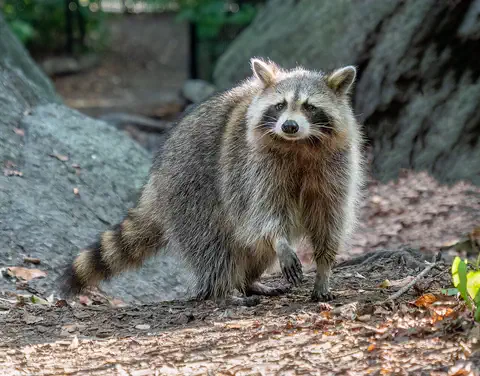
The raccoon has a black mask on its face and a stripy tail. It uses its clever paws to find food at night.
The common raccoon is a clever night-time animal from North and Central America, famous for its black mask, ringed tail and nimble, hand-like front paws. It eats almost anything and lives in forests, wetlands, farms and even big cities. People have also brought raccoons to Europe and Japan, where they now live wild.
Procyon lotor is a highly adaptable omnivore native from southern Canada to Panama, recognized by its facial mask, ringed tail and extraordinarily sensitive forepaws. It thrives alongside people and has been introduced to Europe and Asia, including Japan, where it is now established. The IUCN lists it as Least Concern and increasing.
Photo: Rhododendrites, CC BY-SA 4.0, via Wikimedia Commons
Meet the raccoon
A raccoon has a black mask around its eyes.
Its fluffy tail has dark rings. Its front paws look like little hands. Raccoons are awake at night.
The raccoon is easy to spot: a black 'mask' across its eyes, whitish patches above them and around the nose, gray-brown fur, and a bushy tail with dark rings. A grown-up raccoon usually weighs about 6 to 7 kilograms, a bit more than a big pet cat.
Its front paws are amazing. They look like slender human hands, with five long toes, and they can feel, grab and open things with great skill. Raccoons are nocturnal, which means they come out at night.
Procyon lotor, the common or northern raccoon, belongs to the family Procyonidae. Adults typically weigh 6 to 7 kilograms, though regional extremes run from 1.8 to 10.4 kilograms; males are 10 to 30 percent heavier than females, and northern animals can reach 50 percent body fat. Total length is about 60 to 95 centimeters, of which the tail, with four to six dark rings, makes up 42 to 52 percent.
The raccoon's success comes from flexibility: an opportunistic diet, a tolerance for nearly any habitat with cover and water, and forepaws whose dexterity and sensitivity let it exploit foods other animals cannot reach.
Quick facts
- Group
- Mammal
- Length
- 60 to 95 cm
- Weight
- 6 to 7 kg
- Top speed
- up to 24 km/h
- Lifespan in the wild
- up to 16 years
Where it lives
Raccoons come from North and Central America.
They live in woods, near rivers and on farms. Many live in towns and cities too. Some now live far away, in Europe and Japan.
Raccoons are native to North and Central America, from southern Canada through most of the United States and Mexico to Panama. They like moist woodlands near water best, but they also live on farms, in suburbs and in big cities. Dens can be in hollow trees, old burrows, barns, garages or even storm drains.
People have also taken raccoons to other parts of the world. In parts of Europe and in Japan, raccoons now live in the wild, where they are an introduced species, an animal that does not belong there naturally.
The IUCN's 2015 global assessment lists the native range as Canada, the United States, Mexico and the Central American countries south to Panama. The species is most abundant in moist woodland but occupies tropical to cold-temperate habitats, farmland and urban areas, denning in tree holes, woodchuck burrows, caves, buildings and sewers.
The same assessment lists established introduced populations in more than twenty countries of Europe and western and central Asia, plus Japan; the map shows them as a separate introduced layer. Animal Diversity Web notes that raccoons are now widely distributed in parts of Europe and Asia. Origin in the Bahamas is uncertain and is not mapped.
Continents
Its habitats


Where can you find this animal?
- Brought here by people · Countries and seas named by a scientific source
- Lives here naturally · Countries and seas named by a scientific source
- Sightings recorded · Records of wild sightings (GBIF)
Brought here by people · Countries and seas named by a scientific source
Countries where people introduced raccoons and wild populations are now established, including much of central Europe and Japan. Raccoons do not belong here naturally.
Places: Austria, Azerbaijan, Belgium, Czechia, Estonia, France, Georgia, Germany and 15 more places.
Source: iucn-red-list · checked October 2026
Lives here naturally · Countries and seas named by a scientific source
Woodlands, wetlands, farms and towns from southern Canada through most of the United States and Mexico to Panama. Raccoons are absent from far northern Canada.
Places: Canada, United States, Mexico, Belize, Guatemala, El Salvador, Honduras, Nicaragua and 2 more places.
Source: iucn-red-list · checked October 2026
Sightings recorded · Records of wild sightings (GBIF)
Counts of GBIF records of wild observations (human and machine) and preserved specimens. Records include introduced populations, vagrants, escaped or released animals and misidentifications, so a country with records is not necessarily part of the native range.
Wild sightings have been recorded in United States, Canada, Belgium, Germany, Luxembourg, Japan, Mexico, France and 36 more places.
Source: gbif · checked October 2026
Range maps show where scientists say an animal lives, often country by country. An animal may live in only part of a country shown, and sightings records can include animals that wandered far from home.
What it eats
Raccoons eat almost anything.
They eat fruit, nuts, bugs, crayfish, frogs and eggs. In towns some even look in trash cans for food!
Raccoons are omnivores that will eat nearly anything they find. In some places they eat more plants than animals: wild grapes, cherries, berries, acorns and other nuts, and in farm country, lots of corn. They also catch crayfish, insects, frogs, fish and mice, and eat bird eggs.
In towns, raccoons are famous for raiding garbage cans and pet food. Their clever paws can even pull the lids off bins. That is why people near raccoons use tight-fitting lids and never leave pet food outside.
The raccoon is an opportunistic omnivore. In some habitats plant foods dominate, including wild grapes, cherries, apples, persimmons, berries and acorns, with corn the most important item in some agricultural areas. It eats more invertebrates than vertebrates: crayfish and insects, along with rodents, frogs, fish and bird eggs.
In suburbs and cities raccoons readily use garbage, pet food and roadkill, and they travel in straight lines between dens and rich food patches. Their habit of handling food with the forepaws before eating is linked to the paws' sensitivity. On farms they can damage orchards, vineyards, melon patches and corn.
Did you know?
Raccoons hold their food in their paws before eating it.
Raccoons usually pick up their food with their front paws and feel it before they put it in their mouths.
Food is typically handled with the highly sensitive forepaws before ingestion, reflecting the raccoon's reliance on touch.
Clever paws and a mask
A raccoon's front paws can feel things very well.
It uses them to find food and open things. Its eyes see well in the dark. It is a great climber.
A raccoon's sense of touch is its superpower. Its front paws are very sensitive, so it can feel and recognize food, pry open shells and handle small objects, a bit like you feeling for something in your pocket without looking.
Raccoons also have excellent night vision and good hearing. They are terrific climbers and can drop 10 to 12 meters from a tree without getting hurt. They can swim too, although their fur is not waterproof, so they get heavy when wet.
Touch is the raccoon's most developed sense. The hand-like forepaws, each with five long digits, are highly sensitive and let it identify, manipulate and pry open food and climb with ease; raccoons usually pick food up with the forepaws before putting it in the mouth.
Night vision and hearing are excellent, suiting a nocturnal forager. Raccoons are agile climbers, reportedly unbothered by drops of 35 to 40 feet (about 11 to 12 meters), and strong swimmers, though their fur is not waterproof. Their usual gait is a shuffling walk, but they can reach about 24 kilometers per hour on the ground.
Growing up
Baby raccoons are called kits.
They are born in a den, often in a hollow tree. At first they cannot see. They stay with their mom through their first winter.
Raccoons mate in late winter and spring. About two months later, usually in a tree den, the mother has a litter of three to seven babies, most often four. They are born blind and helpless, and their eyes open after about three weeks.
The young drink milk for about 10 weeks. By the time they are about 20 weeks old, they go out at night with their mother to learn how to find food. They stay with her through their first winter and go off on their own in spring.
Mating runs from about February to June, peaking in March, with northern populations breeding earlier. After a gestation of 63 to 65 days, one litter a year of three to seven young (typically four) is born, blind and helpless, usually in a tree den. Eyes open at 18 to 24 days, and weaning is at about 70 days.
By 20 weeks the young forage with their mother at night. They remain with her through their first winter and become independent early the following spring. Females often mature before their first birthday and males at about two years. Few live long: the wild average is about five years, though some reach 16.

Night life
Raccoons sleep in the day and come out at night.
They mostly live alone. In very cold weather they sleep a lot, but they do not hibernate.
Raccoons are nocturnal: they rest in a den during the day, which keeps them safe from many predators, and come out at night to look for food. Most raccoons live alone, apart from mothers with their young.
In very cold, snowy weather, raccoons may sleep for long stretches in their dens, living on their stored fat. This is not true hibernation, because their body temperature stays the same. They can lose up to half their body weight over a hard winter.
Raccoons are nocturnal and largely solitary; the only lasting social unit is a mother and her young, though males sometimes associate with a female around breeding. Home ranges are typically 1 to 3 kilometers across, and up to 10 kilometers in the West, and in one Virginia study residents traveled 0.75 to 2.5 kilometers a night.
During severe cold they may sleep for long periods but do not hibernate: metabolic rate and body temperature stay constant while they draw on fat reserves, losing up to about half their body mass. Resting in dens by day helps them avoid predators such as coyotes, wolves, large hawks and owls.
Did you know?
Raccoons can climb down from high trees without getting hurt.
Raccoons are such good climbers that a drop of 11 to 12 meters from a tree does not seem to bother them.
Animal Diversity Web reports raccoons are not bothered by drops of 35 to 40 feet (about 11 to 12 meters).
Raccoons and people
There are lots and lots of raccoons.
They are good at living near people. Raccoons are wild, so we watch them from far away and never feed them.
Raccoons are not in danger. They are listed as Least Concern, and their numbers are growing, partly because they are so good at living near people.
But living close to people causes problems. Raccoons can raid crops and trash, and they can carry diseases, including rabies, that can spread to pets and people. In Europe and Japan, where people brought them, they are an introduced species, living wild in places where they do not belong naturally. The best rule is to enjoy raccoons from a distance and never feed them.
The IUCN lists Procyon lotor as Least Concern with an increasing population (2015). Animal Diversity Web reports that raccoon numbers have grown since the turn of the twentieth century, helped by their ability to adapt to human-dominated landscapes, although some small island populations may be threatened.
Conflicts with people include crop damage, garbage raiding and disease: raccoons can carry rabies and other diseases and parasites transmissible to people and domestic animals. Outside the native range, people have introduced raccoons to many countries of Europe and Asia and to Japan, where they now live wild. Secure bins and no feeding reduce conflict where people and raccoons live side by side.
IUCN Red List
How is the common raccoon doing in the wild?
- Least Concern (this animal)
- Near Threatened
- Vulnerable
- Endangered
- Critically Endangered
- Extinct in the Wild
- Extinct
Least Concern
Not at risk of disappearing from the wild right now.
See the IUCN Red List assessment · The IUCN Red List of Threatened Species 2022.2
Amazing facts
-
Raccoons can climb down from high trees without getting hurt.
Raccoons are such good climbers that a drop of 11 to 12 meters from a tree does not seem to bother them.
Animal Diversity Web reports raccoons are not bothered by drops of 35 to 40 feet (about 11 to 12 meters).
-
A raccoon's tail has four to six dark rings.
A raccoon's bushy tail has four to six black rings.
The tail carries four to six black rings and makes up 42 to 52 percent of total length.
-
Raccoons hold their food in their paws before eating it.
Raccoons usually pick up their food with their front paws and feel it before they put it in their mouths.
Food is typically handled with the highly sensitive forepaws before ingestion, reflecting the raccoon's reliance on touch.
-
Raccoons can lose half their weight in a cold winter.
In a long, cold winter, a raccoon can live off its fat and lose up to half its body weight.
Without hibernating, raccoons can lose up to about 50 percent of body mass while sleeping through severe cold on fat reserves.
Words to know
- nocturnal
- active at night and resting during the day
- omnivore
- an animal that eats both plants and animals
- introduced species
- an animal or plant that people brought to a place where it did not live before
- dexterous
- able to use the hands or paws skillfully
- den
- a sheltered place where an animal rests or raises its young
- rabies
- a serious disease some animals can pass on through bites
Discovery challenge
-
What does a raccoon have on its face?
What is a raccoon's best-known face marking?
Which sense is most highly developed in raccoons?
- A black mask
- Long horns
- A beak
Show the answer
A black mask
It has a black mask around its eyes.
A black mask runs across its eyes, with whitish patches above them.
Touch, through the extremely sensitive forepaws.
-
When are raccoons awake?
When do raccoons usually look for food?
Why do raccoons rest in dens by day?
- At night
- Only at lunchtime
- Never
Show the answer
At night
Raccoons come out at night.
They are nocturnal: they rest by day and forage at night.
Daytime denning helps them avoid many predators.
-
Where did raccoons first come from?
Where are raccoons native?
Which describes the raccoon's range?
- North and Central America
- Australia
- Antarctica
Show the answer
North and Central America
They come from North and Central America.
From southern Canada to Panama; people later took them to Europe and Japan.
Native from Canada to Panama, with established introduced populations in Europe, western and central Asia and Japan.
-
Should we feed raccoons?
What is the best way to live near raccoons?
What most reduces conflict between raccoons and people near homes?
- No, keep food and trash put away
- Yes, give them snacks
- Yes, keep them as pets
Show the answer
No, keep food and trash put away
No! Raccoons are wild and find their own food.
Use tight bin lids, never feed them and watch from a distance.
Secure bins and no feeding, so raccoons do not learn to depend on human food.
Explore next
-
 Watch
3D
Animal
Red panda
The red panda is a cat-sized tree climber with rusty-red fur and a bushy ringed tail. It lives in cool mountain forests of the Himalayas and southern China and eats mostly bamboo leaves. Despite its name, it is not a close relative of the giant panda. It is endangered.
-
 Watch
Animal
American black bear
The American black bear is the most common bear in North America. It lives mostly in forests, climbs trees with its short, curved claws, eats mainly plants, and spends the winter in a den. Not all black bears are black: some are brown, cinnamon, blue-gray or even white.
-
 Watch
Animal
Striped skunk
The striped skunk is a cat-sized mammal of North America with bold black and white fur. It comes out at night to hunt insects and other small foods, and it is famous for its warning dance and its strong-smelling spray, which it uses only when it feels threatened.
-
 Watch
Animal
Burmese python
The Burmese python is one of the largest snakes in the world. In its home in South and Southeast Asia it has become rare because so many are caught, but in southern Florida, where people let pet pythons go, it has spread through the Everglades and eats many of the animals that live there.
-
 Watch
3D
Animal
Common snapping turtle
The common snapping turtle is a big freshwater turtle of eastern North America. It hides in the mud of ponds and rivers with just its nose poking up, eats almost anything it finds, and can live for many decades. Each summer, mother turtles walk over land to dig nests in sand and gravel.
-
 Watch
Animal
Aardvark
The aardvark is a shy night digger of African savannas. It sniffs out ant and termite nests, rips them open with its spade-like claws and laps up the insects with a sticky tongue about 30 centimeters long. Its name means 'earth pig' in Afrikaans.
-
 Watch
Animal
African buffalo
The African buffalo is a huge, cow-like grazer with heavy, curving horns. It lives in herds that can number in the thousands, and a herd will rush to protect a calf in danger. It lives across much of Africa south of the Sahara, from open savannas to rainforests.
-
 Watch
Animal
African forest elephant
The African forest elephant is a separate species from the bigger bush elephant. It lives in the rainforests of central and western Africa, eats lots of fruit and spreads the seeds of forest trees in its dung. It is Critically Endangered.
For parents & teachers
What children will learn
- Describe the raccoon's key features, especially its sensitive front paws.
- Explain what an omnivore and a nocturnal animal are.
- Understand what an introduced species is, using raccoons in Europe and Japan.
- Describe safe ways for people and raccoons to share towns.
Recommended ages: 3 to 17 · About 12 minutes
Talk about it
- Why do you think raccoons do so well in cities?
- What might happen when an animal is taken to a place where it never lived before?
- How would you find food at night if you could only use your sense of touch?
Try at home or in class
- Mystery bag: put a few safe objects (an acorn, a spoon, a grape) in a bag and identify them by touch alone, like a raccoon.
- Draw a raccoon-proof trash bin and explain what makes it hard to open.
Key vocabulary: nocturnal, omnivore, introduced species, dexterous, den, rabies
Where these facts come from
- The IUCN Red List of Threatened Species , International Union for Conservation of Nature (IUCN terms of use (no redistribution of Red List data or range maps))
- GBIF Backbone Taxonomy and GBIF Occurrence Search , Global Biodiversity Information Facility (CC0 1.0 (backbone); occurrence counts are facts derived from records under CC0, CC BY and CC BY-NC)
- Procyon lotor (raccoon) , Animal Diversity Web, University of Michigan Museum of Zoology
- Raccoon , National Wildlife Federation
- Procyon lotor (Northern Raccoon), 2015 global assessment , IUCN Red List of Threatened Species
- Wikidata , Wikimedia Foundation (CC0 1.0)
- Wikimedia Commons , Wikimedia Foundation (Per file: Public domain, CC0, CC BY or CC BY-SA only (credited on each page))
Checked, not yet human-reviewed. Last updated October 24, 2026. Spotted a mistake? Tell us.