
Animal
Common warthog
The warthog is a wild pig from Africa. It has curved tusks, bumps on its face and a thin tail that sticks up when it runs.
Common warthogs are tough wild pigs of the African savanna. They kneel down to eat short grass, sleep in old aardvark burrows and run with their tails held straight up like little flags. The bumps on their faces are thick pads of skin.
Phacochoerus africanus is a grazing suid of African savannas, with large curved upper tusks, facial warts and almost no fur or body fat. It shelters in burrows, often dug by aardvarks, lives in small female groups, and remains widespread and Least Concern across sub-Saharan Africa.
Photo: Charles J. Sharp, CC BY-SA 4.0, via Wikimedia Commons
Meet the warthog
The warthog is a wild pig with a big head.
It has two curved tusks and bumps on its face. Its skin is gray, with only a few hairs. A long, scruffy mane runs down its back.
The common warthog is a tough wild pig with a very large head. Its gray skin has only a few bristles, but a long, shaggy mane runs from the top of its head down to the middle of its back. Its thin tail ends in a tuft.
The warthog's name comes from the bumps on its face. They look like warts, but they are thick pads of skin, and males have bigger ones. Its curved upper tusks can grow about 25 to 30 centimeters long.
Phacochoerus africanus is a suid of open African habitats. Animal Diversity Web gives a head and body length of 0.9 to 1.5 meters, a shoulder height of 63.5 to 85 centimeters and a weight of 50 to 150 kilograms, with females 15 to 20 percent lighter than males. The coat is sparse, black or brown, with a mane from the head to the middle of the back and a long tufted tail.
The facial 'warts' are thick protective pads; Animal Diversity Web describes three pairs, the suborbital warts reaching up to 15 centimeters in males. The upper tusks curve out from the sides of the snout in a semicircle, while the lower tusks, at their base, are worn to a sharp cutting edge. Common warthogs differ from the desert warthog in their incisors.
Quick facts
- Group
- Mammal
- Length
- 0.9 to 1.5 m
- Height
- 0.64 to 0.85 m
- Weight
- 50 to 150 kg
- Top speed
- up to 55 km/h
- Lifespan in the wild
- 7 to 11 years
Home on the savanna
Warthogs live in Africa.
They live on grassy plains with some trees. They sleep in holes in the ground, often holes that aardvarks dug.
Common warthogs live across much of Africa south of the Sahara, from Senegal and Mauritania in the west to Ethiopia in the east and down to South Africa. They live in wet and dry savannas and grasslands, and they avoid rainforests, deserts and high mountains.
Warthogs usually do not dig their own homes. They move into old aardvark burrows or natural holes, where they sleep, hide and raise their babies. They back in tail first, so their tusks face any visitor.
The IUCN's 2016 global assessment lists the common warthog as native to 39 countries of sub-Saharan Africa, from Senegal and Mauritania to Ethiopia, Eritrea and Djibouti and south to South Africa, at elevations up to 3,500 meters; it is possibly extinct in the Republic of the Congo. The African Wildlife Foundation notes that it lives in moist and arid savannas and avoids rainforests, deserts and high mountains.
Burrows are central to its life. Warthogs can dig but normally use holes made by other animals, especially aardvarks, and enter backward. With neither fur nor fat, they rely on burrows to stay warm on cold nights and out of the midday sun. The hero photo is a warthog of the West African subspecies, photographed in Senegal.
Continent
Its habitats


Where can you find this animal?
- Lives here naturally · Countries and seas named by a scientific source
- Sightings recorded · Records of wild sightings (GBIF)
Lives here naturally · Countries and seas named by a scientific source
Savannas, grasslands and open woodland across sub-Saharan Africa, from Senegal and Mauritania to the Horn of Africa and south to South Africa.
Places: Angola, Benin, Botswana, Burkina Faso, Cameroon, Central African Rep., Chad, DR Congo and 27 more places.
Source: iucn-red-list · checked October 2026
Sightings recorded · Records of wild sightings (GBIF)
Counts of GBIF records of wild observations (human and machine) and preserved specimens. Records include introduced populations, vagrants, escaped or released animals and misidentifications, so a country with records is not necessarily part of the native range.
Wild sightings have been recorded in South Africa, Benin, Kenya, Tanzania, Namibia, Zambia, Uganda, Botswana and 30 more places.
Source: gbif · checked October 2026
Range maps show where scientists say an animal lives, often country by country. An animal may live in only part of a country shown, and sightings records can include animals that wandered far from home.
Kneeling to eat
Warthogs eat mostly grass.
They kneel down on their front knees to reach the short grass. They also dig up roots with their snouts.
Warthogs are mainly grazers. To nibble short grass, they kneel on their front knees, which have thick, hard, padded skin. Sometimes they even shuffle along on their knees while they eat.
In the dry season, when grass is scarce, they dig up bulbs, roots and tubers with their snouts and tusks. In the wet season they also eat earthworms and other small creatures. Their big snouts can smell food hidden underground.
Common warthogs are omnivores whose diet is dominated by grass. The African Wildlife Foundation describes them kneeling on calloused, padded knees to crop short grass, and the San Diego Zoo Wildlife Alliance notes that they may shuffle forward in that position when food is plentiful.
In the dry season they use snout and tusks to excavate bulbs, tubers and roots; in the wet season they add earthworms and other invertebrates, and they also eat berries, bark and carrion. Most forage in the morning and early evening, but where they are hunted by people they switch to feeding at night.

Tusks, warts and a flag tail
Warthogs have long legs and can run fast.
When a warthog runs, its tail sticks straight up. The tuft at the end waves like a little flag.
Warthogs have longer legs than other pigs, and they can run at up to about 55 kilometers an hour. When they walk, the tail hangs down. When they run, it sticks straight up with the tuft waving, which may warn other warthogs of danger.
They have two pairs of tusks. The big upper tusks curve up and out, while the shorter lower tusks are worn sharp. Warthogs have almost no fur and no fat layer, so hot sun and cold nights can be hard for them.
Longer legs than other swine give common warthogs a top speed of about 55 kilometers an hour, according to the San Diego Zoo Wildlife Alliance, which gives upper tusks of 25 to 30 centimeters and lower tusks of about 13. Animal Diversity Web reports male upper tusks of 25.5 to 63.5 centimeters and female ones of 15 to 25.5.
Without subcutaneous fat and with a sparse coat, warthogs are vulnerable to temperature extremes, so burrows matter for thermoregulation. Scent glands in the lips and in pouches below the eyes are used for marking; boars rub them on trees and rocks as high as they can reach. The tail, carried upright with its tuft hanging when running, may serve as a warning signal.
Piglets in a burrow
Baby warthogs are called piglets.
They are born in a burrow under the ground. The burrow keeps them warm and safe. After some weeks, they come out with their mother.
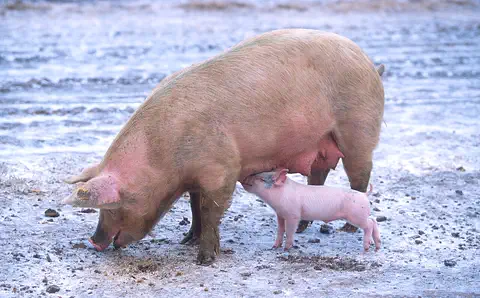
A warthog mother is pregnant for almost six months. Before giving birth she goes off alone, finds a burrow and lines it with grass. She usually has two or three piglets. Each piglet drinks from its own teat, and mothers have four teats.
Newborn piglets cannot keep themselves warm, so they stay in the burrow for their first weeks. Then they follow their mother everywhere. They drink milk until about five or six months old and can have young of their own at about a year and a half.
Breeding is seasonal: females become fertile a few months after the rains end and give birth in the dry season, after a gestation of 170 to 175 days. Litters range from 1 to 7 or 8, usually 2 or 3. The African Wildlife Foundation notes that each piglet suckles from its own teat, and that because sows have only four teats, litters are usually limited to four young.
Piglets cannot regulate their body temperature for the first days, so the sow stays underground with them for about a week; Animal Diversity Web reports 6 to 7 weeks in the den before they accompany her, and weaning at about 21 weeks. First-year survival is under 50 percent. Both sexes mature at 18 to 20 months, but males usually do not mate until about four years old.
Families and pushing contests
Mother warthogs and their babies live together in small groups.
They grunt, snort and squeal to talk. Grown-up males usually live alone.
Warthog mothers live with their young in small family groups, and sometimes two families join together. They rest close to each other and groom each other, and they talk with grunts, chirrups, growls, snorts and squeals. Males usually live alone.
At mating time, males have pushing contests, shoving each other with their heads and blunt upper tusks. Their thick face warts work like cushions, so they rarely get hurt. A male courting a female makes a rhythmic grunting 'chant' that sounds like a rumbling engine.
Females and their young form groups, called sounders (soundings in Animal Diversity Web), which the San Diego Zoo Wildlife Alliance says can reach 40 animals; the African Wildlife Foundation describes the core unit as a female and her young, sometimes joined by a related family. Sows rest together, groom one another and use a repertoire of grunts, chirrups, growls, snorts and squeals for greeting, threat and warning. Adult males are mostly solitary.
Males do not hold territories but contest access to females in estrus, pushing and striking with their heads and blunt upper tusks; the facial warts cushion blows, and the dangerous lower tusks are rarely used, so injuries are rare. When threatened, warthogs flee fast, but they will also defend themselves with their lower tusks. Lions, leopards, cheetahs, African wild dogs, hyenas, crocodiles and eagles all prey on warthogs.
Did you know?
Warthog babies each have their own place to drink milk.
Each warthog piglet drinks from its own teat and does not share, even if another piglet's teat is free.
Piglets suckle exclusively from one teat; with only four teats, sows usually raise no more than four young.
A survivor
There are lots of warthogs in Africa.
Many live in parks where they are safe. Warthogs are good at changing their habits to stay out of trouble.
The IUCN lists the common warthog as Least Concern. It is widespread, and many warthogs live in protected areas. Warthogs are good at adapting: where people hunt them, they switch to feeding at night.
In some farming areas, warthogs are killed for raiding fields of wheat, rice, beans or groundnuts, or because they can carry African swine fever, a disease of pigs. Groups such as the African Wildlife Foundation help by protecting wildlife corridors that connect parks.
The IUCN assessed the common warthog as Least Concern in 2016, though it records a decreasing population trend. Threats it lists include housing and commercial development, plantations, hunting, changes to ecosystems, disease and droughts. The San Diego Zoo Wildlife Alliance describes wild populations as stable for now, with many in protected areas.
The African Wildlife Foundation reports that warthogs are killed for raiding crops such as wheat, rice, beans and groundnuts, and that in some agricultural areas people remove them because they can carry African swine fever. Its responses include wildlife corridors linking protected areas, so warthogs and other animals can move safely between parks, and conservation education with local communities.
IUCN Red List
How is the common warthog doing in the wild?
- Least Concern (this animal)
- Near Threatened
- Vulnerable
- Endangered
- Critically Endangered
- Extinct in the Wild
- Extinct
Least Concern
Not at risk of disappearing from the wild right now.
See the IUCN Red List assessment · The IUCN Red List of Threatened Species 2022.2
Amazing facts
-
Warthogs often live in holes that aardvarks dug.
Warthogs rarely dig their own homes. They move into abandoned aardvark burrows instead.
Although they can excavate, warthogs normally take over burrows dug by other animals, especially aardvarks, sometimes lining them with grass.
-
A warthog's tail sticks up when it runs.
When a warthog runs, it holds its thin tail straight up, with the tuft waving like a tiny flag.
The upright tail with its hanging tuft is a characteristic running posture and may act as a warning to other warthogs.
-
Warthog babies each have their own place to drink milk.
Each warthog piglet drinks from its own teat and does not share, even if another piglet's teat is free.
Piglets suckle exclusively from one teat; with only four teats, sows usually raise no more than four young.
-
A daddy warthog sings a grunting song.
A courting male warthog makes a rhythmic grunting 'chant' that sounds like an engine that needs fixing.
The San Diego Zoo Wildlife Alliance likens the male's rhythmic courtship grunting to an engine in need of a tune-up.
Words to know
- tusk
- a very long tooth that sticks out of an animal's mouth
- burrow
- a hole or tunnel in the ground where an animal lives
- grazer
- an animal that eats mainly grass
- mane
- long hair growing along an animal's neck or back
- sounder
- a group of female pigs or warthogs and their young
Discovery challenge
-
How does a warthog eat short grass?
How does a warthog reach short grass to eat it?
What posture do warthogs use to graze short grass?
- It kneels on its front knees
- It stands on its back legs
- It lies on its back
Show the answer
It kneels on its front knees
It kneels down on its knees to eat.
It kneels on its padded front knees to nibble the short grass.
It kneels on calloused, padded knees, and may shuffle forward in that position.
-
Whose old holes do warthogs sleep in?
Whose old burrows do warthogs often move into?
Which animal digs many of the burrows that warthogs use?
- Aardvarks
- Giraffes
- Eagles
Show the answer
Aardvarks
Aardvarks dig the holes. Warthogs move in.
Warthogs usually use abandoned aardvark burrows instead of digging their own.
The aardvark; warthogs can dig but normally take over existing burrows.
-
What does a warthog's tail do when it runs?
What does a warthog do with its tail when it runs?
How does a warthog carry its tail when running?
- Sticks straight up
- Wraps around its leg
- Drags on the ground
Show the answer
Sticks straight up
It sticks up, like a little flag.
The tail sticks straight up, with the tuft waving like a flag.
Upright, with the tuft hanging; it may warn other warthogs of danger.
-
What are a warthog's 'warts'?
What are the 'warts' on a warthog's face?
What are a warthog's facial warts, which cushion blows in male pushing contests?
- Thick pads that protect the face
- Extra eyes
- Bags for storing food
Show the answer
Thick pads that protect the face
They are thick bumps of skin that protect its face.
They are thick, protective pads, not real warts, and males have bigger ones.
They cushion blows when males push and strike with their heads and blunt upper tusks, so injuries are rare.
Places where you might see it
-
 Watch
 Country
Kenya
Kenya is a country in East Africa, crossed by the equator. It has the snow-capped Mount Kenya, the deep Great Rift Valley, Lake Victoria and a long Indian Ocean coast, and about 54 million people live there, many of them speaking Swahili.
-
 Watch
Natural wonder
Serengeti National Park
Serengeti National Park in northern Tanzania protects 14,763 square kilometers of grassy plains and woodlands. Each year more than a million wildebeest, with zebras and gazelles, travel a great loop across the Serengeti and into Kenya in search of grass and water, followed by lions and other predators.
-
 Watch
 Country
Mauritania
Mauritania is a large country in northwest Africa where the Sahara meets the Atlantic Ocean. Dunes cover about half the land, ancient trading towns stand by desert oases, and many kinds of migrating birds spend the winter on its coast. About 5.3 million people live there.
-
 Watch
 Country
The Gambia
The Gambia is the smallest country on Africa's mainland, a narrow strip of land on both banks of the Gambia River. Except for a short Atlantic coast, it is surrounded by Senegal. More than 500 kinds of birds live there, and about 2.8 million people lived there in 2025.
-
 Watch
 Country
Senegal
Senegal is a country at the far western tip of Africa, on the Atlantic Ocean. Its capital, Dakar, sits on the westernmost point of the continent. About 19 million people live there, and the Senegal River, wetlands full of birds and quiet mangrove deltas make it a place of water as well as dry grassland.
Explore next
-
 Watch
3D
Animal
Wild boar
Wild boars are bristly wild pigs that live in forests and fields across Europe, Asia and North Africa. They sniff out food with their powerful snouts, live in family groups called sounders, and are the wild ancestors of farm pigs.
-
 Watch
3D
Animal
Domestic pig
Domestic pigs live with people on every continent except Antarctica. Their ancestor is the wild boar, which people began taming about 9,000 years ago. Pigs are among the smartest farm animals, with a super-sensitive snout for digging up food.
-
Watch
Country
Kenya
Kenya is a country in East Africa, crossed by the equator. It has the snow-capped Mount Kenya, the deep Great Rift Valley, Lake Victoria and a long Indian Ocean coast, and about 54 million people live there, many of them speaking Swahili.
-
Watch
Natural wonder
Serengeti National Park
Serengeti National Park in northern Tanzania protects 14,763 square kilometers of grassy plains and woodlands. Each year more than a million wildebeest, with zebras and gazelles, travel a great loop across the Serengeti and into Kenya in search of grass and water, followed by lions and other predators.
-
 Watch
Animal
Aardvark
The aardvark is a shy night digger of African savannas. It sniffs out ant and termite nests, rips them open with its spade-like claws and laps up the insects with a sticky tongue about 30 centimeters long. Its name means 'earth pig' in Afrikaans.
-
 Watch
3D
Animal
Lion
The lion is the only big cat that lives in a family group, called a pride. Lionesses hunt together, males guard the pride's land, and their roar can be heard about 8 kilometers away. Wild lions live in Africa, plus one small group in western India.
-
 Watch
3D
Animal
African wild dog
The African wild dog, or painted dog, has a patchy coat unlike any other dog's, big round ears and only four toes on its front feet. It lives in close packs that hunt together, share food and care for the pups. It is endangered: the IUCN estimated in 2025 that only about 1,676 adults are left in the wild.
-
Watch
Country
Mauritania
Mauritania is a large country in northwest Africa where the Sahara meets the Atlantic Ocean. Dunes cover about half the land, ancient trading towns stand by desert oases, and many kinds of migrating birds spend the winter on its coast. About 5.3 million people live there.
For parents & teachers
What children will learn
- Describe how a warthog's tusks, snout, knees and tail help it survive on the savanna.
- Explain why burrows are so important to warthogs.
- Describe the warthog life cycle and family groups.
- Understand why the warthog is Least Concern and how people and warthogs sometimes conflict.
Recommended ages: 3 to 17 · About 15 minutes
Talk about it
- Why might backing into a burrow be safer than going in head first?
- Why would an animal with no fur or fat need a burrow on cold nights?
- How could farmers and warthogs share land without conflict?
Try at home or in class
- Try eating a snack from a low table while kneeling, like a grazing warthog, and talk about why padded knees help.
- Use a ruler to see how long a warthog's 25 to 30 centimeter upper tusk is.
Key vocabulary: tusk, burrow, grazer, mane, sounder
Where these facts come from
- The IUCN Red List of Threatened Species , International Union for Conservation of Nature (IUCN terms of use (no redistribution of Red List data or range maps))
- GBIF Backbone Taxonomy and GBIF Occurrence Search , Global Biodiversity Information Facility (CC0 1.0 (backbone); occurrence counts are facts derived from records under CC0, CC BY and CC BY-NC)
- Phacochoerus africanus (common warthog) , Animal Diversity Web, University of Michigan
- Warthog , San Diego Zoo Wildlife Alliance
- Warthog , African Wildlife Foundation
- Phacochoerus africanus (global assessment) , IUCN Red List
- Wikidata , Wikimedia Foundation (CC0 1.0)
- Wikimedia Commons , Wikimedia Foundation (Per file: Public domain, CC0, CC BY or CC BY-SA only (credited on each page))
Checked, not yet human-reviewed. Last updated October 24, 2026. Spotted a mistake? Tell us.