
Animal
Wild boar
The wild boar is a big, hairy wild pig. It lives in forests and uses its strong snout to dig for food.
Wild boars are bristly wild pigs that live in forests and fields across Europe, Asia and North Africa. They sniff out food with their powerful snouts, live in family groups called sounders, and are the wild ancestors of farm pigs.
Sus scrofa is a highly adaptable omnivorous suid native from western Europe and North Africa across Asia to Indonesia and Japan. It is the ancestor of the domestic pig, and introduced populations in the Americas, Australia and elsewhere have become a serious invasive problem.
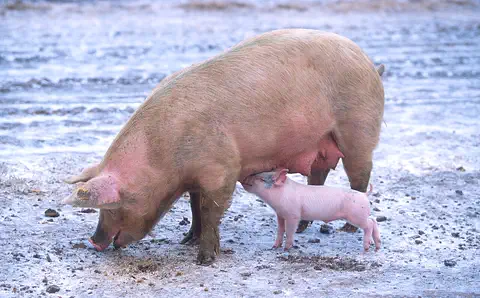
Photo: Valentin Panzirsch, CC BY-SA 3.0 AT, via Wikimedia Commons
Meet the wild boar
The wild boar is a wild pig.
It has a long snout, small eyes and pointy ears. Its coat is thick and bristly. Baby wild boars have stripes on their backs.
The wild boar is a strong, bristly wild pig with a big head, a long snout and a body that is tallest at the shoulders and slopes down toward the tail. Its thick, coarse coat can be black, brownish red or even pale, and some have a ridge of long bristles along the back.
Wild boars have sharp tusks, which are long canine teeth. Wild boars are the ancestors of farm pigs, and they belong to the same family as warthogs.
Sus scrofa belongs to the pig family, Suidae, with warthogs and other wild pigs. Animal Diversity Web gives a total length of 153 to 240 centimeters, a shoulder height of up to about 0.9 meter and an adult weight of 66 to 272 kilograms; females are smaller, and the difference grows with age.
The body is bulky at the shoulders and tapers toward the hindquarters. The coarse coat varies by region from black through brownish red to pale, solid or speckled, often with longer bristles along the spine. Upper canines of 5 to 10 centimeters form tusks. Britannica describes the animal as swift, a good swimmer and normally unaggressive, though it can be dangerous.
Quick facts
- Group
- Mammal
- Length
- 1.53 to 2.4 m
- Height
- 0.9 m
- Weight
- 66 to 272 kg
- Lifespan in the wild
- 1 to 10 years
From Spain to Japan
Wild boars live in Europe, Asia and North Africa.
They like forests with lots of bushes to hide in. They need water nearby.
Wild boars have a huge homeland. They live wild from Portugal and Morocco across Europe and Asia to India, Southeast Asia, China and Japan.
They can live in forests, grassy savannas, scrub, swamps and farmland, as long as there is water nearby and thick plants to hide in. People have also taken wild boars to many places where they never lived before, including the Americas and Australia. There they are called invasive, because they cause a lot of damage.
The IUCN's 2018 global assessment lists native populations across Europe, North Africa (Morocco, Algeria, Tunisia), the Middle East, Central and South Asia, Southeast Asia to Sumatra, Java and Bali, and East Asia including Japan and Taiwan. The species has been reintroduced to Sweden and Great Britain and is regionally extinct in Ireland, Norway, Egypt and Libya.
Animal Diversity Web notes that wild boars need nearby water and dense cover, and that in places with harsh winters, deep snow and frozen ground make roots hard to dig up and can limit their numbers. Introduced populations live in parts of the United States, South America and the Caribbean, Australia, New Zealand, New Guinea, Fiji, South Africa and Sudan. The map shows native, reintroduced, introduced and former range as separate layers.
Continents
Its habitats


Where can you find this animal?
- Used to live here · Countries and seas named by a scientific source
- Brought here by people · Countries and seas named by a scientific source
- Lives here naturally · Countries and seas named by a scientific source
- Sightings recorded · Records of wild sightings (GBIF)
- Brought back by people · Countries and seas named by a scientific source
Used to live here · Countries and seas named by a scientific source
Countries where the IUCN lists the wild boar as extinct: Ireland, Norway, Egypt and Libya.
Places: Ireland, Norway, Egypt and Libya.
Source: iucn-red-list · checked October 2026
Brought here by people · Countries and seas named by a scientific source
Populations started by people outside the native range, in parts of the United States, the Caribbean, South America, Australia, New Zealand, New Guinea, Fiji, South Africa and Sudan. Many cause serious damage to farms and wild places.
Places: United States, Cuba, Dominican Rep., Haiti, Jamaica, Colombia, Ecuador, Brazil and 7 more places.
Source: iucn-red-list · checked October 2026
Lives here naturally · Countries and seas named by a scientific source
Forests, scrub, grassland, wetlands and farmland from western Europe and North Africa across the Middle East and Asia to Japan, Taiwan and western Indonesia. In some countries wild boars live only in part of the land shown.
Places: Afghanistan, Albania, Algeria, Armenia, Austria, Azerbaijan, Bangladesh, Belarus and 63 more places.
Source: iucn-red-list · checked October 2026
Sightings recorded · Records of wild sightings (GBIF)
Counts of GBIF records of wild observations (human and machine) and preserved specimens. Records include introduced populations, vagrants, escaped or released animals and misidentifications, so a country with records is not necessarily part of the native range.
Wild sightings have been recorded in France, Switzerland, Spain, Netherlands, Australia, Germany, Belgium, South Korea and 126 more places.
Source: gbif · checked October 2026
Brought back by people · Countries and seas named by a scientific source
Brought back to Sweden and Great Britain, where wild boars had died out.
Places: Sweden and UK.
Source: iucn-red-list · checked October 2026
Range maps show where scientists say an animal lives, often country by country. An animal may live in only part of a country shown, and sightings records can include animals that wandered far from home.
Snout to the ground
Wild boars eat lots of different foods.
They eat nuts, roots, fruit and plants. They also eat worms, bugs and eggs. They dig in the dirt with their snouts.
Wild boars are omnivores, which means they eat plants and animals. Most of their food is plants: nuts such as acorns, fruits, roots and green leaves, plus crops from farmers' fields. They also eat worms, insects, bird eggs, small rodents and dead animals they find.
To find food underground, they push and dig with their tough snouts. This is called rooting. They do most of their feeding in the late evening and at night, and in winter, frozen ground can make food hard to reach.
Wild boars are omnivores whose diet is dominated by plant matter: crops, fruits, mast (nuts), roots and green plants. Animal Diversity Web adds bird eggs, carrion, small rodents, insects and worms, and occasional predation on young livestock. The diet shifts with season, weather and place.
Foraging by rooting turns over soil and small undergrowth. Where wild boars are introduced, this can increase erosion and reduce seed survival and plant species richness. Feeding peaks in the late evening and at night; in hot weather boars rest in shade and wallow, and in hard winters deep snow and frozen ground restrict their access to roots and so limit population density.
Did you know?
Mother pigs on farms know their own babies by smell.
Studies of farm pigs, which come from wild boars, show that a mother can tell her own piglets from other piglets by smell within a day of their birth.
Studies of domestic pigs show sows use smell to distinguish their own piglets from those of other litters by 24 hours after farrowing; sow-piglet recognition has hardly been studied in wild boars.
A nose for everything
A wild boar's best sense is smell.
Its nose can find food under the ground. Its eyes are on the sides of its head, so it can see a wide area around it.
A wild boar's long, flat snout is its most important tool. It gives the boar an excellent sense of smell and works like a shovel for digging. Hearing is good too. A boar's eyes are on the sides of its head, so it can see a wide area around it.
Wild boars roll in mud and water, called wallowing. It cools them down on hot days, protects them from biting insects and helps get rid of tiny pests on their skin. Their coarse coat helps them blend into the forest.
Animal Diversity Web describes a long, flattened snout that gives a heightened sense of smell, though keeping the nose to the ground while foraging can make it harder to scent approaching danger. Boars rely chiefly on smell and hearing, and their laterally placed eyes give good peripheral vision. In domestic pigs, studies show that sows can tell their own piglets from others by smell within 24 hours of birth; Animal Diversity Web notes that this has barely been studied in wild boars.
Wallowing in water sources cools the body, protects against insects and removes external parasites. Adults' coloring helps them blend with their surroundings. Boars also leave chemical traces by rubbing on the ground, and they growl when aggressive and squeal when excited.
Striped piglets
Baby wild boars are called piglets.
They have stripes on their backs. The stripes help them hide in the leaves. A mother can have many piglets at once.
Before giving birth, a mother wild boar leaves her group and makes a nest of branches and plants. About four months after mating, she has a litter of about five or six piglets. Each one weighs less than a kilogram.
Piglets are born with yellowish-brown stripes along their backs, which help them hide in leaves and bushes. The stripes fade after about four months. Piglets drink milk for 8 to 12 weeks, and young females can have their own piglets at about ten months old.
Wild boars can breed in any season, but mating depends on climate and food: poorly fed females may not breed at all. Gestation lasts 108 to 120 days. Before farrowing, the sow leaves the sounder and builds a nest from saplings and woody plants she breaks off or uproots. Litters average 5 to 6 piglets of 0.4 to 0.8 kilograms each, and a sow can raise up to two litters a year.
Piglets carry camouflaging stripes for about four months, are weaned at 8 to 12 weeks and keep growing until about age five or six. Females can breed at about 10 months, males from 5 to 7 months. Piglet mortality is high, and most wild boars live only 1 to 2 years; the known wild maximum is 9 to 10.

Life in a sounder
Mother wild boars and their babies live together in a group.
The group is called a sounder. The grown-ups walk in front and behind. The piglets walk safely in the middle.
Female wild boars live in groups called sounders: usually 6 to 20 related females and their young, though some groups have more than 100. Daughters often stay with their mothers' group when they grow up. Young males leave at one to two years old and mostly live alone.
The mothers work together to protect all the piglets. When a sounder travels, adults walk at the front and the back, with the young in the middle. Wild boars are mostly active at dusk and at night, and they are good swimmers.
The core social unit is the sounder of 6 to 20 closely related females and their offspring, occasionally over 100 animals. Daughters usually remain; sons leave at one to two years and live mostly alone, joining sounders in the breeding season, when males compete aggressively for access to females. Sounders shift their home ranges with food and weather, and groups often overlap or split.
Females defend all the young in a sounder collectively. On the move, adults lead and bring up the rear with the young in between. Activity depends on conditions: in warm weather boars rest by day and feed in the evening and night, emerging into open areas mostly after dark.
Did you know?
Wild boars roll in mud to cool off.
Wild boars wallow in mud and water to cool down, keep insects away and get rid of tiny pests on their skin.
Wallowing cools the body, protects against biting insects and helps remove ectoparasites.
Wild boars and people
There are lots of wild boars in the world.
In some places, people brought wild boars where they did not live before. There, they dig up farms and wild plants.
The IUCN lists the wild boar as Least Concern, because it is widespread and common. In many of the places where it was introduced, it is now a big problem: it digs up farm fields, eats crops, damages native plants and animals and can carry diseases to farm animals.
People work to control these populations with fences, traps and hunting. Wild boars are also important to people in another way: around 9,000 years ago, people began taming them, and they became the ancestors of the farm pigs we know today.
The IUCN assessed the wild boar as Least Concern in 2018. Animal Diversity Web notes that most populations are in no danger and that many programs aim to control them instead, especially where they were introduced: rooting, nest building and trampling damage farmland and ecosystems, they host parasites and diseases transmissible to livestock and people, and the Galápagos Islands have suffered major harm from introduced boars. Hunting is described as the most effective control, alongside fencing and trapping.
Wild boars are also the ancestors of domestic pigs. Britannica suggests domestication began around 9,000 years ago, probably in present-day Türkiye, and that Chinese and European wild boars were likely domesticated separately, eventually giving rise to some 70 breeds.
IUCN Red List
How is the wild boar doing in the wild?
- Least Concern (this animal)
- Near Threatened
- Vulnerable
- Endangered
- Critically Endangered
- Extinct in the Wild
- Extinct
Least Concern
Not at risk of disappearing from the wild right now.
See the IUCN Red List assessment · The IUCN Red List of Threatened Species 2022.2
Amazing facts
-
Wild boars roll in mud to cool off.
Wild boars wallow in mud and water to cool down, keep insects away and get rid of tiny pests on their skin.
Wallowing cools the body, protects against biting insects and helps remove ectoparasites.
-
Mother pigs on farms know their own babies by smell.
Studies of farm pigs, which come from wild boars, show that a mother can tell her own piglets from other piglets by smell within a day of their birth.
Studies of domestic pigs show sows use smell to distinguish their own piglets from those of other litters by 24 hours after farrowing; sow-piglet recognition has hardly been studied in wild boars.
-
Wild boars are good swimmers.
Wild boars are swift runners and good swimmers, and they are mostly active at dusk and at night.
Britannica describes the wild boar as swift, largely nocturnal and a good swimmer.
-
Farm pigs came from wild boars.
All farm pigs, about 70 breeds, descend from wild boars that people began taming around 9,000 years ago.
Domestic pigs, now some 70 breeds, likely derive from separate domestications of European and Chinese wild boars, beginning around 9,000 years ago.
Words to know
- sounder
- a group of female wild boars and their young
- piglet
- a baby pig or wild boar
- omnivore
- an animal that eats both plants and animals
- rooting
- digging in the ground with the snout to find food
- wallow
- to roll around in mud or water
- invasive species
- a living thing brought to a new place where it spreads and causes harm
Discovery challenge
-
What is a wild boar family group called?
What is a group of female wild boars and their young called?
What is the name of the female-based social group of wild boars?
- A sounder
- A pride
- A flock
Show the answer
A sounder
It is called a sounder.
A sounder: usually 6 to 20 related females and their young.
The sounder, made up of closely related females and their offspring; adult males mostly live alone.
-
What do baby wild boars have on their backs?
What helps wild boar piglets hide in the leaves?
What pattern camouflages young wild boars for their first months?
- Stripes
- Spots
- Shells
Show the answer
Stripes
Stripes! They help the piglets hide.
Yellowish-brown stripes along their backs help piglets hide in undergrowth and in the nest.
Longitudinal yellowish-brown stripes, which fade to even coloring within about four months.
-
What do wild boars eat?
Which best describes what wild boars eat?
Which best describes the wild boar's diet?
- Mostly plants, plus some small animals
- Only fish
- Only grass
Show the answer
Mostly plants, plus some small animals
They eat nuts, roots and fruit, and some worms and bugs.
Wild boars are omnivores: mostly nuts, roots, fruit and plants, plus worms, insects and eggs.
An omnivorous diet dominated by mast, roots, fruit, crops and green plants, with eggs, carrion, rodents and invertebrates.
-
Which farm animal comes from the wild boar?
Which farm animal is descended from the wild boar?
Which domestic animal descends from Sus scrofa?
- The pig
- The cow
- The horse
Show the answer
The pig
Farm pigs came from wild boars.
People began taming wild boars about 9,000 years ago, and they became farm pigs.
The domestic pig, probably domesticated separately from European and Chinese wild boars beginning around 9,000 years ago.
Places where you might see it
-
 Watch
 Country
Germany
Germany is a country in north-central Europe. The land rises from flat plains by the North Sea and the Baltic Sea to forested hills and, in the far south, the Alps. About 83.5 million people (2025) live there, and its capital is Berlin.
-
 Watch
 Country
Armenia
Armenia is a small, landlocked country just south of the Caucasus mountains. Most of it is high mountains and plateaus, its tallest peak is Mount Aragats, and about 3.1 million people lived there in 2025.
-
Watch
 Country
Moldova
Moldova is a small landlocked country in eastern Europe, squeezed between Romania and Ukraine. Most of it lies between two rivers, the Prut and the Dniester, and its rich black soil grows grapes, sunflowers, grain and fruit. About 2.4 million people were counted there in 2024.
-
 Watch
 Country
Belarus
Belarus is a landlocked country in eastern Europe. Ice sheets of the last ice age shaped its low hills and wide plains, it has more than 10,000 lakes and one of Europe's largest wetlands, and about 9.1 million people lived there in 2025.
-
 Watch
 Country
Lithuania
Lithuania is the largest and southernmost of the three Baltic states. Its low land was shaped by glaciers and holds about 3,000 lakes, a long spit of sand dunes lines its coast, and about 2.89 million people lived there in 2025.
-
 Watch
 Country
Luxembourg
Luxembourg is one of the smallest countries in the world, tucked between Belgium, France and Germany. It has forested hills in the north, farms and vineyards in the south, a capital built on a steep rocky outcrop, and about 691,000 people (2026) who use Luxembourgish, French and German.
-
 Watch
 Country
Hungary
Hungary is a landlocked country in central Europe, in a wide lowland called the Carpathian Basin. Wide plains cover much of it, the Danube River flows through its capital, Budapest, and about 9.5 million people lived there in 2026.
-
 Watch
 Country
Serbia
Serbia is a landlocked country in the Balkans. Its north is flat farmland, its middle is wooded hills, and its edges have mountains, while the Danube River cuts a deep gorge called the Iron Gate. About 6.5 million people lived there in 2025.
Explore next
-
 Watch
3D
Animal
Domestic pig
Domestic pigs live with people on every continent except Antarctica. Their ancestor is the wild boar, which people began taming about 9,000 years ago. Pigs are among the smartest farm animals, with a super-sensitive snout for digging up food.
-
 Watch
Animal
Common warthog
Common warthogs are tough wild pigs of the African savanna. They kneel down to eat short grass, sleep in old aardvark burrows and run with their tails held straight up like little flags. The bumps on their faces are thick pads of skin.
-
Watch
Country
Germany
Germany is a country in north-central Europe. The land rises from flat plains by the North Sea and the Baltic Sea to forested hills and, in the far south, the Alps. About 83.5 million people (2025) live there, and its capital is Berlin.
-
 Watch
Animal
Red deer
The red deer is one of the largest deer in the world. It lives in forests, hills and moors across Europe and into western Asia and North Africa. Males, called stags, grow huge branching antlers every year and roar to win mates in autumn.
-
 Watch
3D
Animal
Gray wolf
The gray wolf is the largest member of the dog family and the wild ancestor of pet dogs. Wolves live in family packs that hunt big animals like elk and moose together, and their howls can carry about 10 kilometers. After being wiped out in many places, wolves are coming back in parts of North America and Europe.
-
Watch
Country
Armenia
Armenia is a small, landlocked country just south of the Caucasus mountains. Most of it is high mountains and plateaus, its tallest peak is Mount Aragats, and about 3.1 million people lived there in 2025.
-
Watch
Country
Moldova
Moldova is a small landlocked country in eastern Europe, squeezed between Romania and Ukraine. Most of it lies between two rivers, the Prut and the Dniester, and its rich black soil grows grapes, sunflowers, grain and fruit. About 2.4 million people were counted there in 2024.
-
Watch
Country
Belarus
Belarus is a landlocked country in eastern Europe. Ice sheets of the last ice age shaped its low hills and wide plains, it has more than 10,000 lakes and one of Europe's largest wetlands, and about 9.1 million people lived there in 2025.
For parents & teachers
What children will learn
- Describe how a wild boar's snout, senses and wallowing help it live in forests.
- Describe the wild boar life cycle and life in a sounder.
- Explain the difference between native and introduced populations, and why introduced wild boars cause problems.
- Explain that domestic pigs descend from wild boars.
Recommended ages: 3 to 17 · About 15 minutes
Talk about it
- Why might stripes help a piglet but not a grown-up boar?
- Why can an animal be harmless in its native home and a problem somewhere else?
- How are farm pigs and wild boars alike, and how are they different?
Try at home or in class
- Hide a few smelly treats (like an orange peel) under leaves in a box and try to find them by smell alone, like a wild boar.
- Look up whether wild boars or feral pigs live near you, and whether they are native or introduced there.
Key vocabulary: sounder, piglet, omnivore, rooting, wallow, invasive species
Where these facts come from
- The IUCN Red List of Threatened Species , International Union for Conservation of Nature (IUCN terms of use (no redistribution of Red List data or range maps))
- GBIF Backbone Taxonomy and GBIF Occurrence Search , Global Biodiversity Information Facility (CC0 1.0 (backbone); occurrence counts are facts derived from records under CC0, CC BY and CC BY-NC)
- Sus scrofa (wild boar) , Animal Diversity Web, University of Michigan
- Boar , Encyclopaedia Britannica
- 6 domestic animals and their wild ancestors , Encyclopaedia Britannica
- Sus scrofa (global assessment) , IUCN Red List
- Wikidata , Wikimedia Foundation (CC0 1.0)
- Wikimedia Commons , Wikimedia Foundation (Per file: Public domain, CC0, CC BY or CC BY-SA only (credited on each page))
Checked, not yet human-reviewed. Last updated October 28, 2026. Spotted a mistake? Tell us.