
Animal
Lion
The lion is a big, strong cat. Lions live together in families called prides. A grown-up male lion has a big, shaggy mane.
The lion is the only big cat that lives in a family group, called a pride. Lionesses hunt together, males guard the pride's land, and their roar can be heard about 8 kilometers away. Wild lions live in Africa, plus one small group in western India.
Panthera leo is the most social of all cats: prides of related females, their cubs and a few resident males share and defend a territory. Once spread from Africa across the Middle East to India, lions now survive in scattered African populations and in and around India's Gir Forest, and the IUCN lists the species as Vulnerable.
Photo: GinaFranchi, CC BY-SA 4.0, via Wikimedia Commons
Meet the lion
The lion is a big cat with golden fur.
Lions like to be together. They live in a family called a pride. A grown-up boy lion has a big ring of hair around his face. It is called a mane.
Lions are big cats with short, golden coats and a dark tuft of fur at the tip of the tail. Grown males have a mane, a thick collar of hair around the head and neck, which can be blond, reddish-brown or almost black.
What makes lions special is that they are social. Every other wild cat lives mostly alone, but lions live in prides: groups of related females, their cubs and a few adult males that share the same patch of land.
Panthera leo belongs to the genus Panthera with the tiger, leopard, jaguar and snow leopard. Britannica gives a full-grown male a head-and-body length of about 1.8 to 2.1 meters plus a tail of about 1 meter, a shoulder height of about 1.2 meters and a weight of 170 to 230 kilograms; lionesses are clearly smaller, at about 120 to 180 kilograms.
The mane is the most obvious difference between the sexes. Its length and color vary between individuals and populations; the Smithsonian's National Zoo notes that age, genetics and hormones all play a part. Lions are unique among cats in living in permanent groups, and much of their biology, from hunting to raising cubs, is shaped by pride life.
Quick facts
- Group
- Mammal
- Length
- 1.8 to 2.1 m
- Height
- 0.9 to 1.2 m
- Weight
- 120 to 230 kg
- Lifespan in the wild
- 12 to 16 years
Where it lives
Most wild lions live in Africa.
They live on grassy plains with some trees. A small group of lions lives in a forest in India.
Most wild lions live in Africa, south of the Sahara Desert. They like open woodland, thick grassland and bushy country, where there is enough cover to sneak up on prey and to hide cubs.
There is one more place: the Gir Forest in the state of Gujarat, in western India. A few hundred Asiatic lions live there and in the countryside around it, and nowhere else in Asia.
More than 10,000 years ago, lions and their close relatives lived across Africa, Europe, Asia and even the Americas. Today the IUCN Red List (2025 assessment) lists lions as still present in about twenty African countries, mostly in East and Southern Africa, and as gone from 28 countries, from Morocco and Egypt to Iran and Pakistan.
The only wild lions outside Africa live in and around Gir National Park and Wildlife Sanctuary in Gujarat, India. This isolated Asiatic population numbers several hundred and is strictly protected. Lions were also brought back to national parks in Rwanda and Malawi. The map shows countries where wild lions live today; it is shaded by country, so it does not mean lions live everywhere inside each one.
Continents
Its habitats


Where can you find this animal?
- Lives here naturally · Countries and seas named by a scientific source
- Lives here naturally · Countries and seas named by a scientific source
- Sightings recorded · Records of wild sightings (GBIF)
- Brought back by people · Countries and seas named by a scientific source
Lives here naturally · Countries and seas named by a scientific source
Scattered savanna, woodland and scrub populations in Africa south of the Sahara, most of them in or near protected areas. Lions live in only part of each country shown. The one wild population in Asia is shown as its own layer.
Places: Angola, Benin, Botswana, Cameroon, Central African Rep., Chad, DR Congo, Ethiopia and 11 more places.
Source: iucn-red-list · checked October 2026
Lives here naturally · Countries and seas named by a scientific source
Asiatic lions: only in and around Gir National Park and Wildlife Sanctuary (the Gir Forest region) in Gujarat, western India. Lions do not live in the rest of India.
Places: India.
Source: iucn-red-list · checked October 2026
Sightings recorded · Records of wild sightings (GBIF)
Counts of GBIF records of wild observations (human and machine) and preserved specimens. Records include introduced populations, vagrants, escaped or released animals and misidentifications, so a country with records is not necessarily part of the native range.
Wild sightings have been recorded in South Africa, Kenya, Tanzania, Botswana, Namibia, Benin, Zambia, Uganda and 49 more places.
Source: gbif · checked October 2026
Brought back by people · Countries and seas named by a scientific source
Lions were brought back to protected parks in Malawi and Rwanda after disappearing there.
Places: Malawi and Rwanda.
Source: iucn-red-list · checked October 2026
Range maps show where scientists say an animal lives, often country by country. An animal may live in only part of a country shown, and sightings records can include animals that wandered far from home.
What it eats
Lions eat meat.
They catch big animals like zebras and wildebeest. The lionesses do most of the hunting. Then the whole pride shares the food.
Lions are carnivores, which means they eat meat. Their usual prey are large grazing animals such as zebras, wildebeest and antelopes, weighing roughly 45 to 450 kilograms. When food is hard to find, they also catch smaller animals, from rodents to reptiles.
Lionesses work as a team. Several of them creep toward the prey from different directions, getting within about 30 meters before they rush in. Hunting together gives them a better chance of a meal and makes it less likely that any one lion gets hurt.
Lions take prey from rodents and baboons up to Cape buffalo and hippopotamuses, but most kills are medium to large hoofed mammals such as wildebeest, zebras and antelopes, and the favorite prey differs from place to place and even between neighboring prides. Young or sick elephants and giraffes are taken only rarely.
On open savanna the lionesses do most of the hunting, stalking in a loose group to within about 30 meters before charging; San Diego Zoo Wildlife Alliance reports that males hunt less than 10 percent of the time there and often take a share of the females' kills. In scrub and woodland, where cover is thicker, males spend more time away from the females and hunt most of their own food.
Did you know?
Long ago, lions lived in many more places.
More than 10,000 years ago, lions lived in Africa, Europe, Asia and even North and South America.
Lion relatives once ranged across Africa, Eurasia and the Americas; today the IUCN lists lions as extinct in 28 countries where they lived in recent history.
A hunter's body
A lion has big paws and sharp claws.
Its fur is the color of dry grass. That helps it hide. A lion sleeps a lot, almost all day long.
A lion's sandy coat matches dry grass, which helps it stay hidden while it creeps toward prey. Strong shoulders and front legs, big paws and sharp claws let it grab and hold large animals.
Lions save their energy for short bursts of action. San Diego Zoo Wildlife Alliance says lions can spend up to 21 hours of every day resting and sleeping. Lionesses are smaller and lighter than males, which makes them quicker and more nimble on a hunt.
The lion is built for short, powerful efforts rather than long chases. Powerful forelimbs and large clawed paws let it pull down and hold prey much heavier than itself, and the plain tawny coat gives good camouflage in dry grass.
The difference in size between males and females, called sexual dimorphism, matters in daily life: the heavier males are better at defending the territory, while the lighter lionesses are more agile and do most of the chasing. Lions are inactive for long periods, with bouts of activity that add up to only a few hours in a day; San Diego Zoo Wildlife Alliance reports rest of up to 21 hours.
Growing up
Baby lions are called cubs.
A mother lion has one to four cubs at a time. Cubs drink milk at first. Soon they play, pounce and learn to hunt.
A lioness is pregnant for about three and a half months. She usually has one to four cubs, each weighing less than 2 kilograms, about as much as a bag of sugar. The lionesses of a pride help each other raise the cubs.
Cubs start to eat meat at about three months old and stop drinking milk at about six months. Young females usually stay in their mother's pride for life. Young males leave when they are about two to four years old.
Gestation lasts about 108 days, roughly three and a half months, and a litter of one to four cubs is born, each weighing about 1.65 kilograms. Cubs begin eating meat at around three months and are weaned at about six months; a lioness typically breeds about every two years.
Cub survival is low: the Smithsonian's National Zoo reports that up to 80 percent die before age two, from food shortages and from males that take over a pride. Females usually stay in their birth pride for life. Males are pushed out at about two to four years old, form coalitions, often with brothers and cousins, and try to win residency in a new pride, which they hold for an average of about two years.

Pride life and roaring
Lions in a pride stay close and look after each other.
They roar very loudly. A roar tells other lions, this is our home! People can hear it far, far away.
A pride can have from 3 to about 30 or 40 lions: related lionesses and their cubs, plus one or more adult males. Bigger prides form where there is more food and water. Each pride has a territory, its own home area, that it defends from other lions.
Lions tell others about their territory by roaring and by leaving their scent. A lion's roar can be heard about 8 kilometers away. Pride members even copy each other: when one lion yawns or grooms, others often start to do the same.
Prides consist of several generations of lionesses, many of them related, a smaller number of breeding males and their cubs. Members spend the day in scattered subgroups that come together to hunt or share a kill. Territories range from about 20 square kilometers where prey is plentiful to about 400 where it is scarce, and some prides keep the same land for decades, passed down through the females.
Roaring identifies individuals, reinforces pride bonds and advertises the territory; it is usually heard in the evening before a night's hunting and again around dawn, and carries up to about 8 kilometers. Lions also scent-mark by spraying urine, rubbing their muzzles on vegetation and raking the ground with their scent-gland-bearing hind paws.
Did you know?
When one lion yawns, others yawn too!
Yawning, grooming and roaring are catching in a pride: when one lion starts, the others often join in.
Researchers have described contagious behavior in prides: one lion yawning, grooming or roaring often sets off the same behavior in its companions.
Helping lions
There are fewer wild lions than there used to be.
People are working to keep them safe. Parks give lions room to live and hunt.
Lions are listed as Vulnerable, which means they are at risk of disappearing from the wild. They have already vanished from many countries. The main problems are losing wild land to farms and towns, losing the animals they hunt, and conflict with people when lions catch farm animals.
People are helping. Many lions live in protected parks, lions have been brought back to parks in Rwanda and Malawi, and in India the Gir lions are carefully guarded and slowly growing in number.
The IUCN Red List assessed the lion as Vulnerable again in 2025; its 2023 assessment estimated about 23,000 mature individuals and a declining, severely fragmented population. The main threats are conversion of habitat to farmland and settlements, the loss of wild prey to hunting, and killing of lions in retaliation for attacks on livestock.
The Asiatic lions of Gir face particular risks: as a single, isolated population they suffer from inbreeding, a limited area of habitat and frequent conflicts with people, and the Smithsonian notes that they need additional reserves in order to keep growing. Across Africa, protected areas, reintroductions such as those in Rwanda and Malawi, and efforts to reduce conflict over livestock all help lions and people share the land.
IUCN Red List
How is the lion doing in the wild?
- Least Concern
- Near Threatened
- Vulnerable (this animal)
- Endangered
- Critically Endangered
- Extinct in the Wild
- Extinct
Vulnerable
At high risk of disappearing from the wild.
See the IUCN Red List assessment · The IUCN Red List of Threatened Species 2022.2
Amazing facts
-
A lion's roar can be heard far, far away.
A lion's roar can be heard about 8 kilometers away, as far as walking for almost two hours.
Lion roars carry up to about 8 kilometers and are used to identify individuals, strengthen pride bonds and advertise a territory.
-
Lions rest for most of the day.
Lions can spend up to 21 hours a day resting and sleeping, saving energy for short, powerful hunts.
Lion activity comes in short, intense bursts separated by long periods of rest that can total up to 21 hours in a day.
-
When one lion yawns, others yawn too!
Yawning, grooming and roaring are catching in a pride: when one lion starts, the others often join in.
Researchers have described contagious behavior in prides: one lion yawning, grooming or roaring often sets off the same behavior in its companions.
-
Only one forest in Asia still has wild lions.
The only wild lions outside Africa live in and around the Gir Forest in western India.
Asiatic lions survive in a single wild population centered on Gir National Park and Wildlife Sanctuary in Gujarat, India, so the whole Asian population depends on one small area.
-
Long ago, lions lived in many more places.
More than 10,000 years ago, lions lived in Africa, Europe, Asia and even North and South America.
Lion relatives once ranged across Africa, Eurasia and the Americas; today the IUCN lists lions as extinct in 28 countries where they lived in recent history.
Words to know
- pride
- a family group of lions that lives together
- lioness
- a female lion
- mane
- the long, thick hair around a male lion's head and neck
- carnivore
- an animal that eats meat
- territory
- the area an animal or group lives in and defends
- coalition
- a small group of male lions, often brothers, that live and travel together
Discovery challenge
-
What is a lion family called?
What is a group of lions called?
What is the permanent social group that makes lions unique among cats called?
- A pride
- A flock
- A school
Show the answer
A pride
A lion family is called a pride.
Lions live in prides made of related lionesses, their cubs and a few adult males.
Lions are the only cats that live in permanent social groups, called prides.
-
Who does most of the hunting?
On the open savanna, who does most of the hunting?
On open savanna, which members of a pride make most of the kills?
- The cubs
- The lionesses
- The zebras
Show the answer
The lionesses
The lionesses hunt together as a team.
Lionesses hunt in teams, creeping close from different sides before they rush in.
On open savanna lionesses make most kills; males hunt less than 10 percent of the time there and often share the females' kills.
-
Where do wild lions live in Asia?
Where is the only place wild lions live outside Africa?
Where does the only wild Asian lion population live?
- In Australia
- In the Gir Forest, India
- In the Arctic
Show the answer
In the Gir Forest, India
A small group of lions lives in the Gir Forest in India.
A few hundred Asiatic lions live in and around the Gir Forest in Gujarat, western India.
The Asiatic population is confined to Gir National Park and Wildlife Sanctuary and the surrounding landscape in Gujarat.
-
Why do lions roar?
Why do lions roar?
Which is NOT one of the jobs of a lion's roar?
- To tell other lions about their land
- To help them see in the dark
- To call their pride together
Show the answer
To help them see in the dark
A roar tells other lions, this is our home!
Roaring tells other lions whose territory this is and helps pride members find each other.
Roars advertise territory, identify individuals and strengthen pride bonds; they have nothing to do with vision.
Places where you might see it
-
 Watch
City
Nairobi
Nairobi, the capital of Kenya, sits high in the highlands of East Africa. It began in the late 1890s as a railway camp beside a Maasai water hole called Enkare Nairobi, "Cold Water." Today it is one of the biggest cities in tropical Africa, with Nairobi National Park, full of wild animals, at its edge.
-
 Watch
 Country
Somalia
Somalia is the easternmost country of Africa, on the Horn of Africa between the Gulf of Aden and the Indian Ocean. Most of it is flat, hot and dry, with thornbush savanna, and camels, goats, sheep and cattle are its greatest farm wealth. Its capital is Mogadishu.
-
 Watch
Natural wonder
Ngorongoro Conservation Area
The Ngorongoro Conservation Area in northern Tanzania holds the Ngorongoro Crater, a giant bowl about 16 to 20 kilometers across, left when an ancient volcano collapsed about 2.5 million years ago. Around 25,000 large animals live in and around the crater. The area also protects Olduvai Gorge and Laetoli, where scientists have found important evidence of how humans evolved.
-
 Watch
 Country
Mozambique
Mozambique stretches along the Indian Ocean coast of southeastern Africa. The great Zambezi River cuts through its middle, its beaches face the island of Madagascar, and parks like Gorongosa are home to elephants and lions. About 35.6 million people lived there in 2025, and Portuguese is the official language.
-
 Watch
Natural wonder
Serengeti National Park
Serengeti National Park in northern Tanzania protects 14,763 square kilometers of grassy plains and woodlands. Each year more than a million wildebeest, with zebras and gazelles, travel a great loop across the Serengeti and into Kenya in search of grass and water, followed by lions and other predators.
-
 Watch
 Country
South Africa
South Africa is the southernmost country in Africa, with the Atlantic Ocean on one side and the Indian Ocean on the other. A high plateau covers most of it, about 63.5 million people (2026) live there, and it has 12 official languages and three capital cities.
-
 Watch
 Country
Kenya
Kenya is a country in East Africa, crossed by the equator. It has the snow-capped Mount Kenya, the deep Great Rift Valley, Lake Victoria and a long Indian Ocean coast, and about 54 million people live there, many of them speaking Swahili.
Explore next
-
 Watch
3D
Animal
Tiger
The tiger is a huge cat with orange fur and dark stripes that help it hide in tall grass and forest shadows. It lives alone, hunts deer and wild pigs, and loves to swim. Wild tigers live only in Asia, and they are endangered.
-
 Watch
3D
Animal
Leopard
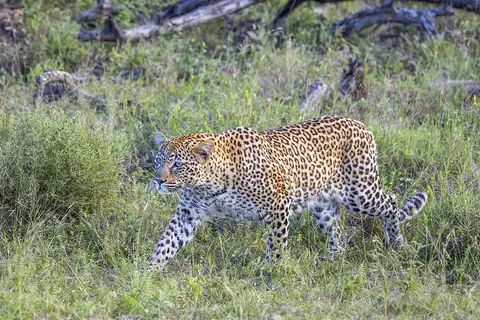
The leopard is a strong, spotted big cat and the best climber of them all. It can carry its food high up into a tree, away from lions and hyenas. Leopards live in more kinds of places than any other big cat, from deserts to rainforests, across Africa and Asia.
-
 Watch
3D
Animal
Cheetah
The cheetah is the fastest land animal. It can go from standing still to 72 kilometers per hour in about two and a half seconds, and its top speed is around 100 kilometers per hour, as fast as a car on a highway. Cheetahs live mostly in Africa, with a very small group in Iran.
-
 Watch
Animal
Plains zebra
Plains zebras are striped members of the horse family that graze on the grasslands of eastern and southern Africa. They live in close family groups, travel long distances to find fresh grass and water, and every zebra's stripes are different.
-
 Watch
Animal
Blue wildebeest
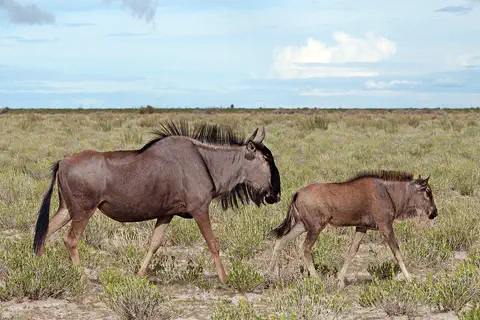
The blue wildebeest, or gnu, is a big antelope with a box-like head, curved horns, a mane and a beard. It grazes the savannas of eastern and southern Africa, and in the Serengeti huge herds travel in a giant circle every year following the rains.
-
 Watch
3D
Animal
Spotted hyena
The spotted hyena is the largest of the hyenas and a skilled hunter of the African savanna. Many people think hyenas only eat leftovers, but in East and Southern Africa they catch most of their own food. They live in big clans led by females, and they whoop, groan and 'giggle' to talk.
-
Watch
City
Nairobi
Nairobi, the capital of Kenya, sits high in the highlands of East Africa. It began in the late 1890s as a railway camp beside a Maasai water hole called Enkare Nairobi, "Cold Water." Today it is one of the biggest cities in tropical Africa, with Nairobi National Park, full of wild animals, at its edge.
-
Watch
Country
Somalia
Somalia is the easternmost country of Africa, on the Horn of Africa between the Gulf of Aden and the Indian Ocean. Most of it is flat, hot and dry, with thornbush savanna, and camels, goats, sheep and cattle are its greatest farm wealth. Its capital is Mogadishu.
For parents & teachers
What children will learn
- Explain how a lion pride is organized and why living in a group helps lions.
- Describe what lions eat and how lionesses hunt together.
- Locate where wild lions live today, including the Asiatic lions of India's Gir Forest.
- Understand why lions are Vulnerable and how people help them.
Recommended ages: 3 to 17 · About 15 minutes
Talk about it
- Why might hunting as a team work better than hunting alone for a lion?
- Lions once lived in many more countries. What do you think changed?
- How could farmers who live near lions protect their animals without harming the lions?
Try at home or in class
- Go outside with a grown-up and count how many steps it takes to walk 30 meters, the distance lionesses creep before they charge.
- Draw a lion family tree for a pride: grandmother, mothers, aunts, cubs and the resident males.
Key vocabulary: pride, lioness, mane, carnivore, territory, coalition
Where these facts come from
- The IUCN Red List of Threatened Species , International Union for Conservation of Nature (IUCN terms of use (no redistribution of Red List data or range maps))
- GBIF Backbone Taxonomy and GBIF Occurrence Search , Global Biodiversity Information Facility (CC0 1.0 (backbone); occurrence counts are facts derived from records under CC0, CC BY and CC BY-NC)
- Wikidata , Wikimedia Foundation (CC0 1.0)
- Lion (Panthera leo), 2025 global assessment , IUCN Red List
- Panthera leo (Lion), 2023 assessment , IUCN Red List of Threatened Species
- Lion , Smithsonian's National Zoo and Conservation Biology Institute
- Lion , San Diego Zoo Wildlife Alliance
- Lion , Encyclopaedia Britannica
- Wikimedia Commons , Wikimedia Foundation (Per file: Public domain, CC0, CC BY or CC BY-SA only (credited on each page))
Checked, not yet human-reviewed. Last updated October 24, 2026. Spotted a mistake? Tell us.
Picture and 3D model credits
- Photo: GinaFranchi, CC BY-SA 4.0, via Wikimedia Commons · source · license
- Photo: This Photo was taken by Timothy A. Gonsalves. Feel free to use my photos, but please mention me as the author. I would much appreciate if you send me an email tagooty@yahoo.com or write on my talk pag, CC BY-SA 4.0, via Wikimedia Commons · source · license
- 3D model: iRahulRajput, CC BY 4.0, via Sketchfab · source · license